
Tomas Loves …
Jude Welton and Jane Telford
Jessica Kingsley Publishers
Herein we meet Tomas and his canine companion Flynn (ever present to provide support and comfort). Tomas lives with his loving parents who understand his likes and disilikes and help him cope with his autism. Mum provides him with a daily visual diary
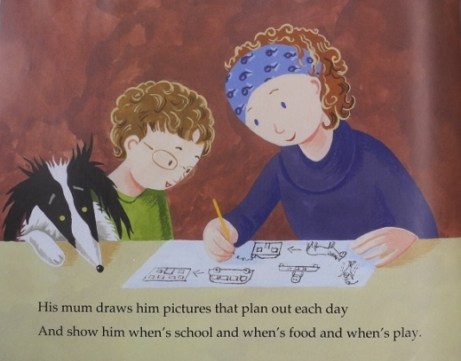
and ensures that as far as possible, he is forewarned of any changes in routine early in the day; and Dad is always there to read him a goodnight story. Thus they create a calm environment wherein Tomas is able to enjoy books with repeating words …
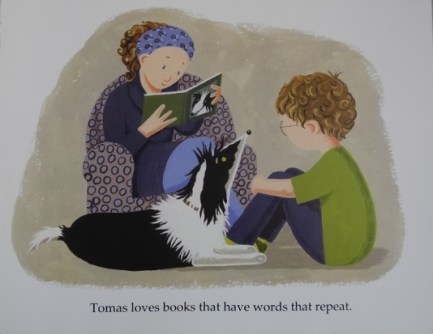
He loves strange-sounding names like ‘thingamybob’ or ‘flipertyjane’ and will repeat them over and over, he also loves to play with his toy trains on the track and also with tiny toys, bouncing on a trampoline, riding a horse and feeding it; and he has a special diet ‘that won’t hurt his tummy’. Sudden loud noises are one thing Tomas hates …
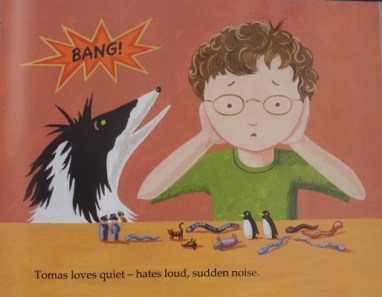
and sometimes if he is feeling very stressed he might start flapping his hands
Although we are told of all the things about Tomas in particular, things that are fairly common in children who have autism, the overall impression is that he is not so different for:
Tomas loves Flynn, and his Flynn loves him too.
Tomas loves fun and friendship – just like you.
Warmly illustrated and affirming with a gentle rhyming text, this is a book for all early years and primary settings and one that offers a good way to introduce the idea of autism to young readers who haven’t come across the behaviours Tomas exhibits.
Buy from JKP
For a slightly older audience is

Can I Tell You about Pathological Demand Avoidance syndrome?
Ruth Fidler and Phil Christie, illustrated by Jonathon Powell
Jessica Kingsley Publishers
This informative little handbook is narrated by Issy, an 11 year old girl with PDA (an autism spectrum condition). She shares with readers what it is like to have this condition – one that relatively little is written about in comparison with other ASDs. (Although I have taught a fair few children on the spectrum I’ve never known one with a PDA diagnosis although retrospectively I can think of at least one child who perhaps should have had one.)
We learn from Issy what makes her feel particularly anxious – “loud noises, new shoes and sitting on the smelly floor at school” and being asked to do something someone else wants them to. The latter can make her come up with rather outlandish excuses and if pushed, a long-lasting tantrum or meltdown can result. On particularly sensitive days, Issy and those like her need special consideration and help.
The last part of the book is written from an adult perspective and takes up this topic in the section ‘How other people can help’. Careful prioritisation of the issues to address, making requests in an oblique manner (‘I’d like someone to help me with this task’, rather than ‘do this’, flexibility of approach, anxiety reduction and support with friendship making/maintaining are some of the topics discussed.
For me, what is particularly good about this useful resource is its positive approach to the topic.
Use your local bookshop 
 Red Reading Hub - Jillrbennett's Reviews of Children's Books