The Little Spacecraft That Could

The Little Spacecraft That Could
Joyce Lapin and Simona Ceccarelli
Sterling

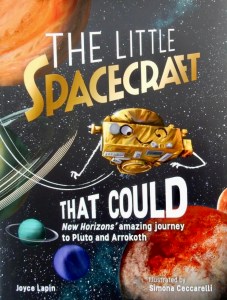
From the title of this book you might expect a story somewhat similar to the Watty Piper classic The Little Engine that Could. Not so. This book is essentially a non-fiction story that, beginning in January 2006, chronicles the journey of NASA’s New Horizons spacecraft travelling towards Pluto, a destination that will take a decade to reach, by which time astronomers have down-graded Pluto from planet to dwarf planet. (This is covered in the text)

The author tells how having burst forth from Earth, the first engine is allowed to fall away leaving, encased in gold foil, the spacecraft ‘no bigger than a small piano’ whizzing through space at over 10 miles per second. (Illustrator Simona Ceccarelli bestows a big grin on the face of New Horizons as this happens and thereafter she becomes a quirky character with personality.)

Now tasked with many questions to answer: what is Pluto made of? What colour is its sky? Are there creepy-crawlies? being just three, New Horizons will fly 3 billion miles to collect close-up photographic evidence and other kinds of data and transmit it all back to scientists on Earth.

On route the spacecraft receives a massive gravity speed boost from ‘ginormous’ Jupiter, after which follows a very long period of hibernation during which time a weekly signal is sent back to Earth. Eventually on 6th December 2014, the probe reawakens and soon begins transmitting photos of Pluto,
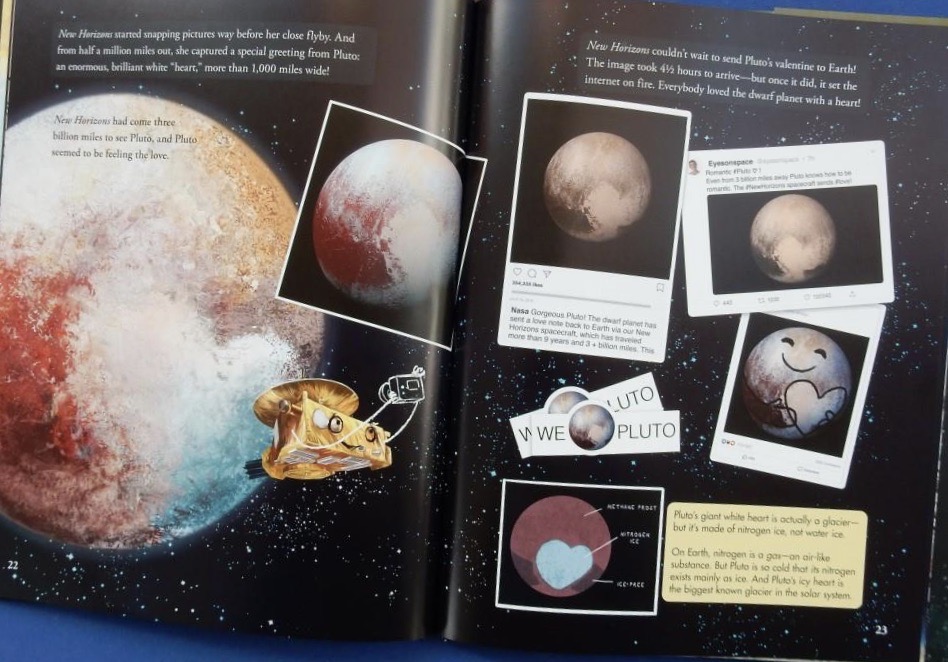
photos that hugely enlarged scientists’ understanding of the dwarf planet and its moons. 

A few years later, on New Year’s Day 2019, New Horizons reaches another object called Arrokoth that had been discovered since her launch.  Photos of this far distant world helped scientists understand more about the solar system’s early years.  New Horizons continues to travel further out in space and the hope is there’ll be a visit to the Kuiper Belt sometime during this decade.

Altogether an absorbing book that, in addition to conveying a huge amount of information about space exploration and the solar system, makes scientific discovery highly engaging and accessible for readers who might not otherwise be inclined to explore this topic. It also includes a timeline, glossary, and resources for further investigation. 

If You Had Your Birthday Party on the Moon / The Race to Space

If You Had Your Birthday Party on the Moon
Joyce Lapin and Simona Ceccarelli
Sterling

Hold on to your helmets, it’s blast off time, destination a birthday party in a place you never expected it to be. Moreover, there’d be a lot more celebration time on your lunar destination for it has a 709-hour day.

On the way to the moon you’ll discover what it feels like to be weightless and your party paraphernalia and pals will also float around inside your spaceship.

Once on the moon’s surface you’ll feel a lot lighter than on Earth and the Moon’s low gravity will keep you safe.
You won’t be able to fly any party balloons on account of the Moon being airless but you can have enormous fun doing one-handed push-ups,

exploring the lunar craters, trying a game of freeze tag and making moondust angels.

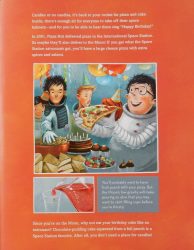
Perhaps you will have to eat your birthday cake astronaut style squeezed out of a foil pouch. Don’t think I’d be so keen on that idea.

Then on the return journey and there’ll be bags of time to open your presents, a whole three days in fact during which you could also open those party bags and sample some of the Moon pies therein.

Woven into all this partying is a great deal of STEM information on exciting topics both astronomical and cosmonautical. Why for instance is the sky black rather than blue; why your birthday will last almost 30 days, and why there wouldn’t be any point in playing musical statues on the moon.

With Simona Ceccarelli’s lively, playful digital illustrations and Joyce Lapin’s enormously engaging narrative that speaks straight to the reader, this is a sure fire winner for younger readers/listeners.

(Included at the back are a glossary, bibliography and suggestions for further reading).

For somewhat older readers is:

The Race to Space
Clive Gifford and Paul Daviz
Words & Pictures

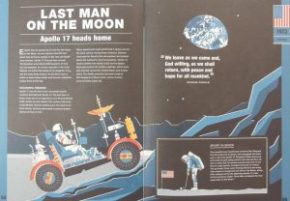
With the 50th anniversary of mankind’s first moon landing fast approaching, here’s a book that traces the history of the space race between two super powers, the U.S. and the Soviet Union, from the launch of Russia’s Sputnik to Neil Armstrong’s planting of a U.S. flag on the moon’s surface and those oft quoted words, “That’s one small step for a man, one giant leap for mankind.” That must be etched into the brains of all who saw that landing broadcast live.

From then on the relationship between the U.S. and the Soviet Union became more one of co-operation and collaboration than competition and the book documents the ‘handshake across space’ in the 1975 joint Apollo-Soyuz mission.

It concludes with more on the co-operation including the establishment of the International Space Station.

Illustrated, retro style by Paul Cadiz, in shades of red, yellow, blue plus black and white,

the book has clear explanations together with a liberal scattering of quotes from significant participants in the whole endeavour.

Recommended for individual reading at home and for KS2 class collections.