The Fierce Little Woman and the Wicked Pirate

In days of yore there lived a fierce little woman in a house at the end of a jetty. She spent her days knitting woolly socks to sell to sailors, or walking along the jetty playing her bagpipes or swimming beneath the jetty. Winters were more restful and she’d sometimes sit by the fire fishing through the trapdoor in her floor.

One day a storm blows in and with it comes a pirate who taps at the window of the woman’s house as she sits knitting. She spurns his persistent demands to be allowed to enter and he retaliates with threats

several times over.

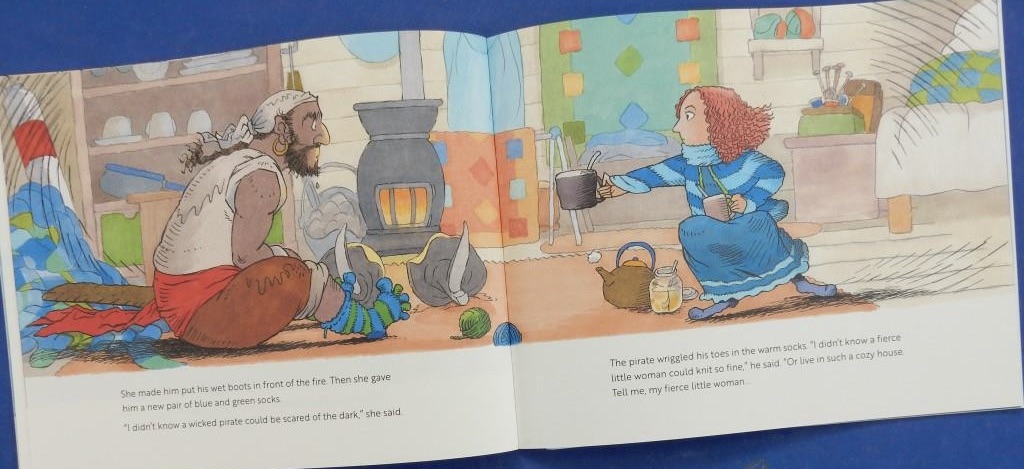
Eventually as darkness falls he tries a different approach and admits that’s he’s very frightened of the dark. Seemingly this pirate is more scared than scary; the woman relents, lifting her trapdoor and allowing him to come through into her cosy abode. As they talk, it becomes clear that each in their own way is vulnerable and they have things to offer one another.

After an initial refusal of his hand in marriage, the woman agrees, they get wed and raise a family together.

With her scenes from various perspectives Miho Satake skilfully brings out the quirkiness of Joy Cowley’s text and the battle of words that takes place between the two protagonists.

Twigs and Stones

Snake and Lizard live in a hole under a rock and like all friends they have their ups and downs with one another.

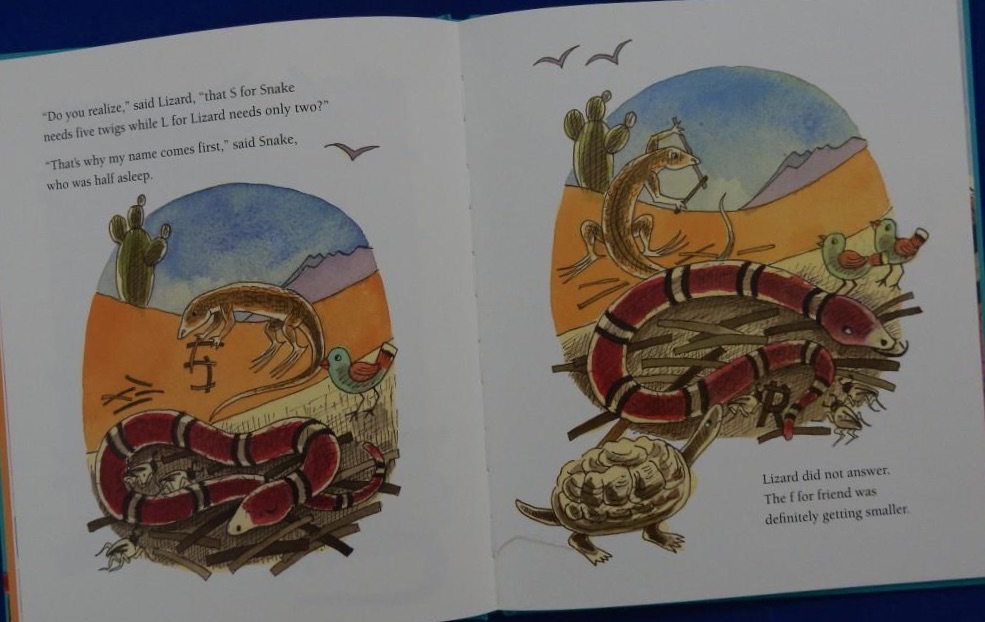
One day Lizard decides it would be good to collect twigs with which to put both their names above the entrance to their home. Off he goes to the river in search of sticks and mud. On his return he sets to work carefully arranging the sticks to form the letters; Snake is unable to assist on account of her bad eyesight. However Snake listens dozily to Lizard’s comments,

the task is completed and the names written large stand on the ledge until along come Tortoise.and Owl warning of the likely consequences of a desert wind. The wind comes, blowing down Snake’s name but then out of their hole comes Lizard to retrieve the fallen letters after which he returns to bed.

Next morning though, Snake emerges first and is furious to see that his friend has accidentally misspelt Snake.

Lizard’s way of dealing with things only makes his friend angrier and both have a most unsatisfactory day in silence.

That night it’s Snake’s turn to go out and check the names: now is her chance to teach Lizard a lesson. Fortunately though all ends well: the letters are removed and the friendship is restored.

There’s a gentle humour in both Joy Cowley’s telling and Gavin Bishop’s pen and ink and watercolour illustrations . The expressions on the faces of both Snake and Lizard are splendidly done heightening the drama throughout the squabbles, making this a great read aloud story with lots of potential for class discussion. It should certainly reassure children that friendships are important and silly incidents should be forgotten quickly.

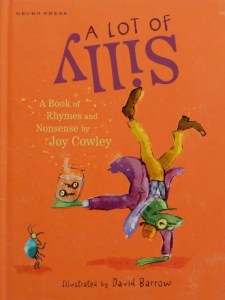
A Lot Of Silly

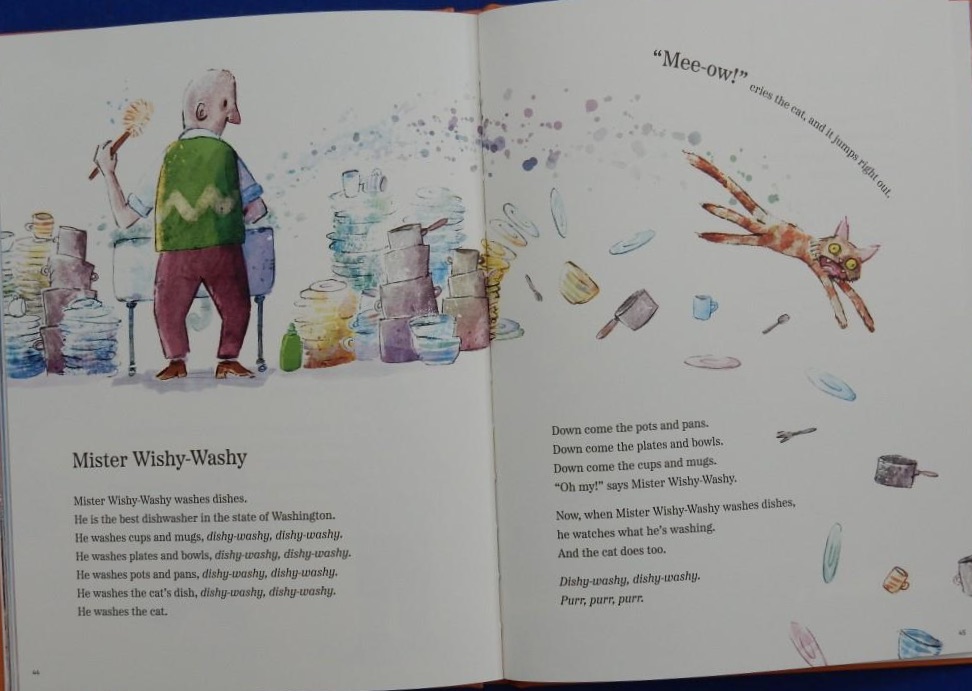
Herein we have almost forty pieces of silliness by Joy Cowley, all of which I think have come from her previous works and it’s terrific to have them brought together just waiting to make both children and adults giggle.

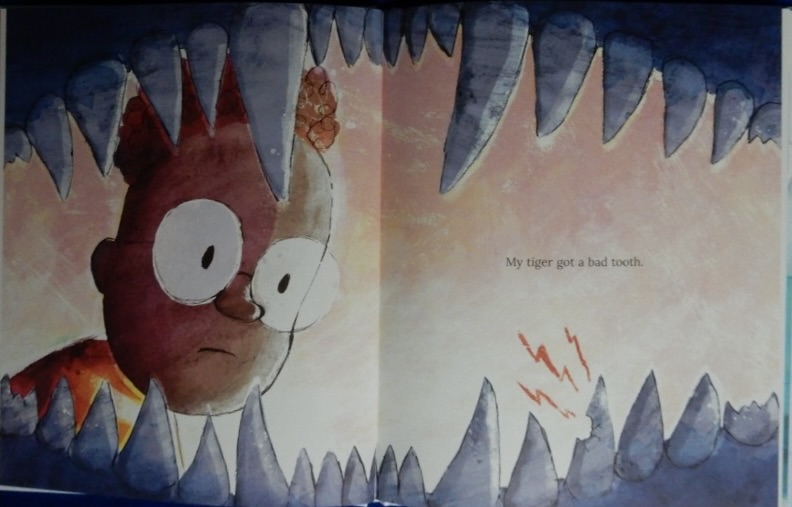
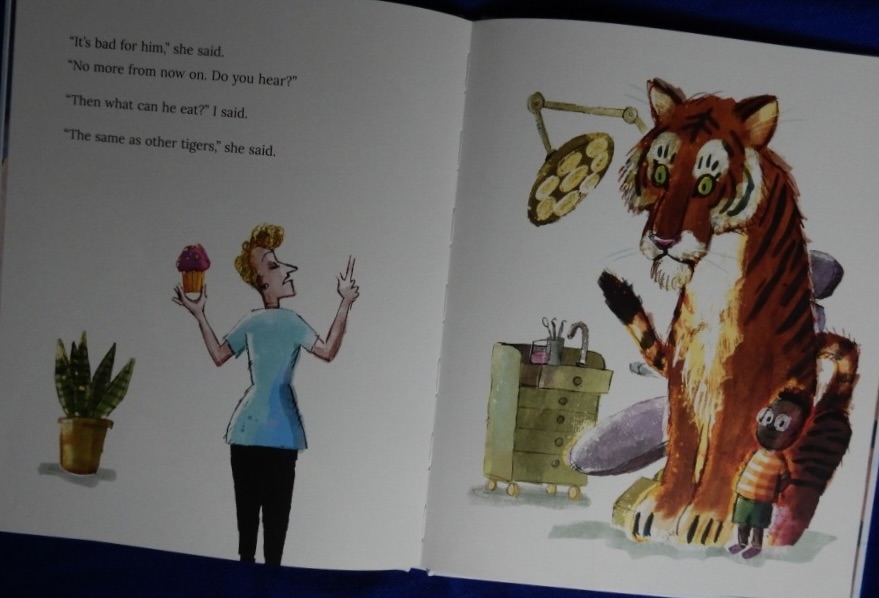
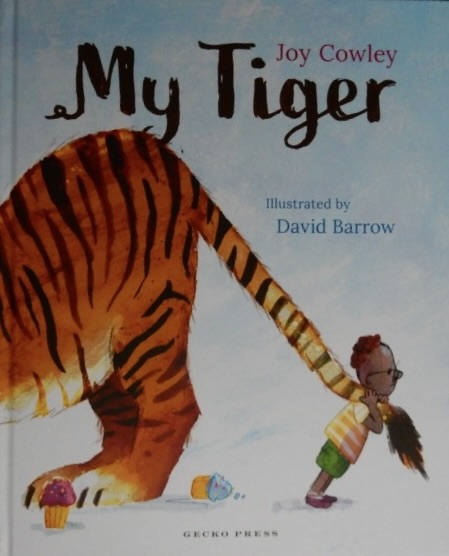
Doubtless everyone will have different favourites but some that especially appealed to me are My Tiger that tells what happens when a child takes his tiger that is suffering from toothache to the dentist. Following the fixing of the problem the dentist instructs, “Tell him he’s not to have cake again. … It’s bad for him.” The dentist goes on to say that the tiger should in future restrict his diet to “The same as other tigers,” You can guess what happens.

Also tickling my fancy was The Big Red Rose. This features Bubba, a little elephant that sniffs said rose; it goes right up her trunk and becomes stuck. A visit to the vet with Mother Elephant proves unsuccessful despite the fact that, ‘The vet got out his telescope, / a light, some pliers, a bit of rope’. Mother Elephant then resorts to an application from a sneeze-inducing condiment. Will that remove the blockage? Ah / Ah – ah / Ah- ah- ah … “ Hurrah!

There are a number of other poems and tales about elephants and you will also find such subjects as frogs, cats,

witches, a grizzly bear that gets stung by a bee and The Horrible Thing with Hairy Feet, intent on making a meal of a bunny rabbit.

Equally full of fun are David Barrow’s illustrations, which combined with the text make this a thoroughly enjoyable book to give or to share in a primary classroom.

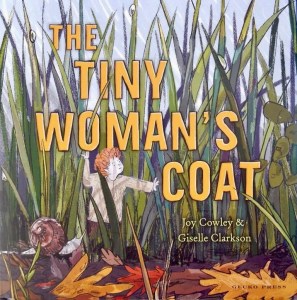
The Tiny Woman’s Coat

The Tiny Woman’s Coat
Joy Cowley and Giselle Clarkson
Gecko Press

This is a heart-warming autumnal tale of need and kindness.

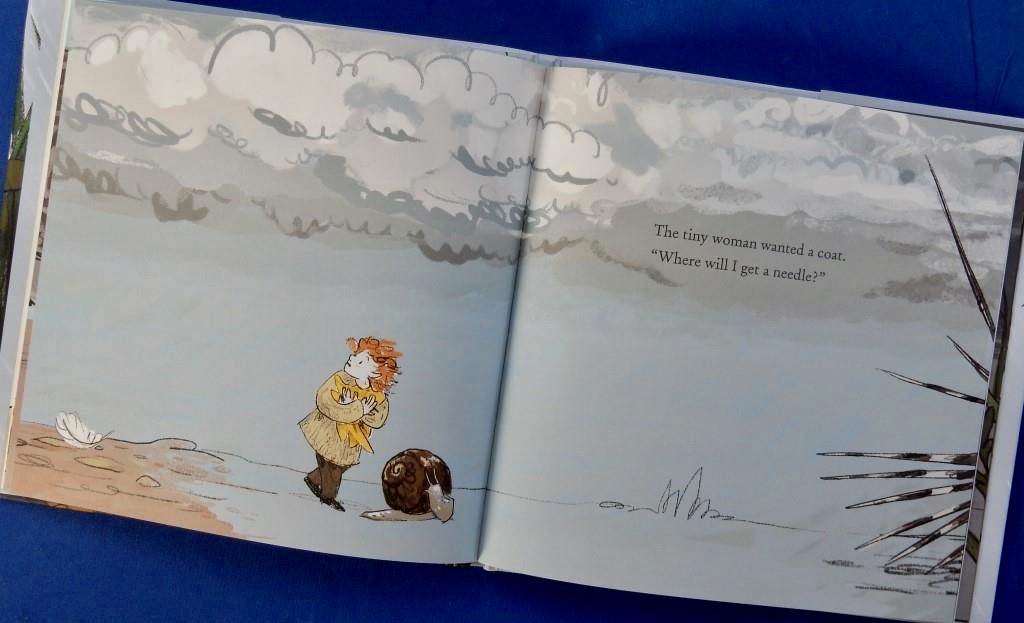
A tiny woman shivering in the chilly wind wants a coat, a coat she resolves to make herself. There might be something of a problem though, for she lacks the necessary tools and materials with which to do the job.

However, happily for her, there are plenty of offers from things natural. The autumn trees provide leaves – ‘Rustle, rustle, rustle.’ Then a grey goose offers its beak in lieu of scissors and ‘Snip, snip, snip’ the leaves are cut into a body and sleeves.

A porcupine’s generosity takes the form of one of its quills

but then this needs to be threaded with something suitable.

A friendly horse provides the thread and then all that’s needed is a means of fastening the garment. The three buttons are seeds given by the ‘wild wet weeds’ and finally hurrah! Out to face the storm, ‘snug as a bug in a rug’ goes the tiny woman clad in her new warm coat of kindness.

Simply constructed and written, Joy Cowley’s folksy story is sheer delight to share and also, with its repeat patterned text, ideal for beginning readers. sheer delight too, and the perfect complement for the text, are Giselle Clarkson’s detailed illustrations with their gentle humour, autumnal hues and close observation of the natural world.

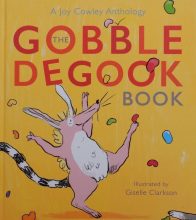
The Gobbledegook Book

The Gobbledegook Book
Joy Cowley illustrated by Giselle Clarkson
Gecko Press

This is an a smashing anthology that brings together twenty of New Zealand author Joy Cowley’s much-loved stories, poems and nonsense rhymes, newly illustrated by Giselle Clarkson whose witty, energetic art is full of fun – a kind of visual poetry.

Open the book anywhere and you’ll find something to love be it the bizarre Nicketty-Nacketty, Noo-Noo-Noo that begins thus;
‘There once was an ogre called Gobbler Magoo / who lived in a swamp where the wild weeds grew. Nicketty-naketty, noo-noo-noo.’

It continues in this sing-song fashion for a further 13 verses, each spread with a splendid illustration.

Or perhaps The Tiny Woman’s Coat about an old woman in need of a coat who is helped by the kindly animals she encounters will tickle your fancy: I love the swirl of rustling autumn leaves and the happy snug-as-a-bug final scene.

How many young listeners will know what a singlet is but they surely will having encountered Uncle Andy and his multi-purpose garment.’Uncle Andy bought the singlet / from an army surplus store. It was the only upper garment / Uncle Andy ever wore. That’s as maybe but it also doubles as a foot warmer, a carrying pouch, a wire substitute, a fire extinguisher and a tea towel. This item has one snag though but to discover what, you’ll need to get your hands on a copy of the book for book yourself.

You’ll also meet several felines including Greedy Cat,

Grandma who owns not spectacles but Goggly Gookers and gives other crazy answers to children’s questions, an exploding pumpkin

and The Jumbaroo that gets a pain in its woggly and more.

Everything about this book is perfect. For those who love to read aloud and those who listen, it’s an absolute cracker: utter zany joyfulness – a treasure for family and school collections. Buy it to keep and buy it to give.

Read it here, read it there, read it pretty much anywhere.

Song of the River

Song of the River
Joy Cowley and Kimberly Andrews
Gecko Press

In this new illustrated Joy Cowley story first published 25 years ago, Kimberly Andrews re-imagines a journey of a little boy, Cam and his adventure as he follows a river from its trickling source all the way to the sea.

One spring morning the lad decides not to wait for his grandfather’s promise to take him to the sea but instead he listens to the watery voice of the first trickle, the waterfall, the leaping trout, the green and gold frogs as the stream becomes a river

that widens, deepens and joins other rivers. Then its voice is that of ‘big brass engines soaked in oil’,

growing louder at the wharves to become ‘the voice of salty wind and crying birds and deep, secret places where whales swim with their young.’ And all the while the river urges Cam to continue his journey until eventually there before him, ‘wild and blue and beautiful … and going on forever’ is …

A sea whose song is deep and wide and truly wonderful.

Back home again, the boy tells his grandfather of his adventure and once again receives the ‘One day we will go there,” response.

No matter whether the boy’s travels were real or imagined, his journey was filled with wonder.

Joy Cowley’s poetic narrative truly sings throughout and is made all the more powerful in the company of Kimberly Andrews’ superb landscapes executed in muted, natural earthy hues.

An awe-inspiring tribute to the natural world and to storytelling itself.