These are both recent Allen & Unwin titles: thanks to the publishers for sending them for review.
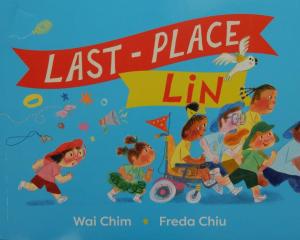
Last-Place Lin
Wai Chim and Freda Chiu
It’s young Lin’s first opportunity to participate in the school sports day and she’s in the red team. Dressed entirely in her team’s colour, she enters first the sack race and then the obstacle race, finding them anything but easy. Next she competes in the water balloon toss but finds it very hard. Unfortunately despite heaving with all her might, another child makes fun of her, calling out to her ‘Last-Place Lin’. Lin doesn’t give up though: she does the crab walk, the wheelbarrow race and the tug of war. Further name calling ensues but still she keeps trying, dropping the baton in the relay.
Then comes the last race – a fun run – and a must compete for everyone so there’s no getting out of it by hiding. After encouragement off she runs, adopting the ‘Last-Place Lin’ as a kind of mantra that enables her feet to follow its rhythm as she puts one foot in front of the other encouraged by a friend and the cheering crowd …

all the way to the finish line
The author Wai Chim’s experience of participating in an Australian TV show was the inspiration for this story. Essentially it’s a celebration of trying, endurance, doing the best you can and never giving up, no matter what. An important message for young children, who can all too easily get swept up in the ‘must win’ mentality that prevails in the sporting world. Freda Chiu’s expressive illustrations show so well how Lin gives the events her all and the difference a bit of encouragement makes to how she feels. Definitely a book to share and discuss with a KS1 class.

Where Will the Sleepy Sheep Sleep?
David Metzenthen and Jonathan Bentley
This is a bedtime tale of the tongue-twisting kind. A sleepy sheep is endeavouring to find a suitable spot for a night’s shuteye. But the places he tries are in turn ‘too deep, steep and stony’, ‘too dangerous’ (not to mention noisy), ‘too scary’, ‘too small, dark and damp’, ‘too cold and uncomfortable’, ‘too grimy and gritty’,

or ‘too lonely’ . Having wandered hither and yon, it seems that luckless ovine is destined to have a miserable night but then … yes young listeners do eventually get an opportunity to bid ‘goodnight’ to the by now, exceedingly sleepy sheep.
Jonathan Bentley’s bold scenes show the sheep’s eyelids becoming heavier and heavier until his eyes are barely open at all as he stands in the corner of the great big paddock almost overcome by somnolence.
Young children love repetition and enjoy alliteration and this fun book has both; it’s just right for a bedtime story, but also, the repeat refrains mean that those in the early stages of reading will soon be taking over from the adult reader aloud.


 Red Reading Hub - Jillrbennett's Reviews of Children's Books