Wise Up! Wise Down!

Three awesome creative people from children’s literature have collaborated on what is sure to become a favourite poetry book for many readers. Two friends John Agard and JonArno Lawson provide the words and the distinctive art of Satoshi Kitamura provides the wonderful, whimsical illustrations. So, when you open this book be prepared to embark on a foray into a lively, thought-provoking conversation between prize-winning poets. It’s so cleverly put together with the two voices taking turns throughout; they’re made to seem as if one person’s thoughts have immediately initiated a response from the other, despite many of the poems having been published previously.

Sure to get your brain cells buzzing are Jon Agard’s Mind, What Exactly Are You? and JonArno Lawson’s rejoinder Never Mind. So too will Questions (JA) and Should I Be Me? (JL) Philosophical posers each one of which could be used to open a community of enquiry type discussion.

There’s humour too, of a wicked kind in for instance, JA’s Crocodile’s Tale: ‘The last man who mistook me for a log / Lost half a foot and can no longer jog.’ and Alligator’s Response (‘Is that right, old Croc? / But can he still walk? // The last man who stopped to look me in the eye? / That falling-down man was an upstanding guy.’ (JL)

What comes across loud and clear is both poets have never lost their sense of awe and wonder about life, the universe and all that: JL summarises this in the final lines of the verse in the final poem: ‘figuring out this strange world will never / be anything less or anything but / a forever and ever adventure.’ A perfect close to a terrific book.

Read it at home, read it in the classroom and then perhaps try out some of the suggestions given at the end.

Over the Shop

Over the Shop
JonArno Lawson and Qin Leng
Walker Books

This is a wordless picture book that tells an uplifting tale of acceptance, trust and transformation.

As the story starts we see a child and her grandmother who is evidently the proprietor of the corner general store, at the back of which are their living quarters. It’s a run down place and upstairs is an empty flat. It’s not an inviting prospect for renters as is evident from the number of people who turn their backs on the place having viewed it.

Then, along come a couple of young people and it’s clear from the grandmother’s expressions that she has her doubts about them as tenants. They however are able to see past the run-down state of what’s on offer, and the child appears to be drawn to them and so begins project metamorphosis.

Not only do they, aided and abetted by the girl and the occasional neighbour, enthusiastically transform the apartment,

they also give the shop’s exterior a fresh coat of paint and help with the day-to-day running of the enterprise.
Meanwhile the girl has also enticed inside the cat her grandmother shooed away early on in the story, and that too now has a home. Thus from unpromising beginnings, a wonderful new family is formed.

Full of vitality, Qin Leng’s intricately detailed storytelling pictures rendered in ink and watercolour, are somewhat reminiscent of Sarah Garland. The presence of a rainbow flag in the final couple of spreads confirm what readers attentive to the fine detail might already have suspected.

This is one of those books where the more you look, the more you discover and the more stories emerge.

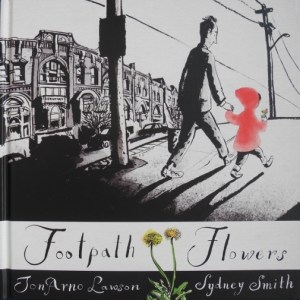
Footpath Flowers

DSCN4345 (800x600)

Footpath Flowers
JonArno Lawson and Sydney Smith
Walker Books
To me this is a poem in pictures – poetry in motion only without the words and a pretty near perfect one too; an ode to young children, to the small wonders of nature, to joy in fact. The whole book is a small treasure.
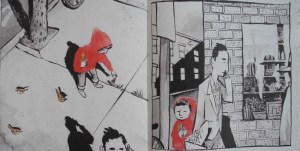
Hand-in-hand, a child (I think a girl) and a man walk, through an urban landscape seemingly without speaking to one another. He is preoccupied with his mobile, the shopping and getting home. The child however, keeps stopping to pick the wild flowers that grow out – as wild flowers do – from all manner of cracks and corners;

DSCN4347 (800x600)

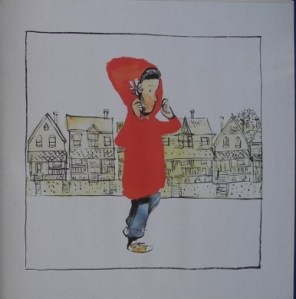
she smells each one lovingly and soon collects a small bunch. But then, still paying attention to the small things around, she notices a dead bird on the path and with due reverence, leaves her first bouquet on the bird.

DSCN4349 (800x600)

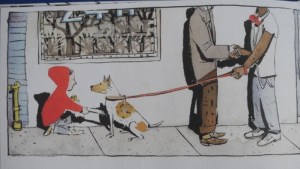
Next to receive her attention is a man (homeless?) snoozing on a park bench: he too receives a floral gift, as does a dog

DSCN4357 (800x600)

and once home she bestows floral offerings on her mum and her siblings. That leaves her just one flower:

DSCN4351 (800x600)

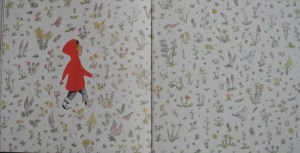
and she’s still walking. Whither next we wonder?

DSCN4358 (800x600)

Those of us who work with young children know that they often exhibit – like the child here – a sense of awe and wonder, a connectedness with nature and with their fellow beings and given opportunities for living in the moment, they demonstrate that felt sense, or sometimes even flow state, that young children can inhabit. To me this book is a demonstration of that and it’s achieved by its creators really getting down to the child’s eye level and showing us things from that perspective. I cannot praise too much the Canadian poet author’s storyline and the way in which he has left Sydney Smith to translate that into visual poetry with just the right amount of sentiment and judicious use of colour.

DSCN4348 (800x600)

His perspective in both full-page scenes and smaller strip-frames, is always that of the child; and this is key. So too is the fact that at no time does the adult become impatient or harass the child; rather he walks on but waits with outstretched hand at appropriate moments. (Would that every child had such an adult who showed that depth of understanding.)
Full of poignancy, this is a book to revisit and to cherish.

Use your local bookshop localbookshops_NameImage-2