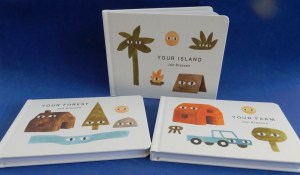
Your Forest / Your Farm / Your Island

Eyes, eyes and more eyes. Every element in each of the three books has an eye, most have two and they all begin the same way. ‘This is your sun. It is coming up for you.’ Thus it positions the child reader as central to the whole.

Your Forest then gives that child suggestions to allow them to assemble a woodland scene comprising trees, a cabin, rocks, a friendly forest ghost (that only appears at night), a stream and a bridge. As the sun sets, the eyes close and the forest sleeps, all but one thing …
Sleepy time pleasure of the inimitable Klassen kind.

Like the previous book, as well as starting at sunrise, Your Farm, ends at night with the young reader receiving permission to sleep and think about the following day. Little ones then meet in turn a tree, a barn, a horse (to go in the barn) ditto some hay, a truck – in the barn too, a stool upon which to sit beneath the tree and a fence to surround everything. The sun then starts to sink, the eyes become sleepy and eventually close altogether. On the final page, it’s the moon that is wide-eyed and wide awake.

In common with the other books, little readers are given the power of creation of Your Island and it’s evident from the outset that the objects belong to the child. Item by item a palm tree, plants, a tent (to go beside the plants beneath the tree, a fire of the magic kind for it never goes out, a boat, a bird that takes to the wing from time to time comprise the island which is fully assembled come sundown. Then eyes close, the island sleeps , the reader contemplates tomorrow on the island under the watchful eyes of the moon.Another whimsical wonder to fuel the imagination and provide pre bedtime pleasure of the empowering, world-creating kind. If you have a toddler, I urge you to try all three and see … see… see.
Ten-Word Tiny Tales of Love

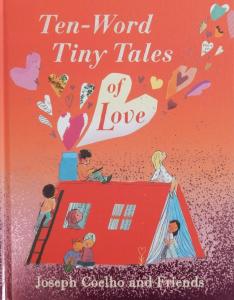
This is former children’s laureate Joseph Coelho’s second Ten-Word Tiny Tales offering, this one having a unifying theme – love – and in an introduction, Joseph tells readers how the tiny tales came about.
Each of the tales is moving in its own special way; you will find great sadness, tender parental and sibling love, spookiness, the fantastical, the humorous and more.

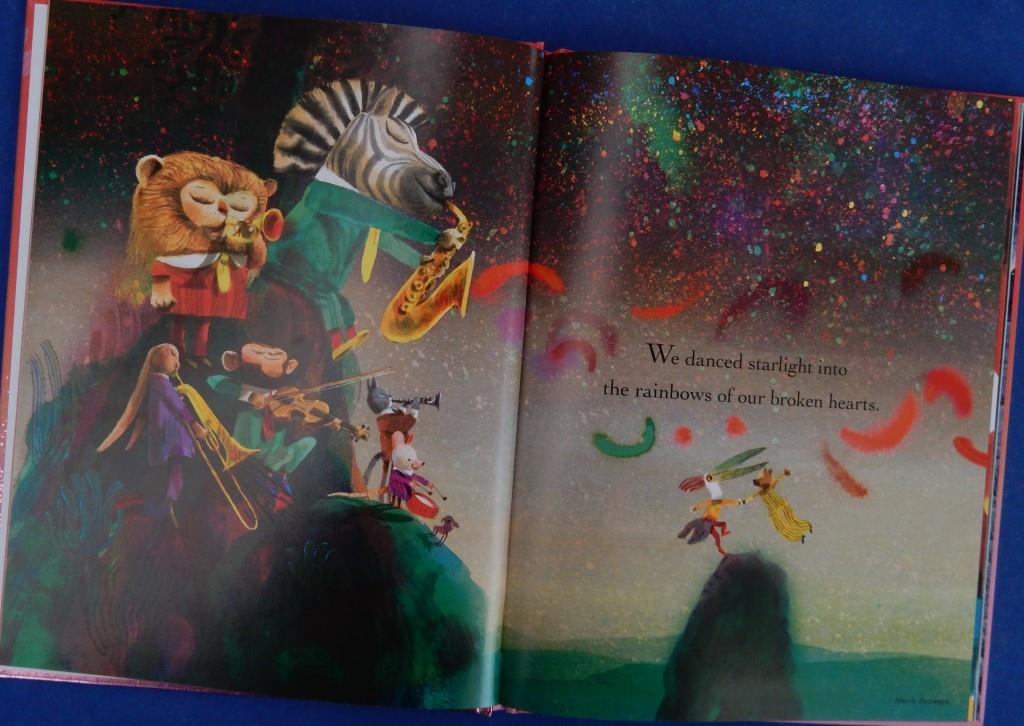
Coming from all over the world, each one of the talented artists has created an equally special, very different scene, thus making every turn of the page a verbal and a visual delight.

We see enigmatic and literal interpretations as well as ambiguity: there is love for such diverse things as a bike, baby birds and a brother,

but in every case the intention is to create a world – a space of awareness – that will spark the reader’s imagination.

To facilitate this, Joseph offers some story writing prompts in the final two spreads.
Altogether a treasure trove that holds within, a wealth of possibilities for creativity both in the classroom and at home.

How Does Santa Go Down the Chimney?

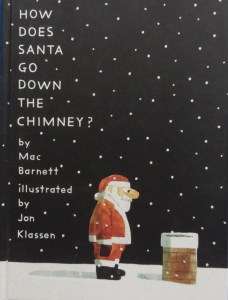
If you’ve ever pondered upon the mystery of how Santa manages to go down the chimney, then this might well be the book for you. Countless young children have been spun that yarn over the years and now, frequent collaborators Mac Barnett using an unidentified narrator and artist Jon Klassen, put forward a series of hypotheses concerning his chimney descent, as well as looking at the possible means of entry should the house not have a chimney at all.

Klassen starts with Santa atop a roof, making adjustments: he pulls his belt tight in at the waist while a reindeer holds his jacket. Turn over and we see a mouse-size shrunken figure contemplating entering the chimney’s large opening. However, he might change shape in a different way. becoming super-stretchy so as to enable him to step in one leg after the other.

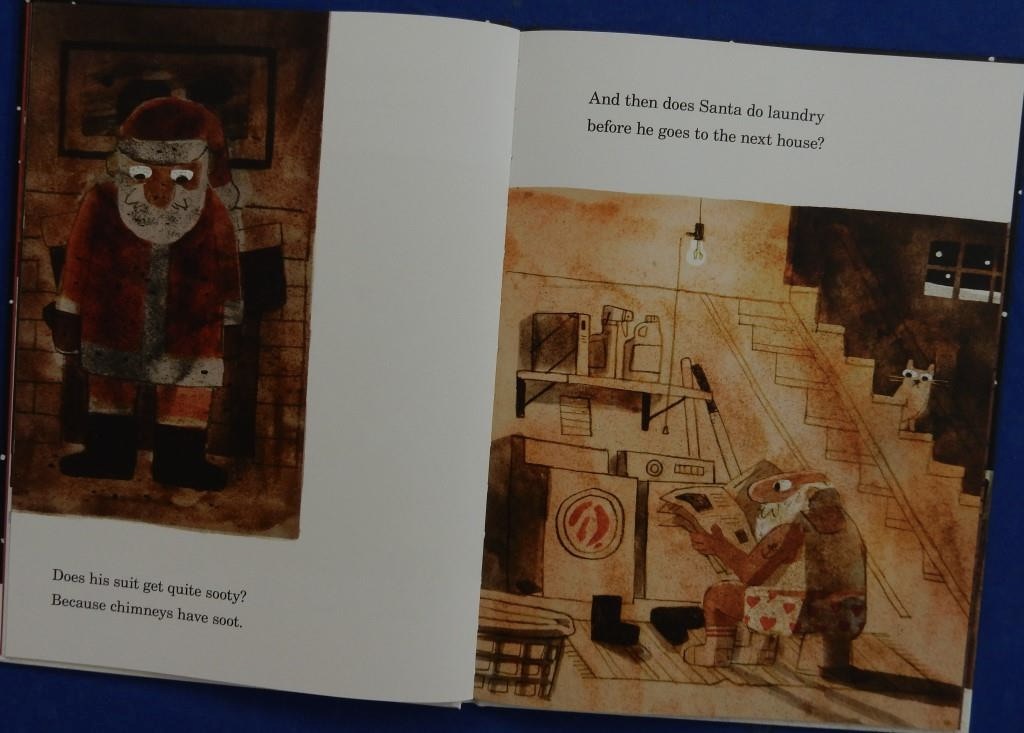
But supposing he should get stuck? Then what? A hefty kick from one of the reindeer maybe.. And what about all the soot that’s likely to get on his suit? A quick bit of laundry before moving on to his next house, perhaps.

For houses that lack chimneys there’s that well guarded (not) secret regarding the key under the flower pot; alternatively he can transform his shape so he can slide beneath the door or pass through the pipes and out of the tap into the sink. Having gained access things get even sillier. Does he possess the ability to get along with every household dog he meets: that would require a stash of doggy treats secreted about himself, as well as becoming the recipient of a succession of slobbery canine kisses. And what about night vision goggles if the lights are off?

Nothing is certain except that, as we read, ‘Santa goes up the chimney the same way he comes down.’ No conjectures about that though, merely the final assertion, “But I’m so glad he can.’

A splendidly silly seasonal comedy from the partnership that are best known for their droll delights delivered through dead pan words and idiosyncratic illustrations.

The Skull

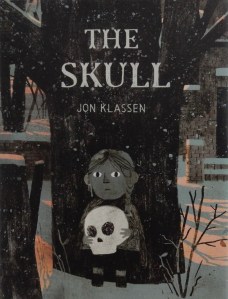
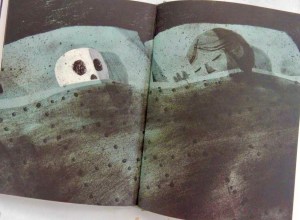
Weird and wonderful is Jon Klassen’s adaptation of a traditional Tyrolean folktale. Klassen brings his wry humour to this sometimes creepy, sometimes comforting and consoling telling of what happens when a runaway girl named Otilla dashes through the forest one night, trips in the snow, falls and having found her way out of the woods, discovers a large, old, seemingly abandoned house.

It’s not abandoned entirely though for inside resides a talking skull. Said skull agrees to let Otilla in; the two gradually form a friendship as the girl assists the bodiless being in doing things it would otherwise be unable to, such as drinking tea,

picking and eating a pear from the garden room; the two even dance together. As they take tea, the skull tells of a headless skeleton that frequents the house each night and Otilla determines to make sure it never catches her new friend.

Drawing on her resourcefulness and ingenuity, she annihilates the skeleton, returns to bed

and next day accepts the skull’s invitation to live with him in the rambling old house. An unexpected and unlikely happy-ever-after if ever there was one.

Klassen’s limited colour palette certainly highlights both the cosiness and spookiness of his telling, after which in an author’s note he tells readers how he came across a story called The Skull in a library. It lingered in his mind, morphed into something rather different and eventually became this book. I can’t envisage many other than he who could envisage a cranium companion for a young girl, unless they were creating an unadulterated horror story. This is anything but and even quite young readers and listeners will love it.

The Rock From the Sky

The Rock From the Sky
Jon Klassen
Walker Books

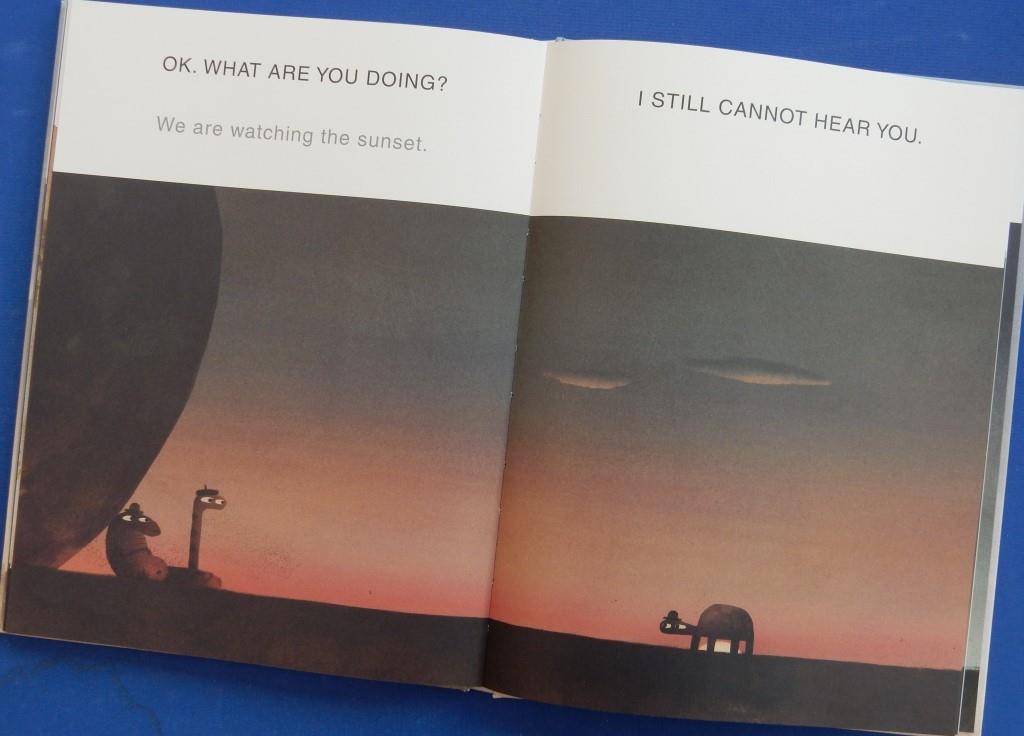
Quintessential quirky Klassen is this sequence of five connected short comic episodes delivered with the author’s dead pan humour, not to mention that its main characters – a tortoise, an armadillo sport Klassen’s signature style hats.

The entire thing is delivered through (colour-coded) dialogue between Tortoise and Armadillo (plus those characteristic Klassen eye-movements).

The topic under discussion in The Rock is the best place to stand/sit. Tortoise favours one particular spot, “I don’t ever want to stand anywhere else.” But Armadillo is unfavourably disposed towards it, “Actually I have a bad feeling about it.’ And rightly so; he instead goes off to try another spot. A to-ing and fro-ing ensues but it’s not until Snake rocks up to join Armadillo that Tortoise decides to join them too – and only just in time … for something huge and mightily heavy falls on his erstwhile spot. Of course, we readers in on the joke, have been anticipating same all the while as we enjoy the mounting tension.

In The Fall, Armadillo attempts to act helpfully while Tortoise tries to save face zzzz. Episode three sees the two, eyes closed, contemplating the future

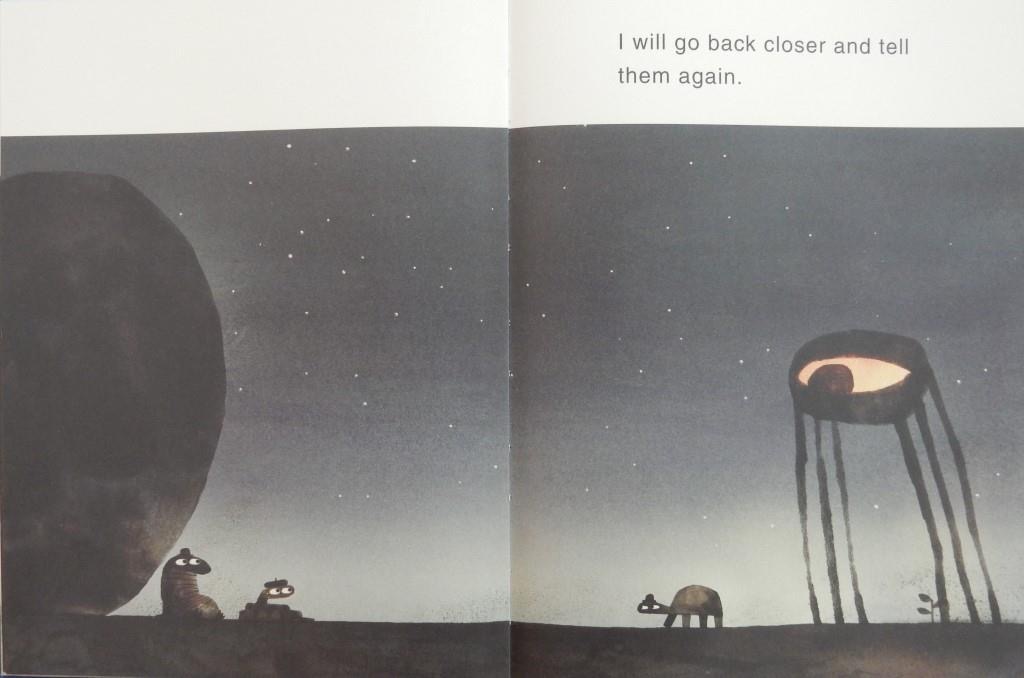
watched by a futuristic creature, while The Sunset is a contemplation of same – kind of;

and finally, in No More Room Tortoise takes umbrage “Maybe I will never come back” and is once more under the watchful Eye now no longer in the future,

but perhaps soon to be in the past. Thank goodness for asteroids!

Another weird and wonderful Klassen gem, albeit somewhat longer (90 pages) than usual, set in a minimalist landscape that offers much to ponder upon in a Waiting For Godot for primary school readers.

Circle

Circle
Mac Barnett and Jon Klassen
Walker Books

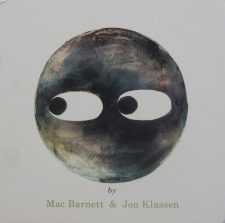
This is the final book in the Shape trilogy that featured first Triangle and then Square as main character; now it’s the turn of Circle.

One day at Circle’s suggestion, the three friends embark on a game of hide-and-seek. Circle stipulates one over arching rule: “No hiding behind the waterfall” because it’s dark there.

Circle completes her counting, only to learn from Square, who has remained static, that Triangle has gone behind the waterfall.

Off goes Circle to find him and as she goes deeper in, the double spreads gradually darken

until everything is black save Circle’s eyes.

Then out of the darkness another pair of eyes appears belonging, Circle assumes, to Triangle. She starts chastising her ‘friend’ but no answer is forthcoming.

There appears a third set of eyes and it’s these, it transpires, that belong to Triangle.

It turns out that the since Square is outside, the other eyes belong to they know not whom. Circle asks the shape before her once again, “Who are you?” and again receives no answer.

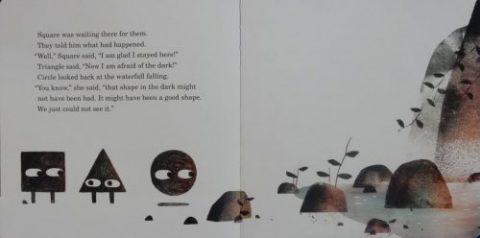
Circle and Triangle rush back in fright, back towards the light and the outside where Square is waiting.

Once safely back in the daylight, Circle ponders upon the identity of the shape; perhaps it wasn’t bad after all. “It might have been a good shape. We just could not see it,” she posits.

An important inherent message from Barnett in our xenophobic times no matter which side on the Atlantic we live on.

His story has an open ending, concluding with a question for readers. It does however suggest that we can perhaps overcome our fears by remaining calm and mindful, rather that letting them overwhelm us.

In his watercolour and pencil, digitally worked style illustrations, Klassen portrays the friends’ emotions with his characteristic minimalist, brilliance.

A book to ponder upon and discuss.

Square

Square
Mac Barnett and Jon Klassen
Walker Books

In a previous book we left Square obstructing the entrance to Triangle’s home and now he’s back moving in and out of his own secret abode hauling large rock cubes from his subterranean stash all the way up to the top of a hill. This he regards as his ‘work’.

One day while he’s thus engaged along comes Circle pronouncing him a “genius” and “sculptor”. Thinking his block sculpture to be a self-portrait, she commissions one of her, promising to return the following day. Now Square really does have a tricky undertaking: Circle is perfect.

Anxiously he sets to work but as the rain falls, Square’s far from perfect shape begins to disintegrate and come nightfall he’s surrounded by a circular pile of rubble into which the rain falls.

By now his anxiety is almost palpable and having determined to stay up all night, overwhelmed by despair, he falls fast asleep.

Morning comes and with it the realisation that he’s allowed himself to be beguiled by Circle’s talk of genius. There he stands in a large puddle surrounded by a circle of rubble.

Eager to set eyes on her portrait, Circle rolls along early and sees her reflection in the puddle.

Declaring it “perfect” she reaffirms Square’s genius and departs.

Barnett’s final throwaway ‘But was he really?’ leaves readers, and indeed Square, to ponder and make their own decisions, not the least of which are, what does it mean to be an artist? And, what is art?

With his characteristic minimalism Klassen imbues his art with humorous detail: the twig for instance that looks like a wilted aerial on Square’s head, and the way he just keels over in utter exhaustion, are superb.

Barnett’s brief, droll text, combined with Klassen’s illustrations make this a perfect offering for those who enjoy pondering upon and discussing philosophical questions. Community of Enquiry enthusiasts and artists in particular will love this, as indeed will anyone who enjoys the subtlety of this duo’s picture books.

The Wolf The Duck & The Mouse

The Wolf The Duck & The Mouse
Mac Barnett and Jon Klassen
Walker Books

There’s a fable-like, porquoi feel to Mac Barnett and Jon Klassen’s latest collaboration: think wolves, think howling at the moon.
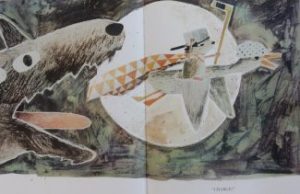
One morning a mouse is gobbled by a wolf; its woeful cry disturbs a duck attempting to get some shut-eye in the belly of the wolf. The two breakfast together and strike up a friendship.

Their dialogue had me spluttering as the mouse asks, “Where did you get the jam? … And a tablecloth?” “I may have been swallowed but I have no intention of being eaten.” the duck assures the mouse. And over lunch preparations he reassuringly comments on the lack of fear of being swallowed by a wolf, leaving them to enjoy their creature comforts from the inside.
Comforts that include a record player and record for a celebratory dance, which has drastic effects on their host’s stomach; but for that the duck has a cure: “Eat a hunk of good cheese. And a flagon of wine! And some beeswax candles, ” he states.
Complying only worsens the wolf’s stomach ache: his moans are heard by a hunter whose target he becomes.
Now, quite suddenly all three animals must combine forces to save their lives and they do so in no uncertain terms …

convincing the hunter that “the woods are full of evil and wraiths.
The grateful wolf offers his saviours a favour, which they are delighted to accept …

Thereafter comes a kind of symbiotic existence between the main protagonists.
Barnett’s snappy narrative style with its repeated “Oh woe!” provides plenty of laugh out loud moments. In combination with Klassen’s mixed media collage-style illustrations the whole thing unfolds rather like a puppet theatre performance.
An off the wall, howlingly funny, brilliantly clever Barnett/Klassen offering, not to be missed at any cost.

Triangle

Triangle
Mac Barnett and Jon Klassen
Walker Books
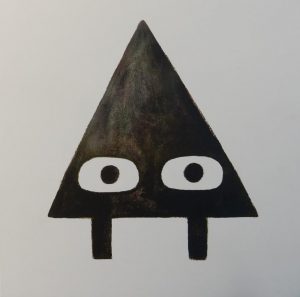
Knowledge of a friend’s ophidiophobia is in part, the driving force behind Triangle’s foray from his home in his triangular neighbourhood, across a barren place of rocky humps ‘They were shapes with no names’ Barnett informs us; and on through the place of squares –

big, medium and small ones – to Square’s abode. All the while he’s been plotting the sneaky trick he’s about to play.
He walks right up Square’s door, whereupon he delivers a round of snake-like “HISS” sounds.
Square is momentarily petrified: Snake dissolves into paroxysms of laughter. A pregnant pause follows,

rapidly replaced on Square’s part by incandescent rage.
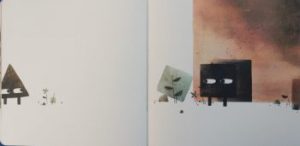
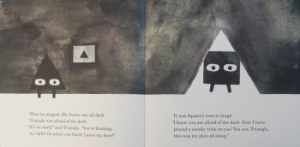
Thereupon the four-sided being chases the three-sider all the way back to his home. His shape however, prevents him from entering and there he stands stuck in the doorway and thus accidentally discovers Triangle’s nyctophobia.

I know you’re afraid of the dark. Now I have played a sneaky trick on you! You see, Triangle, this was my plan all along.” Hmm! I’m not so sure about that.
Klassen’s restrained earthy palette and minimalist scenes (those eloquent eyes again), are in perfect harmony with Barnett’s even sparer, deadpan text allowing readers to step into the narrative landscape and fill for themselves, the host of gaps left by the book’s genius creators.
Prankish play or something more sinister? I come down on the side of the former.
This book is the first of a planned trilogy from this formidable team: I eagerly anticipate the next one … and the next.

I’ve signed the charter 

We Found A Hat

dscn8926

We Found a Hat
Jon Klassen
Walker Books
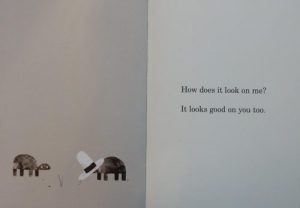
This, the concluding book in Klassen’s “Hat’ trilogy is delivered in the artist’s dead pan style. Longer than the previous two at 56 pages, and divided into three chapters, it features two turtles and just one hat – an exceedingly large one – for turtle heads, that is. Each in turn tries it on and reach one conclusion: It looks good on both of them.

%0a

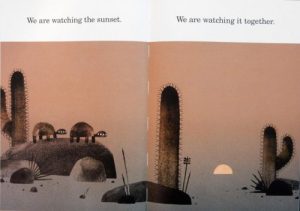
Rather than have a bust-up, the two walk away to watch the sunset from a nearby rock – together.

dscn8928

One starts thinking about the sunset – so we’re told; the other starts thinking about you know what …
Night falls and the two prepare to sleep. One turtle starts moving downwards in the direction of a certain article of headwear … The second dreams – of stars and identical hats, one for each of them. Hmm: now what?

%0a

Seemingly that’s for readers to decide as they relish the subtleties in this Klassen finale. With its spare text and slow-moving visual action – it’s entirely a case of showing, not telling here –
and they are turtles after all. What’s going on behind those eyes? That is the key.
Rendered in sombre hues with a gradual fading out of the soft orange as the sun finally sinks, this is desert dryness in more senses than one.

WNDB_Buttonlocalbookshops_NameImage-2

Sam & Dave Dig a Hole

seen not heard 013 (600x800)

Sam and Dave Dig a Hole
Mac Barnett and Jon Klassen
Walker Books
Sam and Dave, along with their dog ( watch that dog), are on a mission –a mission to find “something spectacular”. They start digging, just missing a largish gemstone,

seen not heard 014 (800x600)

more digging… a larger one … oops missed that one too. They stop for a snack followed by a change of direction (the boys go their separate ways) …

seen not heard 015 (800x600)

still nothing is found. Back to digging straight down again and even after the last of the chocolate milk and biscuits is gone they have discovered absolutely ZILCH. Moreover, the boys have dug themselves to exhaustion; time for a rest, a sleep in fact. Only the dog continues digging; he’s after a bone though. But then all of a sudden both boys and canine companion are cascading down, down …

seen not heard 016 (800x600)

to a soft landing place.
That was pretty spectacular” comments an impassive Sam as they come to earth. Everything looks pretty much the same.

seen not heard 017 (800x600)

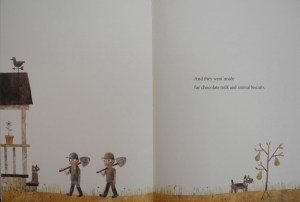
Or does it? Look again – at the weathervane, the plant in the pot, the fruit on the tree, the cat’s collar … another dimension? A dream world? Maybe – that’s your decision though. And that’s the thing about this very clever book where every small detail counts … it’s all in the interpretation. That, and the unspoken interplay of text and earthy coloured illustrations. Then there is the overall design of the book with the, oh so careful, positioning of the words on every spread.
All in all, pretty spectacular I’d say.
Find and buy from your local bookshop:

http://www.booksellers.org.uk/bookshopsearch

Buy from Amazon