Mr Gumpy’s Rhino

My Gumpy’s Rhino
John Burningham
Jonathan Cape

John Burningham died at the beginning of this year and the subject of this final book was one that deeply concerned him. There’s the old Burningham humour in the story but underlying it is a serious message about animal conservation, in particular the plight of the rhinos in Africa.

Last seen driving his motor car in the early 1970s Mr Gumpy is on his travels in Africa when he finds something distressing: a baby rhinoceros that has been left parentless on account of poachers taking their horns.

Knowing the young animal needs milk the kindly protagonist gives it what he has

and buys what he can from the Bedouins but it’s not sufficient for the growing rhino that he calls Charlie.

There’s plenty of milk available once they board a boat, as well as greenery

but once on dry land back home, Mr Gumpy struggles to get sufficient food for the rapidly growing Charlie.

Children at the local primary school suggest the animal might work for the council, keeping the grass and wayside verges under control, an idea that Mr Gumpy wholeheartedly endorses.
Consequently Charlie is given a high vis vest and special road sign, both of which please him considerably.

To show his appreciation, when the children’s school trip is threatened Charlie charges over land and even into the sea to enable them to catch the already departed boat. Hurrah!

This, with its mix of wonderful grainy coloured images and line drawings is vintage Burningham brilliance. Only he could make the baby rhino so appealing a character: who wouldn’t be moved by the sight of him shedding tears over the loss of his parents.

Destined to join the other Mr Gumpy stories as a modern classic, this is a wonderful way to introduce the very young to the topics of endangered creatures and animal conservation.

More Would You Rather

More Would You Rather …
John Burningham
Jonathan Cape (Penguin Random House Children’s Books)

There’s been a recent spate of books celebrating the amazing achievements of women and men from all walks of life and from all over the world, as well as others putting forward the notion that where girls are concerned, they can do anything they set their minds to.
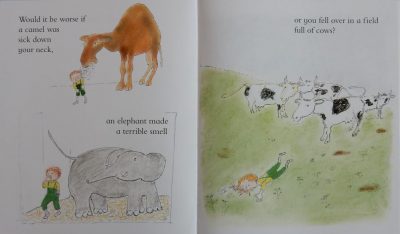
In his new book, John Burningham, (or rather the cheeky-looking child on the cover) invites readers to do something rather different; to ponder somewhat more unlikely possibilities posited in a series of questions. He wants us to consider the unlikely, and to make a choice about such rather disgusting sounding scenarios as having a camel being sick down your neck, an elephant emitting an extremely stinky toot, or falling flat in a field full of cows and your face landing in a pile of s— .

Pet ‘perhapses’ are – a cuddly koala, a vicious-looking vulture, a jagged-toothed alligator or a winsome woolly sheep. Hmm?

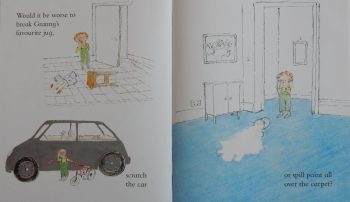
Just imagine the excuses you’d have to come up with should you be careless enough ‘to break Granny’s favourite jug’, ‘scratch the car’ or ‘spill paint all over the carpet’ – whoops!

Then, supposing if for no apparent reason you were the source of amusement to all and sundry; would that be better than having an eagle steal all your clothes? (Even worse might be the latter happening in front of that crowd.)

I’ve never got sufficiently close up to a hippo of any sort, let alone one with bad breath, and I don’t have an Aunt Zelda, but I wouldn’t relish having to cope with either of those bestowing a kiss upon me. On with the trainers and a hasty retreat, would be my response.
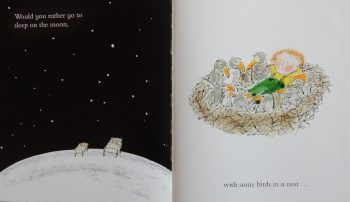
Think about having to spend a night under the stars – no not at a seaside campsite – but with your bed on the moon; is that preferable to nestling up with a whole lot of baby birds, or is the safety of your own bed the best option?

I wonder …
And that phrase is the key to this fabulous book. I’ve spent countless happy hours with various classes of children UUUUGGGHH! -ing and YUCK!-ing, laughing over, deliberating on, , discussing and generally having a whole lot of fun, with Burningham’s original Would You Rather so I cannot wait to share this one with all its imagination-rousing potential.

Need more ideas for your children’s holiday reading: try Toppsta’s Summer Reading Guide

Mouse House

Mouse House
John Burningham
Jonathan Cape

John Burningham returns to the theme of mice for the first time since his 1964 classic, Troubloff: the mouse who wanted to play the balalaika.
The mouse, or rather family of mice in this story has no musical inclinations; rather they desire only to live peaceably alongside the human family whose house they share.
The mice are fully aware of the humans, keeping well out of their way and only emerging at night once the humans have retired to bed.
The humans in contrast, are completely ignorant of their co-residents.
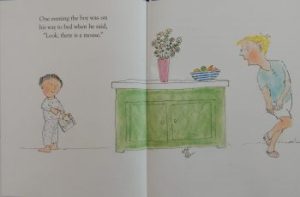
One evening though, on his way to bed, the boy spies a small furry creature …

Before you can say, “Look, there is a mouse,” his father has called the rodent exterminator.
The children are firmly on the side of the mice insisting they’re harmless. They have just until morning to alert them; so they write a note warning them of the imminent danger.
Exit one mouse family …

The following morning the mouse catcher comes: job done, so he says.
The children know otherwise and watch the mice at play from their bedroom window, even making things for them to play on.

But, with the coming of winter, their playthings and the mice are nowhere to be seen. Where can they have gone, without even leaving a note, the children want to know.
I wonder …
In this exploration of the secret world of mice and children, Burningham’s work is as fresh as ever, yet has that enduring, timeless appeal for both youngsters and adults. The former will revel in sharing the children’s secret and the artist’s delicate touch; the latter will delight in the detail, including the copy of Borka, (an early Burningham classic), being clutched by the boy on his way to bed. And who wouldn’t be charmed by the sight of the mouse child holding his cuddly toy …

I’ve signed the charter  


Motor Miles

dscn9201

Motor Miles
John Burningham
Jonathan Cape
A new Burningham book is always a cause for celebration.
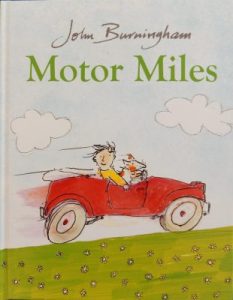
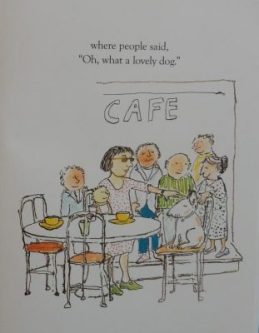
Meet Miles, a rather difficult dog. He refuses to come when called, doesn’t like walks, turns his nose up at the food he’s offered and barks way too much. Despite all this he’s managed to win the hearts of his owners, Norman, and Alice Trudge who takes him for car rides, most notably up the hill to a café where he becomes a petted pooch.

%0a

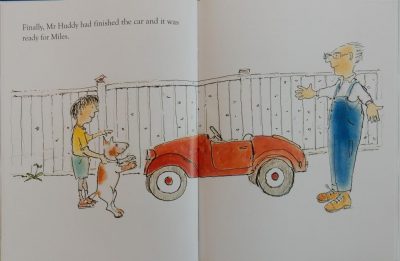
This however, becomes something of a chore for Alice Trudge. Thank goodness then for neighbour Mr Huddy, who builds Miles a car of his very own.

dscn9198

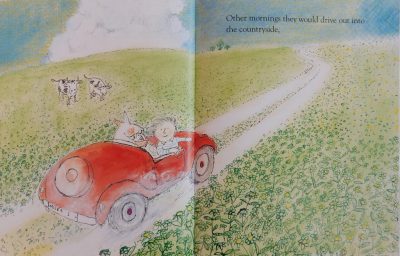
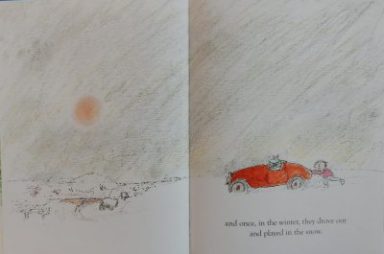
Miles learns to drive – love that sequence – takes to the road and starts taking young Norman on secret excursions. Some glorious Mr Gumpylike scenes show the two enjoying seasonal jaunts through fields …

%0a

woods and valleys,

dscn9200

all of which have a positive effect on Miles, who gradually becomes a reformed character. Inevitably however, Norman outgrows the car and Miles stops driving. Perhaps Mr Huddy has another surprise up his sleeve though …
John Burningham’s down-to-earth telling leaves his masterful illustrations of Miles discovering the joys of freedom, and those lyrical landscapes, to do the talking. For me, Burningham still wields a very special magic.

Animal Alert!

A new Burningham book always calls for shouting and waving from the rooftops; this one, for me, especially so:

DSCN2080

The Way to the Zoo
John Burningham
Walker Books
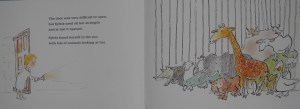
When Sylvie discovers a door in her bedroom wall leading to steps and a passageway, of course she decides to investigate. Torch in hand, she moves along only to discover another door.
Hard work and determination make it yield and Sylvie comes face to face with a zoo full of animals.
DSCN2091

Back to bed she goes, taking with her as sleeping companion a small bear, with the proviso that it is returned to the zoo before school-time next morning.
This, naturally leads to other nocturnal visitors – the small ones only – to Sylvie’s bed but then she brings back penguins; these of course splash water all over the bathroom. Next night comes a tiger and cub, the next a whole collection of birds.

DSCN2092

Not all animals however, are suitable guests,
some steal, DSCN2093

others smell and size is an issue in a couple of instances …

DSCN2095

Then one morning, in a rush Sylvie forgets to close the bedroom wall door and on her return discovers that there’s been an animal invasion of the sitting room. Sylvie vents her wrath,

DSCN2097

the animals depart and it’s time for a hasty clean up before her mother returns – O OH!
Now, there’s a lesson to be learned there, Miss Sylvie.
As the inimitable John Burningham himself says, children do believe that their bears are real. Indeed, in my experience, at a young age, the line between fantasy and reality is often blurred and as teachers we frequently encourage their imaginative play and flights of fancy.
This wonderfully understated story works on several levels and the interplay of the verbal and visual is, as ever, truly brilliant Burningham.
Buy from Amazon

DSCN2098

Barbapapa’s Ark
Annette Tison and Talus Taylor
Orchard Books
The shape-shifting Barpapapas don their ‘green’ hats and come to the aid of all manner of threatened animals in this story, be they suffering from pollution sickness, chased by hunters or hounded out of their ocean home by zealous fishermen.

DSCN2099

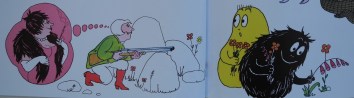
The hunters are particularly persistent with the result that even Barbabeau with his desirable fur pelt, finds himself in danger.
DSCN2100

Time for the Barba flea sprinklers to set to work …

DSCN2101

Eventually the Barbapapa Refuge is not only over flowing but in serious danger of the encroaching city’s pollution. A rocket-style ark is designed and the Barba family, Francois and Cindy plus all the animals blast off in search of a peaceful, green planet.
Only then do the earth’s inhabitants see the error of their ways: a clean up operation ensues, air and water are purified, promises made, trees planted. Finally Barbabright spies the newly greened planet Earth and the Barba family and animals return home.
The environmental message comes across loud and clear in this delightful re-issue and it is equally pertinent today as it was when the story was first published in 1970. (Interestingly, Talus Taylor, co-creator of the series was himself a biology teacher.) Let’s hope that the people of our earth pay more heed to the Barbapapas’ message this time.
Buy from Amazon
DSCN2102

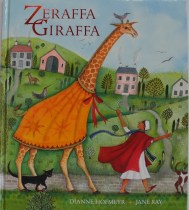
Zeraffa Giraffa
Dianne Hofmeyr and Jane Ray
Frances Lincoln
What is a giraffe doing in Paris of all places?
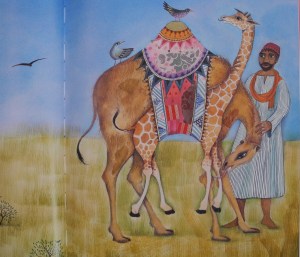
Crazy as it may sound, this gorgeous book relates how in 1824, Zeraffa is caught on the plains as a baby giraffe and sent by the Great Pasha of Egypt to the King of France as a gift.
DSCN2103

First though, she is slung on the side of a camel, fed on camel’s milk, then put on board a felucca sailing craft and travels from Africa all the way down the Nile to the coast

DSCN2104

and thence to France. From where, accompanied all the while by the devoted Atir who protects her and cares for her, their journey continues on foot to the palace of Saint-Cloud and where she becomes beloved by the King’s granddaughter too.


DSCN2106

Jane Ray’s glorious illustrations illuminate every facet of the journey from the start to Zeraffa’s triumphant welcome into Paris. There seemingly, the entire city is struck by an attack of ‘giraffism’, which embraces everything from baking to hairstyles, musical notation even.

DSCN2105

Ray’s patchwork of giraffe pieces is particularly fine and suitably tinged with humour.
Assuredly this beautifully told and illustrated story is an example of the oft said ‘Truth is stranger than fiction.’
Buy from Amazon

newly out in paperback and previously reviewed are:

DSCN2162

Monkey Found a Baby
Jeanne Willis and Jane Chapman
Walker Books pbk
A charming rhythmic story about a baby monkey found by a larger one ‘beneath the banyan tree‘.
Buy from Amazon 

and:

DSCN2163

The Ice Bear
Jackie Morris
Frances Lincoln pbk
This lyrical story from the beginning of time when people and animals shared the earth, tells of a polar bear cub, stolen from his mother by Raven, raised as their own child by hunters and much later, having wandered far away from home, forced to make a choice between two families.
Both words and pictures are of equal beauty. Morris’s paintings are both magical and awe-inspiring and as she says at the beginning of the story, ‘Words held a magic‘; assuredly hers do herein.
Buy from Amazon

Find and buy from your local bookshop: http://www.booksellers.org.uk/bookshopsearch

Beasts and Baskets

Picnic
John Burningham
Jonathan Cape
There are echoes of the wonderful Mr Gumpy’s Outing in Burningham’s latest book. Boy and girl invite sheep, pig and duck to join them for a picnic. Their search for a picnic place proves protracted. They are chased by bull and have to hide in the woods, the wind whisks sheep’s hat away, pig drops his ball and duck loses his scarf. When all the items are retrieved they share the picnic basket spread and after fun and games the tired picnickers return to boy and girl’s house on the hill and bed.
Burningham’s peerless pictures in crayon, ink and watercolour and his spare, clear short sentences with engaging questions are in perfect balance within the empty spaces of each page.
Buy from Amazon

DSCN0984

Big Book of Beasts
Emily Gravett
Macmillan
Emily Gravett has a co-creator for her latest offering; it’s Little Mouse (from a Big Book of Fears). Said rodent proceeds to edit her efforts throughout, daubing, nibbling, scribbling and generally interfering with every spread. As the author attempts to present ten animals pictorially with accompanying verse, Little Mouse offers his own take on each one. So, he proceeds to silence the lion’s roar, placing mittens over its claws, swat the worrying wasps with a specially pressed newspaper, and put dainty high-heeled shoes on the feet of the rampaging rhinoceros; but can he avoid being swallowed by the crushing Boa-Constrictor? Seemingly so, for after one final confrontation, what do we find fleeing across the final end-papers but a small, white, paint-spattered mouse?
Purists may be left aghast at mouse’s defacement but the rest of us will revel in this ingenious, truly interactive creation with its mini book of origami, wasp-swatting newspaper, healthy teeth guide, flaps to open and holes throughout.
Buy from Amazon

The Cat, the Mouse and the Runaway Train
Peter Bently and Steve Cox
Hodder Children’s Books
This adventure starts when a mouse – a skitter-scattery one – living in the stationmaster’s house, steals a piece of cheese and is seen by Carruthers the cat. The mouse is trapped, escapes and is hotly pursued by Carruthers but as he crosses the track, the cat takes a tumble getting his tail stuck in the rails. The minutes tick by and a large red steam train is speeding ever closer, Carruthers promising to chase him no more, begs the mouse to stop the train. Can that tiny creature get back and warn the stationmaster before the train makes mincemeat of his much-loved moggy? Suffice it to say that by the end of the day there is a third resident in the stationmaster’s house, and now he’s entirely welcome.
This rhyming tale, like the train positively races along and one can almost hear the rhythmic sound of the wheels on the track echoing when reading the book aloud. There’s some delicious alliteration too and the tension builds as the stopwatch counts the minutes to ten o’clock when the train is due.
Full of humour and pathos, Steve Cox’s bold bright illustrations mirror the gathering pace and tension of the text. For additional fun, spot Cat and Mouse among the cogwheels, clocks and pipes of the endpapers.
Buy from Amazon

DSCN0985

The Lion and the Mouse
Nahta Noj
Templar Publishing
Cleverly interactive die-cuts really make this version of one of the most retold of Aesop’s fables distinctive.
Standing out against the flat colour backgrounds, composite, collage-style cut-outs help build up the bold images which are truly striking. Jenny Broom’s retelling too is noteworthy and further enlivened by variations in the font size, and weight with lines of print sometimes following the outlines of the illustrations.

DSCN0986

A great book for the primary classroom or for individual sharing.
Buy from Amazon

Little Evie in the Wild Wood
Jackie Morris and Catherine Hyde
Frances Lincoln Children’s Books
One afternoon, wearing red and carrying a basket, Little Evie sets off alone into woods. Following the path ever deeper, her senses alert, she emerges into a clearing and there encounters a great black she wolf. Shades of Red Riding Hood; but, Evie has been sent by her Grandma to find the wolf and share with her seven blood-red jam tarts. After their meal, as the sun sets, the wolf carries Evie on her back to the edge of the wood where she can see the cottage and her waiting mama.
It’s not so much the story, but the manner of the telling that is so striking. Its lyrical, powerfully atmospheric, eerie haunting quality draws you right in from the start creating an air of wonder and mystery.
Visually wonderful too, Catherine Hyde has used acrylics to conjure soft-focus woodland scenes suffused with glowing sunlight, which intensify the air of mystery.
Truly, a book to enchant young and old alike.
Buy from Amazon

DSCN0988

The Day the Crayons Quit
Oliver Jeffers and Drew Daywalt
Harper Collins
Have you ever thought about the crayons you give children to use; did you know for example that they have feelings? No? Well, this hilarious book/story by the brilliant Jeffers (no prizes for guessing which medium he has used) and debut author, Daywalt might make you think again.
Duncan wants to do some colouring but when he goes to use his crayons, he discovers a bundle of twelve letters all of which contain strong words of admonition for the would-be artist.
Red complains that he is even has to work on holidays, Purple is upset that Duncan won’t keep his colour within the lines, Beige is fed up with playing second fiddle to Brown, Grey is demanding a break from colouring large animals, White feels empty and Black doesn’t want to be limited to outlines, Green is happy with his use but wants Duncan to settle a dispute between Yellow and Orange over which is the rightful colour of the Sun, Blue is bothered that he is almost completely used up and Pink thinks she is being discriminated against because Duncan is a boy. And finally, Peach doesn’t want to leave the crayon box because Duncan has peeled his label off leaving him naked.
Needless to say, this wonderfully wacky, creative picture book has plenty of colour particularly after Duncan takes on board all the crayons concerns. I’m not convinced that Beige will be entirely happy though.
Don’t miss this one.
Buy from Amazon

DSCN0987

Eddie and Dog
Alison Brown
Little Tiger Press
Eddie lives close to an airport; he spends time watching the planes and dreaming of adventures in faraway places. One day he spies a small dog in a basket on the luggage carousel and invites him to play. The two briefly enjoy some adventures together but on their return home, Eddie’s mum sends his new playmate to a more suitable home. Next day however, dog is back and despite further attempts to send him packing, Eddie’s determined canine pal returns. Moreover he has a plan: a clever one involving a rooftop space whereon he and Eddie construct a garden compete with lawn, topiary, a tree-house and more.
I like the fact that imagination, determination and perseverance win the day in this story for which Alison Brown’s illustrative style creates the illusion that the characters and objects have been created with a modeling medium.
Buy from Amazon