Voyage to Arghan / Ernest and I

Voyage to Arghan
Ernest and I

Joanna Grace and Helen Lanzrein
LDA

In her book Sensory Stories, Joanna Grace wrote of two key elements of sensory story sessions: – the importance of sensory stimulation, which is central to cognitive development and the power of narrative, and the storytelling space it can create for those who share a story.
Sensory stories (that include in the telling not only words but also pictures, tastes, smells, sights, sounds and touches) in general are inclusive and can be used for people of all ages.

These two titles are part of a new picture book series by Joanna.

Each begins with an explanatory preface that outlines the sensory story concept, explains how best to share the book with one or more children and provides a resource list of items that need to be to hand before you start.
The introductory notes suggest you share the story hearing first the words, then focusing on the pictures and finally, the sensory element. This pattern lends a natural rhythm to the whole process.

Voyage to Arghan , created particularly for ‘supporting children with their mental wellbeing’, tells of a little girl who as winner of the “First Child in Space” competition, blasts off into space,
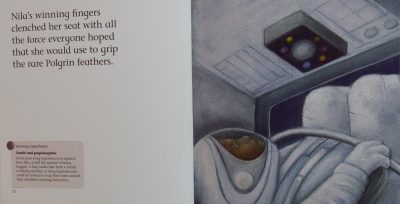
destination the distant planet Arghan, in the hope of finding rare Polgrin feathers.

Both her story telling and the suggestions for the sensory elements are a reflection of the author’s creativity while her inclusion of technical terminology demonstrates her academic knowledge of her subject.

Some of the experiences suggested in this story need no extra resources. These include a hug, a lunge, a breathing techinque; and rolling back and raising the feet in the air (you might with their permission, tip backwards the chair of a wheelchair user) to simulate the rocket launching. Other elements need a little preparation but nothing more exacting than the adornment of a shoe-box to create an entire Arghanian world.

Beautiful textured pastel illustrations by Helen Lanzrein provide the visual element of the story and there’s a final ‘voyage log’ offering ideas for discussion.

Parents and educators alike will welcome this book, as they will Ernest and I, created particularly for ‘supporting children to identify with their attachments’.

Its rhyming narrative, essentially a soothing reflective story of childhood memories of a boy and his much loved soft toy penguin, is also beautifully illustrated by Helen Lanzrein.

With more multi-sensory storybooks to follow I as an educator, look forward to seeing them.

Sensory Stories

sensory rtories 001 (600x800)

Sensory Stories
Joanna Grace
Jessica Kingsley Publishers
That the author, Joanna Grace is passionate about sensory stories and their life enhancing power comes through loud and clear in her book aimed at those who work with children, young people  and adults who have special educational needs. Subtitled a practical guide, it is exactly that and more.
Beginning with a brief, straightforward explanation of what sensory stories actually are, she goes on to provide a five part book, the contents of which, I suggest, could become the heart of a curriculum for those with a wide range of special needs including individuals with profound and multiple learning difficulties (PMLD), those with SPD (sensory processing disorder) those who have autism spectrum disorder (ASD), communication difficulties, memory difficulties and individuals with mental health challenges and the physically challenged.
The first section gives an overview of the two key elements in the enterprise – the importance of sensory stimulation, which is central to cognitive development and the power of narrative and the storytelling space it can create for those who share a story.
The second section gives a straightforward account of how to share a sensory story and embraces practicalities and the importance of being consistent when sharing a particular story.
As well as using sensory stories with individuals, they can also be shared in a group context and the third section centres on using one context rich story with a range of learners with differing abilities. Herein Joanna looks at ways to do this effectively.
Assessment and most importantly, its use to celebrate achievement is the focus of part four –some whys and some how tos, the latter offered as suggestions, starting with questions based on the P(erformance) level descriptors.
The last part of the book presents five sensory stories and associated cross-curricular activities created with the classroom in mind; but they can equally be used at home or in other settings. The range of stories is wide: there is a traditional tale, The Selkie Wife, a cooking story Seasoned with Spice, Two People Made Me a story told in the first person from conception to birth, a science fiction adventure, To the Centre of the Earth! and finally, a wonderful reworking of the Sleeping Beauty tale entitled The Forest of Thorns which has a splendidly realistic ending: ‘He wasn’t sure he could give the sleeping princess happily ever after, but he could start by giving her a rose.’
Of course, the telling of sensory stories is not for the faint hearted; it needs a certain amount of imagination and creativity on the part of the teller; a teller who is, ideally, convinced about the power and centrality of story in human experience. With those elements in place, (if they aren’t already, this book must surely go a long way in fostering their development), and this excellent ‘resource-guide’ to hand, what further is needed? Only the story stimuli of course – the ‘props’ that evoke the essence of the story – but as readers are told, these are not difficult to obtain. Practitioners/carers and parents aware of the particular needs of their group/individuals would be able to choose other stories appropriate to those needs and the sensory stimuli to go with them.
Just do it!

Buy from the publisher: http://jkp.com/
Use your local bookshop:localbookshops_NameImage-2