A Dinosaur A Day

A Dinosaur A Day
Miranda Smith, illustrated by Jenny Wren, Juan Calle, Xuan Le, Max Rambaldi and Olga Baumert
Red Shed

Imagine being able to encounter a different dinosaur, or other prehistoric animal, every day for a whole year. That’s what you can do if you plunge into this prehistoric extravaganza. Herein, after a general introductory spread, you will meet all your favourites such as the fearsome Tyrannosaurus, the club-tailed Ankylosaurus and the plant-eating Triceratops and Diplodocus. You’ll also encounter a great many unfamiliar creatures, some of which have only recently been discovered: I have to admit the majority were new names to me.

One such is Aquilops, one of the beaked dinosaurs. It was a herbivore about the size of a cat with a skull smaller than the hand of a human. Another small herbivore was the Nqwebasaurus (found in what is now Southern Africa) Amazingly so we read, ‘fossils have been found with gastroliths in the stomach – stones it swallowed to help grind up tough plant food,’

As well as dividing the contents by months, the author also uses dinosaur groups – examples are: ‘some of the smallest’, ‘duck-billed dinosaurs’, ‘horn-faced dinosaurs’ and ‘largest of them all’. Surprising to me was that all those included here were herbivorous. One such Antarctosaurus never chewed its food, rather it swallowed plants whole.

Key facts for each dinosaur featured include the period it lived, the family it belonged to, diet, length, weight anywhere remains have been found; and there is also a brief paragraph giving key information ; and helpfully, the backmatter includes a pronunciation guide.

If you have a dinosaur fanatic or a budding palaeontologist in your family then you should definitely get a copy of this book. It’s also one to add to school collections: I envisage it being in much demand especially with KS2 readers.

In Focus: Forests

In Focus: Forests
Libby Walden et al
360 Degrees (Little Tiger Group)

Ten exciting illustrators showcase some of the world’s most famous forests in this smashing book that’s been put together under the stewardship of Libby Walden.

Herein is a wealth of information about the natural flora and fauna of these stunning green places as well as associated facts on such things as, in the first and hugely biodiverse location – The Black Forest – things to do, the Brothers Grimm and more. Grace Easton is the illustrator of this place.

Gate fold flaps are employed by each artist, the second being Julie Colombet who explores The Anatomy of Trees;

Suzanne Washington takes us to the Rainforests; with the artistic work of Sol Linereo we visit National Parks.

Stephanie Fizer Coleman dives deep to the Kelp Forests to show us the sea otter and many more amazing inhabitants.

Forest Mythology is the next focus, illustrated by Irene Montano;

the Amazon Rainforest wherein we ‘meet two famous British naturalists, is illustrated by Marc Pattenden;

Alfred Wallace & Henry Bates

Alessandra Santelli portrays peoples of the Forest; Aaron Cushley, Mangrove Forests and the final topic is Produce and Preservation (including the tree hugging, Chipko movement) illustrated by Jenny Wren.

Each spread is totally absorbing and the entire chunky volume is sure to draw you in to what are probably my favourite places – forests – and hold you there for a considerable time.

The River / Wilderness: Nature’s Wonders

%0A

The River
Hanako Clulow and Patricia Hegarty
Caterpillar Books
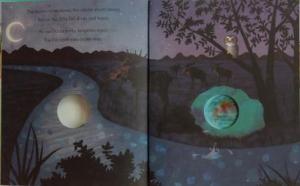
‘In snow-capped mountains among the firs/ The north wind blows; something stirs./ Through icy water, a small fish darts -/ This is where her journey starts …
We join that shimmering, glimmering fish as she journeys down river starting from the snow-capped mountain peaks, swishing past dense mountain woods …

%0A

and pine forests, through ever-changing landscapes as she travels by day and night …

DSCN8410

and through the seasons, on her epic swim to the vast, deep open sea ‘where she’s meant to be!’ – a sea populated by a shoal of sparkly fish.

DSCN8390

Readers delight in joining the fish on her journey, making her swim faster or slower by tilting and angling the book, viewing her as an ever-in-motion hologram (set inside the back cover) through a die-cut hole that keeps her, mid-stream, on every spread. Read it first to play with the fish and then turn back and re-read the whole, savouring Patricia Hegarty’s lyrical rhyming text and being spell-bound by the wonderful wildlife scenes rendered in soft, matte textured, illustrations. The richly detailed, painterly style shows feathers and fur as if close up …
%0A

as well as the gorgeous hues of the surrounding flora of the landscapes.
What a superb testament to one particular river, and to the rich abundance of flora and fauna through which it flows and of course, to one little fish on its migratory journey. SO much to see, SO much to think about, SO much to relish.

DSCN8411

Wilderness
Hannah Pang and Jenny Wren
360 Degrees (a Little Tiger imprint)
Subtitled ‘An Interactive Atlas of Animals’ this has visual appeal in bucket loads and it’s highly informative too. It introduces readers to a variety of habitats in both Eastern and Western Hemispheres and then focuses on different habitats in turn allocating a double spread to each one. We embark on a tropical rainforest ramble (visiting various locations as not all the animals featured are found in the same part of the world),

DSCN8383

a safari in the hot grassy savannahs of Africa, join an ocean dive and search, visit a freshwater location, the desert dunes, polar regions and high mountain pastures and forests, complete with pop-up mountain …

DSCN8381

Snippets of information abound on every location spread and there are flaps to lift enabling readers to discover more about the various animals resting upon them; there are even mini booklets on Bugs, Creatures of the Deep, the Honeybee and the salmon life-cycle.

DSCN8384

There’s a tiny life-cycle book on the left …

So, we have some desert dunes populated by Arabian camels, Addax (rare creatures also called Screwhorn antelopes), a vulture, a Namib Dune Gecko, a rattlesnake that leaves tell-tale tracks in the sand, hairy, scary giant scorpions and tarantulas; and there’s a side wheel which when turned shows the enormous range of temperatures of the habitat. (sub zero at night and 45 degrees C at mid-day).

%0A

Rotating wheel top left …

Chock-full of details, rich in the colours of mother nature’s palette, and sturdily designed and built to withstand frequent handling, this is one to engender a sense of awe and wonder about the natural world, and highly recommended for the family bookshelf and a must-buy for early years and primary school classroom.

WNDB_Button localbookshops_NameImage-2