Naeli and the Secret Song

Naeli’s passion and her greatest talent is playing her treasured violin given to her by her father. An English doctor, he returned from India to his homeland years back when his own father was seriously ill, since when nobody has heard from him. So when her mother dies from malaria, Naeli is left completely alone, except for her ayah, Vanya, and spends her time playing her violin and learning the sitar.. After a year, she still misses her mother every day,.

Then one day her ayah brings her an unsigned letter with the name Naeli Harwood on the envelope. Inside the envelope is some money, a ticket to travel to London and instructions to bring her violin. Has her father made contact at last? Determined to find out she knows she must undertake the three month long journey from Calcutta port. As she boards the ship, she encounters a boy who introduces himself as Jack; he’s on his way to his hated boarding school and soon becomes Naeli’s friend.

On arrival Naeli is hoping to get a carriage with Jack but she’s met by a man saying he’s been instructed to take her to a lodging house and she’s put to work in a pie shop. Eight days later Naeli is sent to her Uncle Daniel’s home and on his return he tells her that her father went missing some time back and is presumed dead. This uncle, she discovers, was the person who sent her the ticket and he’s extremely interested in her violin and even more interested in hearing her play it. over and over and over. until she can’t play any more. Naeli is very frightened by his behaviour; she flees her uncle’s home and goes to Westminster School to seek out Jack.

She persuades him to go with her to her ancestral home in Northumberland. What they discover there is almost unbelievably shocking but they’re determined to try and get sufficient evidence to prevent a terrible miscarriage of justice from prevailing. The problem is that it’s exceedingly dangerous especially when Uncle Daniel appears on the scene – a real-life adventure – as Jack says in the penultimate chapter of this utterly compelling historical novel.

With its themes of identity and grief, it will surely appeal to older readers with an interest in history, adventure or music; and with lots of personal connections with India, I absolutely loved it and read it in a single sitting.
Anya’s Quest

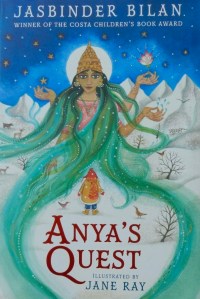
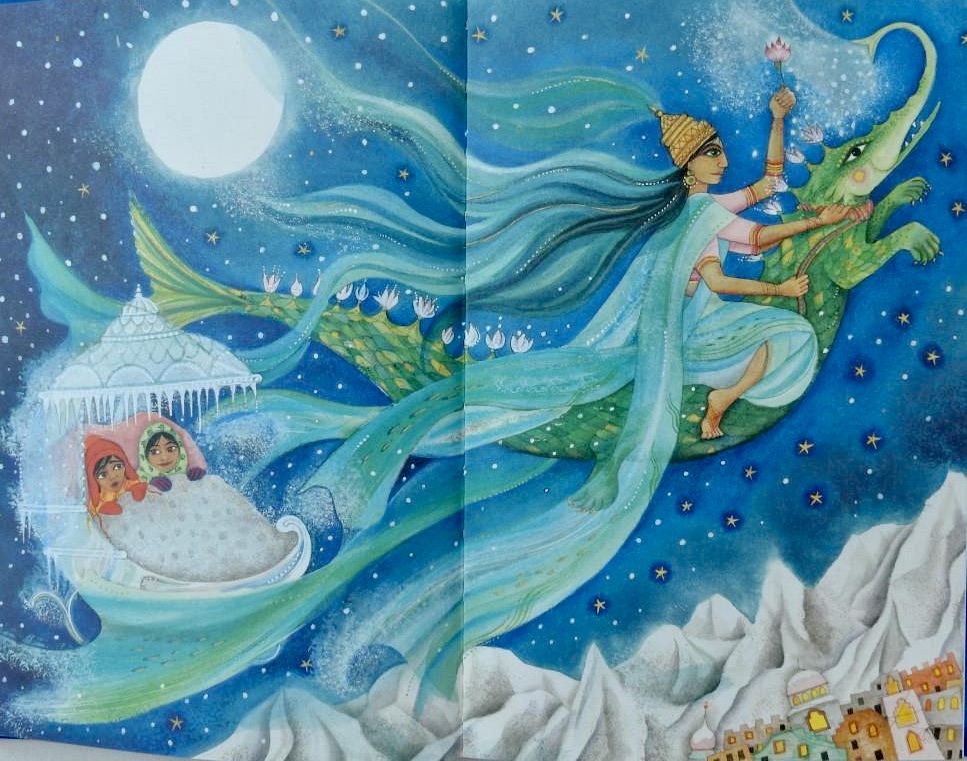
Little does Anya know when she complains to her papa of boredom that she is soon to embark on a vital quest. With her goes Mahi, the cook’s daughter with whom Anya reluctantly accepts as someone to play with in the snow. Anya is called by the goddess, Ganga and the two girls step into a chariot drawn by Ganga’s river dragon spirit companion and they undertake an epic journey through time and right across India.

As they fly Ganga explains that she urgently needs their help to heal the terrible damage that greedy, thoughtless humans have done to the fragile planet over time. They search for elusive spirit animals, lullabies long forgotten and while so doing Anya realises that she’s treated Mahi badly and apologises asking that the two become friends. Friends who can communicate effectively with the children of the world about the horrendous, pollution and its effects and save everything before it’s too late. The girls have to be brave, confront their fears and Anya has to dig deep within herself and connect with her ancestors as her friend has always done. She also needs to find a sacred star-shaped flower from her dreams, said to have healing powers, and use it to help a wounded bear cub.: could the bear be Anya’s spirit animal?

Once Ganga knows both girls are ready, she tells them that they ‘need to join the songs of all the children and sing the earth lullaby’, and thereby gradually heal the planet just like Anya helped the bear cub to heal. She also enlists the help of the other gods to support the earth healing cause and so more and more appear to join in ‘the celebration of sharing the lullabies and the message of hope.’ Finally with a promise to Ganga to do their utmost, the girls return home to the palace where anxious parents await and Anya and Mahi regale them with an account of their adventure and how they intend to make changes in their own lives.

Jasbinder Bilan’s thoroughly enchanting tale inspired by Hindu mythology, and equally enchantingly illustrated by Jane Ray, combine to make a truly gorgeous book. It’s one that will make a superb gift for a special occasion be that Diwali, a birthday, Raksha Bandhan or even Christmas.

India Incredible India

India Incredible India
Jasbinder Bilan, illustrated by Nina Chakrabarti
Walker Books

As a frequent visitor to India I know that to be there is an onslaught on the senses. You almost experience that when you read Jasbinder Bilan and Nina Chakrabarti’s book and as the author implies in her ‘welcome’ introduction, to visit any of the states is like visiting a different country. I totally agree when she says this vast country has a ‘huge welcoming heart’. Indeed it has many, for I have formed some very close friendships over the years with people in various states from Rajasthan to Kerala.

The book is narrated by Thara whose nanijee has a very special old trunk full of precious objects collected over the years as mementos of her travels all over the country. Every Friday night the two sit together and nanijee takes out one object and tells her granddaughter all about it – the state of its origin, what makes it unique and why it’s so special to her.

The first item is a book entitled Ganga and we learn the story of the goddess Ganga and the origin of the holy river Ganges that starts its journey in the Himalayas in the state of Uttarakhand. I was excited to see that second object was an envelope with a stamp showing sculptures from a place I once visited – Chandigarh’s sculpture garden – where everything is made from recycled waste.

As the journey continues, readers will discover something of the history of Delhi, where ancient and modern sit side by side; see some of India’s amazing and diverse wildlife, be astonished by the beauty of some of the architecture, notably the Taj Mahal, the Golden Temple in Amritsar – the holiest city for members of the Sikh religion and Udaipur’s Lake Palace. Rajasthan and in particular Udaipur is like my second home.

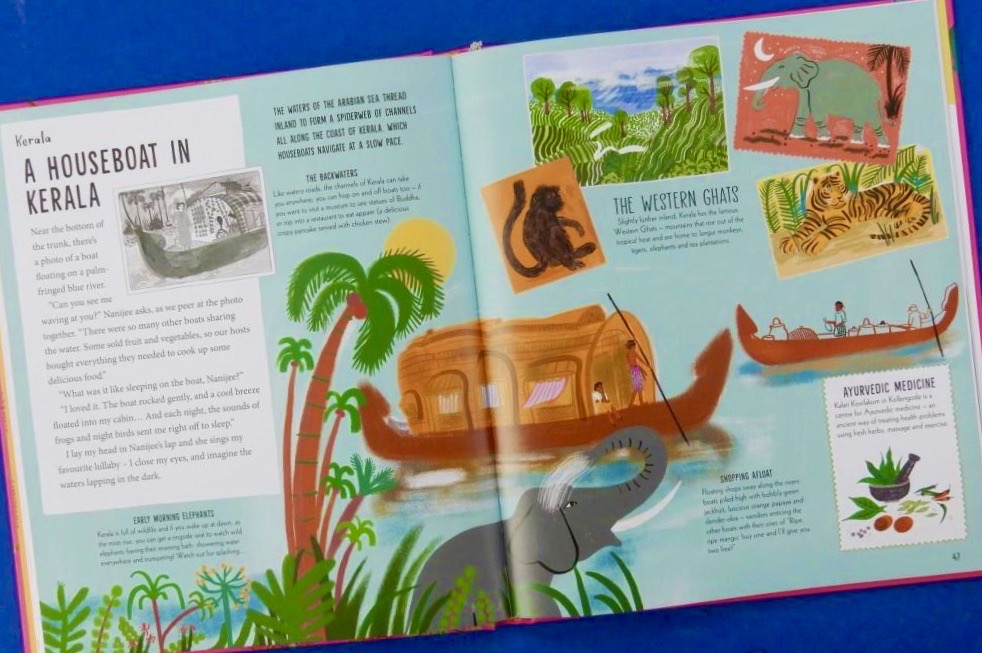
If you take a trip on a boat along Kerala’s backwaters, you may well encounter elephants taking their morning bath.

But no matter where you go, there will be markets, some selling good things to eat, others, richly patterned clothing, wonderfully crafted jewellery or perhaps dhokra (metal statues like those in Odisha and West Bengal.)

I could continue enthusing about the multitude of wonders India has to offer, and this book with its splendid illustrations, gives a real taste of those wonders, so I suggest you get a copy, read it and start planning your visit.