The Curse of the Tomb Robbers

The Curse of the Tomb Robbers
Andy Seed and James Weston Lewis
Nosy Crow

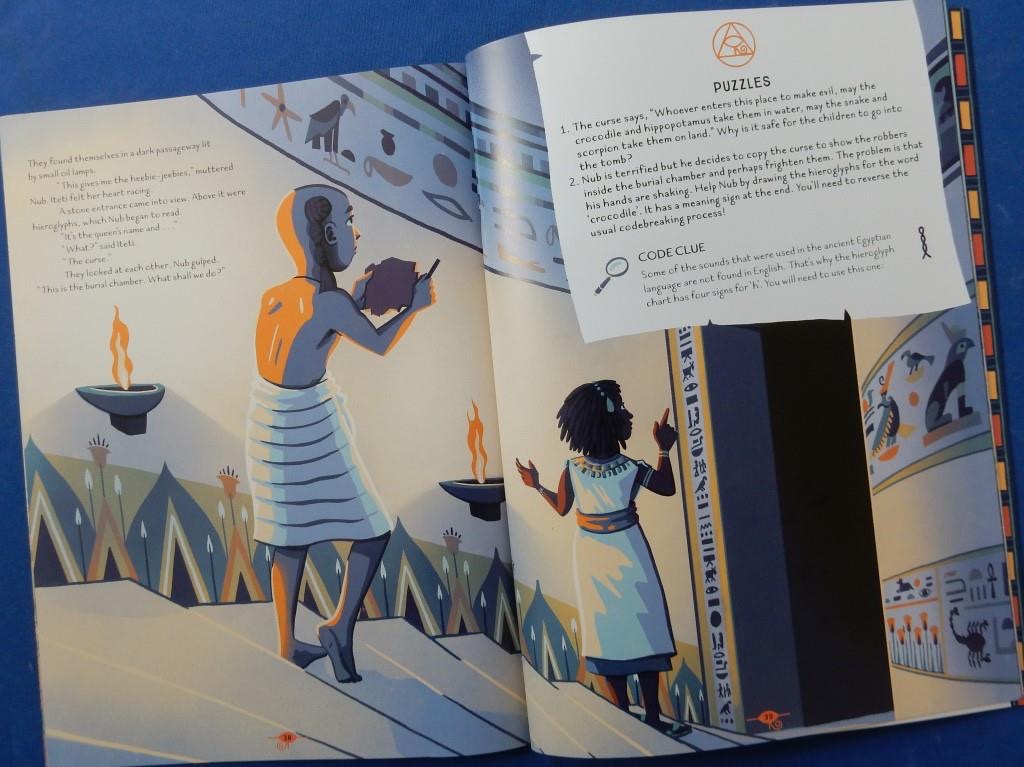
In this puzzling adventure set in ancient Egypt 1422 BCE readers are asked to assist apprentice scribe Nub and his friend Iteti to stop a gang of robbers intent of stealing items from the tomb of Queen Neith.
To do so the two friends need to discover the exact location of the burial place and halt the robbers before a terrible curse is unleashed. 

When they try to find Iteti’s father the vizier to let him know of the robbers, they are told he’s away, so leaving a message with a trusted servant telling him to go with soldiers to Queen Neith’s tomb. they decide to go ahead and follow the robber gang to the pyramids.

There’s a hieroglyph puzzle to solve on most spreads and lots of ‘Did You Know’ information bubbles as the story proceeds, as well as the possibility of whether or not there really was a curse to ponder upon. If you find yourself stuck over any of the puzzles all the solutions are at the back of the book as is a glossary, a codebreaking guide, hieroglyph charts and a list of 70 Egyptian words with their English translations.

Written in collaboration with The British Museum, readers will learn a lot as they participate in this adventure and James Weston Lewis’s stylish illustrations do an excellent job of capturing life in Ancient Egypt. KS2 readers, especially those with an interest in history will enjoy this and it’s a good one to add to primary school libraries too.

Human Journey / Prehistoric Pets

Human Journey
Professor Alice Roberts, illustrated by James Weston Lewis
Red Shed

Readers may recall the BBC documentary series researched and presented by biological anthropologist, Professor Alice Roberts about a decade back called The Incredible Human Journey and now at last we have this superbly presented illustrated book Human Journey for children.

In a dramatic telling, that includes sufficient but never an excess of detail, we’re taken on a journey way, way back to the beginning of time to trace our ancestors. Did you know that at the Dawn of Humankind, our early human ancestors lived on the grasslands of Africa some two and a half million years ago?

It’s those people whose migrations it’s possible to trace to other parts of the globe, and that’s what this fascinating, highly accessible book does. We follow the spread of humankind to Asia, then to Australia; then around 50,000 years ago to Europe where Homo sapiens encountered the Neanderthals.

Then come several spreads on the Ice Age after the peak of which, human hunters began to colonise the Americas – first North and then South.

There’s a map at the end tracing the entire human journeys; journeys where there were perils to face in the form of deserts, climate change, oceans, volcanoes, enormous creatures, floods

and even more. Incredibly however, the people adapted and invented, survived and thrived.

If you’ve ever pondered upon what it means to be part of the human race, this book is one to read. It’s one too where, with their wonderful details, the illustrations of James Weston Lewis merit close attention. There’s also a useful timeline and glossary.

For family bookshelves and school collections from KS2 on.

Prehistoric Pets
Dr Dean Lomax and Mike Love
Templar Books

If you’ve ever wondered what your moggy or your pooch’s ancestors long, long ago were like, then this book is for you. And even if you haven’t or perhaps don’t own a pet but are interested in the branch of science that is concerned with fossil animals and plants, called palaentology as is the author Dr Dean Lomax, then this book will fascinate you.

Herein Dr Lomax has selected seven animals, four of which are mammals: representing the rodents is Ernest the guinea pig, the Felidae is Flossy the cat; there’s Toby whose Canidae family first evolved some 40 million years back,

while horse, Pippa with her thick keratin hooves to help her run on both hard and soft ground, is the Equidae representative.

Each of these creatures, as well as budgerigar Lucky, Jasper the corn snake and Goldfish, Bubbles that belongs to a group of ray-finned fish that first appeared some 415 million years back – wow!

Every one has a double spread with a gatefold that opens to reveal, not only lots more fascinating paleontological information including a fossil file, but also an exciting, sometimes alarming pop-out creature, its prehistoric ancestor, which virtually springs to life before you.

Illustrator Mike Love provides the visuals and has done a terrific job in making every page alluring and exciting; indeed the design of the whole book is terrific.

The Great Fire of London

DSCN7530

The Great Fire of London
Emma Adams and James Weston Lewis
Wayland Books
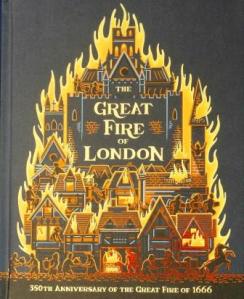
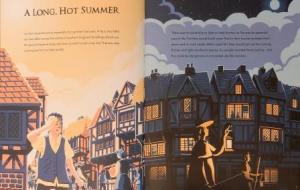
Spectacular illustrations by James Weston Lewis at every turn of the page and a topic that’s certain to become even more popular in schools later this year with the 350th anniversary of London’s Great Fire: a recipe for success if ever there was one. But this book also has a narrative that draws readers in right from the start and keeps them gripped throughout the account of the disaster from first sparks falling from that Pudding Lane bakery oven, to unstoppable, all-consuming nightmare that lasted for more than three days.
Emma Adams, sets the scene for the fire’s outbreak by detailing a filthy, busy 1666, end of summer, London city with its closely packed wood, straw and pitch houses, made even more dusty and dry by lack of rain; and relying on fire and candles for cooking and light – a disaster waiting to happen.

DSCN7531

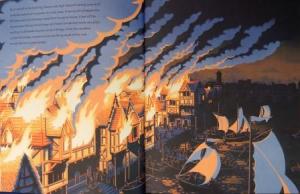
The account of the spreading fire itself …

DSCN7532

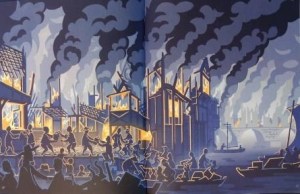
includes extracts from Pepys’ diary, details of the Mayor’s reluctance to demolish buildings, the destruction of the old St Paul’s Cathedral, as well as the eventual demolition organisation by the King that helped slow the fire’s progress.

%0A

Even then though, Londoners were a resilient lot: rich and poor alike set up huts and tents to the north of the city and over the next thirty years London city was rebuilt. New building laws were passed that meant safer housing and Christopher Wren designed the new St Paul’s Cathedral that was to take almost 40 years to complete.
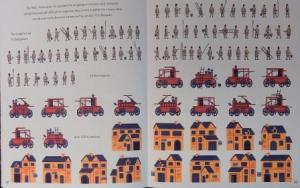
From the ashes too came new improved fire-fighting techniques and equipment and eventually, the London Fire Brigade; mentions of all this is integrated into the narrative and visuals add further detail …

DSCN7534

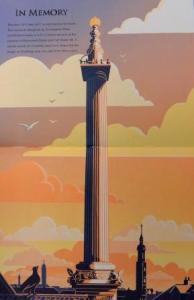
Standing tall in commemoration of London’s Great Fire we have The Monument, just 61.5 metres so we are told, from where the fire broke out.

DSCN7535

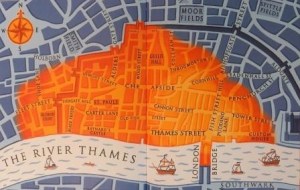
The three final spreads are given to People – the three significant figures being King Charles 11, the inadequate mayor, Sir Thomas Bludworth and Samuel Pepys; Places – St Paul’s Cathedral, London Bridge, the Old Bailey and Guildhall; and a map.

%0A

This really does bring home the extent of the fire and would make an excellent starting point for a visit to seek out evidence of its legacy.
All in all, this is an exciting resource book for primary schools and any child interested in this chapter of London’s history.

Use your local bookshop     localbookshops_NameImage-2

WNDB_Button