The Seaside Sleepover

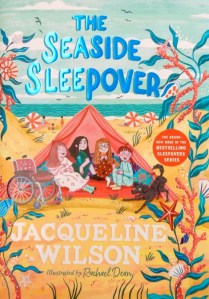
This latest addition to the Sleepover series takes place during the summer holidays. (For those who haven’t read the previous ones, Daisy’s elder sister Lily is a wheelchair user and uses Makaton to communicate.) Daisy wonders what she’ll find to do with her best friend, Emily having gone on a seaside holiday in a caravan.

Next door to Daisy’s family lives old Mr Norman and his dog, Scruff. She’s very fond of the dog but Mr Norman is standoffish and proud so resents interference from other people. However when he takes a tumble and has to go to hospital there’s really nobody else to take care of Scruff and reluctantly Mum agrees that the dog can stay with them. This makes the school holiday a rather more exciting prospect. Then Daisy starts wishing they could take Scruff to the seaside; she’s sure he’d enjoy that as much as she would.

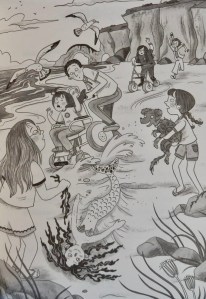
That evening Daisy’s Uncle Gary face-times them and is very excited: he’s putting on a family friendly comedy show at the seaside. He’s staying in a posh hotel that has additional holiday homes including one he thinks would suit them. At last Daisy’s parents agree and on the Saturday, they’re off, accompanied by Scruff and Lily’s friend, Natalie who uses a support for walking.

What an eventful time they have especially being in the front row for Uncle Gary’s performance when he cross-dresses and becomes Gloriette; but there are surprises, new friends

and some difficult situations to deal with too.

There are few authors who both understand children so well and portray them so credibly in stories as Jacqueline Wilson. Rachael Dean’s light-hearted illustrations further enliven the drama.

KS2 readers will devour this and I throughly recommend it for classroom collections and home bookshelves.

Star of the Show

I have a guest reviewer today: my relation Emmanuelle, an 11 year old, avid reader. Here’s what she had to say:

Jaqueline Wilson’s latest book is an amazing tale of family and hardship. Tess, from whose viewpoint the story is told, and her family live in Victorian England. Sadly their Ma has just died and their Pa has walked out on the children. The five siblings, Maggie, Connor, Tess, Tommy and baby Ada do their best to support one another, the older brother and sister doing all they can to earn some money. Tess though dreams of being a dancer. but she has to attend The Ragged School where she looks after little Ada.
One day she learns of a pantomime that is to be performed at The Grand Theatre and she determines to audition for a role dancing in Cinderella … Can she possibly fulfil her wish?

I really loved reading this story, especially the way in which you are introduced to the characters and gradually learn more about them all as the narrative unfolds. It’s great to see how, from such a bad situation at the start, things get progressively better for every one of them.
One thing I found surprising was that readers only truly understand the title in the second part of the book.

A wonderful story and one I would definitely recommend to anyone who enjoys stories set in bygone days or wants to pursue a dream.

The Girl Who Wasn’t There

When Dad drives Luna (nearly eleven), her younger sister Aurora (almost six) and their Mum to the foot of a hill and stops the car, everyone is amazed at the tower perched atop the hill. “It’s like Rapunzel’s tower!” comments Luna. But then Dad announces that it’s to be their new home, their shocked Mum thinks he’s joking. Not so. Having lost his restaurant, Dad has somewhat recklessly bought this crumbling/tumbledown building at a bargain price and to say it needs some work done on it before they can move in is putting it mildly.

With the room at the very top strictly out of bounds, it’s anything but the ‘happily ever after’ fairytale abode Aurora imagined. However Dad promises Luna that they can have a puppy. despite the fact that temporarily they are going to have to live in a caravan. The following weekend he takes the family out to lunch to meet an elderly couple, the Stanleys, who have a pup – Molly – but are finding it too lively. They agree that a new home with Luna and her family is the ideal solution.

As someone who frequently gets her own way, Aurora has never been to school before, though thanks to her big sister, she can read and write well. However at the end of the summer there’s no choice, go to school Aurora must. Unlike her sister who is quick to make friends, Aurora decides that she hates her classmates and prefers the company of Tansy, an imaginary friend. Luna meanwhile worries that Mum and Dad might split up with so little real progress being made on their new home even though Dad now has the help of two new friends. She’s also concerned about her status in the family – is she truly a part of it when Dad isn’t her birth father?

As time passes, Aurora’s make-believe life becomes problematic for all the family, particularly as she insists Tansy is real. Could she perhaps be a ghost? And is there a curse on the tower? If so, can Luna be the one to break it?


I was fortunate that on the day this arrived it was the only book delivered so I was able to indulge myself and read right through to the end. It’s a wonderful mix of magic, the power of the imagination, family life, human resilience and love.

One of my relations, Emmanuelle an avid reader in Y6 was keen to read the book and review it: here’s what she wrote:
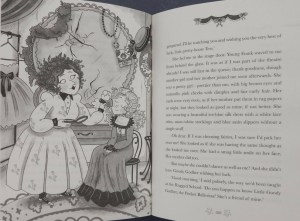
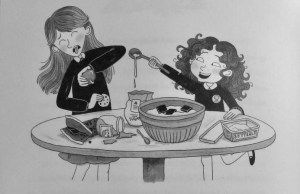
Jaqueline Wilson’s new book is a beautifully-written story complimented by delightful illustrations from Rachel Dean.
This book is perfect for anyone struggling with change or anyone finding it hard to be an elder sibling. They will be able to relate to Luna, the main character, who has to adapt to moving to live in an unfamiliar place and, on top of that, has a sister who she occasionally finds hard to deal with.

For fans of fairytales, there is an allusion to the story of Rapunzel because the main character is a girl with blonde hair who moves to live in a tower.
In my opinion, surprisingly, the title does not link to the main theme of the story. I think the theme of the story is Luna’s journey in adapting to a new house, a new school, a new life, whereas the title links to the fact that Luna’s little sister, Aurora, has an imaginary friend who actually used to live in the same tower that they own now.
Because of its cliffhanger ending, I think this book begs for a sequel. The final enigma leaves the reader hungry for more.

Mermaid Academy: Isla and Bubble / The Magic Faraway Tree: A New Adventure

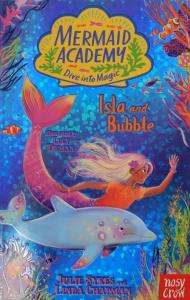
Mermaid Academy: Isla and Bubble
Julie Sykes and Linda Chapman, illustrated by Lucy Truman
Nosy Crow

Fans of the Unicorn Academy books will love this, the first of a magical new series set beneath the waves of Wild Sea. Just as the pupils of that establishment have captured the hearts of countless younger readers, I’m sure those of Mermaid Academy, led by headteacher, Dr Oceania, will do likewise, starting with Isla and the twins, Isobel and Cora who join the school on the same day.

Once the new pupils have been allocated their dorms, rather than lessons, they all participate in a treasure hunt intended to enable them to get to know one another, the dolphins and their new environment. Isla is a spirited character with a tendency to be headstrong, so when it comes to saving the woolly seahorses, even if that means breaking one of the Academy’s strict rules and venturing beyond its walls, she feels compelled to do so, however much danger that puts her team in.

Can she perhaps use her bubbliness to extricate them all from an emergency situation?

With adventure, friendship and discovering their magic and bonding with a special dolphin awaiting, (not to mention Lucy Truman’s black and white illustrations) who wouldn’t want to join Isla as she dives into this underwater world and helps protect its fauna and flora.

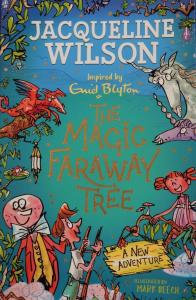
The Magic Faraway Tree: A New Adventure
Jacqueline Wilson, illustrated by Mark Beech
Hodder Children’s Books

The Faraway Tree is a series of popular children’s books by British author Enid Blyton. Blyton’s classic The Magic Faraway Tree, first published in 1939, was Jacqueline Wilson’s own favourite book as a very young child. Now the accomplished, popular contemporary children’s author, Wilson, has woven a new story that revisits this much-loved magical world in A New Adventure, that is just right for the next generation of young readers.

Those familiar with the original classic will remember some of their favourite characters, Moonface, Silky the fairy and The Saucepanman who loves to make up songs (and is now selling his wares on-line); but it’s the turn of a new family to experience what the magical tree has to offer.The family – dad, mum and three children are to spend their six week holiday staying at Rose Cottage and almost immediately, Birdy the youngest of the children meets a fairy outside her window. She invites the little girl to the Faraway Tree and so begins their adventure.

The next day Milo (10, the oldest), Mia about a year younger and Birdy (fourish), led by a talking rabbit, venture into the Enchanted Wood where among the whispering leaves stands the Faraway Tree: the tree that offers those who climb to the top, the opportunity to discover extraordinary places. Newly created by Jacqueline Wilson, the places the children experience are the Land of Unicorns – Mia absolutely loves this one,

the Land of Bouncy Castles, the Land of Princes and Princesses and finally, the Land of Dragons where a dangerous encounter awaits one of their number. This fourth story ends somewhat suddenly, I suspect to leave the way open for another Wilson sortie into the Enchanted Wood.

While keeping a strong sense of the original place, Jacqueline Wilson has challenged the stereotypical Blyton attitudes and language, one example being the way Mia is quick to admonish Mr Moonface: “Why on earth should it be Silky’s job to clean up after you … It’s terribly old-fashioned to expect a woman o keep a house tidy, … My mum and dad share all the chores and we have to help too.”

Also helping to give the book a modern feel that is just right for 21st century readers are Mark Burgess’ lively, often gently humorous illustrations.
Flights of Fancy

Flights of Fancy
Quentin Blake, Anne Fine, Michael Morpurgo, Jacqueline Wilson, Michael Rosen, Julia Donaldson, Anthony Browne, Malorie Blackman, Chris Riddell, Lauren Child
Walker Books

Now in paperback, here’s a truly special gem of an anthology subtitled ‘Let your imagination soar with top tips from ten Children’s Laureates’. It brings together the ten awesome authors and illustrators who have held the title (given in celebration of their outstanding achievements) and first awarded to Quentin Blake in 1999.

To open, Michael Morpurgo explains how the original idea of the role (each person holds it for two years), was first thought up by himself and Ted Hughes, the then Poet Laureate.

You might be especially interested in poetry, rhyme and wordplay, if so head first to the sections from Michael Rosen and Julia Donaldson. Michael in Poetry Belongs to Everyone talks about playing around with a word to create a poem. Julia Donaldson’s Plays to Read and to Write discusses one of her own plays that she based on the Aesop’s fable, The Hare and the Tortoise, offering a fun, lively 6-parter

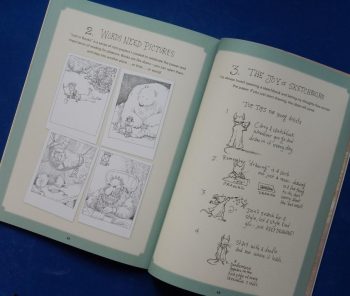
If you’d rather be playful in the visual sense then Anthony Browne’s The Shape Game could be your starting point: having talked about how to play it, he showcases some examples from 3 other famous illustrators to whom he gave the same shape to play as the one of his own shown in the book. The potential with this one is endless. Probably that is the case with most of the chapters however.

In The Only Way to Travel, Quentin Blake writes with reference to  Dahl’s stories, about how when illustrating someone else’s texts it’s important to ‘put yourself inside their story’ and capture the atmosphere before diving in and drawing those fabulous illustrations of his.

More about how other fabulous illustrators approach their drawing and what provides their inspiration comes from Chris Riddell –

make sure you check out his brilliant cartoons of all ten Children’s Laureates in the final section – and Lauren Child.

How fantastic and moving is Michael Morpurgo’s Find Your Own Voice that tells children how to do so in ‘I Believe in Unicorns’.
I thoroughly enjoyed too, Malorie Blackman’s Taking a Word for a Walk using SEA as her example,

before she moves on to discussing from whose viewpoint a story is being told when one writes.

If you want to inspire children to let their imaginations soar, then you really, really must have a copy of this cracker of a book in your home or classroom; not only will it do just that, but it will also ignite or add fuel to a passion for reading, writing and illustrating. (BookTrust, which manages the Children’s Laureate gets 50p from every sale.)