A Midsummer Night’s Drama

The whole story is presented in three acts and includes a performance of Shakespeare’s A Midsummer Night’s Dream unlike anything you’ve experienced before. It’s penned, so we’re led to believe by a clever bear, Bill, residing in a treehouse with his friends Sir Bun Bun, Foxy and Lady Bushytail. The friends love to act plays at their theatre, The Glade and these attract large audiences from all over the kingdom.

There’s great excitement as Bill and his pals are performing a brand new play. Its entire cast comprises a fairy queen, a fairy king, Puck the cheeky sprite and Bottom. Various insects perform the duties of stage manager, set designer, understudy, and one looks after lighting and another is responsible for props. Its opening night constitutes Act 1. It’s a wild success,
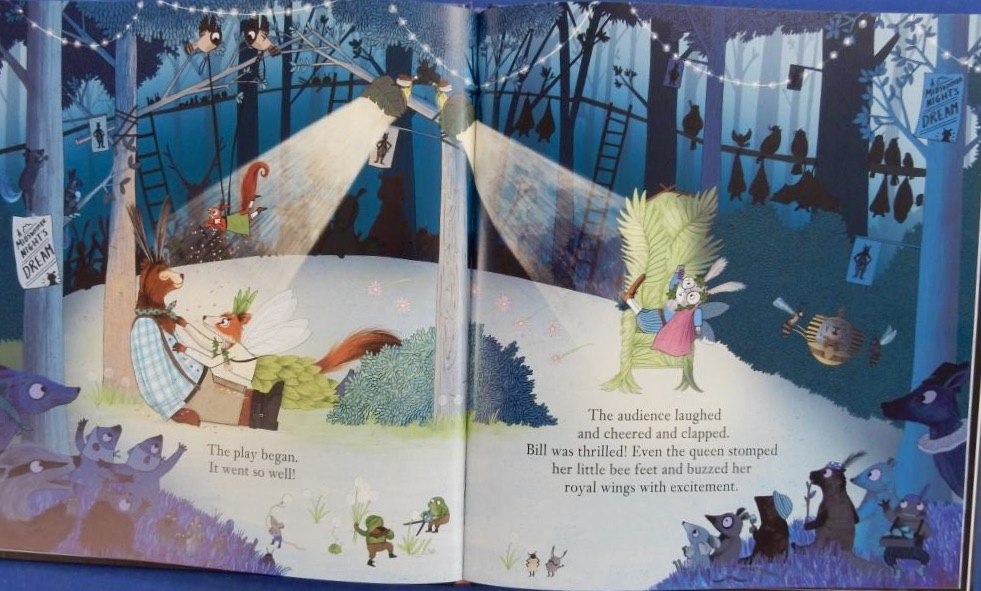
which leaves Bill thrilled but over-excited.

Act 11 shows he is just that, unable to sleep in his cosy bed, his brain all a-fizz with ideas. Up he leaps and against his friends’ advice, begins working on another play until that is, in buzzes Queen Bee who speaks thus, “I COMMAND you to zzzzzzzsleep!” and buzzes out again leaving the acting troupe to offer sleeping advice.

Act 111 opens with Bill trying out some of the ideas proffered, the first being to dance, but to no avail.

Perhaps Sir Bun Bun’s suggestion will induce that much-needed slumber …

With appropriately dramatic illustrations by Isobel Lundie and Louie Stowell’s clever word usage both hinting at the story’s Shakespearean origins and background, this is a pre bedtime treat. Equally it’s enormous fun to share with a class and you can enjoy investigating the book’s final spread that presents some information about the bard himself, William Shakespeare, and his work. Make sure you look closely at the front endpapers too. I wonder what Bill Bear et al would do with Twelfth Night, my favourite Shakespeare play.

Habitats

We visit six different locations in this journey around the world. The first stop is a tropical rainforest in Borneo where brief descriptions together with Isobel Lundie’s split page style illustrations introduce four or five animals and plant residents of every level from the canopy to the forest floor, each opposite to a scene in which animals are depicted.

From there we move on to in turn the Namibian desert in south-western Africa; a location off the eastern coast of Australia where we visit every layer of the ocean including the Great Barrier Reef home to thousands of different species including what is thought to be the only reef manta ray discovered in the world.

Germany’s Black Forest is the next to be explored; it’s home to badgers, red foxes, hedgehogs, peregrine falcons, adders, barn owls and pygmy owls as well as bark beetles that lay their eggs beneath the bark of spruce trees causing considerable damage to the trees.
Then it’s on to The Andes, a part of the world rich in bird species including the Andean condor, black-chested buzzard eagles and water birds such as Chilean flamingos and Darwin’s rheas, the males of which do the early caring of the chicks. There too lives the Patagonian dragon, an insect with antifreeze in its blood that allows it to live on the glacier ice.
The final stop is Florida’s natural springs where you might catch sight of a raccoon or a nine-banded armadillo.

With facts aplenty and vibrant collage style art, this engaging book will be enjoyed by young budding naturalists who will surely agree with Hannah Pang’s concluding statement ‘… animal habitats connect together into one amazing home. … Our Earth.’

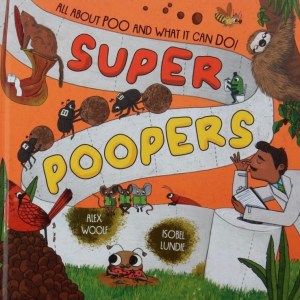
Super Poopers

Super Poopers
Alex Woolf and Isobel Lundie
Little Tiger

The topic of poo almost invariably raises interest in young readers and this book will surely do so with its humorous approach to those often whiffy bodily emanations. Before you turn your nose up though, consider this statement that concludes the author’s introduction: ‘In short, there seems to be no end to human and animal ingenuity when it comes to finding uses for poo’.
A fair bit of ingenuity is also presented between the covers of this collaboration between author Alex Woolf and illustrator Isobel Lundie.

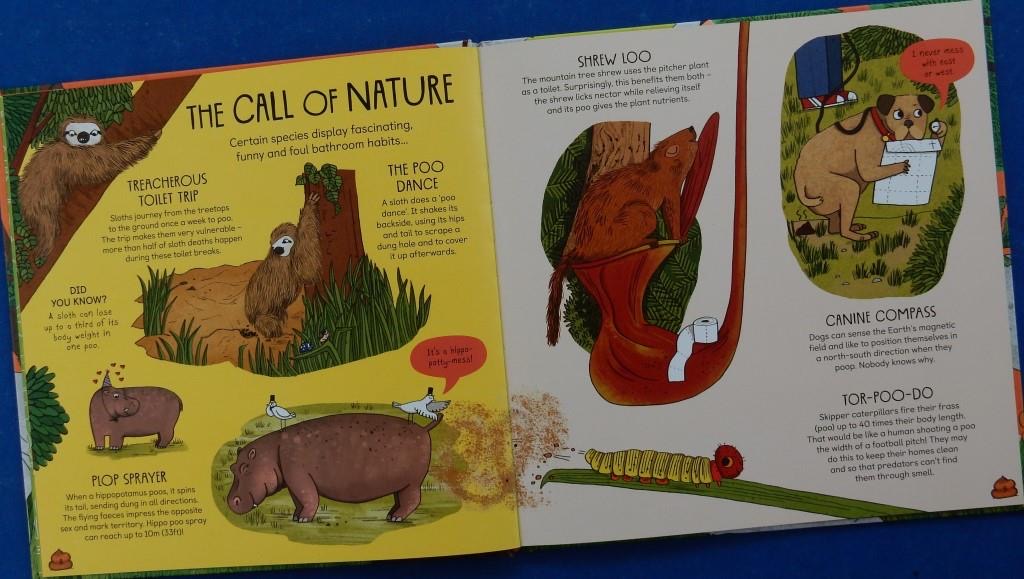
They start by presenting a handful or two of the weirdest facts about creatures and their poop. Did you know for instance that a hippopotamus whirls its tail while pooing. The result being flying faeces (sometimes reaching as high as 10 metres) that can be used to mark their territory and to show off to the opposite sex. 

Imagine being a pitcher plant in the vicinity of a mountain tree shrew; said animals use pitcher plants as toilets, which is of mutual benefit: the plant receives nutrients in the poo and the shrew licks the plant’s nectar.

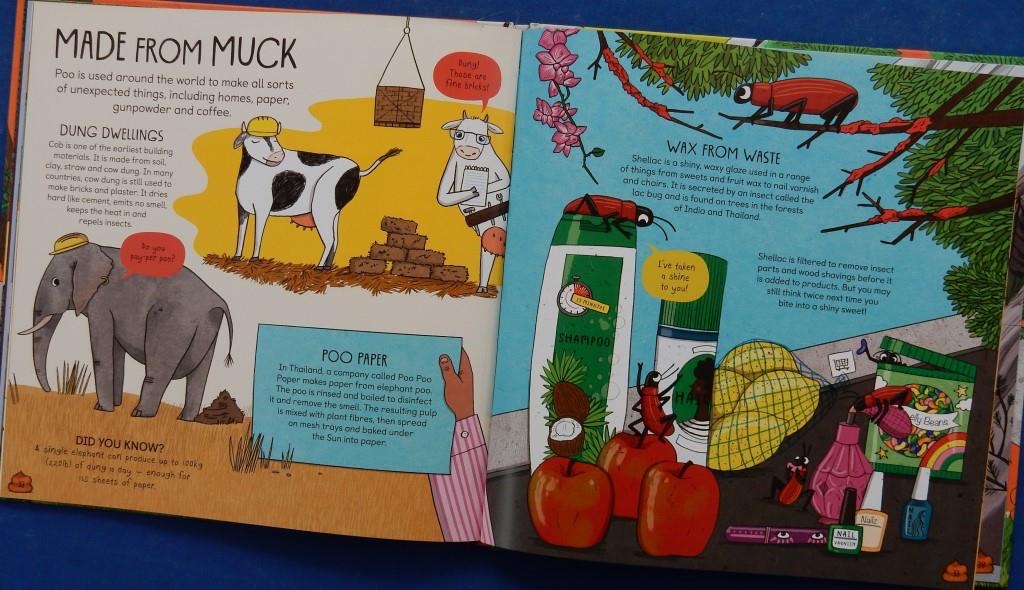
Child readers may well be aware that poo makes a fantastic fertiliser – there’s a spread on that topic herein – but how many are aware of some of the things it can be used to make. For instance there’s a company in Thailand aptly named Poo Poo Paper that uses elephant poo to make paper. Of course, the pong is removed during a process of boiling that also disinfects the pulp before it’s mixed with plant fibres, spread on mesh trays and left to bake in the sun. The result is paper. Apparently one elephant’s daily dung dump is sufficient for over 100 sheets of paper. 

There’s also a luxury coffee that uses beans collected from the poo of Asian palm civets and it’s said to cost way, way more than your usual cup of coffee. I don’t think I’ll be trying that though.

Covering twelve topics in all, Alex Woolf’s playful, punning text is both fascinating – yes really – and full of amazing information and includes such topics as diverse as ancient fossilised faeces and what it can teach us, and ways poo can or might be utilised to produce power for heating, lighting and even vehicle fuel. In keeping with the tone of the verbal content, Isobel Lundie’s bright, detailed visuals are appropriately amusing and the resulting combination is sure to produce giggles aplenty in readers.