The Mouse Who Carried A House On His Back

The Mouse Who Carried A House On His Back
Jonathan Stutzman and Isabelle Arsenault
Walker Books

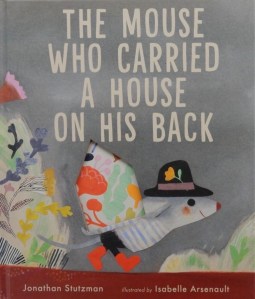
Vincent is a mouse ‘with boots on his feet, a hat on his head, and a house in his back.’ He also has an enormous heart and a special skill of knowing just where to stop and put down his house. Said house is no ordinary house however: it expands to accommodate whomsoever needs shelter. On this occasion he puts it down upon a hill and almost immediately along comes a weary bullfrog. Straightway Vincent offers him a roof over his head and in goes the frog, surprised that he can fit within. It’s not long before the house has expanded to welcome in also a hungry cat, a family of wet hedgehogs, a fox, badgers and a herd of deer and Vincent serves them all with dinner.

Just as they’re all seated around the table an enormous bear knocks saying he’s lost. The other animals are terrified. insisting, “there is no room for a bear.”

Vincent however thinks otherwise. “This is my house … all animals are welcome, “ he insists. And so it is on that night all the animals sleep safely and comfortably, ‘full of honeycomb and warm milk under a sky that stretched for miles.”

Jonathan Stutzman adopts a formal tone for his telling using repetition to good effect in this fable-like story of unconditional acceptance and inclusion. Isabelle Arsenault’s playful gouache, ink and cut-paper illustrations bring these themes to life: on the opening spread, she shows Vincent’s house as a simple cut-out pentagon and each time a new visitor appears at Vincent’s doorstep, a new house in a different style appears on the hillside adjacent to the pentagon, gradually creating a conglomeration of homes; then a gatefold spread captures the final proliferation.

A timely message of open hearts making for open doors in these troubled times of ours.

Just Because

Just Because
Isabelle Arsenault and Mac Barnett
Walker Books

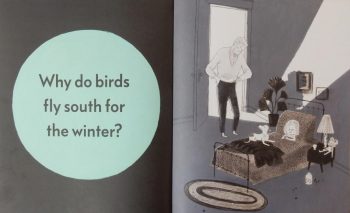
Would that every young child had a parent as ready and willing to answer the seemingly endless string of questions as the father of the small girl in this book even though her “Why is the ocean blue?” ; “What is rain?”; “Why do leaves change colour?”

and the other posers she puts forward as she lies tucked under her duvet in the dark, are clearly in part a tactic for delaying bedtime.

Quality time is what he provides and never once does he find himself trotting out the titular ‘Just because’.

Instead his responses are flights of fancy: the ocean’s blueness is because ‘the fish take out guitars. They sing sad songs and cry blue tears’; rain is “The tears of flying fish”; Leaves change colour because “the trees keep warm by setting quiet little fires in their leaves? By winter, their branches have all burned up.” (I love that!).

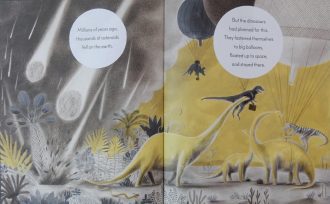
The answers get increasingly and wonderfully outlandish: The reason dinosaurs disappeared is that “Millions of years ago thousands of asteroids fell on the earth. / But the dinosaurs had planned for this. They fastened themselves to big balloons, floated up to space, and stayed there.”

The ever-patient father’s benedictory finale is surely, pitch perfect to send his little daughter off into her own dream world at last.

Mac Barnett’s story takes creative thinking to a new level that will likely inspire youngsters to think up their own playful answers to the questions his child protagonist poses.

A perfect complement to the telling, Isabelle Arsenault’s mixed media illustrations have a retro feel, while the imaginary worlds she conjures forth are intricately detailed and full of wonderful whimsical otherworldly touches.

Virginia Wolf

Virginia Wolf
Kyo Maclear and Isabelle Arsenault
Book Island
Author, Kyo Maclear (The Listzs) and Isabelle Arsenhault, illustrator (Cloth Lullaby) have together invented an episode from the youth of Virginia Wolf, narrated by her sister Vanessa when the former was overcome by depression: ‘She made wolf sounds and did strange things … ‘ Unsurprisingly, her actions affected the entire household –

‘She was a very bossy wolf. The whole house sank. Up became down. Bright became dim. Glad became gloom.’
Vanessa is a very understanding and supportive sister and does her upmost to cheer up her sibling. Eventually she responds to Virginia’s wish to fly to a perfect place … with “ABSOLUTELY NO DOLDRUMS”, a place called Bloomsberry, by creating, as Virginia sleeps …

a glorious ‘Bloomsberry’ garden.
This has the effect of lifting the gloom that has engulfed her sister– for the time being at least.

Strong emotions are part and parcel of childhood but comparatively few children go on to develop the dark melancholic, depressive feelings that would frequently engulf Virginia in her adult life. Not everyone, however hard they try will be able to help a depressed family member, but this is no detraction from what is undoubtedly a beautiful picture book.
Arsenault’s eloquent illustrations capture superbly the whole gamut of emotions of Maclear’s text: the graceful beauty of the pictures Vanessa creates would surely bring solace to almost anyone. The use of a hand-lettered text that sometimes almost explodes off the page, further adds to the impact of what is an immensely powerful and intensely personal tale of love and hope.
This is a book to share and discuss with older children (from around ten, and into early secondary school). I hope teachers have the insightfulness and perhaps courage to do so: its potential is rich.

I’ve signed the charter 

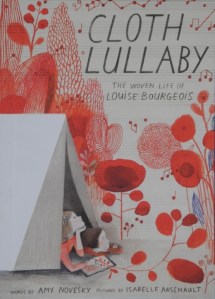
Cloth Lullaby

DSCN6633 (800x600)

Cloth Lullaby
Amy Novesky and Isabelle Arsenault
Abrams Books for Young Readers
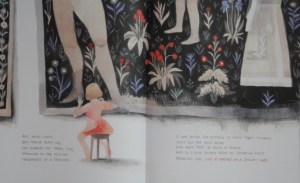
Subtitled ‘The Woven Life of Louise Bourgeois’, this poetic book give details of the life of the world famous artist, best known for her sculptures. Louise spent the early part of her life living beside a river in a big family house. Her family were tapestry restorers and when she was just twelve, Louise began to learn the trade.

DSCN6634 (800x600)

Her mother taught her about form, colour and the various styles of textiles. As she learned about the warp and the weft, about the tools of the trade and how to dye, the relationship between mother and daughter became increasingly intense, ‘ … patient, soothing … subtle, indispensible … and as useful as an araignée (spider) while that with her father (not a weaver but a buyer of cloth) was more dramatic. She once threw herself into a river, so angry was she at her father’s frequent departures on buying trips.
When Louise’s mother died, deeply affected she abandoned her mathematical studies at university and turned to art. ‘She drew, she painted, she wove, She missed her mother so much, she sculpted giant spiders made of bronze, steel and marble she named maman.’

DSCN6635 (800x600)

Then later she began focusing on fabrics – the fabric of her life -, sewing, stitching, weaving and sculpting smaller, more delicate spiders …

DSCN6636 (800x600)

and other objects in particular cloth books and a cloth lullaby.
Louise Bourgeois worked in bronze, steel, wood, stone and cast rubber and in textiles. Her life story here is rendered in ink, pastel, pencil, watercolour and photoshop by Isabelle Arsenhault whose wonderful mixed media collages, predominantly in shades of red and blue, feature spiders, web designs, water and textiles, music even. These powerfully evoke the rivers and threads that were a constant running through her life, and are a superb demonstration of how we all weave memories into our own lives in one way or another.
It’s difficult to know who would most enjoy this book, adults interested in the artist and her work, those generally interested in shape and form and creativity, or younger readers coming upon this poetic homage to Louise Bourgeois either as part of a topic or simply being attracted to it by the wonderful cover.

Use your local bookshop        localbookshops_NameImage-2

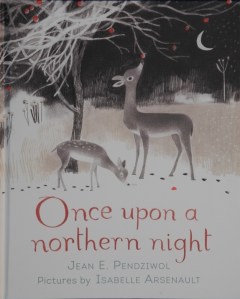
Once Upon a Northern Night

DSCN5592 (800x600)

Once Upon a Northern Night
Jean E. Pendziwol and Isabelle Arsenault
Walker Books
Once upon a northern night/ while you lay sleeping, / wrapped in a downy blanket. /I painted you a picture.’ (The opening line of this lyrical prose poem directed towards a sleeping child one dark, soon to be snowy, night is repeated at the beginning each subsequent verse.)
As more and more snowflakes fall, the earth is ‘wrapped in a downy blanket’, the night sky alive with ‘sparkling specks of white, /crowding/ and floating.

DSCN5598 (800x600)

Gradually the whole landscape is transformed as the writer word paints a picture taking readers for a walk beneath the trees, under one of which a mother deer and her fawn stand before moving on to taste (as on the cover) a frozen apple still clinging to the tree. I was reminded here of Robert Frost’s Two Look at Two
while the whole thing has a feeling of his ‘Stopping By Woods on a Snowy Evening’ about it.

DSCN5596 (800x600)

Who one wonders, is the speaker of this lullaby– a loving parent, nature itself perhaps? Some enchantress?
Wonderfully evocative and breathtakingly and starkly beautiful are the hushed scenes painted by Isabelle Arsenault using an effective limited colour palette predominantly black and white, grey and blue,

DSCN5595 (800x600)

but with yellow for the owl’s eyes and beak, touches of green foliage, those red apples and ‘auburn’ for the fox’s tail.

DSCN5600 (800x600)

I love everything about this book: the circularity of the whole thing, the almost ethereal nature of the illustrations with their shadowy effects, and the reverence of the words themselves – ‘pine trees held out prickly hands/ to catch the falling flakes.’
Truly it sends shudders down the spine, such is it’s magic, both verbal and visual.
If you want something to generate awe and wonder in listeners and readers this book will surely do so.

Use your local bookshop          localbookshops_NameImage-2