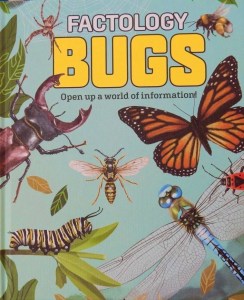
Factology: Bugs

Absolutely brimming over with minibeast-related information, photographs and diagrams: spend a few hours with this book and you’ll surely come away knowing a lot more about creepy crawlers, fliers, hoppers, wrigglers and jumpers than before. Did you know for instance that it’s thought that 90% of our planet’s life forms and the most diverse group are bugs? Or that bugs have existed on Earth for 470 million years and predate dinosaurs. Wow!

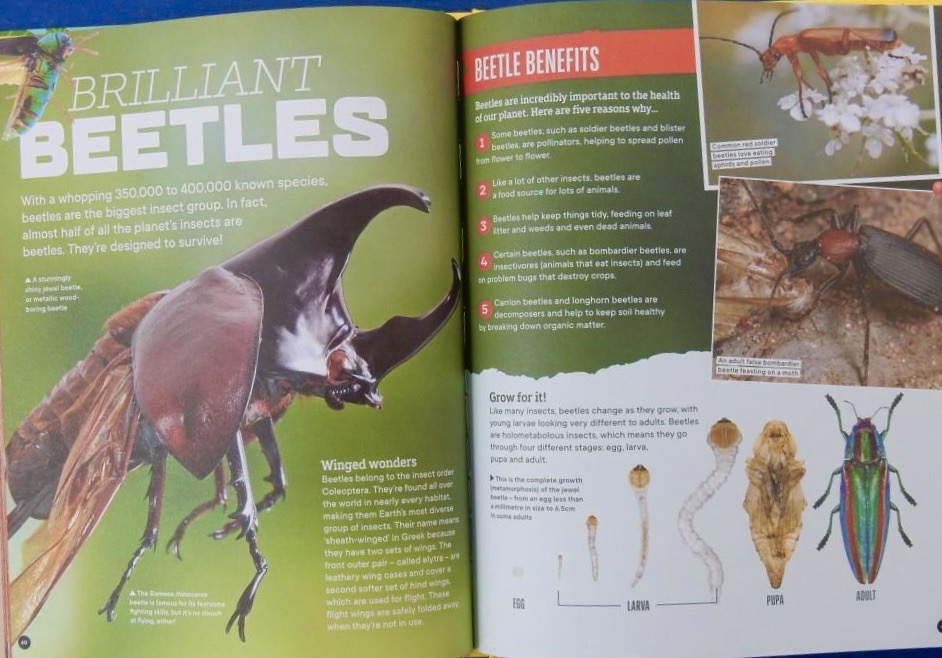
Insects with their chitinous exoskeletons and three-section bodies, form the largest group of arthropods. There are spreads presenting life cycles, habitats; you can dive into a bee hive as well as learn about how honey is made, meet all sorts of beetles and find out why some are so important to the health of the planet.
Not insects but included in this buggy extravaganza are spiders, comprising around half of the arachnid species. You might be surprised to learn that unlike we humans, spiders have blue blood; this is on account of the oxygen being transported around their bodies by haemocyanin, a copper-containing protein. 
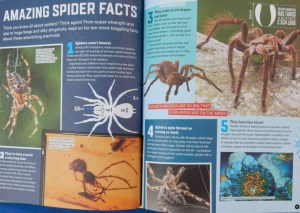
Watch out for tarantulas, several varieties of which are presented on one of the spreads in this book. So too are ten highly dangerous bugs that can cause serious damage to unwary or unfortunate humans.

In the chapter ‘Bugs and Us’ is a spread detailing how to build a bug hotel and another offering ways to create an insect-friendly garden and there’s a final quiz, should you want to test your acquired knowledge. Back-matter includes a glossary and index. 

Also available in this new series are Factology: The Human BodyFactology: Space and Factology: Ancient Egypt, each of which provides a pacy, highly illustrated introduction to the subject, 
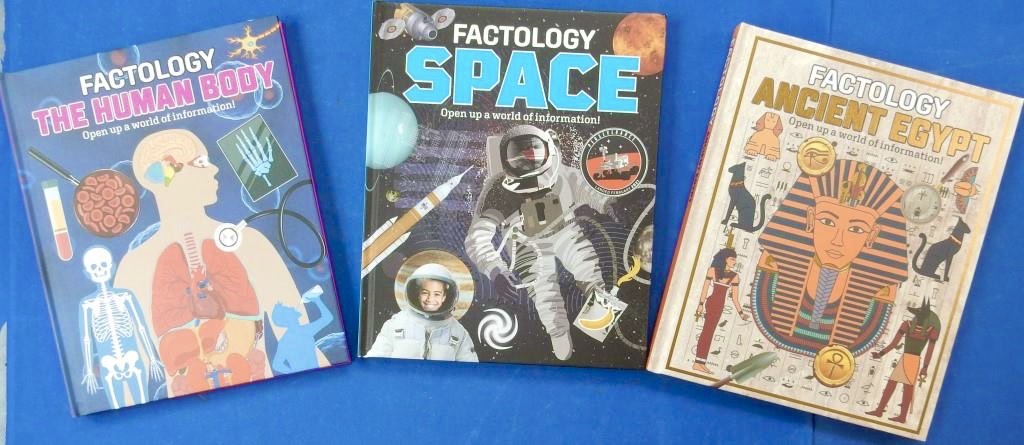
so if you know children with a budding interest in human biology, space science/astronomy or ancient history, these are a good place to start. They’re ideal for school libraries too.
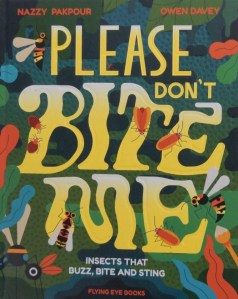
Please Don’t Bite Me!

Please Don’t Bite Me!
Nazzy Pakpour and Owen Davey
Flying Eye Books

With a partner who can’t walk more than twenty metres without stopping to examine the vegetation for insects in various stages of metamorphosis – complete or incomplete – Nazzy Parker explains the difference – I was I suppose, predisposed to be interested in the contents of this book. It introduces readers to six varieties of insect pests, mosquitoes, lice, wasps, cockroaches, fleas and bedbugs; the very names, excluding wasps, make me want to squirm.

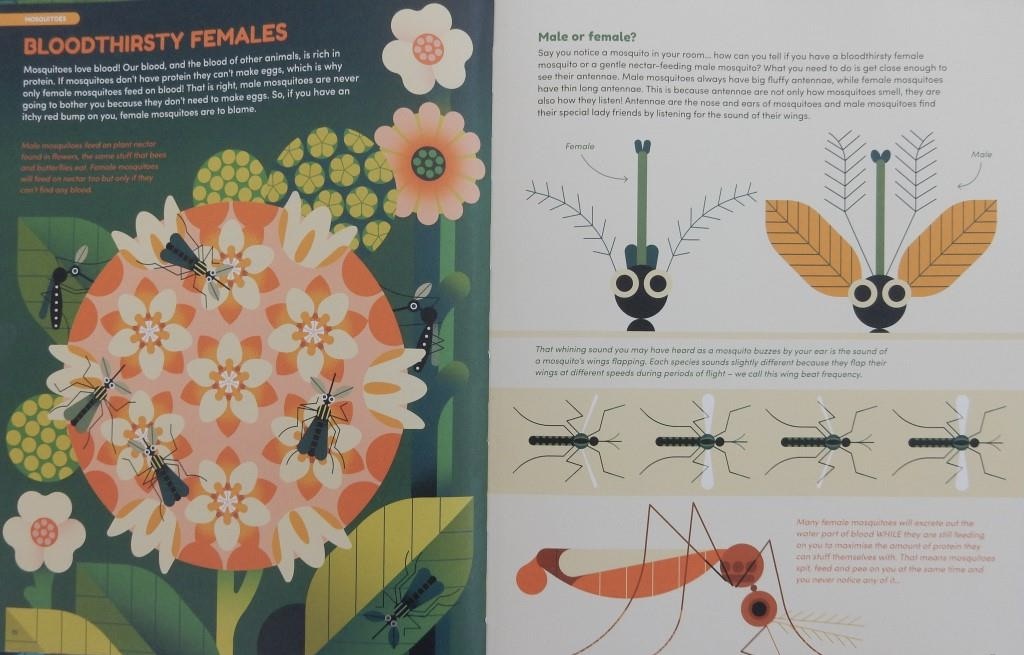
Pakpour starts by defining insects and the scientists who study them after which three or more spreads are devoted to each of the aforementioned pests. She describes their appearance including the difference between males and females, their impact on humans and how they find us, their habitat – I was intrigued to discover that mosquitoes are found everywhere except Antarctica and Iceland where it’s too cold for them to survive, and that it’s only the females that bite.

We also read about their habits and their development from egg to adult. Mosquitoes, wasps, and fleas undergo ‘complete’ ie four stage metamorphosis, whereas lice, cockroaches and bedbugs have a three stage, or incomplete metamorphosis.

Can you believe that there are more than 5,000 different kinds of lice, each kind being specific to the kind of animal it feeds on. Those that feed on humans spit saliva that can take as much as thirty days for us to develop an allergic response to. Weirdly though the very mention of a child in one of my classes having headlice has always made me start itching round my hairline straight away.

As for cockroaches, I will never forget the sight of an enormous one crawling across the pillow of our room in one of Jaipur’s five-star luxury palace hotels; it certainly didn’t get a five star review from me despite the fact that so we are reminded herein, the creatures don’t actually feed on human blood.

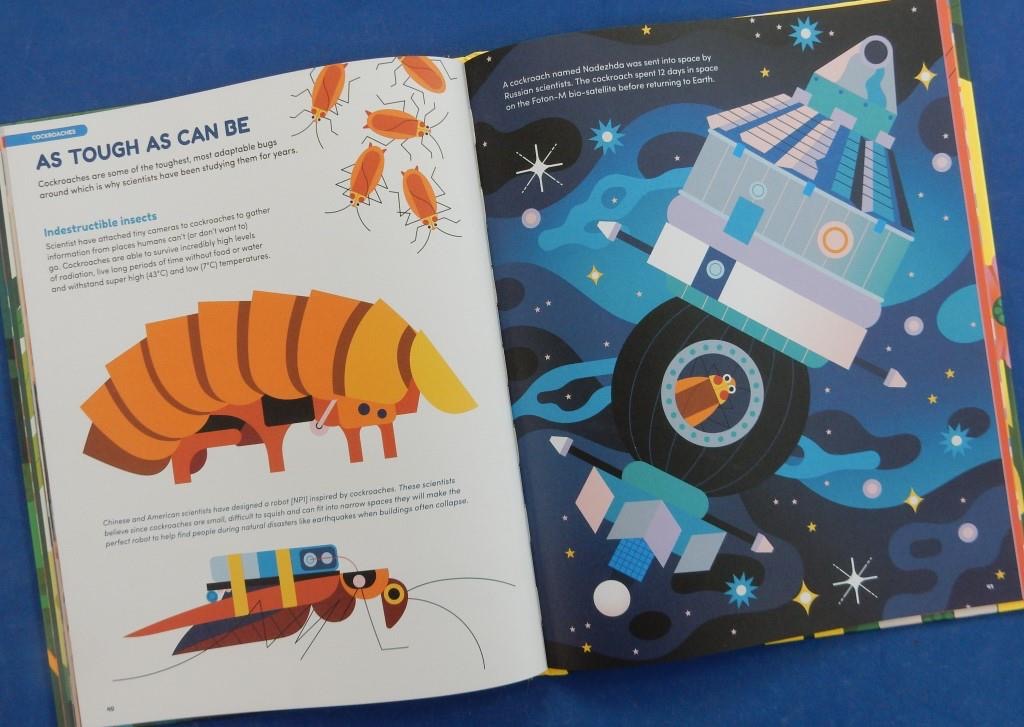
The author provides lots of fascinating snippets of information including that Chinese and American scientists have designed a robot inspired by cockroaches and that Russian scientists sent a cockroach into space for twelve days on a bio-satellite.

Probably though what is most important is the role of various insects in the world’s ecosystem; this is assigned the book’s final paragraph.

Owen Davey’s stylised, stylish illustrations work really well with biologist, Nazzy Pakpour’s text. Not the first book one would go to for general information about insects but a thoroughly engrossing one nonetheless.

Bonkers About Beetles

Bonkers About Beetles
Owen Davey
Flying Eye Books

After focussing on monkeys, sharks and cats, Owen Davey turns his attention to beetles, a particularly successful insect group.

I knew that that were a great many different beetle species, some very tiny, others around the size of a human hand, but I had no idea that already 400,000 different kinds have been found, nor that beetles account for a quarter of all the animal species in the world being found on every continent other that Antarctica. Awesome!

There are basically four different ways of life; there are predators, herbivores, omnivores and decomposers each of which Davey explains giving examples of each of these kinds.

Clearly beetles come in many different shapes and sizes, although as we see here, all have a similar basic design.

As always in this series, Owen Davey’s playful sense of humour comes across in his choice of titles for some of the spreads as well as paragraph headings; for instance ‘Love You and Leaf You’ heads up some information about leaf-rolling weevils that construct special rounded homes for their eggs, taking around two hours to do the job.
And, dung beetles shaping dung balls to enclose their eggs, (one per egg) is under the heading ‘Let the Good Times Roll’.

What tickled my quirky nature particularly was discovering there’s a beetle that practises yoga: the head-stander beetle lives in the southern African Namib desert where the lack of water means it’s often difficult to find a drink. In the early morning, head-stander beetles climb to the top of the dunes when there’s a fog laden with moisture. They put their heads down and lift their rear ends to the sky so water collects on their backs and runs down into their mouths:
amazingly clever creatures.

I was also especially taken with the ‘Weird and Wonderful’ spread showcasing the likes of the giraffe weevil, the violin beetle and the harlequin beetle.

I’ve loved all Davey’s brilliantly illustrated books in the series but this one has to be my favourite.
What next I wonder?

Friends for a Day

Friends for a Day
Neal Layton
Hodder Children’s Books

Oh, oh, this is achingly adorable, a real treasure of a book that is both poignant and joyful by the absolute master of sublime, scribbly artwork, Neal Layton who is a self confessed lover of bears. As I started to read it I thought hey, this is a bit familiar and then realised it is actually a reincarnation of Bartholomew and the Bug published almost fifteen years ago. Nevertheless, those children I shared it with back then are all grown up now and it’s exciting to think it’s once again available to a whole new generation of listeners.

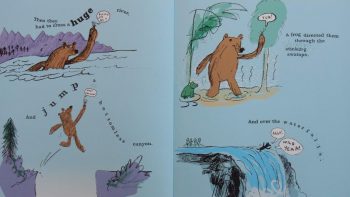
Bartholomew is a laid back bear who lives an undemanding existence atop a mountain although occasionally contemplating the world down in the valley with its twinkling lights: maybe one day, he thinks to himself.

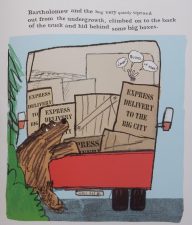
However that day comes a lot sooner than he’d anticipated: enter Bug. This tiny creature is in urgent need of Bartholomew’s assistance. Whatever the reason for the hurry, it’s pretty clear that Bug cannot go it alone and so the bear and bug set off together for the bright lights.

What a truly epic adventure this turns out to be (117 miles of travelling)

and all the while Bartholomew’s tiny pal seems to grow ever more eager to reach their destination.

The two finally arrive at the big city in record-breaking time and it truly is a surprising sight but where are all those lights?

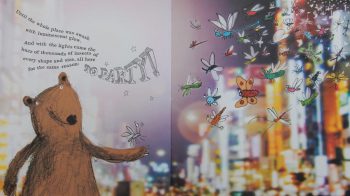
Before long Bartholomew discovers just what all the hurry was for as thousand upon thousand of wonderful bugs of all shapes and sizes wing their way into the neon lights that come on only when darkness falls.

An awesome time is had by all but then comes the moment –it’s full of poignancy – when Bartholomew realises that his job is done and it’s time to bid farewell to his tiny pal.

Yes, some days are never forgotten and some books likewise. This is one of those, and like all special stories, it leaves plenty of gaps for child audiences to fill.

Du Iz Tak?

%0a

Du Iz Tak?
Carson Ellis
Walker Books
Google translate often comes to the rescue when one is confronted with a piece of text in an unfamiliar language. I doubt it would be of help here though for the characters in this story speak ‘insect’. It’s delivered in dialogue – nonsense dialogue unless of course, you happen to be a damselfly or another insect.
Du iz tak?” one asks the other as a pair of damselflies gaze upon an unfurling shoot. “Ma nazoot.” comes the reply. Now, as this brief exchange is contextualised by the picture we can take a guess at its meaning ‘What is that?’ and ‘I don’t know.’ in the same way somebody learning English as an additional language might.
Time passes: The shoot continues to grow and to the left, the dangling caterpillar has become a pupa. More bugs discuss the ‘thing’ -a plant, but what kind? They need something:“Ru badda unk ribble.” We need a ladder – context again.
They call on Icky who lives, conveniently, close by …

dscn9205

A ladder is produced, a cricket serenades the moon …

%0a

and work on building a ‘furt’ starts. Then danger presents itself in the form of an ominous arachnid

dscn9208

that soon starts enveloping their enterprise in a large web, until that is, along comes a large bird putting paid to that. Happily the gladdenboot remains intact and eventually, fully unfurled delights both the whole insect community and readers.

%0a

That however is not quite the end of the story for the cycle of nature must take its course with further transformations – plant and animal – so the whole thing can start over … and over and …
By this time readers will most likely be fluent readers of ‘insectspeak’, but whether or not this is so matters not: the superbly whimsical story visuals carry you through with their own spectacular grammar.
I do wonder whether despite being from the US, Carson Ellis could be having a satirical dig at the nonsense words six year olds are asked to read in that ridiculous phonics test they’re faced with towards the end of Y1; the one that many who read for meaning come unstuck with; the one the government insists is assessing reading. It’s not. At best, it’s merely assessing one aspect – decoding. Rant over: this extraordinary book is a total delight.

Jill and the Homeless Bumblebee

FullSizeRender-5

Jill and the Homeless Bumblebee
David Greaves and Danielle Callaghan
Friends of the Earth
This tale tells of a once happy bumblebee, made homeless when her meadow home is ploughed up by a tractor one day.

%0A

With all the wild flowers gone, she is forced to find somewhere else to live, somewhere that wild flowers grow freely; and is aided by a small child (Jill in this instance) in her search.
After many hours and several abortive attempts – thanks to a hedge cutting machine,

%0A

crop spraying, harvesting and pollution …

%0A

the two finally come upon the ideal place for the bee to settle. A bee-friendly farmer has just the place …

%0A

Told in jaunty rhyme, (which does work when read aloud), and illustrated with bold, bright artwork, this timely ‘name’ book supports a very important cause. It’s one I’m more than pleased to support living on the fringes of Stroud, the town that claims to be Britain’s first bee-friendly town, and knowing that numbers of our precious bees are in decline at present, thanks to housing development (yes I know that’s crucial too), as well as intensive farming.
(I was sent this personalized copy by FOE; all proceeds from sales of the book go to the charity and its vital work.)
If you, or anyone you know wants to help, then first head to the Friends of the Earth Bee page: www.foe.co.uk/page/bee-cause
Better still perhaps, especially if you know a child – and that’s pretty much all of us – a personalised book about a Homeless Bumblebee, tailor made with choice of name, skin colour, hair colour etc. from http://www.homelessbee.starringstorys.co.uk especially a bee-auty like this one with a crucial conservation message at its heart, has got to be worth getting.

WNDB_Button