The Boy Who Cried Ghost

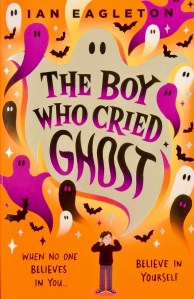
This story of Richard Barnes is a very personal one for author Ian Eagleton: Richard has OCD, with which Ian was diagnosed in his late teens.

Richard and his mother move into what was Grandma’s house just before the beginning of Year 6 and the likelihood that this is permanent, taking him away from his friends, troubles the boy greatly. Everything about his new room troubles him too: he lies awake on his first night thinking about starting at a new school and listening out for the strange sounds that seem to be coming from the old wardrobe in the corner. He resolves to keep it locked to prevent anything hiding inside from escaping. He checks it many more times before leaving for school, which makes him late but Richard believes it’s the only way to keep him and his mother safe.

One day his mum’s friend, Tony, who has been doing some painting in their house, collects Richard from school, accompanies him home and reveals that the boy’s mum has already told him about there being something in the wardrobe. Moreover, he’s also found its key and insists on unlocking the door. Richard is horrified at his thoughtless attempt to show the boy that his anxieties are unjustified: he fears that the ghost has now been released into the room with the result that he experiences a massive panic attack.
However when he tries explaining, both Tony and then his mother tell him that his anxieties about the released ghost are down to his over-active mind.

Scared and very angry he decides to enlist the support of his new school friends. They are willing and together settle on calling it ‘The Whisperer’. Meanwhile Mum reveals something about his Grandma and Richard wonders, could she be the Whisperer?

Richard’s friends come to a sleepover with the aim of banishing the spirit once and for all. They reveal lots about themselves during the night but they don’t see the ghost. Then things go disastrously wrong, Mei is hurt and Richard ends up falling out with them, albeit temporarily. Now he feels totally isolated and desperately in need of help. Can Richard finally admit he needs to find somebody to talk to about what is going on and the debilitating voices in his head? Only then might he be able to live comfortably with himself.

Written from the heart, with themes of acceptance, confronting fear, family, friendship and mental health, this powerful story needs to be read widely by older KS2 and KS3 readers as well as adults, many of whom have little or no understanding of OCD. It made me feel I should have been far more empathetic towards a teacher I once worked with who has OCD and frequently turned up late for school. There’s humour and laughter in this book too and in the author’s notes at the end of the book, he pays tribute to his dad who loved jokes, using humour to help him and others deal with their worries.

Millie’s Big Decision

Young Millie has long wanted a dog and as this story begins she’s visiting a dog shelter with her dads. However, each time she’s introduced to a dog she comes up with an excuse as to why it’s not suitable. Even when she sees one that appears to be a strong contender, she says no.

Then we learn that her grandmother has recently died and Millie fears the possibility of becoming attached to another person, or dog, and experiencing loss again. However her patient parents tell her of the wonderful adventures they and a dog could have together and Millie eventually admits what is holding her back. Once more the little girl thinks of the joy a dog could bring and finally, she takes her favourite into her arms

and decides he should be named Oscar; seemingly she’s already opened her heart. to him.
The following week, Oscar joins the family, ‘ready for a new adventure’.

Loss is never an easy subject to discuss with young children, but with Ian’s empathetic, sensitively written story together with Max Rambaldi’s expressive illustrations, this book offers an ideal starting point showing the importance of remembering those we have lost, but also of enjoying the present and looking forward to what the future might hold.

Strongly recommended for family collections and classroom bookshelves.

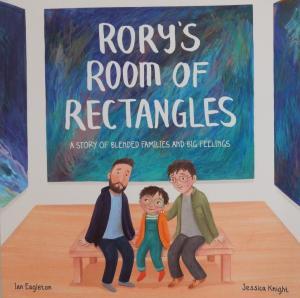
Rory’s Room of Rectangles

Rory’s Room of Rectangles
Ian Eagleton and Jessica Knight
Owlet Press

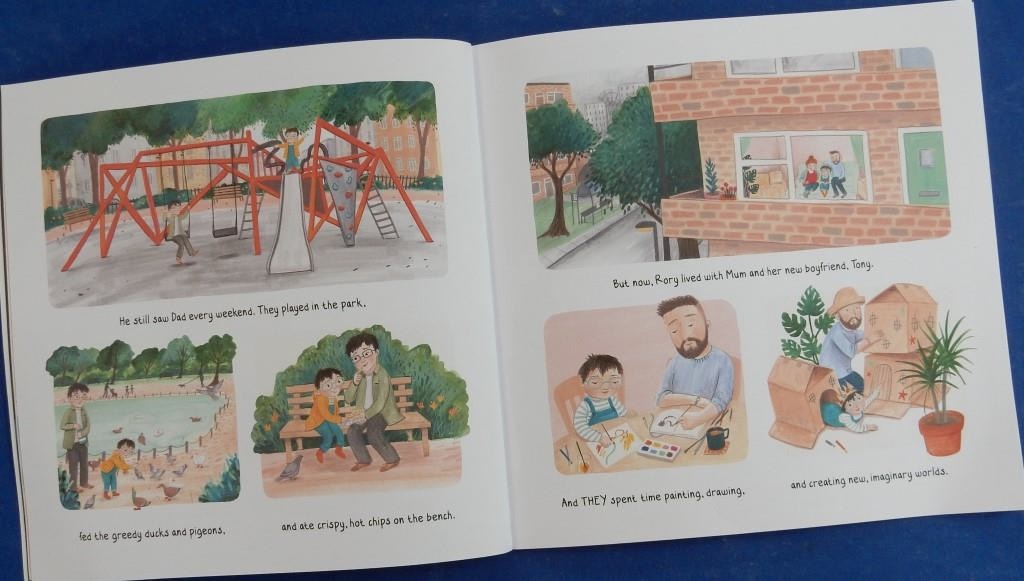
With Father’s Day coming up Rory’s class are making cards but he is feeling conflicted. His Dad no longer lives with him and his Mum, who has a live in new boyfriend Tony. Rory sees his Dad at weekends; the rest of the time is spent at home with Mum and Tony, whom he likes a lot, but inevitably he misses Dad very much.

So who should he send his card to? Anger takes over and at home time the boy tears his card in two and puts it in his coat pocket.

On Father’s Day as he sits with his Mum and Tony, Rory remembers that card still stashed away in his coat. Is Dad feeling lonely, he wonders as the rain falls. Tony is a perceptive man; he notices Rory’s change of mood and suggests the two of them go outside together saying, “I’ve been saving up some money for a rainy day.”

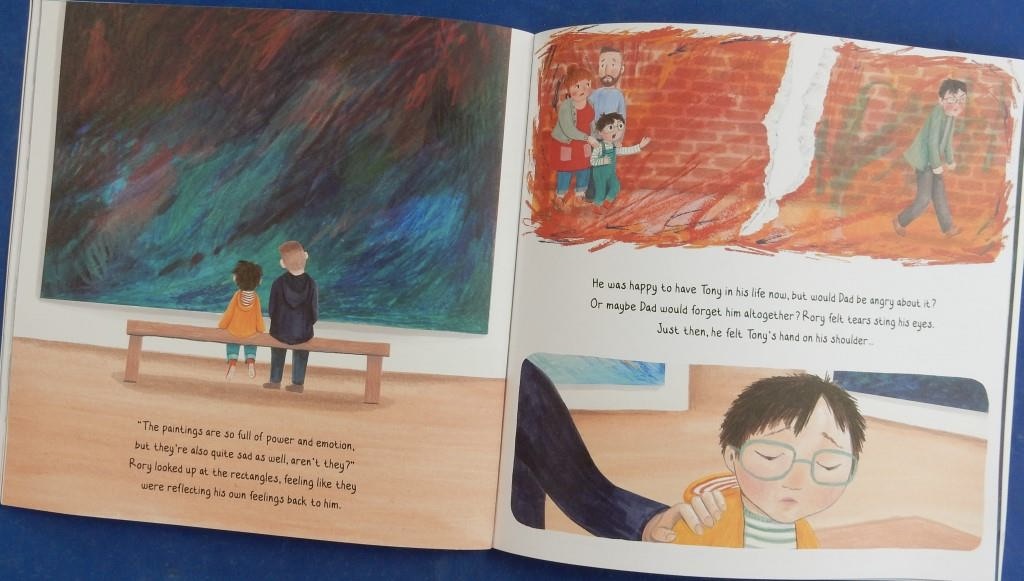
Off the two of them go together, and make their way to an art gallery with wonderful paintings of all kinds. They stop and sit in a room full of rectangles of different colours where Rory feels as though his clashing feelings are being reflected back to him. As the colours wield their power, the boy finds his eyes filling with tears.

The empathetic Tony responds with these words, “ I guess life is like an art gallery … sometimes it’s full of happiness and joy, sometimes it’s scary, and sometimes it’s sad But that’s OK. Whatever you feel is OK.”

Outside once more, as the sun sets, Tony has one more surprise for Rory … As the day ends Rory realises, on their walk back beneath a beautiful sky, that there is no need for him to feel torn.

Inspired by author, Ian Eagleton’s own experiences of being a new adoptive father, this powerful heartfelt tale of a blended family is sensitively illustrated by debut book illustrator Jessica Knight, whose portrayal of Rory’s roller coaster of emotions and his supportive adults is in perfect harmony with the telling.

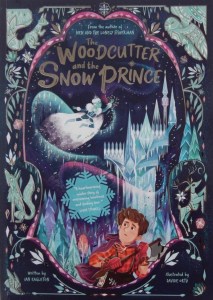
The Woodcutter and the Snow Prince

The Woodcutter and the Snow Prince
Ian Eagleton and Davide Ortu
Owlet Press

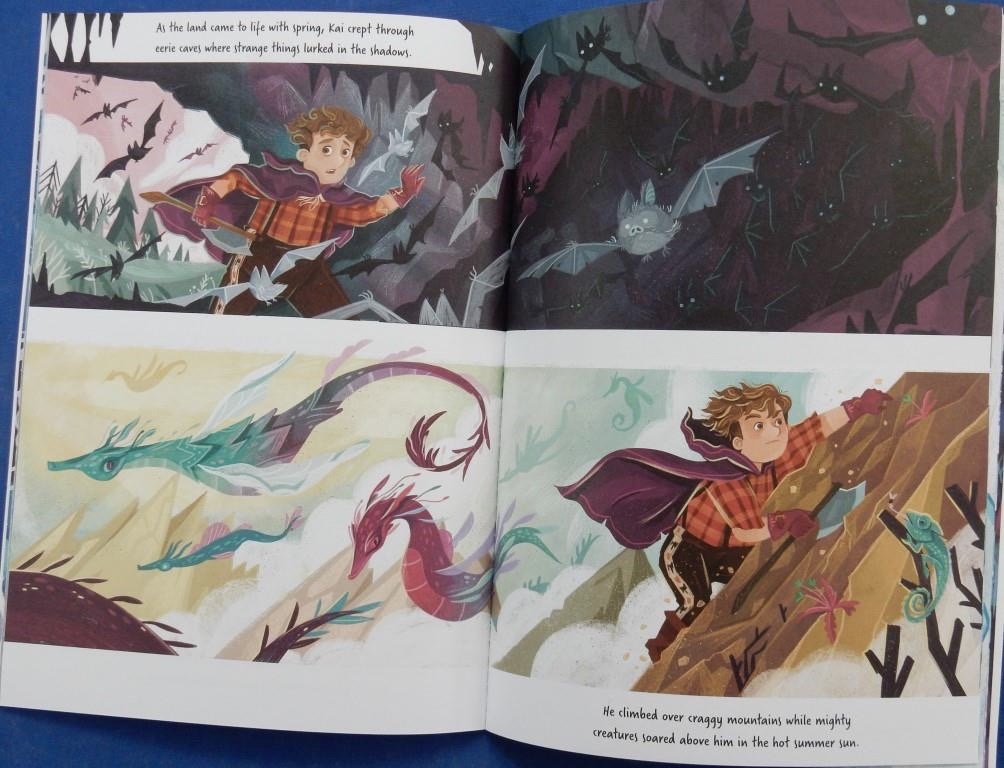
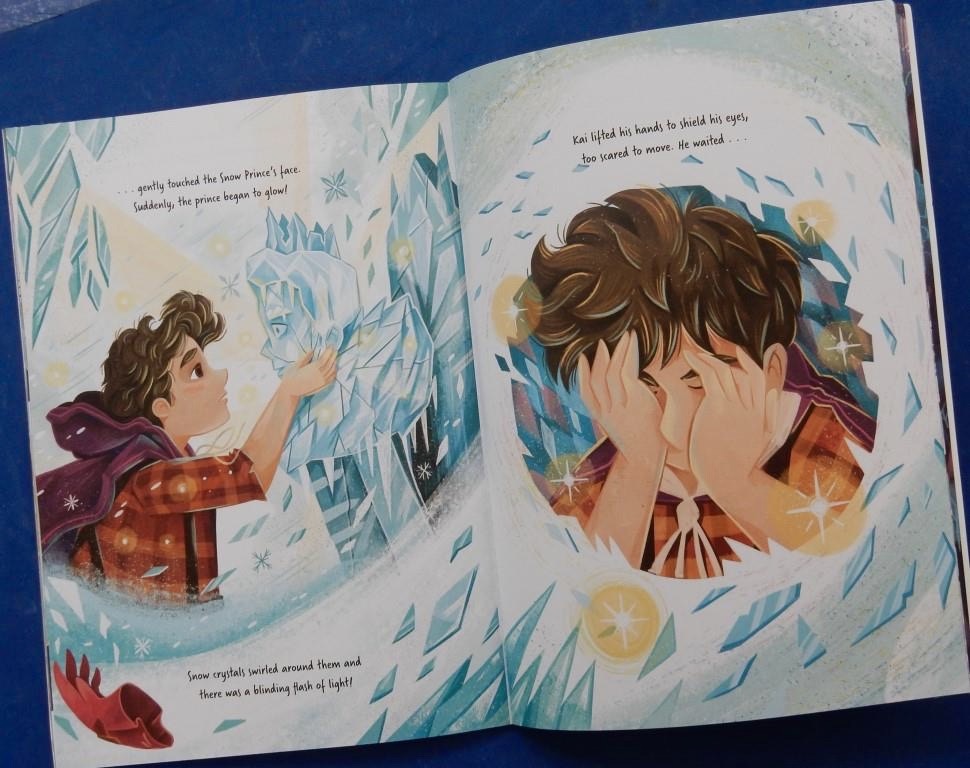
With links to the classic fairytale The Snow Queen, Ian, a wonderful spinner of inclusive stories brings us what is, despite its wintry setting, a magical heart-warming tale of a lonely woodcutter who searches for love.

Kai is a woodcutter who enjoys carving statues for people to enjoy on Christmas Eve but nobody ever passes by. This year he is feeling particularly lonely without his grandmother, whose wondrous tale he recalls: ‘But this year he was alone,’ we read. Then as Kai ponders upon the possibility that his grandmother’s stories might be true, he is visited, but only briefly, by the Snow Prince. What he sees in the Prince’s eyes is hope.

So begins his journey to find love. To do so though, Kai undertakes a long, long journey, travelling though days, weeks and months 

and all kinds of weather until it’s Christmas Eve once more. Now he needs to break the curse on the Prince imprisoned once again in his palace of ice. Can he do so with his loving touch?

The power of love is palpable in both Ian’s lyrical words and Davide Ortu’s beautiful, richly detailed filmic illustrations; 

and make sure you take time to look at the pictorial maps that precede and follow the story.

Teachers and others, if you want your seasonal bookshelves to be for everyone, then you must add this LGBTQ+ picture book to your collection and share it this winter and beyond.

Nen and the Lonely Fisherman / Love Grows Everywhere

Nen and the Lonely Fisherman
Ian Eagleton and James Mayhew
Owlet Press

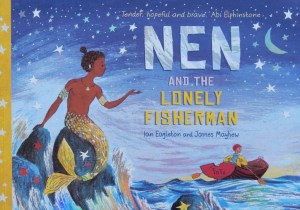
Far out to sea lives Nen; he’s a merman who loves exploring but nonetheless has an empty feeling in his heart. Every night he sits beneath a starry sky singing to the sea whose waves carry his words of hope but Nen remains alone when he returns to the seabed.

Despite his father Pelagios’s warnings, Nen’s explorations of the world beyond his own lead him to discover fishing boats beyond which lives Ernest, a lonely fisherman who also feels something is lacking in his life.

One night Ernest hears Nen’s song and feeling something in his heart, he sets off in his boat to find the owner of this magical voice. So it is that a bond develops between Nen and Ernest. However Pelagios urges his son to stay away from the humans who are harming the oceans. Nen pays no heed however for he feels that the gentle, kind Ernest is special and their nightly meetings continue.

As Pelagios’ anger and sadness increase they unleash a terrible storm that puts Ernest’s life in danger as he’s thrown from his rickety boat into the foaming deep. Can Nen possibly come to his rescue

and if so, might it just change the mind of his father?

Washed through with an important conservation message, Ian Eagleton’s soft-spoken, lyrical tale of acceptance and love is compelling and perfectly paced, helped in no small part by James Mayhew’s powerfully atmospheric illustrations that include a wonderful full-length vertical scene of Nen searching the depths for Ernest, as well as small vignettes and double page spreads.

There’s love too in:

Love Grows Everywhere
Barry Timms and Tisha Lee
Frances Lincoln Children’s Books

‘Love grows everywhere…
From country farm to city square
From desert village, hot and dry,
to mountain home where eagles fly
.’
Through Barry Timms’ gentle rhyming text and Tisha Lee’s vibrant illustrations we share a family’s love, not only for one another but also for the plants they grow, nurture, sell, and give to members of their local community, newcomers especially. When reading this It’s impossible not to feel the various ways love is shown and shared

be it within the family, the richly diverse community or anywhere else: for love is a gift that helps to make the world a brighter, happier place; it keeps on growing and there’s sufficient for everyone, everywhere. It might just take some time for its magic to happen.

How wonderful it would be if this heartfelt book could show the way to everyone, in every place where such love is yet to manifest itself.

Violet’s Tempest

Violet’s Tempest
Ian Eagleton and Clara Anganuzzi
Lantana Publishing

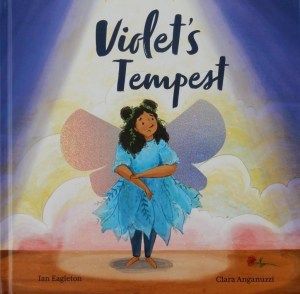
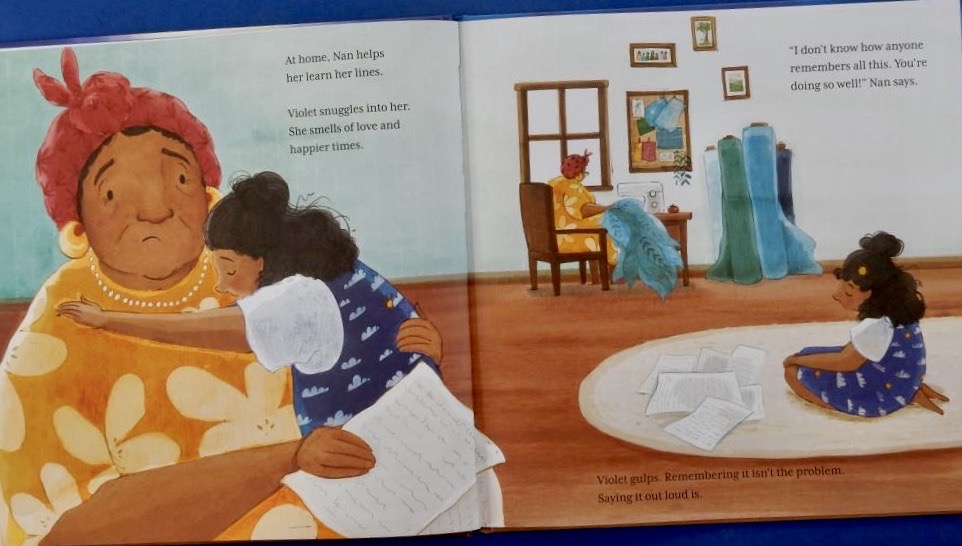
There’s a change in Violet’s world: what was once her giggly voice is now a whisper. Consequently when Mr Newland, her teacher, casts her as the mischievous Ariel in the school play, she’s beset by nerves and worries – suppose people laugh at her?

Back home, Violet’s loving, empathetic Nan offers her support and encouragement,

so too do her uncle Tony and his partner Uncle Sebastian.

Meanwhile the rehearsals continue apace at school where her teacher too is supportive and suggests Violet tries to imagine how Ariel would feel trapped and unable to escape.

The weeks pass and the day of the performance of The Tempest draws ever closer, with Nan continuing to inspire and embolden Violet as she practises her lines. Then comes the dress rehearsal: “Violet … think about how Ariel will feel once they’re free” Mr Newland tells her. The girl breathes deeply reminding herself of her Nan, and beginning with a whisper, starts playing her part.

When the big night arrives, Violet is beset by the inevitable racing heart and turbulent tummy but nonetheless as she steps out onto the stage, something amazing, indeed magical happens: Violet feels at peace with herself as Ariel

gliding and swooping across the stage and suddenly her voice changes from a soft whisper to a wonderful roar, much to the delight of her family and doubtless everyone else.

This is a wonderfully warm story of facing up to and over-coming your fears, as well as the power of a supportive family. Clara Anganuzzi’s sensitive illustrations capture effectively the characters’ feelings, making this book one to share and discuss with children either in the classroom or at home. (Despite how he looks in the story, I can’t help but think the author and teacher Ian Eagleton would be just as empathetic as Violet’s class teacher in a similar situation).