Marvellous Body

Marvellous Body
Jane Wilsher and Andrés Lozano
What on Earth Books

The focus of the second in the ingenious Magic Lens Book series is the human body and its inner workings.

Our bodies are amazing: that, emerges loud and clear from this book. The author confirms it in the opening spread 24-hour body where we read, ‘The body eats and drinks for energy. It learns and daydreams too. Then it sleeps. The body grows and keeps on changing.’ Even that straightforward paragraph gives young readers plenty to think about and it’s good to see the reminder that everyone is different too.

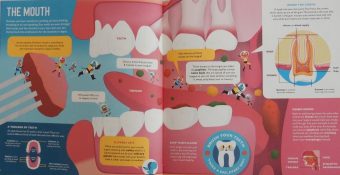
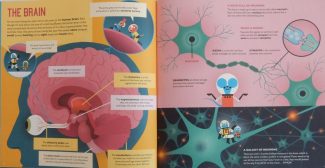
The rest of the spreads are more specific, the first being about the brain, the body’s HQ – what each part does and how it functions. There’s a ‘Find It Box’ in the bottom corner of this and on most other of the spreads, asking the reader to use the magic lens and find the items listed – that’s lots of fun learning. The function of each of the five senses is simply and concisely explained in a large fact box and smaller ones provide a considerable, but never overwhelming, amount of information.

Eyes, ears, then the nose and tongue are the focus of the next three spreads. I found Andrés Lozano’s illustration for Nose and Tongue particularly amusing.

Teeth (which includes dental health), then Skin and Hair come next, followed by bones. Prepare to be confronted by a large skeleton …
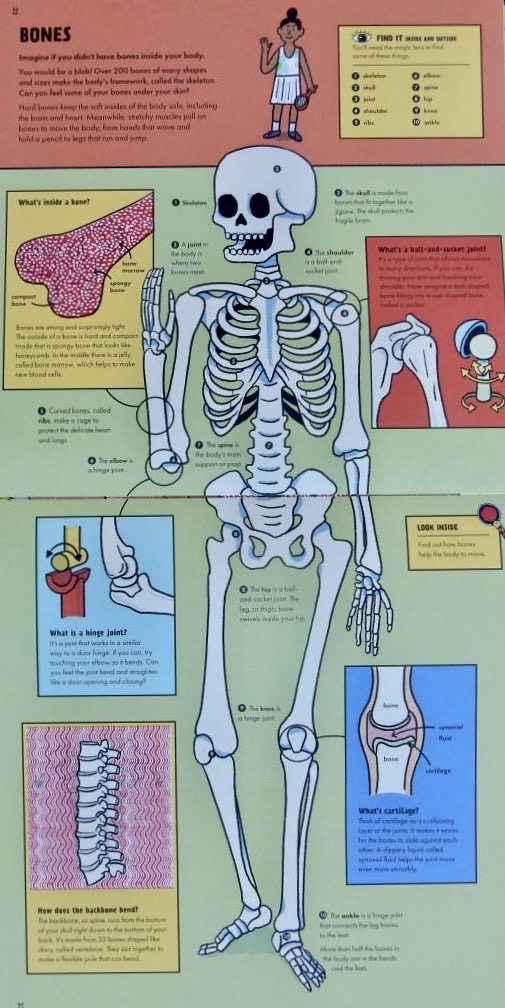
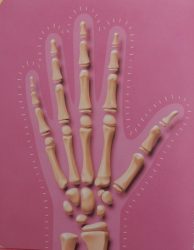
Did you know that over half the bones in the body are in the hands and feet? That’s more than one hundred: check the clear diagram.

No matter which system or part of the body you want to find out about, if you have an interest in staying healthy and happy, or in the medicines doctors are busy inventing right now, then there’s something on the topic here; and the clarity of each explanation given is first-rate. Enticing, exciting and a rewarding learning experience, and you couldn’t make a non-fiction book for children more interactive than this.
The Good Germ Hotel

The Good Germ Hotel
Kim Sung-hwa and Kwon Soo-jin, illustrated by Kim Ryung-eon
What on Earth Books

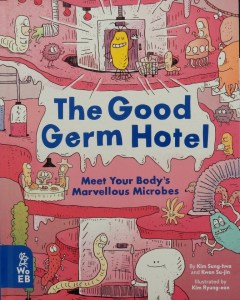
What an unusual and entertaining way of presenting information is this dialogue between the main narrator – Colon Bacteroides – and the nine year old girl – the hotel within which it lives. This bacterium describes its role and those of its fellow bacteria explaining the various tasks they perform in the body. I wonder how many children realise that there are microbes all over the body, many good – the superheroes – and some bad too.

The narrator takes readers on a journey through the digestive system talking about what happens when food is eaten and how gut bacteria help provide energy by removing nutrients from the food consumed, and thus helping the body work and grow.
Protection from bad germs is another job for the ‘good’ bacteria but if those baddies do invade then the hotel’s army of immune cells are called into action.

At this point in the narrator’s explanation there comes, (along with the likes of stomach bugs, strep throat and cold, a brief, timely mention of the virus Covid-19.

Next is an explanation of the role of antibiotics and a discussion of how important it is that they are only prescribed when absolutely vital in case all those good bacteria are destroyed too, or the nasties learn how to become antibiotic resistant.

Alongside such examples of serious scientific topics, young readers will definitely enjoy the references to farts and poo, especially that farewell final spread from the narrator so graphically illustrated.

Indeed all the illustrations are comical and huge fun to peruse, helping to make the entire topic accessible to primary school age readers. Who ever would have thought that talking with a bacterium could be so enlightening. There’s a final glossary in case readers need to check the meaning of any of the terms used during the conversation.

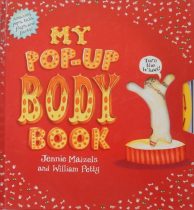
My Pop-Up Body Book

My Pop-Up Body Book
Jennie Maizels and William Petty
Walker Books

Who doesn’t love a pop-up book especially when it includes SO much learning in such a fun way as this one written by William Petty and illustrated by Jennie Maizels.

It contains a wheel, flaps, even a handful of small books within the main book; and all in just five incredible spreads whereon David Hawcock’s paper engineering is awesome. Scattered throughout the spreads are simply masses of bite-sized chunks of information, some hand lettered by the illustrator.

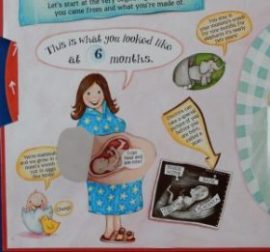
The level of interactive opportunities is incredible: readers can follow the development of a baby in the mother’s womb by rotating the wheel;

the thoracic skeleton positively leaps out of the pages, and the chambers of a heart can be revealed beneath a flap. Did you know that the heart of a girl beats faster than that of a boy?

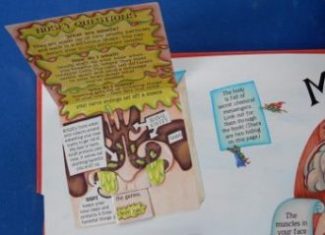
The central pop-up from each spread reveals in turn, a baby, the head and organs on and within – a nose mini book lets you emit green snot from the nostrils;

the chest, the tummy and intestines (you can even track poo on the move) and finally, the whole skeleton. There is SO much to explore and discover on every one of the spreads.

An absolutely superb introduction to the body and its biology – its form, functions, growth and repair; and a terrific production, creative, clever and totally fascinating. Delve into this and children will see that they share much more in common with one another than any superficial differences.

Strongly recommended for the family shelves and classroom collection.

Argh! There’s a Skeleton Inside You! / A Cat Called Trim

Allen & Unwin offer some unusual ways of presenting information in these two non-fiction books

Argh! There’s a Skeleton Inside You!
Idan Ben-Barak and Julian Frost
Allen & Unwin

Quog (a blobbly armless thing) and Oort (a gas cloud) are in their spacecraft going to a party but mechanical issues hold things up. They need to get out and fix the problem but without hands or arms, opening the door isn’t possible. Or is it? That’s when the narrative becomes interactive – the reader turns the page and … out they come.

‘Give Quog and Oort a wave,’ we’re told and a page turn reveals Quog has grown arms and hands. That’s a good start but there are further issues.

Little by little youngsters are then introduced to the bones,

muscles …

and nerves of the hand – their form and function.

With simple, bright, lively illustrations, this, zany mix of fact and fiction is enormously engaging: little humans will love the idea of helping the little aliens reach their destination, and in so doing learning some basic human biology – anatomy and physiology – as presented by the clever human team Idan Ben-Barak (author/scientist) and illustrator Julian Frost.

A Cat Called Trim
Corinne Fenton and Craig Smith
Allen & Unwin

‘Trim was a cat born for adventure.’ That he surely was having been born aboard the sailing ship Reliance bound for Botany Bay and then not long after, finds himself hurtling over the side of the ship into the inky depths of the Indian Ocean.

Happily for the kitten and his saviour Matthew Flinders, a special relationship is forged, with Trim accompanying his master on all his expeditions until the fateful day when Flinders was accused of spying, his precious books, charts and journals confiscated and he became a prisoner on the Isle de France (Mauritius).

After a while Trim disappeared and his master never saw him again.

Both educative and entertaining, Corinne Fenton’s telling of this true story is compelling and accompanied by Craig Smith’s dramatic, detailed illustrations, and maps, makes for an absorbing starting point for primary readers interested in Australia and its history.

Professor Astro Cat’s Human Body Odyssey

Professor Astro Cat’s Human Body Odyssey
Dominic Walliman and Ben Newman
Flying Eye Books

It’s time to join Professor Astro Cat and his crew on another amazing journey, no not a blast into the depths of outer space, rather a dive into a much more confined space, our very own bodies. Pretty awesome machines they are too; and one body in particular, that of test subject Dr Dominic Walliman. We join him and of course, Professor Astro Cat and his pals in a close up look at human biology.

First off they remind us of the seven characteristics of living things and we discover why we’re not robots!

Thereafter comes a look at our cellular structure, our skeleton, our muscles – did you know we have more than 640 intricately arranged skeletal muscles. Further investigations require the gang to become microscopic to check out our skin, our sensory organs; (our teeth as well as our tongue are inspected within the mouth).

Of course, without our brains we’d be pretty much unable to function, so next we take a look at that complex supercomputer-like mass– its composition, its functioning and how it operates in conjunction with the nervous system.

Other vital organs we learn about are the lungs, blood – not an organ but vital nonetheless, the heart, and those dealing with digestion and excretion.

There’s a page each on the lymphatic system,

the endocrine system and the immune system, all of which are crucial for a fully functioning body.

Reproduction, human development and genetics have a double spread each and since it’s vital to keep healthy, the Prof provides info. on that topic too, as well as touching upon medicine and what to do if we’re poorly.

The concluding topics are ‘Impairments’, which shows how incredibly adaptable both our bodies and minds are, and we even get a glimpse into how future technologies might change humankind – wow!

All this is presented in a splendidly visual format similar to Walliman and Newman’s previous Astro Cat science offerings. It’s packed with information, enormous fun and with a final index, this is altogether a terrific book on a topic that fascinates almost every child I’ve ever come across.