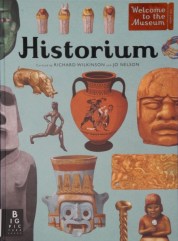
Historium
Richard Wilkinson and Jo Nelson
Big Picture Press
This handsome, outsized volume offers a virtual museum experience within hard covers. The opening pages – the ‘Entrance’ provide a brief rationale for what is included, ‘ only a selection of the civilisations that have ever existed, but we hope it will inspire future exploration.’ and a short explanation of archaeology. Next comes a timeline that illustrates the objects featured in the six galleries: Africa, America, Asia, Europe, The Middle East and Oceania.
Gallery 1 includes Southern Africa, Western Africa …
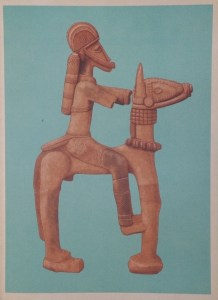
and Ancient Egypt with each culture being given a short overview followed by a key to the artefacts that includes description, cultural context and anthropological significance.
In Gallery 2, America, five civilisations feature: The Olmec, The Maya,
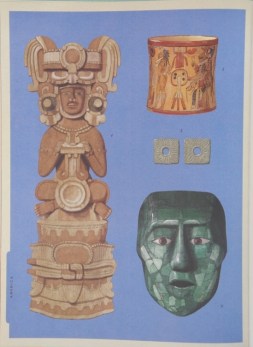
The Aztecs, The Hopewell (I hate to admit my ignorance about this one), and the Pueblo.
Enter Gallery 3 and you’re taken to Ancient Asia – India (the ancient culture I’m most familiar with),
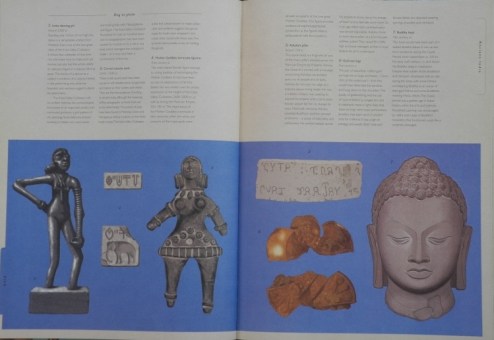
China, Japan and Korea.
Gallery 4, Europe encompasses The Celts, Ancient Greece, Ancient Rome …
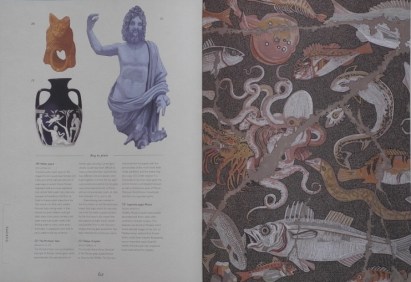
and The Vikings.
The Middle East is the location for Gallery 5 and here Jo Nelson offers readers five Mesopotamian objects, another five from The Ancient Levant, a frieze from Ancient Persia; and Early Islam has fragments of a woven tapestry, wall painting fragments and an earthenware bowl.
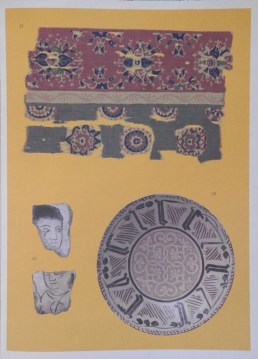
The 6th Gallery, Oceania includes items from the Indigenous Australians,
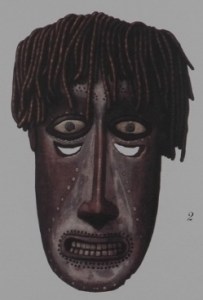
Melanesia, Polynesia and The Maori.
Wilkinson’s digital illustrations are not photos though they have a considerable degree of photorealism in the detail and some truly stand out from the page.
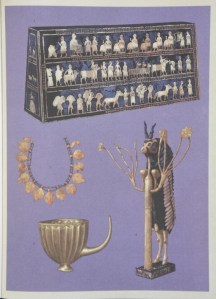
Moving from early Stone Age (a hand axe) right through to the 19th century (a Polynesian head of a staff god) is indeed an ambitious enterprise and of course, it can never take the place of a real museum visit; but you would need to visit a great many to see everything Historium presents. There is a final index citing the museums (with locations) of the artefacts displayed in the whole fascinating enterprise. It certainly does give the next best thing: a basic introduction to a number of ancient cultures (mostly no longer in existence) and an exciting visual experience that will one hopes, inspire readers to go (coining a phrase from Bruner), ‘beyond the information given’
Use your local bookshop 
 Red Reading Hub - Jillrbennett's Reviews of Children's Books