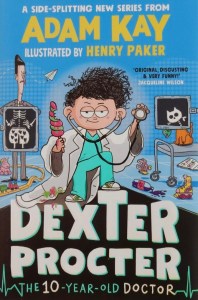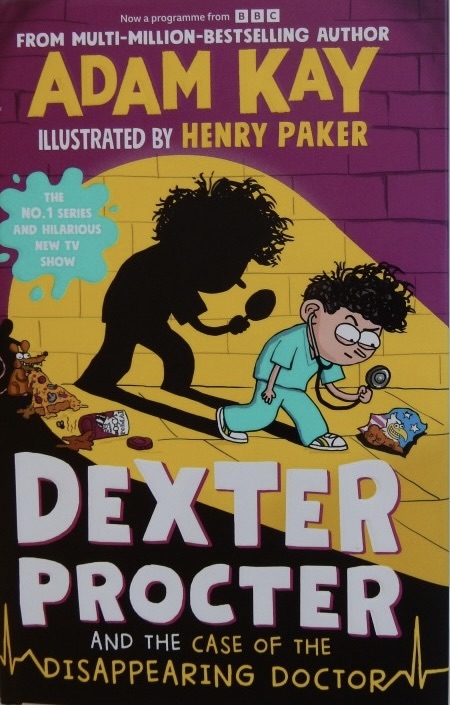
Dexter Procter and the Case of the Disappearing Doctor
Adam Kay, illustrated by Henry Paker
Puffin
Ten year old prodigy Dexter Procter works as a paediatrician at Lilydale General Hospital and almost as soon as this story starts he manages to ride his scooter straight into Granny Bet causing her to suffer (despite her saying she’s fine) ‘a monomalleolar lateral fracture’ to her fibula; in other words, a broken ankle. As a result she has to wait in hospital for an operation. Being kind-hearted, she doesn’t spill the beans about the cause of her injury. Dexter decides to go home and change and on the way meets his pal Rupi in a state of distress, having been expelled from Elmwood School by the temporary head teacher.
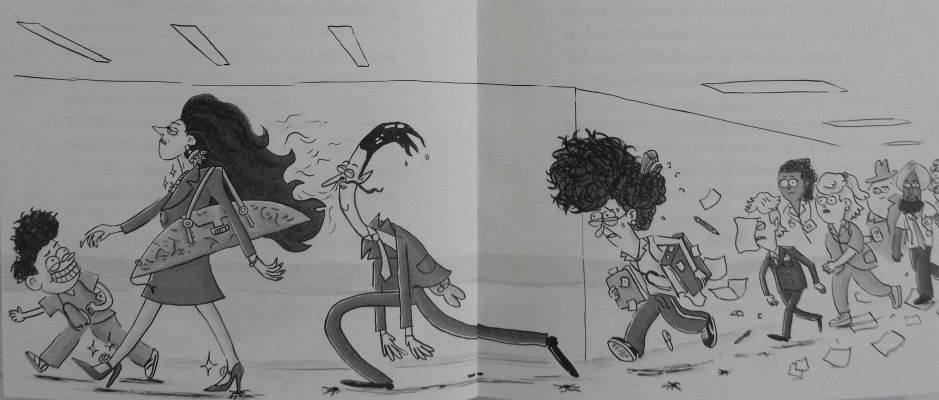
Not long after said temp. (Mrs Rhubarb) appears on the scene. She mentions her sister Barbara Burnhall, an MP and it turns out, the very one who is soon to visit Dexter’s place of work. She’s also someone the hospital relies on for funding every year, Dexter later learns. He also learns that he’s to accompany Dr Marigold and show BB around when she visits. Unsurprisingly, things go badly from the start.
On the school front: what on earth is Ms Saeed, the proper head of Rupi’s school, doing in Azerbaijan? Hmm.
Then Dr Marigold disappears and the wretched Dr Drake appears wearing a sign that reads DR EDWIN DRAKE, ACTING METAL DETECTOR. You can guess what it’s meant to be. What he says about Dr Marigold is totally bonkers. Moreover, he refuses to believe what Dexter tells him about Barbara Burnhall. (I won’t say how he came by this information).
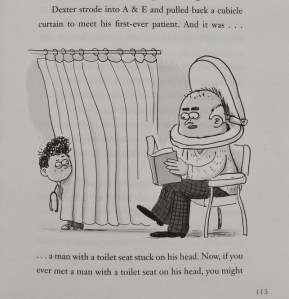
On the home front, Granny Bet is back at home with her operation delayed. At this stage we’re less than halfway through this book but rather than be a story spoiler I’ll merely say that I laughed all the way through to the final paragraph that contains the words ‘Downing Street’ during the course of a phone call to Dexter. I’m sure young readers will do the same and like me be eagerly awaiting the third book. I must add that Henry Paker’s drawings are thoroughly giggle-inducing too, and don’t miss the acknowledgements acrostic.
Word has it that there’s a BBC mini-series of the book later this year.