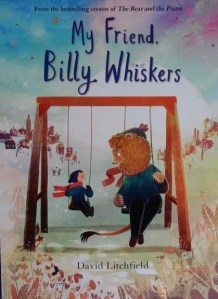
My Friend, Billy Whiskers David Litchfield Frances Lincoln Children’s Books
Patrick is shy and as a consequence doesn’t join in with other children’s play. However, Patrick has Billy Whiskers, an imaginary lion friend that nobody else can see. They cycle together, read stories together and Billy listens as Patrick talks about all kinds of things. Billy’s a great listener; he listens as they play games and use the swings; he encourages Patrick when he kicks the ball up in the air over and over and when he climbs his favourite tree, watching the other children as he does so.
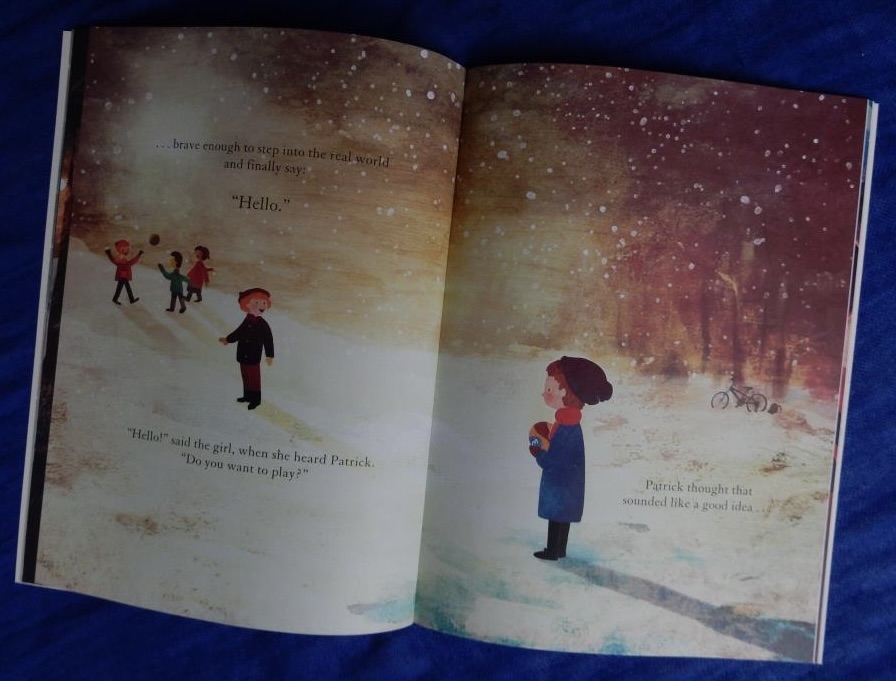
Patrick worries more and more about making friends and that’s when Billy takes him on extraordinary adventures through the air, through magical forests, eventually reaching a stadium where the boy scores the wining goal in a soccer game. Their adventures together make Billy ‘feel big and brave.’ Now he has the confidence to say hello to other children and at last he’s invited to play with them.
Patrick has a great time until he falls from a tree and back come all those worries. making him long to fly away with Billy Whiskers once again. That’s when something truly magical happens …
That’s not quite the end of the story, for Billy remains a part of Patrick’s story throughout his life, but he only appears now and then.
David Litchfield’s watercolour scenes are every bit as magical as the adventures Patrick and Billy Whiskers share, particularly those of the two characters flying through the starry skies and wandering through the forest.
The Girl Who Wasn’t There Jacqueline Wilson Puffin Books
When Dad drives Luna (nearly eleven), her younger sister Aurora (almost six) and their Mum to the foot of a hill and stops the car, everyone is amazed at the tower perched atop the hill. “It’s like Rapunzel’s tower!” comments Luna. But then Dad announces that it’s to be their new home, their shocked Mum thinks he’s joking. Not so. Having lost his restaurant, Dad has somewhat recklessly bought this crumbling/tumbledown building at a bargain price and to say it needs some work done on it before they can move in is putting it mildly.
With the room at the very top strictly out of bounds, it’s anything but the ‘happily ever after’ fairytale abode Aurora imagined. However Dad promises Luna that they can have a puppy. despite the fact that temporarily they are going to have to live in a caravan. The following weekend he takes the family out to lunch to meet an elderly couple, the Stanleys, who have a pup – Molly – but are finding it too lively. They agree that a new home with Luna and her family is the ideal solution.
As someone who frequently gets her own way, Aurora has never been to school before, though thanks to her big sister, she can read and write well. However at the end of the summer there’s no choice, go to school Aurora must. Unlike her sister who is quick to make friends, Aurora decides that she hates her classmates and prefers the company of Tansy, an imaginary friend. Luna meanwhile worries that Mum and Dad might split up with so little real progress being made on their new home even though Dad now has the help of two new friends. She’s also concerned about her status in the family – is she truly a part of it when Dad isn’t her birth father?
As time passes, Aurora’s make-believe life becomes problematic for all the family, particularly as she insists Tansy is real. Could she perhaps be a ghost? And is there a curse on the tower? If so, can Luna be the one to break it?
I was fortunate that on the day this arrived it was the only book delivered so I was able to indulge myself and read right through to the end. It’s a wonderful mix of magic, the power of the imagination, family life, human resilience and love.
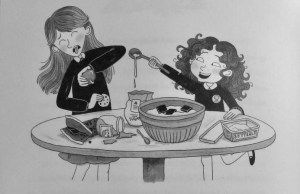
One of my relations, Emmanuelle an avid reader in Y6 was keen to read the book and review it: here’s what she wrote: Jaqueline Wilson’s new book is a beautifully-written story complimented by delightful illustrations from Rachel Dean. This book is perfect for anyone struggling with change or anyone finding it hard to be an elder sibling. They will be able to relate to Luna, the main character, who has to adapt to moving to live in an unfamiliar place and, on top of that, has a sister who she occasionally finds hard to deal with.
For fans of fairytales, there is an allusion to the story of Rapunzel because the main character is a girl with blonde hair who moves to live in a tower. In my opinion, surprisingly, the title does not link to the main theme of the story. I think the theme of the story is Luna’s journey in adapting to a new house, a new school, a new life, whereas the title links to the fact that Luna’s little sister, Aurora, has an imaginary friend who actually used to live in the same tower that they own now. Because of its cliffhanger ending, I think this book begs for a sequel. The final enigma leaves the reader hungry for more.
Polly and the New Baby
Rachel Quarry
Oxford University Press
Little Polly’s imaginary friend Bunny goes everywhere with her. She takes him in the pushchair she had as a tiny baby.
Every time her Mum or Dad try to persuade her to do without said pushchair, she insists it’s an absolute necessity. Bunny and chair go to the supermarket, the park and even to her Gran’s house.
There’s a problem though: Mum is soon to have a new baby and needs the chair for her own purposes. Several replacement modes of transport for Bunny are offered but none satisfy Polly
and all the while Mum’s due date draws ever closer.
Even when it’s imminent, and Polly and Bunny go to stay at Gran’s, you’ve guessed, the pushchair goes too.
However, when Mum introduces Polly to her new little sister Lily, the now big sis. makes a special announcement concerning her friend: “Bunny can walk!”
Definitely now’s the time to pass on that old pushchair surely; or is it? … It would appear that Polly isn’t the only one with a new sibling.
Happily Polly’s imagination stretches to making a compromise that might just work for everyone.
The understated humour in both words and illustrations makes this story of a family with a super-cute creative thinking protagonist, a delight to share with little ones around Polly’s age whether or not a new arrival is in the offing.



 Red Reading Hub - Jillrbennett's Reviews of Children's Books