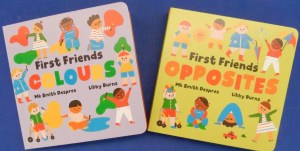
First Friends: Colours, First Friends: Opposites / Don’t Ever Mess with a Monkey

Colours begins with the nursery children and their teachers heading outside to play. The instruction is, ‘Look high, look low. / Look all around!// So many colours/ to be found.’ There are black ants marching across the sand, pink worms wiggling on two children’s hands, a red slide, a blue swing and a purple bar to swing along, as well as a wonderfully messy opportunity to use mud and leaves to create mudpie faces. Meanwhile at the water tray a floating and sinking activity has yellow, orange and white objects to test. Then just before snack time everybody blows bubbles with rainbow colours. The final spread encourages interactive learning with a ‘can you find’ showing all the coloured items featured throughout the book.
In Opposites, we join the children preparing for a rest time with some winding down movements that involve stretching high and low, then yawning, mouths open and sleepy eyes closed. When everyone wakes up, some are smiling, others frowning as they stack the mats up and take down the toys.
During the remainder of the session the narrative builds in other opposites – empty/full, small/big, behind/ in front and the final spread asks listeners to act out eight pairs of opposites.
Both books have bright, inclusive illustrations that show a diverse cast of characters.
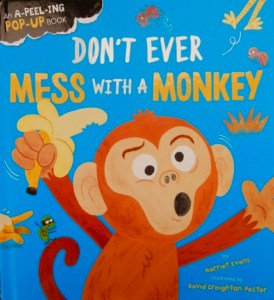
The latest in the Don’t Ever pop-up series features five wild animals that live in the savannah region. Readers/listeners are warned against riding a zebra, boxing with hyenas, question the decision of rhino, rob an ostrich or give a monkey food that isn’t to its taste. For sure, the results will be far from pleasant for anyone who ignores the warning on each spread.
Harriet’s rhyming text accompanies David Creighton-Pester’s dramatic scenes, each of which includes one or more bit part players that young children will enjoy spotting
The Bookshop Dog

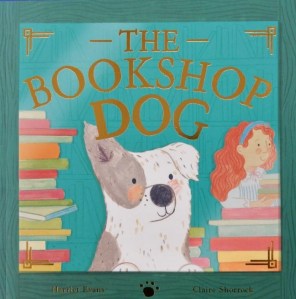
Scamper absolutely loves his home with Paige at The Happy Tails Bookshop and can’t imagine a better place to live in the whole world. Everybody in the neighbourhood has made him feel welcome and he loves them all, Paige especially. To show his appreciation, the pooch decides to follow her example and he selects some books he thinks his friends might enjoy reading. This proves very successful: Scamper has helped all his friends

but is there a book that can put a smile on the face of the person who seems to have read every one already? His search of his friends’ abodes yields nothing suitable and it’s a down-hearted Scamper that returns to the bookshop but joy of joys …

What a delightful character is Scamper, especially in the way his observations enable him to find the right book for each person, even though it’s unlikely to be what they themselves would have chosen.
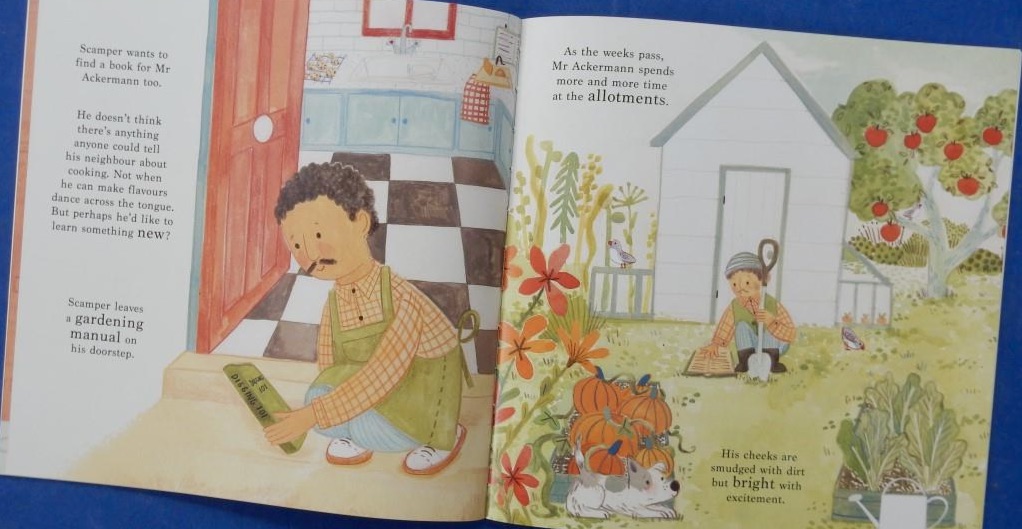
I love that reading and books are celebrated both verbally and visually at every turn of the page: listeners and readers aloud will love the wordplay and clever book titles – Mansfield Bark and Doggy Deeds of Derring Do – for instance. Claire Shorrock’s illustrations have lots of details that offer starting points for discussion and I absolutely love the exchange between Paige and Scamper near the end: “Reading takes us all on incredible journeys.” (Paige) and ‘reading is a way of coming home.’ (Scamper). So true, both.

Interact With Board Books

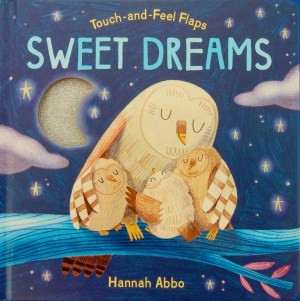
Very young children are invited to join mother owl as she hunts for food, soaring across the starlit sky one night. She flies over tall grass that shelters a mother rabbit and her little ones, passes a log pausing briefly to peep at Fox and its cub, discovers a mother mouse and her babies snuggled together under some leaves and finally flies back to the tree where she tucks her three waiting owlets safely beneath her wing.
With its alluring die-cut cover, five differently textured, touchy feely flaps to explore, a gentle rhyming text and scenes of the natural world at night from various viewpoints by Hanna Abbo this is a lovely board book to share with the youngest humans at bedtime especially.

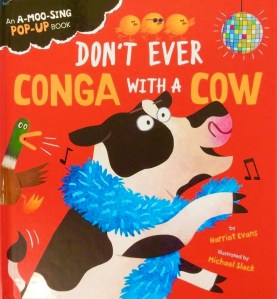
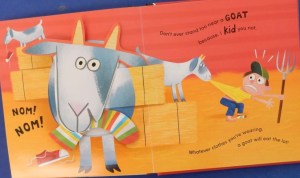
This is an addition to team Evans and Slack’s Don’t Ever series, this one being set down on the farm. Young children are warned against disturbing a slumbering rooster; tricking a woolly sheep, wrongly blaming a large pig for the mucky deposits it hasn’t left; getting your rear end too close to a hungry goat

and finally never ever attempt the titular conga with a cow; it’s sure to move to a different tune.
Farm animal silliness with creatures that are guaranteed to make little ones giggle and relish joining in with the RING! RINGs, YEE-HAWS, OINKs and NOM NOMs as you turn the pages making each animal in turn move. Cause alarm and you’re in for a shock.

How It Works: Shark / Don’t Ever Laugh at a Ladybird

These are two new novelty board books from Little Tiger: thanks to the publisher for sending them for review.

Cleverly designed with strategically placed peep through parts of every page, this serves well as an introduction to sharks for preschoolers. They will be fascinated to learn that these powerful predators have super-strong tails that enable them to swim faster than a motorboat can move. They may well be surprised to hear that sharks were around before dinosaurs existed. I’m sure humans young and not so young are pleased not to have 300 teeth to clean, the number some sharks possess and having learned that, in contrast to humans, sharks very seldom sleep, young children might try that as an excuse not to go to bed at the proper time.
Playful, fun learning in bite-sized portions, with clearly labelled body parts and “Did you know? interjections from a deep-sea diving mouse that swims up on every spread.

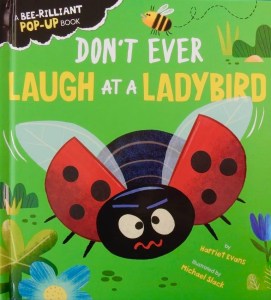
You will probably decide to heed the titular warning of the furious faced ladybird, as well as the rhyming ones concerning the other four irate minibeast kinds that fly, spin forth, leap or slither from the pop-ups on Michael Slack’s wacky brightly coloured spreads. If not, you might easily end up in a honey covered mess after baking with a bee, dizzy from trying to out dance a disco crazy spider, lose your voice while endeavouring to emulate a ribbiting frog, or smothered in slime should you hug a shell-loving snail.
Minibeast madness to read aloud with the very young

I Love You More / Love is in the Little Things / I Turtley Love You

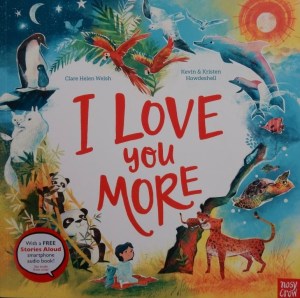
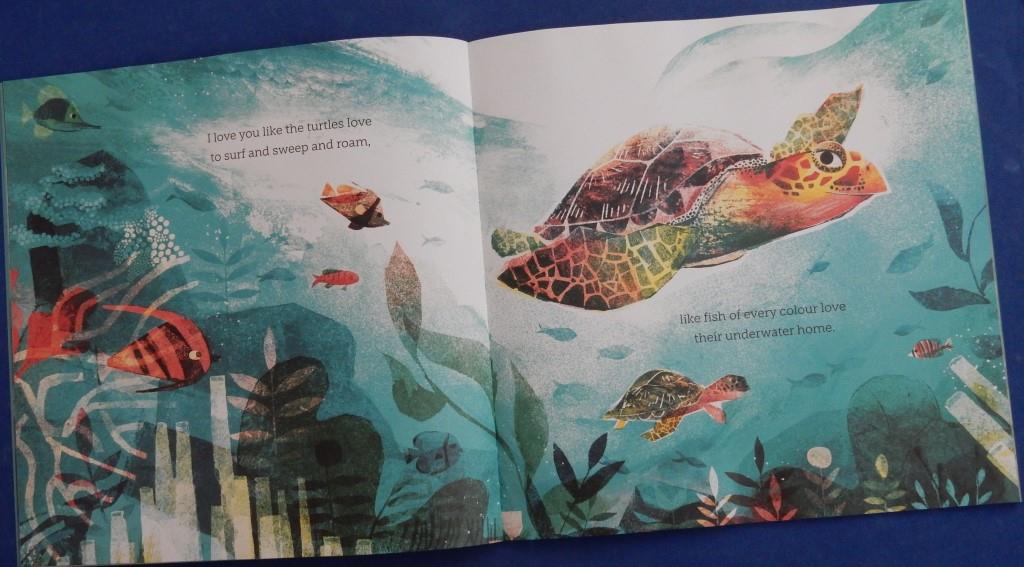
Parental love and the wonders and beauty of the natural world come together one bedtime when Rae’s Mum attempts to tell her daughter just how much she loves her. Clare’s lyrical text in combination with team Howdeshell, the illustrators, convey the heartfelt message effectively, showing that such love is unconditional and life long.

Herein we encounter among other creatures, waddling penguins and snoozy seal pups atop the ice, gliding eagles, desert dwelling camels and lizards, various marine creatures ,

majestic big cats and pandas as well as celestial bodies – ‘sparkly planets shining brightly in the night’ and more. As the two finish counting the stars in the sky, Rae realises the enormity of her Mum’s love, .
a love that even then Mum feels she’s not expressed sufficiently strongly- and we see the two snuggled lovingly together.

The mixed media illustrations of the animals in their home environs suggest that the way is left open for Rae to change as she too explores beyond her immediate home and surroundings.

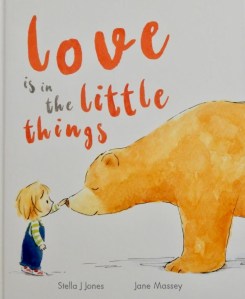
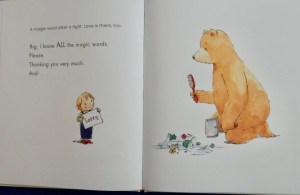
Small – a human child and Big – a large bear love one another very much, but how do they show that love? Stella Jones’s first person text and Jane Massey’s heart-warming watercolour illustrations show that essentially as Big says, ‘ love is made from the little things’ – every day things such as holding hands, making and taking tea together, a goodnight kiss, hugs, saying sorry,

extending a helping paw or hand. As Little realises as they look skywards, “Love is made of ALL the little things. Just like the trillions of tiny twinkly stars make the forever of the deep blue sky.’
Gentle, reassuring, and sometimes exciting like those ‘tingletastic, tummy jumbling, giant-enormous glorious fireworks and starbursts.’

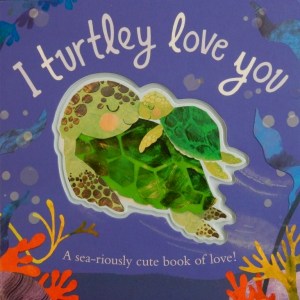
This board book takes readers beneath the ocean waves where, through Harriet’s gentle rhymes and Bryony’s engaging illustrations they will encounter several ocean creatures and their little ones. There are turtles, seahorses, clownfish, jellyfish and more either playing or snuggled up together. The emphasis on each spread is the love the adult gives to the little one.
With cut-outs and stand-outs on each spread, little humans will enjoy the tactile opportunities offered by interesting watery, collage style visuals. Some adults might find the words slightly too sugary.

Don’t Take a T-Rex Out For Tea / My Big Playbook / Polly Put the Kettle On

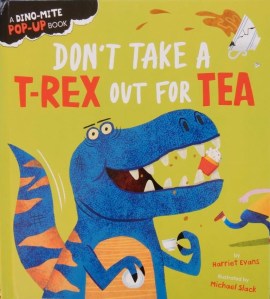
The five dinosaurs lurking between the covers of this large format board book practically leap off the pages as you turn them. In turn young children will delightedly encounter a stegosaurus – a decidedly bad sport that can’t bear to lose, a pterodactyl, not a creature to challenge for a race, then comes a diplodocus, an unsuitable dino. to try to hide in your bedroom on account of its colossal size, a triceratops that will put paid to any musical activities you might engage in, and finally be warned: T-Rex is always on the lookout for a tasty treat, so don’t even contemplate inviting one out for tea.
A rhyming text accompanies the prehistoric pop-outs depicted in Michael Stack’s splendidly silly scenes.

A large format board book, with a die-cut and felt flap to explore on every page. There’s a double spread devoted to numbers 1-5, with other pages of things that go, things you would see outside, shapes, weather-related words. things to find at home, colours, animal sounds and finally, bedtime, which includes a surprise hidden mirror.
Ingela P Arrhenius’ bright, enticing illustrations show either separate items each set against its own coloured background, or a whole scene.
Interactive fun learning for the very youngest to enjoy at home or in a nursery setting.

The local cafe is the setting for this version of a favourite nursery rhyme, its customers being a variety of anthropomorphic animals and Polly is a panda. Once the tea has been duly served, it’s down to pooch, Sukey to remove it from the stove. Off go all the tea drinkers and cake consumers waved on their way by Polly.
One of the ‘Sing along with me!’ series that has a sliding mechanism to add to the enjoyment on every spread and a QR code on the back cover to scan, which enables you to listen to the song. With ever fewer young children starting nursery knowing any nursery rhymes, this is a good place to start.

All Change! / Colour Gallery

Here are two new board books from Little Tiger – thanks to the publisher for sending them for review.

All Change!
Harriet Evans and Linda Tordoff

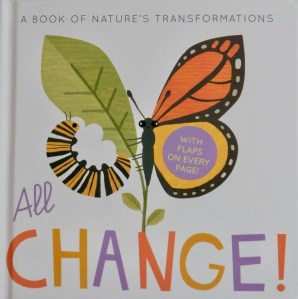
Transformations in the natural world is the theme of this board book with its clever, enticing cover picture.
By means of the flaps integral to each of Linda Tordoff’s illustrations, we see changes brought about by the seasons, through life-cycles of insects and frogs, the weather, danger, the lunar cycle, the need to catch food, for safety and more. Executed in soft, soothing colours, each scene is pleasing to the eye and the simple text offers a starting point for discussion with very young children.

Colour Gallery
Sophie Ledesma and Isabel Otter

Ready and waiting to take the animal visitors, and readers, on a learning tour around the art gallery is Gigi the giraffe. First stop is the Red Mosaic Hall, followed by the Blue Portrait Gallery, the Green Sculpture Park and the Yellow Landscape Room. This art establishment certainly makes effective use of all its space for there’s a corridor devoted to still life paintings

and the cafe displays abstract art on its walls.
As well as reinforcing the concept of colour in an unusual manner, Isabel Otter’s interactive text, the book’s design with its shaped pages and gatefolds and Sophie Ledesma’s bright illustrations (with a tiny mouse lurking on every spread), provide a fun introduction to the world of art for the very youngest children.

Who Owns the Woods? / Above and Below: Sea and Shore

Here are two recent picture books about the natural world from Little Tiger – thanks to the publishers for sending them for review.

Who Owns the Woods?
Emily Hibbs and Jess Mason

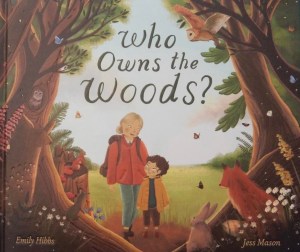
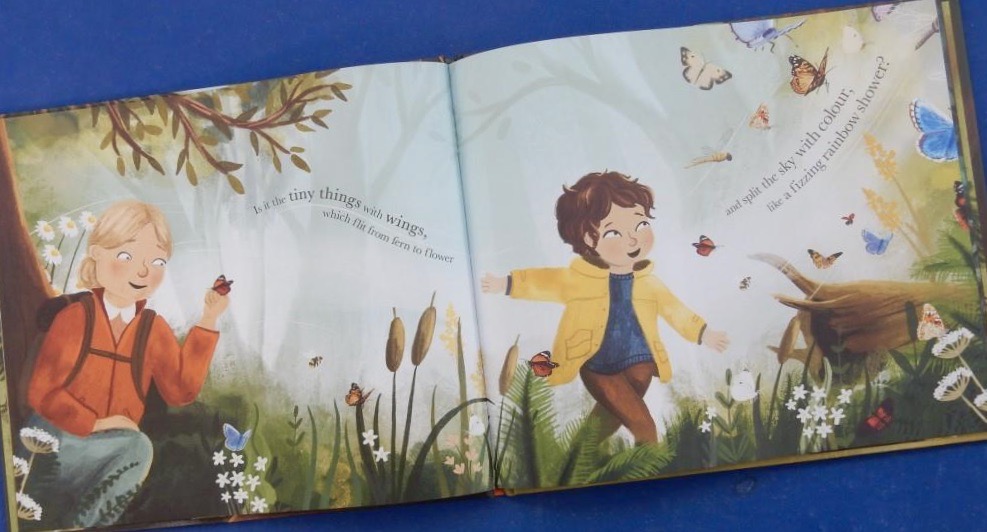
A boy and his grandma go exploring in the woods and as they walk, the child asks ‘who owns’ various natural things. Could it be one of the tiny animals they stop to observe – the spiders spinning their webs perhaps, or the butterflies with their beautifully patterned wings. 

Perhaps the woods belong to the magnificent stag, a fox or … maybe the boy himself is the owner of all those magnificent trees.

Not so, says his wise grandma; nobody can claim ownership of this particular area of woodland forest with its wealth of awe-inspiring flora and fauna; it is there for the enjoyment of every single person and moreover, as the boy himself confirms, it needs to be shown respect and treated with care.

What is needed is stewardship not ownership; that is the key message in this book beautifully illustrated by Jess Mason. Her scenes truly evoke the magic and tranquility of these special places. I really like the way the branches of the trees speak to readers serving to re-inforce the all important theme of Emily’s Hibb’s text.

Above and Below: Sea and Shore
Harriet Evans and Hannah Bailey

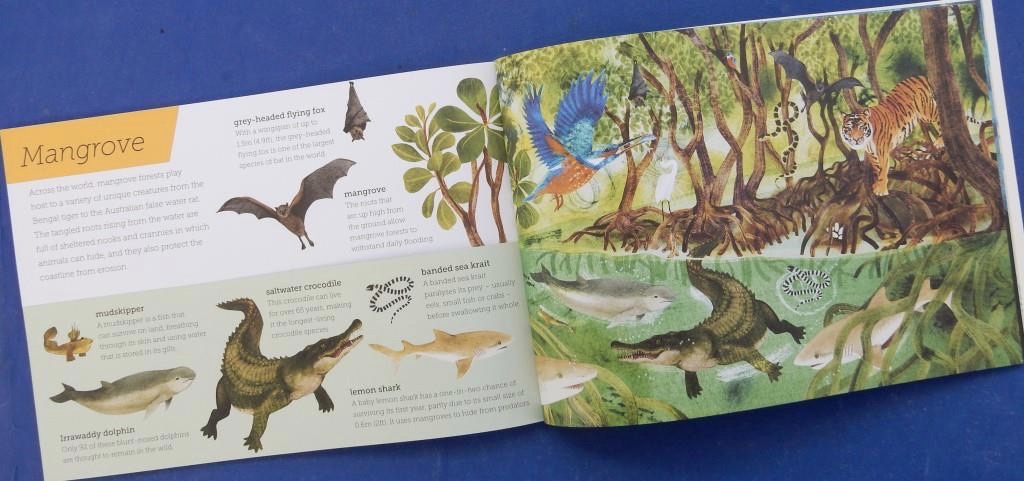
Now published in paperback, this is one of an excellent spilt page, lift-the-flap natural history series; it explores ocean habitats below and above the waves taking readers to such locations as the coastline, a sub-aquatic kelp forest, polar oceans and an estuary. There’s a visit to a tropical shore, a coral reef, a mangrove swamp and more.

The information comes in bite-sized portions making it accessible to EYFS and KS1 audiences. Children will be fascinated to discover that for instance, a lobster tastes with its legs and has teeth in its stomach and that in the forests of a mangrove swamp is a grey-headed flying fox with a wingspan of 1.5 metres, making it one of the world’s largest bat species.

The spilt pages work well providing as the title indicates, above and below views of the locations featured, each being beautifully illustrated with lots of detail: there’s so much to see.

This is a book that celebrates the natural world and gives a real sense of the sheer diversity of life in our oceans and rivers and on our shores.

Everything Changes / When You Joined Our Family

Everything Changes
Clare Helen Welsh and Åsa Gilland
Little Tiger

A parental break up is never easy for a young child and it’s certainly challenging for the young narrator of this picture book.

Clare Helen Welsh is a perceptive and skilled writer who handles difficult topics with great sensitivity, always keeping in mind that she’s creating a compelling story that is also a source of acknowledgement, guidance, and comfort. Through her sensitive words and Åsa Gilland’s exquisite illustrations we see and feel the emotional upheaval of the child from the time Mummy and Daddy announce one summer’s day against the backdrop of the seashore, that they can no longer live together.

The parents in this story both clearly very much love their child and using the natural world against which to have this story unfold is, like The Perfect Shelter, inspired. Herein we see the changing seasons as we follow the changes in the life of the three characters through the eyes of the child. Autumn brings a new house for dad, a garden with trees that shed their leaves forming a ‘blanket of red and orange’ and strong wind that causes the little one to wonder, ‘Was it my fault?’ Dad’s reassuring explanation in response calms his daughter’s inner turbulence however and her worries dissipate.

Winter brings snowy days and discussions with both mum and dad, further reassurance of their love for the narrator for ‘ it isn’t about hoping that the storm will pass … it’s about learning to dance in the raindrops!’

The story ends with a celebratory sixth birthday gathering of adults and children and the uplifting narrative conclusion, that change can bring good things and once you know that, everything changes. Åsa Gilland uses a changing colour palette for her striking illustrations that capture superbly the gamut of emotions and the different seasons of the text.

When You Joined Our Family
Harriet Evans and Nia Tudor
Little Tiger

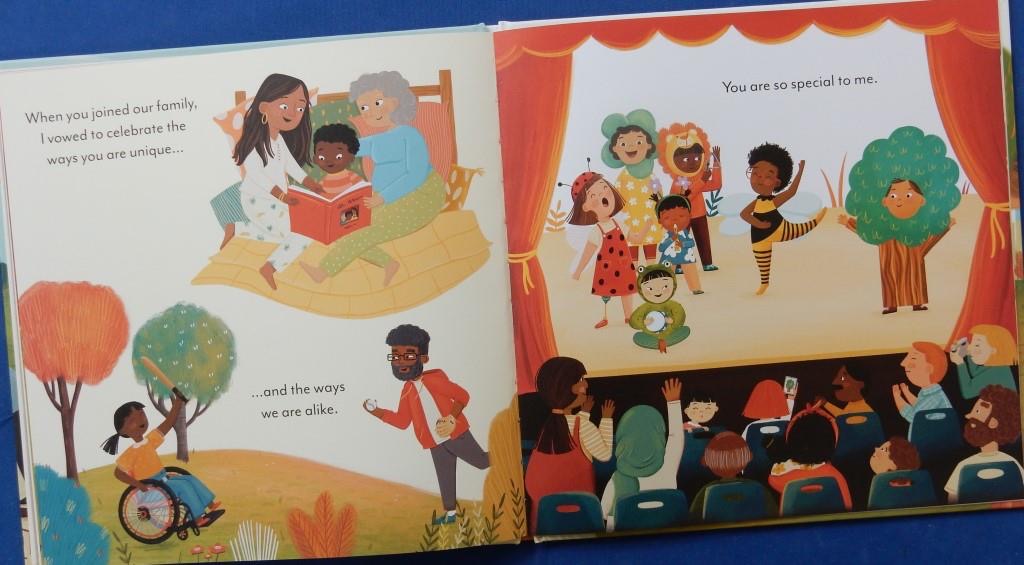
This is a wonderfully warm look at the experience of adoption and a celebration belonging in a family, seen through the eyes of several adopters. Love is the key element that unites a family and love is what shines out from Nia Tudor’s illustrations on every spread.

The children adopted might look different from their new parent(s), be differently abled, tiny babies or of school age, it matters not. In this book we share in the entire adoption experience from those very first meetings to feeling a part of something unique and special:

there’s excitement, strangeness, reassurances, pride, unconditional love, a sharing of stories, sometimes the meeting of a new brother or sister and the beginning of new family traditions. All this is presented through a straightforward, affirmative text and Nia Tudor’s beautifully patterned, details illustrations that underscore the positive nature of Harriet’s words.

Both books are musts for primary school collections. I’d also recommend any family experiencing a break up to get hold of Everything Changes, and any new adoptive parents to have a copy of When You Joined Our Family to share.

A Celebration of Board Books

Here’s a handful of recent Little Tiger Board Books – thanks to the publishers for sending them for review

First Nature: Ladybird
Harriet Evans and Bryony Clarkson

Following on from Caterpillar in this ‘first nature’ flap-book series is the equally playful Ladybird. Very young children will love Bryony Clarkson’s bright alluring, textured art and Harriet’s brief, sometimes alliterative rhyming text as Ladybird scuttles and scurries, hastens and hurries across the cleverly cut-away pages, slowing to feed, feel fear, fall and fly to the nest, finally ready to hibernate.

Elephant Elephant What Can You See?
Pintachan

Accompanied by a questioning chirpy bird friend, Elephant takes a wander in this lift-the-flap book, and the two play a kind of hide-and-seek game with the animals that are tucked away in turn, beneath the lily pad, in the tall grass, under water and behind a tree. Then, on the final spread, when the final flap is lifted, there’s a surprise mirror so tinies will come face to face with their own image.
With Pintachan’s simple, bright images and the repeat patterned rhyming narrative, this is likely to be a winner with little ones.

Beep Beep! Builders
Becky Davies and Gareth Lucas

Be ready for a noisy time when you share this with your little one. Set on a building site, we meet the boss Little B and his five co-workers. There’s Digger, Mixer, Crane, all of which are somewhat over-enthusiastic, as well as a roller and a tip-up truck. Having dug, mixed, built and lifted all day long, come sundown the boss praises their teamwork and suggests it’s time for play.
Tinies will love pressing the squishy bodies of the jolly diggers as they follow their actions and join in the rumbling, tooting, whirring and other sounds.

For a slightly older audience is

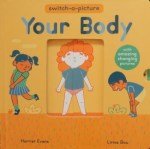
Your Body
Harriet Evans and Lirios Bou

Another of the cleverly designed ‘switch-a-picture’ books with Harriet’s rhyming presentation of in turn, the skeleton, breathing, eating, thinking and the circulatory system accompanied by Lirios Bou’s subtly coloured images of children’s bodies, first clad and then, when the central tab on each page edge is pulled, the related internal working are revealed along with additional relevant information.

A to Z: An Alphabet of Animals
illustrated by Linda Tordoff

Published under the Caterpillar Books imprint this lift-the-flap board book presents animals large and small; but where are they? They’re all hiding, just waiting to be discovered by eager fingers opening their respective initial letter flaps. Little ones can meet creatures feathered, furry, scaly and smooth all stylishly illustrated in subtle colours.

First Nature: Caterpillar / Little Hen Little Hen What Can You See? / When Mummy Goes to Work

First Nature: Caterpillar
Harriet Evans and Bryony Clarkson
Caterpillar Books (Little Tiger)

By means of a lovely playful, descriptive rhyming text – ‘Caterpillar chomps and caterpillar crunches. // Caterpillar chews / and caterpillar munches.’ and clever cutaway pages with flaps, author Harriet and illustrator Bryony present the life cycle of an eponymous butterfly.
Additional information snippets are hidden beneath the flaps making this fun for little fingers to explore, as well as little ears to enjoy.

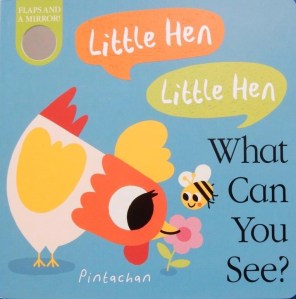
Little Hen Little Hen What Can You See?
Amelia Hepworth and Pintachan
Little Tiger

Little humans will love accompanying the little hen as it wanders around the farmyard and in response to the titular question posed on each spread by the friendly little bee, discovers the various creatures hiding in plain sight and named when the flap is lifted to reveal in turn Mouse, Cow, Horse, Sheep. Beneath the final flap is a mirror so tinies will come face to face with their own image.
The simple, repeat pattern text and Pintachan’s bold bright images of the animal characters offer a hide-and-seek game for toddlers and adults to enjoy together, probably over and over again.

When Mummy Goes to Work
Paul Schofield and Anna Terreros-Martin
Templar Publishing

This is a cleverly crafted little book, the first in a new series and it’s ideal for a parent just returning to work after the birth of a child, to share with a little one.

Having breakfasted together, Mum dons her paramedic’s uniform and bids farewell to her child, leaving Nan and Grandad in charge.

Events from her working day are then chronicled in a first person rhyming narrative illustrated with small images on each verso – driving the ambulance,

tending a patient in bed, pushing a wheel chair, examining someone’s ears.

These are mirrored in full page, detailed scenes on the recto, showing the child playing out similar scenarios.

As if speaking directly to the little one, author Paul Schofield uses the mother’s reassuring voice for the sequence of verses; illustrator Anna Terreros-Martin’s visual interpretations are an absolute delight and full of wonderful details to pore over.

Little Tiger Board Books for Little Humans

Day and Night
Harriet Evans and Lirios Bou

There are five different locations – a temperate forest, a desert (wherein I encountered a hyrax for the first time), marshes, a savannah and a steamy tropical jungle – to visit in this ’switch-a-picture’ book, both during the daytime and then, by means of a series of tabs on each recto, at night. Thus for example in the marshes rather than the seeing “Bright dragonflies swarm through blue sunny skies,’ if the tab is pulled, these disappear from the window and are replaced by a much darker sky wherein fireflies make looping patterns. While in the jungle instead of the monkeys climbing trees that are visible in daytime, a pull of the tab reveals bats.
Innovative, and engaging, with attractive illustrations by Lirios Bou and Harriet Evans’ brief rhyming text and additional facts hidden until the tabs are tugged, this is a fun book for day or evening sharing with the very young.

I Can Learn: Dinosaurs
Lauren Crisp and Thomas Elliott

New in the publisher’s I Can Learn series, Dinosaurs has both cutaway pages and flaps. Starting at the Triassic period, then moving to the Jurassic and finally the Cretaceous period, little ones can meet a host of dinosaurs both large and small. Lauren Crisp provides the brief rhyming text and questions that accompany Elliott’s enticing illustrations of the prehistoric animals set against different colour backgrounds.
There are lots of new names to learn (pronunciation provided) and the occasional surprise such as the erupting volcano, the lava of which is only revealed when you lift the flap.

Also illustrated by Thomas Elliott is

How Many Beads?
written by Nicola Edwards

Here’s a book that offers both measuring and counting fun with the aid of the string of ten beads inserted in the back cover.
Collections of items at home, in the sea, in a garden, around town,

‘my things’ and ‘at night’ are each allocated a double spread that contains guiding questions and a wealth of labelled objects. So, little ones can try counting oysters, clownfish, rocks and starfish beneath the sea as well as finding out which of the underwater creatures is the longest. (Once they get used to using the beads for measuring, an adult might introduce the idea of estimating first.)

Plenty to engage little hands, eyes and minds here.

This is Crab / The Bedtime Book

Here are two titles from the Little Tiger group that are just right to share with preschool children:

This is Crab
Harriet Evans and Jacqui Lee
Caterpillar Books

This is another interactive book from Harriet Evans and illustrator Jacqui Lee and this one has an ocean floor setting and a googly-eyed red crustacean as its central character.

We join and assist Crab as he wanders around the sea bed encountering in turn, bit part players in the form of an octopus,

some coral, sea turtles, fish of various kinds and hues as well as a Decorator Crab that our meanderer gets a tad cheeky with.

Bright alluring illustrations including several spreads with die-cut overlays will certainly engage visually, while eager fingers will enjoy responding to such instructions as ‘shake your finger at Crab, please’; ‘Try tickling Crab so he lets go’ and ‘Tap on Crab to make the crack larger’ and they’ll assuredly delight in the revelation of Crab’s new pink shell once they’ve helped peel off the cracked red one.

Words such as ‘drumroll’, ‘scuttle’ and ‘pincers’ are introduced as the action proceeds, so will likely be absorbed by youngsters as they react to the prompts to facilitate Crab’s perambulations through the story.

The Bedtime Book
S. Marendaz and Carly Gledhill
Little Tiger

Like little humans, Mouse has a favourite bedtime book. Who better to help her find it when it goes missing than Frank the dachshund but he’s just snuggled down for a peaceful night’s sleep in his kennel.

Cosy as he might be though, Frank’s not one to leave his friend to search alone so off they go together ‘scurry, scurry, scurry … pant, pant, pant’ on a book hunt. They follow a trail that leads them to Bella the cat.

What Bella tells them has all three of them scurrying and panting off again but still there’s no sign of the missing book.

Owl overhears their conversation and reveals that he had it but it’s now set to be the next bedtime story for Baby Hedgehog.

Kind-hearted Mouse won’t hear of trying to retrieve it and instead goes sadly back to bed. So too does Frank although instead of falling asleep he has a wonderful idea that soon sees him back at Mouse’s residence

where in lieu of Mouse’s book, we’ll leave the two friends snuggled together under the stars having shared Frank’s bedtime favourite …

This sweet gentle story is likely to become a bedtime favourite for pre-schoolers who will love to snuggle down and make some animal friends thanks to Carly Gledhill’s delightful portrayal of the nocturnal happenings.

In the Sky: Designs Inspired by Nature

In the Sky: Designs Inspired by Nature
Harriet Evans, illustrated by Gonçalo Viana
Caterpillar Books

Yet again, prepare to be awed by nature. This time at the way scientists and technologists have been inspired by things in the natural world, both animal and plant, as described in this book.

Did you know for example that the Wright brothers were inspired in part by pigeons when they designed and flew their first successful plane; or that the wingtips of the Airbus A350 XWB are curved like a bird to help it fly faster?
As well as such information, readers can learn how forces affect the speed of flying objects, be they birds or aeroplanes.

I was fascinated to read that the Japanese engineer Eiji Nakatsu was an avid bird watcher and when faced with the challenge of lessening the noise of the Shinkansen bullet train, he took inspiration from the Adélie penguin for the bottom half of the pantograph (device connecting the train to the overhead wires), and was able to make it more streamlined.

Architects too, have used nature as designer to influence creations such as the apartment building, Arbre Blanc in France, while Vietnamese architects have covered the roofs of some houses with trees to help lower the temperature of the locality and improve air quality. Other architects have drawn upon the hexagon shapes created by bees’ honeycombs in designs including the British HiveHaus homes, while the Slovenian social housing in Izola comprises hexagonal modules and the Sinasteel skyscraper in Tianjin, China will have hexagonal windows.

I was interested to learn scientists have copied the rough coating of moths’ eyes, using microscopic bumps on the surfaces of phone screens and other electronic devices to reduce glare;

while in the USA designers have created special screens for such devices, which bend light like butterfly wings. Amazing.

All this and other intriguing topics are covered in Harriet Evan’s text. Gonçalo Viana’s dramatic illustrations make it all the more alluring, exciting and imagination stirring. There’s a glossary too and I love the endpapers.

All in all, a super STEM book.

This is Frog / Let’s Find the Tiger

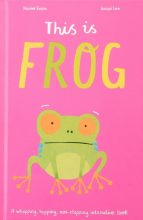
This is Frog
Harriet Evans and Jacqui Lee
Caterpillar Books

Rainforest dwelling Frog (a tree frog) needs help with everyday life and little ones can help him by following the author’s suggestions throughout the story.
Occasionally though the outcome is somewhat unexpected as when having followed him up the page, we discover Frog now upside down, but happily he can use those sticky feet to stay attached to the branch.
When he has a brief attack of forgetfulness as a swarm of yummy-looking flies are blown in his direction, he needs readers to show him how to use his tongue, and then to stop all but the one he’s savouring from buzzing away.

If Frog’s not careful he’ll be the next meal of a toucan who most definitely hasn’t come along for a friendly visit – a loud croak will warn our Frog though, along with a deft hand movement.

There’s more to do however, when monsoon rains come splashing down, especially as our Frog friend, being a tree frog isn’t enthusiastic about swimming, so help is needed to ensure that he ends the day’s adventure safe and sound on his branch to recover for his next round of froggy fun.

With a spattering of playful language throughout and a plethora of interactive opportunities for little ones to perform, Harriet Evans’ narrative should keep them interested throughout.

With occasional cutaway pages, Jacqui Lee’s amusing illustrations of Frog in his lush habitat make for a fun book to share with the very young, and along the way they might absorb a few Tree froggy facts.

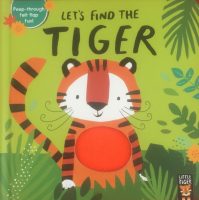
Let’s Find the Tiger
illustrated by Alex Willmore
Caterpillar Books

In this seek-and-find, peep through, felt flap board book, little ones are invited to find Tiger. The playful creature has hidden away somewhere in the jungle wherein live lots of other creatures some of which when almost completely hidden away behind the flora or even in the water, might at first glance be the animal they’re looking for.

But the supposed long stripy tail, sparkly white teeth, curly whiskers,

and striped curvy objects are not Tiger.

Could the dark, tucked away location be its hideaway?

With an engaging question and answer, repeat refrain narrative and Alex WIllmore’s colourful jungle scenes to explore, this is both fun and gently educative.