How To Stop The End of the World

Col Coleridge is facing a boring summer holiday especially as his parents are far from happy about the time he spends on his Xbox; time they think he should be spending keeping himself fit, especially as he’s just messed up a relay race his family were running in. Then Col notices some strange chalk markings on the pavement close to his home, followed shortly by the appearance of strangers acting suspiciously who claim to be to do with installing super fast broadband in the locality. Could they be burglars perhaps? Col decides to dial 999. However the police and his parents, who are both solicitors, are not at all impressed.

Having had a somewhat strange conversation about strangers in his garden with his young golf fanatic neighbour Noah, Col goes out and formulates a plan, the first part being to further investigate the strange markings. While so doing he encounters Lucy who has only recently moved to the area; she too is intrigued by the markings and is sure they are not to do with broadband. They are runes she informs Col, Anglo Saxon runes.

Another strange thing is that having put up special cameras given him by Lucy, Noah and his dad become convinced they are to spy on Noah’s golfing shots and come a-knocking on the Coleridge’s door to complain. Of course Col doesn’t tell them the real purpose is to watch for the strangers but says he’s bird-watching.

Things get progressively crazier as both Col and Lucy embark on a quest that involves combat re-enactment, an ancient mythical sword, a curse and a mission to save the world.

The writing is bursting with droll humour as the pacy plot twists hither and thither towards the dramatic denouement. A book that will work well as a KS2 class read aloud and for individual readers.
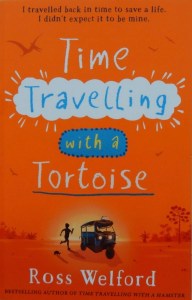
Time Travelling with a Tortoise

This is the brilliantly inventive sequel to Time Travelling with a Hamster wherein Al (Albert Einstein Hawking Chaudhury) and his hamster, Alan Shearer, time travelled into the past to prevent the accident that would prematurely end his father’s life.

This has set everything back the way Al thinks it should be: no infuriating stepfather and no thoroughly annoying stepsister, though somehow it isn’t so. The laws of spacetime are set up to have the last laugh, as Al’s Grandpa points out.

But then an accident in his tuk-tuk for which Al blames himself, leaves Grandpa Byron – he of the truly amazing memory – struggling to remember things. Consequently Al decides to risk another trip back in time, taking with him two companions and they find themselves in a prehistoric dimension where dinosaurs roam. To say things don’t quite go as intended is putting it mildly; they’re way more complex than he ever expected and include that titular tortoise.

Readers will be swept away as Al grapples with the unintended aftermath of his actions; we too feel his guilt, determination, and fear as he navigates the ramifications of his choices.

What a brilliant mix of poignancy, humour and gripping excitement Ross Welford has created once again; but at the heart of everything, quantum physics and all, is the enduring power of human love. I thoroughly endorse Grandpa Byron’s philosophical comment as he and Al sit together at the end, “Sometimes… not getting exactly what you want turns out to be the best luck of all.”

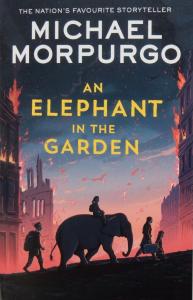
An Elephant in the Garden

This image has an empty alt attribute; its file name is dscn9988-1.jpg

First published some ten years ago, it’s good to see this tale now made available to a new audience. It was inspired by a real life rescue of an elephant during World War 2.


From her bed a frail old lady named Lizzie, resident of a Canadian nursing home, relates her story to her nurse and the nurse’s son, Karl, who reminds Lizzie of her young brother.


During WW2, Lizzie, then sixteen, her pacifist mum, Mutti, and her younger brother Karli lived in Dresden. Their peace-loving Papi was called to fight, Mutti went to work at the Dresden Zoo with the elephants. She had seen a small elephant born and named him Marlene. Rather than have the creature subject to mercy killing like the other zoo animals, should Dresden be bombed, she had persuaded the zoo keeper to let her take the baby elephant home to her back garden and care for it.


When Dresden comes under heavy bombing in 1945 and the city is destroyed. Lizzie, her mum and Karli decide to escape into the country and head with the elephant, towards Uncle Manfred and Aunt Lotto’s farm. At first they think the place is empty but in a barn they come upon Peter, a Canadian flyer who has bailed out of his plane. What does one do when encountering an enemy combatant? Mutti is conflicted but Lizzie is immediately drawn to the young man. Together they all make their way on a perilous trek towards the American lines, helped at one point by a Countess who asks them to take a homeless school choir along with them. As they journey Lizzie becomes ever closer to Peter.


Eventually, despite Peter’s best efforts, Mutti and the children are sent to a camp along with other displaced Germans and Peter returns to Canada promising to come back and marry Lizzie. Is he able to keep that promise? And what of Lizzie’s Papi? Does he survive the war?


A gripping, enormously moving tale that offers an unusual perspective on what was a horrendous time for countless numbers of people. I read it in a single sitting.

Whirly Twirly Me

Sometimes children get so overwhelmed by their feelings that they find them impossible to control: so it is for the little girl protagonist in the story Manjeet Mann tells.

From the moment she wakes up, the girl talks of feeling a ‘bit whirly, my insides a bit twirly. my stomach in a knot’ which results in a strop, then a flop and at breakfast time, her elder sister takes the last of her favourite cereal. Hmm! This tangled turmoil continues all the way to school despite Mum promising to replace the cereal but things get even worse. A boy takes her favourite pencil to use, friends play a new game, which she doesn’t understand,

Lola tells her, “You’re no fun” and refuses to play.

Back home, on hearing about their daughter’s anger at school, her parents tell her that it isn’t acceptable to get angry for no reason; but still that whirling twirling persists. Up in her bedroom our narrator is overwhelmed and unable to stop stomping until up comes Mum.

As the two sit together and talk, those knotty feelings begin to dissipate until, reassured by hearing that ‘It’s normal to feel all those feelings,’ … It’s all part of who she is, the child finds a smile, a hug and a way to move forward.

Amanda Quartrey’s illustrations immediately take hold of you, as you follow the progtagonist through her day of small upsetting dramas that mount up and up into something really big.
A good book to start a classroom discussion about emotions.