Britannica’s Baby Encyclopedia / Night-Night Animals

Britannica’s Baby Encyclopedia
Sally Symes, illustrated by Hanako Clulow
Britannica Books

With just over seventy pages in all, this board book first encyclopaedia is divided into sections: our world, animals, plants, body, food, machines, art & music, shapes and numbers, every one of which is beautifully illustrated in bold colours. Each section begins and ends with a full page picture and the accompanying suitably simple text is thoughtfully worded to read like an opening and finale. 
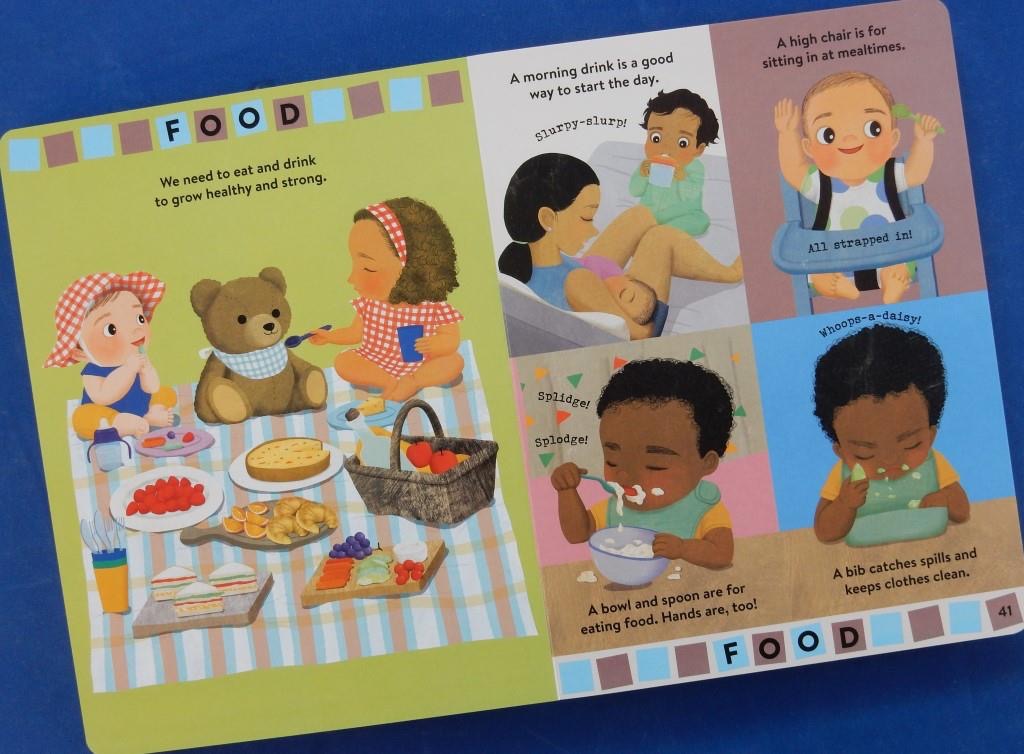
For example Our World starts thus: ‘Our world is a place called Earth. In the morning, the sun comes up and the day begins.’ and concludes, ‘At the end of the day, the moon and stars light up the night sky.’ So, it would work well if an adult and child shared the book, one section per sitting. Little ones will love joining in with all the ‘sound’ words: this section has ‘Plip-plop!’ ‘Flitter! Flutter!’, ‘Gurgle! Burble!, ‘Crash! Smash!’ and several farm animal noises. 

Just the right amount of information is included in each section to engage small children, while also enhancing their vocabulary and knowledge.(A consultant Dr Amanda Gummer was used to this end.) It’s good to see that care has been taken to include a diverse range of humans in every topic presented.
A book to add to family collections if there is a very young child.
Night-Night Animals
Patricia Hegarty and Thomas Elliott
Little Tiger

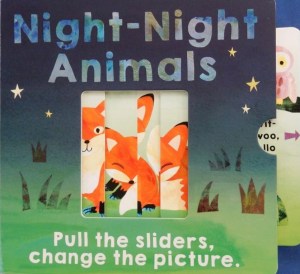
This ‘pull the sliders, change the picture’ title takes little ones to various natural locations where it’s time for the fauna to go to sleep. First visit is the forest wherein there are rabbits, deer, a fox, a mouse and a nesting bird. Which one is nocturnal and needs waking with the help of the slider?
The savannah animals all seem to have shut their eyes already except for one; he needs help to get to sleep. The deep sea has lots of sleepy creatures large and small but one with eight limbs needs the reader’s help. After helping whichever of the rainforest animals is wide awake, it’s the turn of little humans including one very bouncy person who has to stop all those boings.

A fun, interactive bedtime book for the very youngest children who will enjoy assisting the animals before nodding off themselves.

The Journey / Sounds of the Wild

Here are two books from Little Tiger featuring amazing wildlife from different parts of the world

The Journey
Jonny Marx and Hanako Clulow

Nature’s greatest journey begins on the parched Serengeti plains and follows the herd of zebras as they make the arduous, annual migration across the dusty, sandy terrain. It’s a long trek, battered sometimes by wind, before they reach the waterhole where they stop to quench their thirst.

The zebras are not the only animals to undertake the journey; there are elephants, boars, birds and giraffes too, all bound for the watering place eager to drink their fill.

Ahead though, lie green pastures and that is where these animals are heading. but first there’s a swim ahead across crocodile infested waters.

Once safely on dry land again the verdant grasslands stretch as far as the eye can see and then down comes the rain – in huge torrents. Ahhhh!

There (so the author’s note on the title spread tells us) they remain for two months feasting on the abundant grass before it’s time to make that long, long journey back once again.

After his rhyming narrative that really conjures up the landscape of the journey, Jonny provides more information about plains zebras. I was amazed to learn that each zebra’s striped pattern is unique and that a zebra’s kick is so strong it can kill a lion. Hanaka Clulow’s illustrations too capture the sandy plains and the animal inhabitants, and have an almost photographic quality.

Sounds of the Wild
Moira Butterfield and Stephanie Fizer Coleman

Immerse yourself in the pages of this book and you can visit nine island locations where you can see and listen to a variety of their animal inhabitants.

Each double spread introduces a different habitat and its wildlife be that a jungle in Madagascar with ring-tailed lemurs, its predator if it catches one, the fossa, tomato frogs and stunningly coloured birds. By pushing the ‘Press Here’ button readers can hear the lemur’s call.

You can also hear an elephant seal (South Georgia Island),

a bellbird (Isla Escudoo de Veraguas), sooty terns (Ascension Island), a Komodo dragon (Flores), polar bears on Svalbard, a humpback whale (around the Azores), marine iguanas,(Galapagos)

and a tiger (Sumatra).

After the eco-system island tour, there’s a world map showing each habitat’s location., an index and finally, an ‘animals under threat’ page mentioning the endandered status and threats to six of the animals whose sounds were heard. Warning cries indeed.

Each spread is beautifully and brightly illustrated by Stephanie Fizer Coleman and Moira Butterflied provides short factual paragraphs on each of the animals shown. Those who love wild animals will enjoy this and doubtless wear out the battery, leaving the animals voiceless until it’s replaced.

10 reasons to love a bear / 10 reasons to love a whale

10 reasons to love a bear
10 reasons to love a whale

Catherine Barr and Hanako Clulow
Lincoln Children’s Books

This engaging series of fun animal books for younger readers from Barr and Clulow, working in conjunction with the Natural History Museum, has two new titles.

The first features the eight bear species: the polar bear, the sun bear, the sloth bear, the American black bear, the brown bear, the Asian black bear, the spectacled bear and the giant panda.

Did you know that bears, with the exception of the bamboo only eating giant pandas, will consume pretty much whatever they can find be that fish, meat, berries or bark; and some honey loving bears will tear trees apart to access a bees’ nest and sometimes even lap up the bees. Ouch!

Have you ever seen a bear dance? I certainly haven’t but they rub their backs against tree trunks and do a kind of wiggle dance to leave a scent for other bears, either to attract a mate or scare off a rival.

Giant pandas so we’re told though will do a handstand to leave their mark.

Another way in which bears communicate is through sound: they might snort, growl, grunt or cough; and mother bears and their cubs hum if all is well. Panda bears on the other hand make a bleating sound.

All this ursine information and more, together with five ways humans can show they love bears, can be found in 10 reasons to love a bear.

The subject of 10 reasons to love a whale is the blue whale.
These enormous mammalian creatures are, when fully grown, around 30 times heavier than an elephant and have a heart the size of a small car. Amazing!

A blue whale’s mouth too, is gigantic, and its tongue alone weighs as much as an elephant.

Sadly these amazing animals are still a threatened species and their survival depends on we humans.

Most children, in my experience are fascinated by blue whales and so, I suspect, they’ll be eager to dive into this book.

Add these two to your primary school class collection or topic boxes.

10 Reasons to Love: an Elephant / a Turtle & Dolphin Baby

10 Reasons to Love an Elephant
10 Reasons to Love a Turtle

Catherine Barr and Hanako Clulow
Frances Lincoln Children’s Books
Two titles published in collaboration with the Natural History Museum focus on what makes the particular animal special.
Each is sandwiched between two sturdy covers with a die cut of the animal through the front one and a double spread is devoted to each reason.
I didn’t need any persuasion to love elephants mainly because of frequent encounters with the Asian variety on my numerous visits to India. (I’ve never seen any with googly eyes however.) In addition to the reason that gives each spread its title, there is plenty more to enjoy. I was fascinated to learn that elephants ‘wrap their trucks around each other in warm greetings’ and that ‘they understand how other elephants feel.’ Here for example one can see a beautiful Indian swallowtail butterfly, a common rose butterfly and a common bluebottle butterfly among the flora.

Children will I’m sure be amused to learn that forest elephants eat seeds that pass through their bodies and out in their poo, and then the seeds start growing in their dung making them “good gardeners’ for their role in seed dispersal. Equally they might, having read the ‘Show You Love an Elephant’ badge, want to look online and find how to buy some paper made from recycled elephant poo.
Ecologist, Catherine Barr’s text is very reader friendly and Hanako Clulow’s illustrations offer plenty to observe and discuss.
10 Reasons to love a Turtle features the seven different sea turtle species and interestingly, ‘gardening’ features herein too,

with sea turtles acting like ‘underwater lawn movers’ grazing on the seagrass and keeping it the appropriate length for fish, crabs and seahorses to make their homes in.
At the end of the book, readers are reminded of the threat that pollution, fishing and hunting pose to these gentle animals.
With their environmental focus, these would be worthwhile additions to classroom libraries; as well as for interested individuals, who it is hoped, might turn into conservationists.

Dolphin Baby
Nicola Davies and Brita Granström
Walker Books
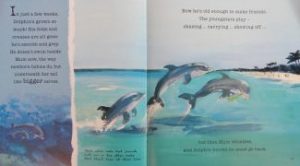
‘Tail first, head last, Dolphin POPS out into the blue.’ What could be a more engaging way to start a book of narrative non-fiction? But then this is zoologist Nicola Davies writing and she knows just how to grab the attention of young readers and listeners and keep them entranced throughout.
Here, through the story of Dolphin and Mum, she describes the first six months of a baby calf’s life as it learns to feed, to acquaint itself with and respond to her call, and to explore its world playing, making friends …

and all the while he’s growing and developing his very own whistle to communicate that he has at six months old, caught his very first fish.
The text uses two fonts: the large provides the narrative with additional facts given in smaller italics; and the final spread reminds readers that dolphins need protecting from pollution, from over-fishing and from the careless use of fishing nets.
Brita Granström’s superb acrylic illustrations grace every spread helping to make the book a winner for both early years and primary school audiences.

I’ve signed the charter  

The River / Wilderness: Nature’s Wonders

%0A

The River
Hanako Clulow and Patricia Hegarty
Caterpillar Books
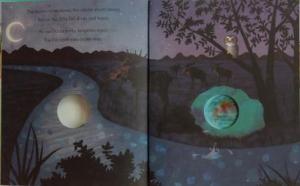
‘In snow-capped mountains among the firs/ The north wind blows; something stirs./ Through icy water, a small fish darts -/ This is where her journey starts …
We join that shimmering, glimmering fish as she journeys down river starting from the snow-capped mountain peaks, swishing past dense mountain woods …

%0A

and pine forests, through ever-changing landscapes as she travels by day and night …

DSCN8410

and through the seasons, on her epic swim to the vast, deep open sea ‘where she’s meant to be!’ – a sea populated by a shoal of sparkly fish.

DSCN8390

Readers delight in joining the fish on her journey, making her swim faster or slower by tilting and angling the book, viewing her as an ever-in-motion hologram (set inside the back cover) through a die-cut hole that keeps her, mid-stream, on every spread. Read it first to play with the fish and then turn back and re-read the whole, savouring Patricia Hegarty’s lyrical rhyming text and being spell-bound by the wonderful wildlife scenes rendered in soft, matte textured, illustrations. The richly detailed, painterly style shows feathers and fur as if close up …
%0A

as well as the gorgeous hues of the surrounding flora of the landscapes.
What a superb testament to one particular river, and to the rich abundance of flora and fauna through which it flows and of course, to one little fish on its migratory journey. SO much to see, SO much to think about, SO much to relish.

DSCN8411

Wilderness
Hannah Pang and Jenny Wren
360 Degrees (a Little Tiger imprint)
Subtitled ‘An Interactive Atlas of Animals’ this has visual appeal in bucket loads and it’s highly informative too. It introduces readers to a variety of habitats in both Eastern and Western Hemispheres and then focuses on different habitats in turn allocating a double spread to each one. We embark on a tropical rainforest ramble (visiting various locations as not all the animals featured are found in the same part of the world),

DSCN8383

a safari in the hot grassy savannahs of Africa, join an ocean dive and search, visit a freshwater location, the desert dunes, polar regions and high mountain pastures and forests, complete with pop-up mountain …

DSCN8381

Snippets of information abound on every location spread and there are flaps to lift enabling readers to discover more about the various animals resting upon them; there are even mini booklets on Bugs, Creatures of the Deep, the Honeybee and the salmon life-cycle.

DSCN8384

There’s a tiny life-cycle book on the left …

So, we have some desert dunes populated by Arabian camels, Addax (rare creatures also called Screwhorn antelopes), a vulture, a Namib Dune Gecko, a rattlesnake that leaves tell-tale tracks in the sand, hairy, scary giant scorpions and tarantulas; and there’s a side wheel which when turned shows the enormous range of temperatures of the habitat. (sub zero at night and 45 degrees C at mid-day).

%0A

Rotating wheel top left …

Chock-full of details, rich in the colours of mother nature’s palette, and sturdily designed and built to withstand frequent handling, this is one to engender a sense of awe and wonder about the natural world, and highly recommended for the family bookshelf and a must-buy for early years and primary school classroom.

WNDB_Button localbookshops_NameImage-2