My Mindful A to Zen / Being Healthy / Learning

My Mindful A to Zen
Krina Patel-Sage
Lantana Publishing
As the author/illustrator points out after presenting twenty six haiku ‘for happy little minds’, each of the entries in this book highlights one or more of the ‘five ways to wellbeing’, known to boost mental health and positivity: connecting,

being active, taking notice, keeping on learning and giving.

No matter whether youngsters prefer the great outdoors and all that has to offer,

or to stay indoors getting lost in a good book, or being creative with their favourite materials,

or perhaps spending time in the kitchen cooking a yummy cake (even if it doesn’t quite go to plan), done mindfully, it can be part and parcel of getting the very best out of life.

With its diverse cast of characters bringing to life this alphabet of contented being and doing, Krina Patel-Sage offers youngsters much to think about, talk about and act upon. This teacher/yoga teacher and reviewer heartily endorses this well-being picture book.

Also for fostering children’s wellbeing:
Being Healthy
Learning
Helen Mortimer and Cristina Trapanese
Oxford Children’s Book

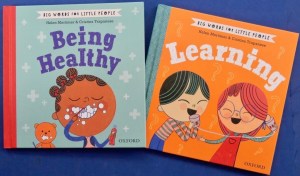
These are two new titles in the Big Words for Little People series that offers a very useful resource to early years teachers and other practitioners as well as parents of young children.

Using age-appropriate language, Helen Mortimer takes little ones through the day doing those activities that should foster their Being Healthy. There’s personal hygiene washing and tooth brushing, eating ‘wholesome’ food and drinking plenty, taking exercise that works their muscles, as well as engaging in mood boosting activities, getting out in the sun whenever possible. There are also spreads on allergies, doing things in your own way, being aware of and avoiding potential dangers, the helpers who might provide treatment when there’s an accident or illness, and finally, very important comes sleep.
Inclusive, engaging and interactive, as is Learning. This is a huge topic that begins at birth and continues throughout life but to get the most from it, that learning needs to excite the learners and that’s what this little book aims to do. It encourages questioning, problem solving, taking advantage of technology, developing good concentration, trying hard and taking risks with learning, as well as keeping the mind open to new ideas. Like previous titles, both books have Cristina Trapanese’s lively illustrations, a spread with helpful ideas for adult users and a glossary.
Together / Insect Superpowers

Red Reading Hub looks at two interesting, unusual and very different ways of presenting non-fiction:

Together
Isabel Otter and Clover Robin
Caterpillar Books

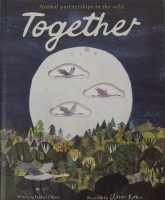
By means of gorgeous collage style, die cut illustrations and a series of haiku accompanied by factual paragraphs, illustrator Clover Robin and writer Isabel Otter present a nonfiction nature book that looks at animal partnerships in the wild.

Beginning thus: ‘ A vast migration. / Cranes take turns to lead their flock: / The feathered arrow.’ and explaining that when cranes migrate and the leader of the group becomes tired, another takes its turn to lead and so on.

The migrating cranes fly above in turn, a pack of wolves; a herd of chamois deer; and a pod of pilot whales. They then pass above a shark that has its skin kept parasite free by remora fish that get a free lift;

anemones kept clean by goby fish; a badger that works with a honey guide bird; a crocodile that has its teeth cleaned by plovers; a herd of loyal elephants; giraffes with oxpecker birds that help keep down their fleas,

and finally, zebras and ostriches that use their complementary sense organs to alert each other to danger.

At last the cranes reach their winter feeding grounds and their journey is over – for the time being.

A fascinating way of presenting non-fiction that offers youngsters an introduction to an intriguing aspect of animal life.

Insect Superpowers
Kate Messner, illustrated by Jillian Nickell
Chronicle Books

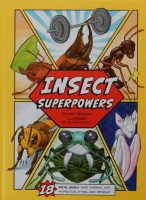
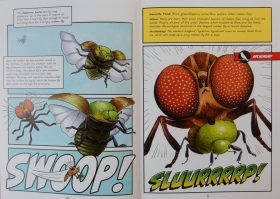
Taking advantage of the seemingly never-ending popularity of superheroes, author Kate Messner and illustrator Jillian Nickell present in action-packed, graphic novel format, an alluring array of eighteen insects with extraordinary abilities.

Before plunging readers into the specifics of the various insects’ superpowers, Messner provides an introduction to insect orders and using the Monarch butterfly as her example, shows how biological classification works.

Dramatic illustrations immediately snare the reader’s attention as they confront the bugs one by one starting with in the first FAST & FIERCE chapter, ‘Supersonic Assassin Giant robber fly – more like a supervillian – that uses its venomous spit to paralyse its prey.

Also in this chapter are The Decapitator aka the Asian giant hornet with its painful sting and fierce jaws that often rip bees apart before stealing their larvae and feeding them to their own hornet larvae.

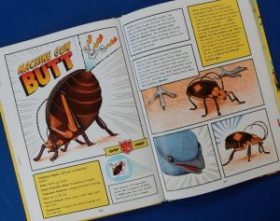
Other chapters feature insects that use mimicry (the ‘Great Imposters’); the ‘Big & Tough’ bugs some of which are among the strongest creatures on earth; then come the ‘Masters of Chemical Weaponry’. I definitely wouldn’t fancy being sprayed by the hot noxious mist that the African bombardier beetle can emit from its abdomen when something bothers it. Yikes!

Further chapters are devoted to ‘Engineers & Architects’ and ‘Amazing Ants’ (although some of the insects in the previous chapter are also ants).

For each insect included there are facts about habitat, size, diet, allies and enemies, and of course, its superpower.

If you have or know children who are into superheroes but have yet to discover the delights of insects, this book that’s all a-buzz with superpowered bugs might just fire up their enthusiasm.

Earth Verse

Earth Verse
Sally M.Walker and William Grill
Walker Studio

The earth is a vast entity orbiting in space: haiku as a poetic form is by nature brief and spare. The combination of the two makes for a truly stunning picture book particularly when the artist is a recent Kate Greenaway medal winner William Grill and the author Sally Walker, a Sibert medal winner some years ago.

The book focuses on Earth’s geological and meteorological aspects beginning with its place in the solar system: ‘third one from the sun. / Earth’s blue and white majesty / dwarfs her lunar child.’

We then move inwards ‘fragile outer crust. / shell around mantle and core – / Earth: a hard-boiled egg.’ How cleverly and succinctly Walker introduces scientific vocabulary into her poetry and you’d find it hard to get more playful than her description of minerals and metals as ‘glittery Earth-bling’;

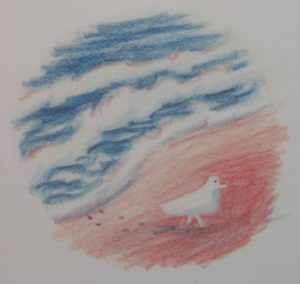
more beautiful than ‘sediment-filled waves / tumble in a frothy foam … / a gull wears sand socks

or more dramatic than ‘hot-headed mountain / loses its cool, spews ash cloud – / igneous tantrum’.

For each of these small poetic gems, and the others, Grill provides a wonderful atmospheric coloured pencil illustration in his trademark style that is frequently more impressionistic than realistic and never overwhelming the words.
Right in the bottom corner of each spread or sometimes page, is a symbol.: earth, minerals, rocks, fossils, earthquakes, volcanoes, atmospheric and surface water, glaciers and groundwater. Each of these links to the final section of the book where additional prose information on the nine topics is provided, and there’s also a list of suggested further reading.
This surely is a book to encourage children (and adults) to pause and to wonder at the awesomeness of the world and all its natural beauty.

Origami, Poems and Pictures

Origami, Poems and Pictures
Nosy Crow
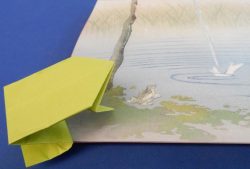
This truly beautiful book is published in collaboration with the British Museum and its publication coincides with the Museum’s Hokusai exhibition, Beyond the Great Wave. That picture is just one of the thirteen (all belonging to The British Museum) featured in this celebration of three Japanese arts and crafts: origami, haiku poetry and painting (all but one are woodblock prints) and with it the delights begin. Making the paper boat (after reading the associated haiku and pondering upon The Great Wave picture, I’d suggest) is one of the easier (1st level) projects. I already knew how to make that so passed on to something else at the same level to get my hand in: I chose the frog …

really because I already love the accompanying Bashō haiku:
the old pond,
a frog jumps in –
the sound of water.

before proceeding to something challenging. For my origami frog I used ordinary paper cut to a square and on the thick side;

but included at the back of the book is a pad of 50 sheets patterned on one side, plain on the other, which are the ideal size and weight for the projects.
Each of the projects is graded and there is a mix of each of the three levels of difficulty, the third level requiring considerable dexterity, not to mention patience. I absolutely loved the graceful crane and the dragonfly.
You’re guaranteed many hours of pleasure from this absorbing and stunning book; and should you require some further instruction with the origami, there’s a QR code on the index page which provides a link to step-by-step ‘How to’ videos.

I’ve signed the charter