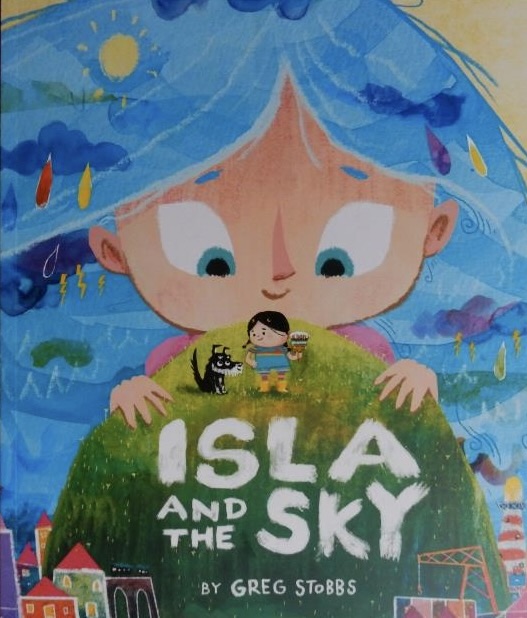
Isla and the Sky

Isla sees Sky differently from other people and this is reflected in her paintings. Sky has a variety of moods: sometimes she is rainy and people complain about her dreariness and grumble about the awful weather. Isla however loves the sky on the days when it rains – those dancing, swirling clouds – and with her paintbrush she creates swirls of purple, white, brown, blue, pink and many kinds of black she sees. She loves the sunset on such days and brushes gentle pink and pale yellow across her page. Equally she loves the deep inky black sky on a cloudy night and paints that too.

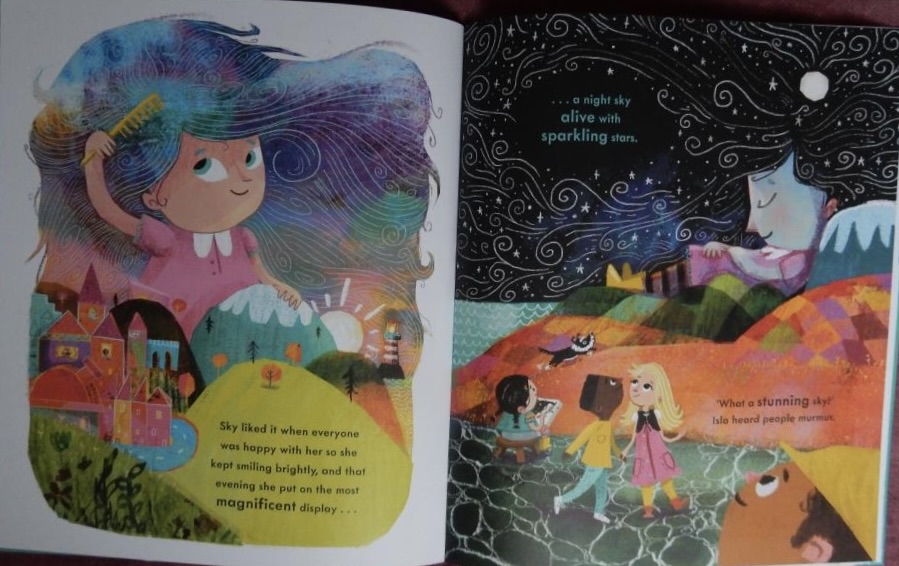
Come morning Isla’s bedroom is filled with sunlight and this bright blue delights everybody. “If only every day were like this,” Isla hears them say. This is a day to use her bright blue paint. The sky that night is gorgeous – star filled and stunningly beautiful. Several days and nights like this ensue: Sky smiles and Isla paints, again and again and …
The lack of rain causes the landscape to change, Sky’s smile starts to fade and Isla’s paintings are boringly the same for she misses the variety of weather. The girl is just about to give up painting but decides to try something different first. She climbs high up a mountain and calls to Sky offering her help. Sky finally sees Isla and explains why she’s been people pleasing rather than being true to how she feels. Isla’s encouraging words and her paintings might just change this.

How will the people react if Sky reverts to expressing her true emotions? And will Isla start painting again?

A touching tale of emotions and artistic representation, gorgeously illustrated by the author showing how important it is for big feelings to be understood and supported.

Cloud Boy

No matter how hard he tries, Bobby’s attention keeps wandering and he finds it hard to stay still. When he becomes distracted, he starts floating upwards and the more his imagination takes over, the higher he goes. His friends, his mum and his teacher try to help but there are so many things that draw his attention away from the everyday things – the colour of a bird’s song and the idea that the moon might get lonely – for instance. Bobby really does want to concentrate like his friends Jess and Nelson, to be organised like his Mum and focused like teacher, Mr Brian, but it only works very, very briefly and makes the boy very tired. His friends and family devise a plan.

However, this restraint makes him feel empty, devoid of imagination and so he cuts himself free. The result is immediately uplifting, leaving friends and family pondering upon how to get the boy down. Perhaps they should try looking at things from Bobby’s viewpoint …

This uplifting story shows the importance of understanding and valuing neurodivergence: it appears that Bobby has ADHD and author/illustrator Greg Stobbs, has drawn on his personal experience in creating the book. I love his use of pink neon to represent Bobby’s imagination.

An important story to share and discuss.

What The Crow Saw Below

As the story starts we meet a curious young crow who is doing as she’s told, looking down and squawking a warning at anything and everything she sees beneath her on the forest floor. while the others are asleep though, our young crow looks around to see what’s going on. Seemingly there’s nothing sinister at all: could her elders be mistaken?

Then, tired of looking for supposed dangers below she finds the courage to look up and see what she can discover. The older crows are horrified but this doesn’t stop the youngest corvid not only looking but moving upwards. Bravely she takes to the air and then accepts the invitation from a different kind of bird to join them.

Deciding that she can then return to the other crows and encourage them to ‘throw caw, caution to the wind’, she finally leads them all upwards and life begins anew, with a positive, hopeful attitude (and of course, a modicum of caution.)

A terrific rhyming telling with descriptive language that excites and includes alliteration and other clever word play by Robert Tregoning and Greg Stobbs’ illustrations that wonderfully complement the words, this is a joy to share with young listeners. I love a book like this one that encourages children to think for themselves and to focus on the positive things in life. Definitely one to enjoy and talk about both at home and in the primary classroom.