No. 5 Bubblegum Street

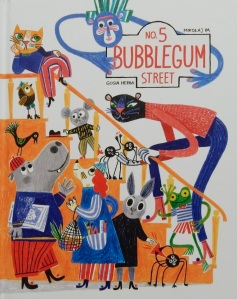
Translated from the original Polish by Scotia Gilroy, this picture book takes readers inside the apartment building at No. 5 Bubblegum Street. It’s five pm we’re told by our tiny, friendly insect narrator, who lives in the top floor apartment, number 11.

One by one, we are introduced to the residents of each floor, the first being Mouse, a famous rapper preparing to go out. Mouse is frantically searching for his hat to complete his outfit. Apartment two is home to some monkeys and we join them in their kitchen as they bake a delicious “speckled orange orangutan cake” Apartment three, owl’s residence is currently empty; all we see is evidence that Owl enjoys games of different kinds.

There’s also Cat, lover of birdsong; Panther who is mad about house plants, a family of spiders, musicians all, a slumbering Hippo,

frogs, a sculptor dog and Bat ready and willing to share a twenty one move dance routine.
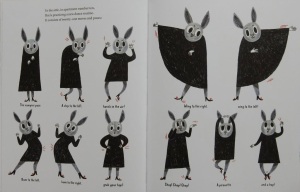
Come 6pm all these neighbours meet on the rooftop terrace where they each contribute their particular talent to a party and a great time is had by all.

This will appeal to children who enjoy poring over detailed illustrations, especially of the quirky kind. Full of movement and joyfulness, Gosia Herba’s, executed in bright pencil colours, are certainly that.
Powered By Plants

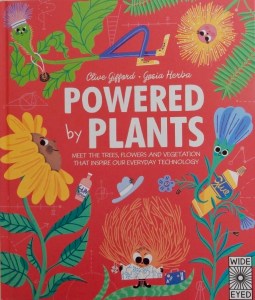
Powered by Plants
Clive Gifford and Gosia Herba
Wide Eyed Editions

How many people I wonder are aware of the wealth of cutting edge science and technology of yesterday, today and the future, that involves members of the diverse plant world found in the many ecosystems on our planet? Some of this rich diversity is being increasingly studied and copied, inspiring innovations in design, science, engineering and technology. This third book about biomimicry introduces some awesome plant inventors. Prepare to be awed for as Tumbleweed says in the book’s introduction, plants are the experts and you’ll likely never look at flowers, trees or seaweed in the same way again.

There are six main sections: Structures, Robotics, Energy, Health, Sustainability and Materials and a final look to the future. Each plant is allowed to speak for itself and informs readers about such things as how it grows and why its particular structure is or was, so useful to humans. All this fascinating information is broken up into bite-sized chunks placed in fact boxes and embedded in a funky, colourful illustration by Gosia Herba.

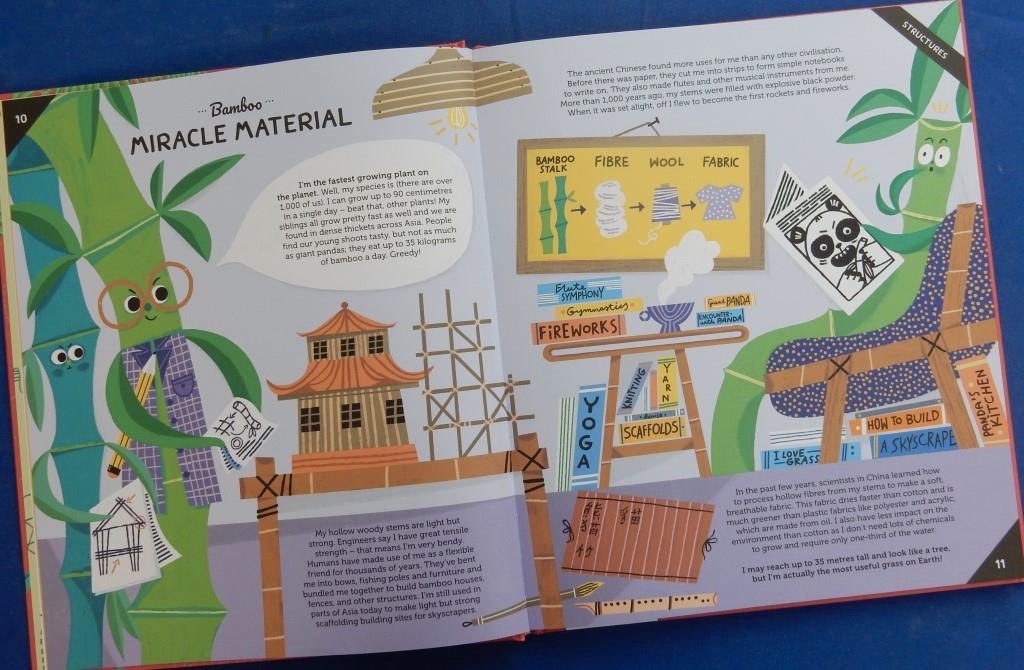
If you’ve ever wondered what the fastest growing plant on the planet is, no it isn’t dandelions or that pesky Himalayan balsam that seems to be choking up so many of the UK’s waterways, it’s actually bamboo and there are more than 1,000 different bamboo species. With its high tensile strength bamboo has been used to build houses in Asia and is still used to make scaffolding. Perhaps more exciting though is that some scientists in China now know how to process the hollow fibres from its stems to make a soft, breathable, very fast drying fabric that is much more environmentally friendly than acrylic, polyester and even cotton.

Five other plants present their super powers in the Structures section including the ‘earthquake proof’ coconut palm, the fruit of which has a multitude of uses including in the production coir, a mosquito repellent, coconut milk and of course, coconut water.

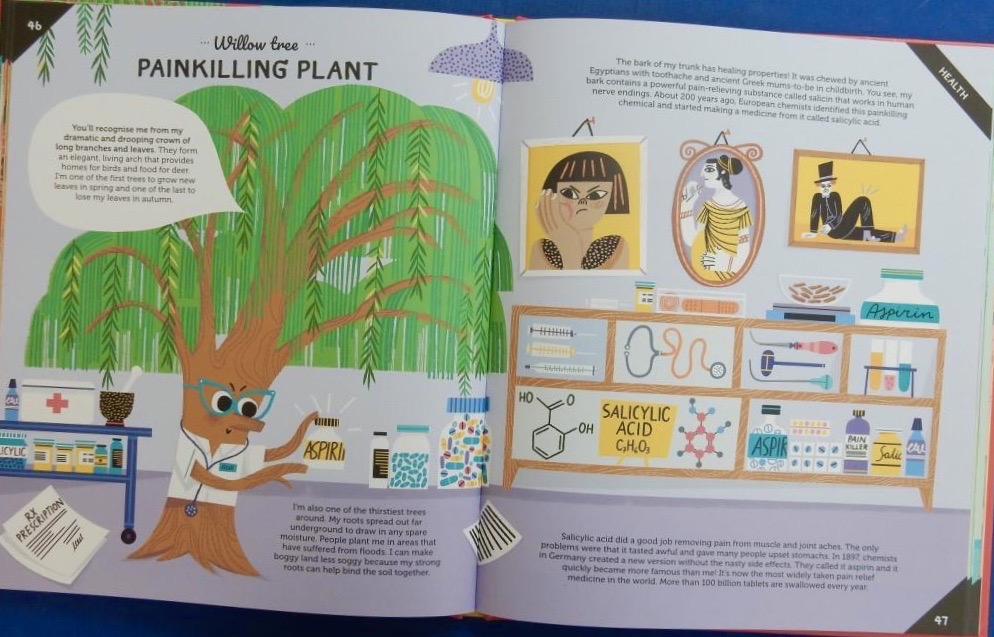
No matter which section you choose to dip into you’re sure to be excited: from the fast-growing cottonwood trees with wind power potential, to the slick, slippery carnivores like the pitcher plant and the super-thirsty willow tree, the bark of which has healing properties thanks to salicin – a powerful pain-relieving substance, it will be a case of WOW! that is truly amazing.

An absolute treasure of a book for both home and school use.

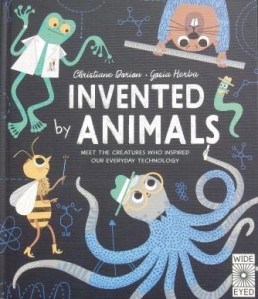
Invented By Animals

Invented by Animals
Christiane Dorion and Gosia Herba
Wide Eyed Editions

Animals have pretty much taken over in this book – there’s even an introductory ‘Dear Reader’ letter typed by a frog pointing out that many techniques, designs and ‘superpowers’ used by animals have been the inspiration for human inventions or lie at the heart of future technological advances that are works in progress. Thereafter, it’s left to the various creatures to do the talking.

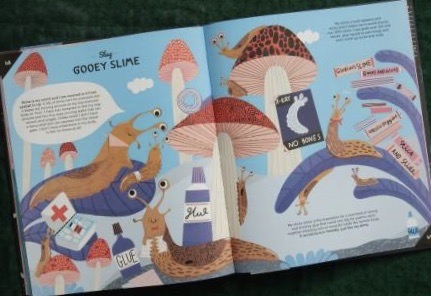
For instance there’s the shark whose skin was mimicked in super-fast swimwear that was ultimately banned after too many records were broken in the 2000 Olympics; the slug with sticky slime that is behind a super-strong glue that may well be used to mend wounds both inside and outside the human body.

Another creature helping humans in their exploration of post surgical wound closing is the prickly porcupine with its antiseptic-coated quills.

Readers also meet the super fast flying, amazingly clever hovering dragonfly whose abilities in the air are behind the invention of a little four-winged drone, as well as the woodpecker with its thick skull and shock-absorbing bones, the design of which is being copied by technologists endeavouring to make safer helmets for cyclists and others who need protective headwear.

The engaging manner through which Christiane Dorion conveys a wealth of STEM information will likely appeal to primary readers, as will Gosia Herba’s bright playful illustrations. There are lots of potential cross-curricular links: I particularly like the way many of the animals encourage child readers to think both creatively and critically in this fun exploration of biomimicry.