Tree Matters

DSCN6169 (684x800)

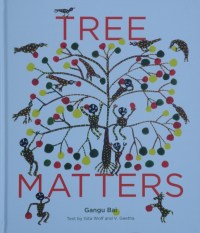
Tree Matters
Gangu Bai, Gita Wolf and V.Geetha
Tara Books
I’m a tree lover, a lover of India and have an interest in the Bhil culture, so this fascinating book was a winner with me right away.
One of the largest tribal communities in India, the Bhils tend to live in villages set between forest and field, relying less now due to restrictions of access, on the forests for supplying food and firewood than did their ancestors. Their sense of connectedness with the forests remains strong however, despite the fact that some are now city dwellers working in mines and factories. Cleverly titled, Tree Matters sets out to demonstrate through wonderful paintings by Bhil artist Gangu Bai, and her oral narrative that has been edited for the book, by Gita Wolf and V.Geetha, to show just how much they matter to members of her tribe, to the natural world, indeed to the whole country and our planet itself.
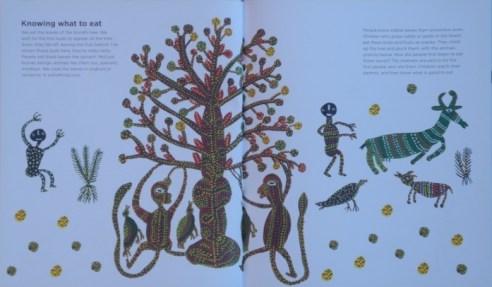
There are four main sections Everyday in the Forest; Tree Matters; Guardians and Gods and finally, Trees for Every Occasion. The first focuses on what particular trees have to offer in the way of food for either humans or animals: berries of the Sindi berry tree provide snacks for birds, monkeys and children: beware of the sharp thorns though, and the twigs make good brooms. The Ghondi tree has edible leaves – food for monkeys and humans (and delicious when cooked especially in bud form.) We also learn in this section, how people first began to eat leaves and to distinguish good ones from poisonous kinds.
DSCN6170 (800x464)

The second section includes a spread of beautiful tattoo designs based on the Ryan tree…

DSCN6171 (800x470)

and another pictorially documenting the birth of Jangal, the son of a friend of the artist.
In Guardians and Gods we learn of a mischievous, demanding jungle spirit; the protective Mother goddess; then there’s the god Kasumer, a fulfiller of wishes and finally, the Great God Badadev. Here he’s shown as a stone beneath a banyan tree.

DSCN6173 (800x471)

The final part depicts trees being used for all manner of occasions: the Mango beneath which the bridegroom’s party sits during a wedding reception; the Neem – that plays an important medicinal role with its oil, bitter leaves, and twigs that can be used as toothbrushes …

DSCN6174 (800x464)

Then there’s the Khakra tree that plays a central role in tribal life; Mahua is the tree of life whose flowers are used to distil a sacred liquor; the Toddy palm…

DSCN6175 (800x464)

the fruits of which are tapped for the sometimes intoxicating, drink and finally, we see a Jamun tree beneath which young girls might congregate following the festival of Holi.
This totally fascinating, absorbing look at many aspects of Bhil life, rendered in traditional tribal style paintings offers much to anyone interested in sustainability, tribal culture, art, the natural environment and much more. Indeed I would love to have each and every one of Gangu Bai’s paintings adorning the walls of my home.

Use your local bookshop          localbookshops_NameImage-2

Visit the Bhil Carnival

DSCN4205 (800x600)

Visit the Bhil Carnival
Subhash Amaliyar and Gita Wolf
Tara Books
Is it a book, a poster or a map? All three really, and certainly what is contained within the covers is fascinating and well worth a visit or rather, multiple visits. Herein we follow that ‘COME IN’ balloon and accompany Neela and younger sister, Peela on a visit to the mela – the first on their own. To visit an Indian mela or fair is assuredly an assault on the senses – sights, sounds and smells almost overwhelm. (I’ve visited many including a Bhil Gavari in Rajasthan.) Something of this feeling is engendered here in this rendition of a colourful Bhil carnival, held annually in Madhya Pradesh and called Bhagoria, but it certainly is not overwhelming; rather it’s inviting and fascinating.

DSCN4204 (800x600)

A ride on the dizzying ferris wheel – scarily pushed by big men, is a must. There are shops and stalls – some selling delicious food – “COCONUT BURFI! TOFFEE! LADDOO!” is the cry (joy to Neela’s ears) and those scrumptious cooling ices from the ice-cream wallah – “CHOC-O-BAR! CONE ICE-CREAM! … PINEAPPLE! PISTA! ICE-CREAM!”, tempting toys (Peela’s favourite place), bouncing balloons – Peela cannot resist a pink one; and then there’s a stop at the photo booth for a souvenir snap before the brother and sister must wend their way home.
An accessible narrative by Gita Wolf in the small book discreetly placed in a corner and also illustrated by the Bhil artist, Subhash Amaliyar, whose images painted in vibrant traditional style form the main fold-out spread, really bring the whole thing alive.
There is also a final paragraph or two about the artist, his background and that of Bhagoria inside the back cover.
All in all, a dazzling experience and one to be revisited on many occasions, rather than – like the festival – just once a year.
Those of us who work in education will likely find this a boon for exploring art forms and techniques with young (or not so young) children. For further information and ideas you can pay a visit to the Tara website: http://www.tarabooks.com

Use your local bookshop

localbookshops_NameImage-2

Tell Me a Picture/Following My Paint Brush

DSCN3987 (800x600)

Tell Me a Picture
Quentin Blake
Frances Lincoln Children’s Books
Subtitled Adventures in looking at art, this excellent book introduces its readers to twenty six paintings that were Quentin Blake’s choice for an exhibition that was held at the National Gallery in 2001. Representing a wide range of artists, alphabetically arranged we start with

DSCN3986 (800x600)

Avercamp’s A Winter Scene with Skaters near a Castle and conclude with Austrian picture book illustrator, Lisbeth Zwerger’s scene from Dwarf Nose, one of her collaborations with Wilhelm Hauff.
The former is packed full with detail and narrative possibility. However there is no wordy preamble about the painting as such, merely the artist’s name on a display board sign held by one of Blake’s characteristically offbeat characters alongside whom are other Blake characters who are discussing the painting by way of a prelude. The latter might send readers off in all manner of directions depending on what they are bringing to the painting.


DSCN3984 (800x600)

Actually that is part of the appeal of the whole enterprise: every time one turns the page or opens the book afresh, there is the possibility of new stories emerging. It truly is about opening up: opening up to the countless possibilities offered by way of interpretation and inspiration and of course, creativity and the imagination. I’m not dismissing of course, the notion that the book could also act as a starting point for inquiry of a more academic nature but that I’d say comes later.
And, how wonderfully those half dozen or so picture book artists of today (and I’m including Gabrielle Vincent here) stand up against the painters from as far back as the fifteenth century.
How I wish I’d been able to visit the National Gallery exhibition but I must content myself with this wonderful volume and the opportunities it offers me to share its contents with, and I hope inspire, children of all ages although, hopefully not to try emulating the antics of those shown in the lead-in to Polish illustrator Józef Wilkon’s Bats in the Belfry

DSCN3985 (800x600)

which is not a book I’m familiar with although I love some of his other picture books.

DSCN4207 (600x800)

Following My Paintbrush
Duari Devi and Gita Wolf
Tara Books
This is an inspiring, first person narrative account of how one woman, a domestic worker, follows her dreams and learns to become a painter.
Dulari Devi, from a poor village family, was unable to go to school. Instead she had to work with her mother caring for her brothers and sisters, selling in the market fish her father had caught, and working in other people’s homes as a domestic; sometimes she wished for more.
One day she stops to watch a group of children by the village pond and in her own words, “As I stood and looked at the children playing, the scene turned into a picture in my mind. It came alive, bright and lively, telling stories …

DSCN4215 (800x600)

Shortly after, she accompanies her mother to work at the home of an artist and is inspired by her paintings. Back home she begins creating her own things of beauty.

DSCN4216 (800x600)

Returning the next day, Dulari asks if she can join the painting class her employer is teaching and thus begins her journey of learning and discovery. Hard work, yes, but painting soon becomes part of her life and still is to this day. For now, as she says, “I am not just ‘a cleaner woman’, I am an artist.” And one who, having met a book publisher can finally say, “I have made a book.”- this one.
The distinctive artistic style Dulari uses is called Mithila and is a folk art characterised by bold images, richly patterned with lines, zigzags, circles and often, vividly coloured.
Here is one of the glorious paintings from the book…
DSCN4217 (800x600)

Truly an uplifting account of an individual discovering and developing her innate creativity, and a powerful, stunning creation to share with children everywhere whether you want to explore with them a distinctive artistic style from another culture, or inspire them to develop their creativity and follow their dreams. I’d suggest both.

Use your local bookshop localbookshops_NameImage-2

Tales of Old Retold

DSCN1371

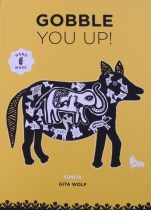
Gobble You Up!
Sunita and Gita Wolf
Tara Books
The wily jackal is hungry but he’s far too lazy to search for his own food. Instead he tricks his friend crane into catching some fish. Crane obliges but not only does jackal eat the lot, he gobbles up crane as well. He then goes on to consume tortoise, squirrel and cat. “My, you’ve put on weight!” peacock remarks and meets the same fate. Then along comes a huge elephant. Surely jackal won’t manage to fit an elephant into his now enormous tum but …
Time for a drink of water he thinks. But even jackal’s tummy cannot go on stretching for ever: SQUEE! BLEAH! BLAM! BURST and out tumble all the animals safe and sound.

DSCN1369

And what about jackal? Considerably deflated, he goes off in search of the tailor bird for a large repair job.
This lively retelling of an old Rajasthani folk tale will perhaps remind European readers of the Danish story The Fat Cat or the Russian tale of The Clay Pot Boy. Readers aloud and their young audiences will enjoy the cumulative rhyming refrains and the latter will want to join in this part of the telling.
The illustrations are done by a Meena artist, Sunita, who was taught Mandana art by her mother. (In the Meena villages of Rajasthan women paint the floors and walls of their homes as well as communal areas to mark festivals, such as Diwali, celebrations and the passing seasons using this decorative form. Designs and images are made using cloth soaked in a chalk and lime paste that is squeezed through the fingers of the artist.)
As a frequent visitor to Rajasthan I was particularly interested to see, what is to me a familiar art form, being used to illustrate a story. In order to create this beautiful and unusual book, the artist’s original images (made with diluted acrylic paint squeezed through her fingers) were photographed, converted into graphic images and silkscreen printed – with the jackal rendered in black and the animals he consumes in white – onto specially made paper and hand bound. Truly a work of both art and craft.
Buy from Amazon

Even quite young children can try out this technique using white acrylic paint on brown sugar paper or better, large sheets of paper painted over with household size brushes in terracotta colour paint and left to dry before the design is added. This can be applied using a variety of tools – fingers, cotton buds, twisted rag, small plastic bottles with nozzles such as those from hair colour, etc.

DSCN1372

Wayland
Tony Mitton and John Lawrence
David Fickling Books
Tony Mitton seems to get better and better. For me this spell-binding reimagining of a northern legend, brought to these shores by the Vikings, is his best yet. Essentially it is a tale of greed, revenge, hope and above all, love. It tells how three brothers, two warriors and Wayland, a smith, take three Swan Sisters as their brides having seized and hidden their swan capes to prevent their escape. Only Wayland’s wife loves him and when the three discover the whereabouts of their capes and plan their escape, she alone hopes to see her husband again. After the wives flee, Wayland’s life gets harder and harder. More and more terrible events occur but eventually, in this version at least, he and his beloved are reunited.
Tony Mitton’s beautifully crafted, lyrical verses are a joy to read aloud, and to get the best out of this book, it really must be read aloud.
‘From out of the dark spring stories
to banish both drear and cold.
So gather you near, come, listen and hear,
Where the fire burns red and gold.’
Equally beautifully crafted and the perfect complement to the poetry, are John Lawrence’s exquisite woodcut illustrations. These really draw you even deeper into the story making you want to linger long over each one.

DSCN1376
There are some allusions of sex in the story so parents/teachers should read this themselves before offering it to under elevens.
Buy from Amazon

Find and buy from your local bookshop:

http://www.booksellers.org.uk/bookshopsearch


Traditional Art, Traditional Tales

DSCN1325

Alone in the Forest
Bhajju Shyam, Gita Wolf and Andrea Anastasio
Tara Books
Gond tribal art has a distinctive style characterised by two dimensional patterned forms intricately detailed with dots, dashes and lines. According to The All India Artisans and Craftworkers website artists use colours extracted from natural materials: colored soil, charcoal, plant sap, rice paste, cow dung and leaves. Colours are used to convey emotions and character. Red is said to depict fear and green is associated with nature. Originally the paintings were done on the mud walls of houses.
Here, one Gond artist, Bhajju Shyam has used his talent to provide a powerful and striking visual interpretation of a story about a boy, Musa who ventures off alone into the forest to find firewood when his mother is sick. Wandering and humming to himself, he hears a loud noise and lets his imagination run riot.

DSCN1324

As he hides in the hollow of a tree, Musa visualizes first one and then a whole herd of wild boars close by. After what feels like a very long time, Musa emerges from his hiding place to find that the source of the noise that gave rise to his escalating fear was in fact a friendly cow. The same animal leads him safely back to the village – albeit without any firewood but with a story to tell.
An unusual story that draws readers into what for Western audiences is largely, a completely unfamiliar world. It offers an opportunity to look at, discuss and perhaps try experimenting with this particular style of aboriginal art.
A beautifully designed book; recommended for primary school libraries and for anyone interested in art.
Buy from Amazon

DSCN1326

Breaking the Spell
Lari Don illustrated by Cate James
Frances Lincoln Children’s Books
Lari Don is an accomplished storyteller so each of the ten stories in this collection is a pleasure to read aloud. She has included some traditional tales that are specific to Scotland and others such as Whuppity Stoorie, which are Scottish tales that have variants the world over. You can find witches, giants, monsters, royalty, warriors and more herein.
It’s impossible to pick a favourite; each one weaves its own enchantment. I particularly liked The Monster of Raasay wherein we are shown that true monsters are not always the ones billed as such.

DSCN1327

Then of course, the teacher part of me found The Three Questions great fun. It was so good to see that horrible bully of a teacher get his just deserts and to learn why ‘nowadays all teachers are clever and kind and very good at riddles, and none of them ever shout. Do they?’
All the stories are quite short especially The Ring of Brodgar (though if you felt adventurous, its duration could be extended by some giant dancing, or rather stomping, thumping, jumping and yelling).
If you are familiar with the Lollipop and Grandpa picture books series you will recognize Cate James’ illustrative style. She layers ink drawing and textures digitally to create whimsical, witty illustrations and here they range from small vignettes to whole page pictures.
This would certainly make a very worthwhile addition to any family or primary school collection.
Buy from Amazon

DSCN1334

Beauty and the Beast
Ursula Jones and Sarah Gibb
Orchard Books pbk.
Ursula Jones infuses her spirited retelling of the classic fairy tale with gentle humour: ‘The two older sisters were horrified by the countryside. It was full of plants! And not a clothes shop in sight!’ …
’boom! – in a split second the pretty clothes turned into silly knickers and the sisters had to cover themselves up in Beauty’s sheets.’ Here we seem to have up to the minute language in what looks like a regency setting.
Sarah Gibb’s delicately patterned illustrations are gorgeous. Her fine silhouettes remind me not a little of some of Jan Pienkowski’s work which in turn was influenced by Lotte Reiniger.
Altogether an interesting edition, well worth exploring. One to invest in.
Buy from Amazon