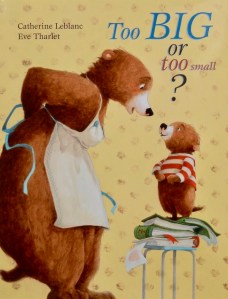
Too Big or Too Small? / Pompon

Too Big or Too Small?
Catherine Leblanc and Eve Tharlet
minedition

Where his parents are concerned, little bear, Martin just can’t win with his actions. “Don’t be silly, Martin” says Mama when the cub sees his baby sister drinking from a bottle and asks for a bottle, too – “you’re far too big for a bottle!” (Is she aware of sibling jealousy one wonders.) Shortly after when the cub tries using a knife to cut his food, she insists on doing it for him. (Why not show him how to help himself?).

Then his father chastises him for dragging his favourite soft toy animal around all the time – apparently he’s too big to take him out; but then he won’t allow him to use his mobile “No Martin. you’re still too small … you might break it.”
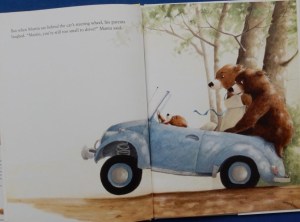
Now Martin isn’t one to be completely dominated and tries to find some ways of his own to show his parents how he feels about what’s been happening.

He also makes the occasional comments about what his parents are attempting to do: “Mama, aren’t you too big to do that?” is his comment on seeing her taking a fingerful of chocolate frosting while baking. Eventually both Mama and Papa come to realise they need to give more importance to doing things they can all enjoy together as a family.
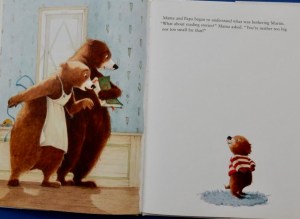
It’s great that Catherine Leblanc makes Martin himself instrumental in changing his mum and dad’s parenting in this fun demonstration of child activism. Throughout the story, Eve Tharlet’s droll scenes are sure to amuse adults as well as young listeners: her portrayal of the bears’ body language and facial expressions are superbly done, especially when the adults are at odds with Martin.
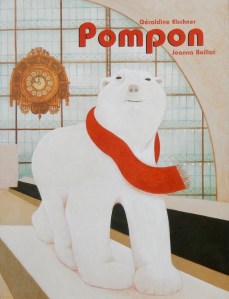
Pompon
Géraldine Elschner and Joanna Boillat
minedition

This story was inspired by a famous real statue almost seven feet long created by French sculptor François Pompon.
The titular Pompon is a large white bear statue in a museum, a statue that fascinates young Leo when he visits one day. Mesmerised Leo stands staring for ages, taking in its shape and enormity, its smooth texture and the curve of its ears. (This we see in Joanna Boillat’s close-ups that extend over half a dozen spreads.) Now Leo has a special magical look in his eyes and cannot resist reaching up and stroking Pompon’s cheek. The museum guard, initially angry,
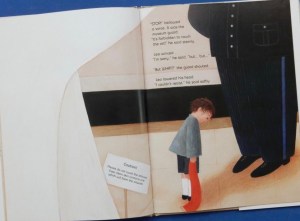
then softens towards the boy, seemingly understanding how he felt but asking him to promise it was a one time only touch. A touch however that sets off a transformation in the ursine statue; wings appear on its back and Pompon is free and he takes flight, far, far away … Could it perhaps be that he becomes the constellation shown in the final illustration.

A magical tale engagingly and poetically told and even more magically illustrated, particularly on account of the artist’s clever use of the white space of the bear’s form; that, and the contrast with Leo and his red scarf. A book to encourage youngsters to imagine, to dream and to look long at art in all its forms.
Introducing Art to Children – Anna and Johanna & A Journey Through Art: A Global Journey

Anna and Johanna
Géraldine Elschner and Florence Kœnig
Prestel

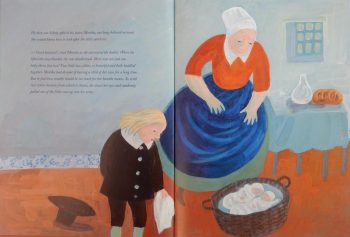
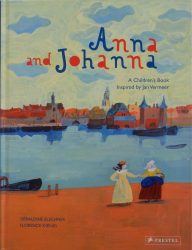
It’s 12th October 1666 and we’re in the city of Delft where two girls are busy working. One is Anna, the daughter of the well-to-do master of the house; the other is Anna’s maid and co-incidentally they both share the same birthday. Each girl is creating something special for the other in celebration of the day.

For her friend, Johanna, Anna is fashioning a lace collar just like her own, which she knows her friend likes a lot.
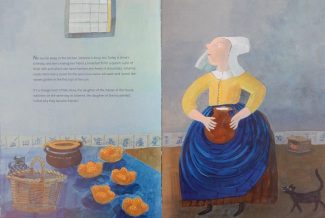
In the kitchen Johanna is cooking a special birthday breakfast mousse as a treat for her friend Anna. It’s a breakfast fit for a queen.

But why are they such close friends and why do they share a birthday? Is it co-incidence or something much deeper?

When the girls meet and exchange their gifts, they discover something intended for both of them – a letter addressed simply ‘For your birthday’, which begins, ‘Dear children’ – a letter from Anna’s father telling of an incident that had occurred exactly twelve years earlier and disclosing a secret that he’s been keeping ever since.

Inspired by two of 17th century Dutch painter, Jan Vermeer’s greatest works of art, The Lacemaker and The Milkmaid Géraldine Elschner has crafted a story of friendship and more that reflect the painter’s impressions of domestic life.

Equally evocative of Vermeer’s style are Florence Koenig’s acrylic paintings executed predominantly in subtle blue, yellow, brown and orange hues of the Dutch city’s landscapes and scenes of domesticity.

There are many ways to interest children in art and artists: this lovely tale of friendship and devotion offers an unusual introduction for young readers to Vermeer’s art.

 Journey Through Art: A Global History
Aaron Rosen, illustrated by Lucy Dalzell
Thames & Hudson

Aaron Rosen takes readers on a journey through time and place to visit some thirty locations as he tells how the art and architecture of different cultures developed.
The tour, which travels to four continents, begins in northern Australia at Nawarla Gabarnmung in 35,000 BCE where we see prehistoric petroglyphs.

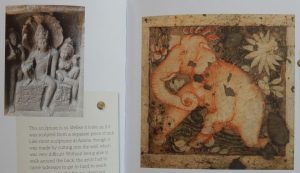
The next location is the city of Thebes 1250 BCE and then on to Nineveh 700 BCE, followed by more cities – almost all sites visited are cities – and thereafter to the site of a Buddhist monastery hidden in caves at Ajanta in Central India. Those caves contain some amazing sculptures and the oldest surviving paintings in India, done by the Buddhist monks who lived there around 500BCE.

All the locations thus far are included in the first of the three sections entitled Prehistoric and Ancient Art and next comes Medieval and Early Modern Art that encompasses Granada, Florence, the 16th century town of Timbuktu, 1650 Amsterdam where we find the first mention of a woman artist, Judith Leyster who was celebrated for her paintings of musicians.

The final Modern and Contemporary section includes a stop at 1825 Haida Gwaii to view the Northwest Pacific woodcarvings, one of the few non-urban destinations.

At every stop Rosen begins with a spread giving an overview of the site and a painting by Lucy Dazell; following this is another spread comprising information about the culture/customs together with small photos of significant artefacts, paintings and monuments together with printed notes.
The journey terminates at Rio de Janiero where the 2016 Olympic Games took place and thereafter are notes about visiting museums and art galleries and a glossary.

A whistle-stop tour indeed and one that might leave you feeling somewhat breathless but equally one hopes, hungry to find out more about the art of some of the places visited.

I Am Peace / The Two Doves

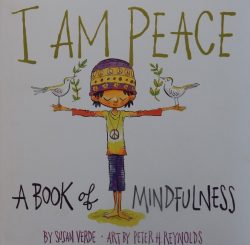
I Am Peace
Susan Verde and Peter H. Reynolds
Abrams Books for Young Readers

This is a companion book to yoga teacher, Verde, and illustrator, Reynolds’ I Am Yoga.
Here, a worried child narrator, feeling “like a boat with no anchor” …

shares with readers how focussing on the here and now helps to calm all those worries and troubling emotions, allowing them to dissipate and disappear. Inwardly watching the breath enables the child to feel centred and then, through acts of kindness, by connecting with nature and fully using the senses, feelings of at oneness with the world, inner peace pervades and can be shared with all those who need it.

With today’s increasingly fast-paced, pressurised and stressful world, this is a lovely gently joyful reminder to children, and also adults of the importance of cultivating the habit of mindfulness. That (along with yoga), can help them change their own world and perhaps that of others. Just 3 to 5 minutes a day with no distractions, no doing, merely being.
Peter Reynolds’ ink, watercolour and gouache illustrations reinforce the mindfulness message and add a delightful touch of whimsy as he portrays the child, peace symbols and all, balancing, cloud watching, feeding the birds and meditating.
(A guided meditation is included at the end of the book.)


The Two Doves
Géraldine Elschner and Zaū
Prestel

In search of a safe place to rest, a white dove lands on a deserted island; deserted save for another dove, a blue one that has been badly injured.

The white dove tends to the blue one until after a few days, it’s sufficiently recovered to take flight,
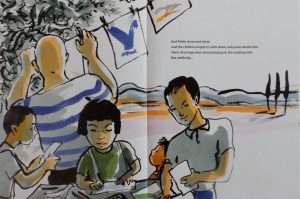
Together the two birds take wing eventually landing in – or rather in the case of the blue dove, falling – into a large garden where, under an olive tree, a man was painting, while around him some children played.
The man is the artist Picasso. The children see the wounded dove and want to care for it. Soon though both man and children are busy creating pictures of the bird,

pictures that Picasso tells them as their images are borne aloft by a gust of wind, will “go to countries all around the world.
Soon after, the white dove takes flight once more leaving the blue one safe in the children’s care.

This lovely story of Géraldine Elschner’s, inspired by Picasso’s iconic work, The Dove of Peace, is beautifully illustrated by Zaü whose ink drawings filled mostly with greys, greens and blue give a strong sense of both the desolation of the war struck third island and the stark beauty of its countryside.
Adults using the book with primary age children may well need to fill in with a little information about the Spanish Civil War and on the visual references from Picasso paintings that the book’s illustrator mentions in a note at the end of the book.