
Everything You Know About Sharks Is Wrong
Dr Nick Crumpton, illustrated by Gavin Scott
Nosy Crow
Having set the record straight about dinosaurs and minibeasts, Dr Nick Crumpton has (along with illustrator Gavin Scott) turned his attention to the oceans and in particular, sharks. Writing in an entertaining style he discredits many of the shark-related myths that have grown up over time and it’s likely they have the worst reputation of all living creatures. Remember those dogfish you studied in zoology at school back in the day? They are related to sharks, both being elasmobranchs.(cartilaginous fish).
Assuredly sharks are predatory creatures but do they kill lots of people? Worldwide sharks killed 11 people in 2021 but cows killed 22 people and that was just in the USA and snakes were responsible for the deaths of 50,000 people worldwide: the numbers speak for themselves. On the other hand, we read, humans kill 100 million sharks and rays each year and sharks are unable to replace those lost quickly enough, so actually a number of species are at risk.
What about those fearsome-looking sharp pointy teeth all sharks have. No they don’t, at least not all of them: different sharks have different sorts of teeth, which help them eat a wide range of food by piercing, slicing or crushing their prey. Did you know that all sharks’ skin is made from millions of tiny teeth and whale sharks even have teeth on their eyes. Moreover, these ‘dermal denticles’ each have elements – dentine, a pulp cavity containing blood and nerves and an enamel covering – similar to our own teeth. Knowledge about how these v-shaped denticles work has led scientists and technologists to develop swimsuits that enable swimmers who wear them to move faster through the water.

Amazingly the prey of Cookie Cutter Sharks are much larger than their predators; these sharks don’t hunt, rather they lure their fleshy prey to them. There’s a whole spread on how various sharks hunt: filter feeding whale sharks don’t bite, instead they open their mouths and swim straight into clouds of microscopic planktonic organisms. On the other hand, some of the smaller sharks might end up as food for other, much larger sharks, and recently there have been reports of orca whales eating sharks.
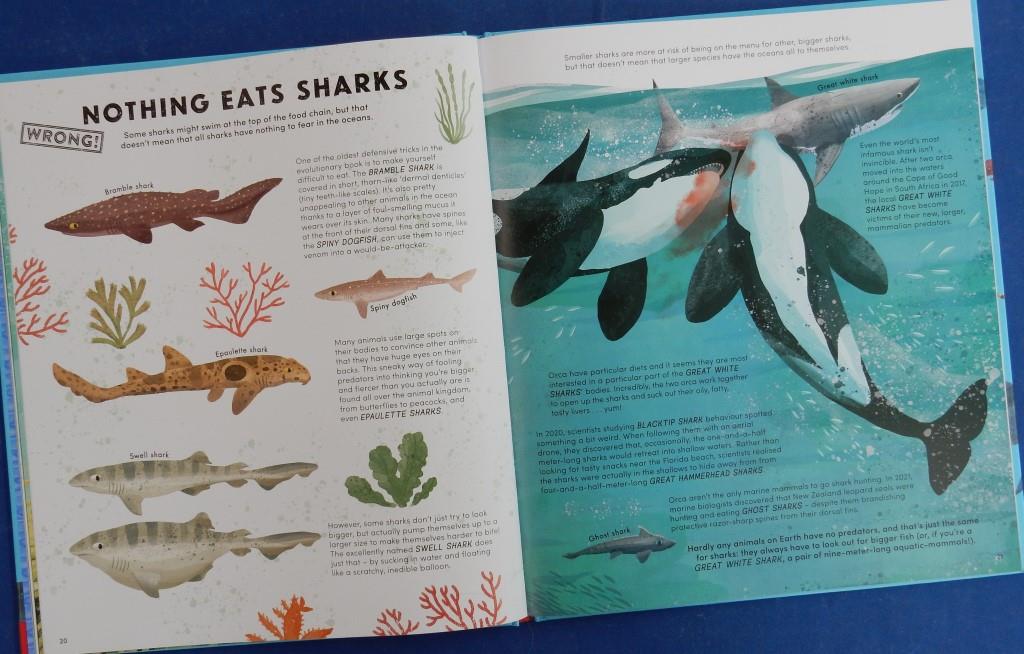
An absolute wealth of fascinating information is packed into the pages of this book and Gavin Scott has done a terrific job with the illustrations. The mystery, power and beauty of these amazing creatures and the underwater world they inhabit are spectacularly portrayed in his scientifically accurate paintings.
Primary readers (and beyond) with an interest in biology will find this absorbing.


 Red Reading Hub - Jillrbennett's Reviews of Children's Books