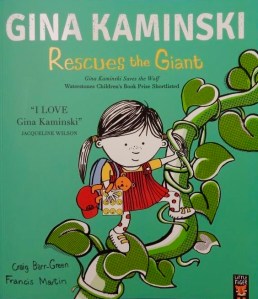
Gina Kaminski Rescues the Giant

Gina Kaminski, the book’s narrator, is a wonderful character and she’s back sorting out the errors in another fairy tale.

She and her classmates are on a school trip to a large art gallery, one Gina deems is rubbish as it’s too big, too brightly lit and lacks an obvious place for her to eat her lunch. On the first spread readers will notice she’s carrying a card with emojis and is accompanied by her helper, Anya. Realising Gina is stressed Anya takes her to the reading room, and selects two books asking the girl to choose but this is also stressful and so Anya decides on Jack and the Beanstalk.

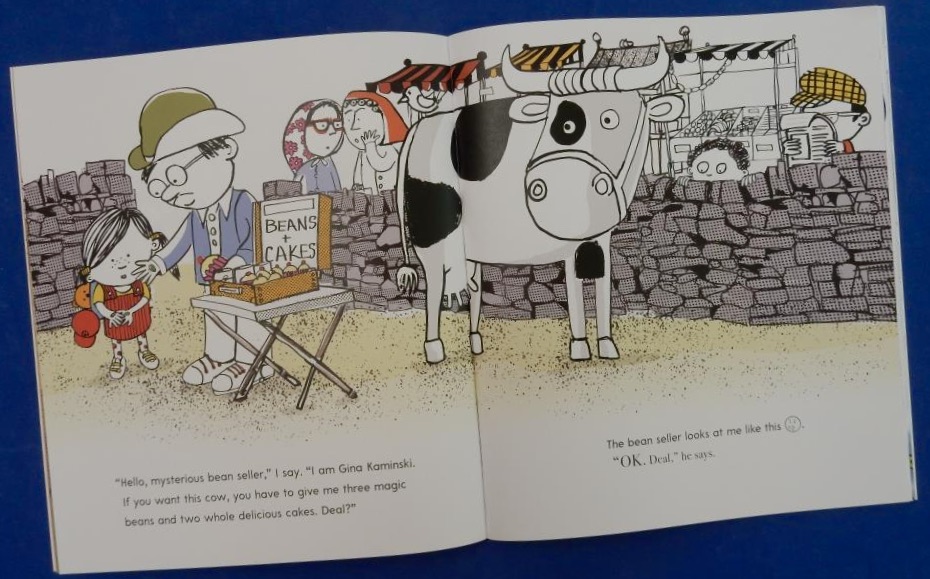
Straightaway, Gina’s analytical mind gets working and she points out that the book has ‘three massive mistakes’. She picks up her teddy, Lady Wiggles, puts it in her backpack and off they set to fairy land to sort out the mistakes. First comes getting a better deal in exchange for the cow: Gina negotiates two cakes in addition to the three magic beans.
Second, why actually plant the beans – that will put paid to any beanstalk. However, as she sits eating her cake a beanstalk grows, seemingly by itself.

Gina gets going on plan B: she warns the giant, confronts the villagers making them drop his harp and most special hen, deals with the beanstalk and bids farewell to the giant. 
She then returns to the Reading Room – job done, Gina informs Anya. Meanwhile Anya has found a map of the gallery which they use to find the place to have their lunch before taking Gina to an exhibit of everyday giant items that meet with her approval as well as causing her to reconsider her initial judgement of the school trip.

Practical, inventive and a hugely engaging hero – that’s Gina Kaminski; she’s also neurodivergent and looks at things in her own way as readers who have read her previous story will know, and others will likely have worked out.

Craig Barr-Green has carefully chosen his words for Gina so as to present her as someone who feels safer in an orderly, rational environment. Illustrator, Frances Martin’s illustrations ensure that in the busy opening scene, we readers share Gina’s unease, which continues until she gets to the reading room, then gradually become more relaxed as she takes control of the events.

Altogether a smashing book to share with KS1 children especially; they will love the protagonist and her alternative version of a favourite fairy tale.
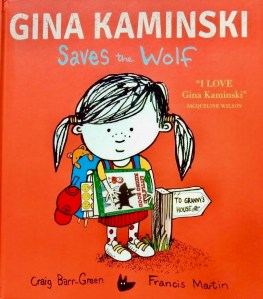
Gina Kaminski Saves the Wolf

If you are a teacher, you are likely to realise from the start that Craig Barr-Green’s delightful protagonist and narrator, Gina Kaminstki is neurodivergent.

One morning in school, Gina is finding things a bit ‘rubbish’ and so her TA, Anya, takes her to the peace and quiet of the reading room, says she will read to Gina offering the choice of two books, Little Red Riding Hood or The Big Book of Wolves. Gina picks the former, Anya reads the story. Afterwards our narrator disagrees completely with the tale, declaring, “That girl and the wolf make three big mistakes,” These she decides to fix by paying a visit to fairy tale land.

Duly prepared with a backpack containing breadsticks, her cap and her teddybear, off she goes.into the fairytale. First stop is the home of the mum who duly produces a yummy-looking cake, which she tells Gina to deliver to Granny, giving an excess of information to the child. Then comes ‘Mistake One’ but that is easily rectified: what would you do with a cake? Avoiding making mistake two, she proceeds through the woods, followed by a scary-looking wolf. That’s when the breadsticks come in handy, allowing our protagonist to reach granny’s house, confirm her identity and give her three pieces of information before the lupine arrives on the scene.

When the creature does arrive, Gina tells him of her plan; the wolf acts as per instructions and before you can say, ‘here’s the woodcutter’, off goes Gina, back to the reading room

and thence her classroom. Then it’s a happy ending both for Gina and a certain wolf.

I absolutely loved this; both words and pictures are wonderful. The matter-of-fact telling works SO well – it’s really great for reading aloud – and Francis Martin’s illustrations perfectly capture Gina’s feelings throughout the book, showing so well her spirit of inquiry and propensity for gentle rebelliousness.

Apart from being a splendid story, the classroom potential is massive.

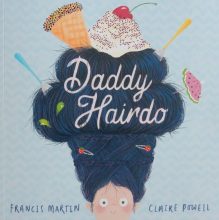
Daddy Hairdo

Daddy Hairdo
Francis Martin and Claire Powell
Simon & Schuster

Like many newborn babes, Amy had started life with very little hair: in contrast her Dad was the proud owner of a prolific mop.

As time passes she catches her dad up in the hair stakes and then, as his starts to disappear, she overtakes him.
She decides to join her Dad in a search for his hair but unsurprisingly it has vanished for good.
Eager to discover what happens to hair that’s been shed they search through books and ponder over its disappearance.: both to no avail.
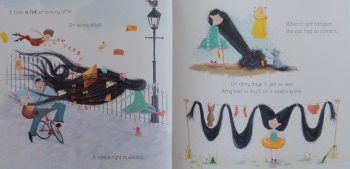
Meanwhile Amy’s hair has grown apace and just keeps on so doing. It definitely needs a great deal of TLC and eventually becomes so long she requires a carry from a kind adult. Even so she’s reluctant to visit the hairdressers.

Dad studies and works on honing his tonsorial skills until he is ready to unleash them on his daughter.
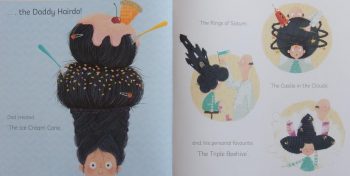
The results are sensational …

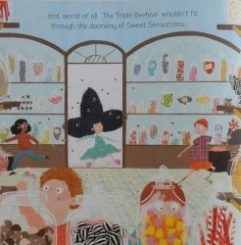
There’s a snag however: such funky hair-dos make life pretty problematic: indeed all kinds of Amy’s favourite activities become impossible.

There’s only one solution …

Readers will delight in the splendid creations Claire Powell has depicted and laugh long and loud over Francis Martin’s zany father/daughter tale of tonsure-related trials and tribulations. She and he have created a winner there.