Children of the Throne

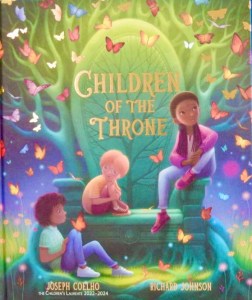
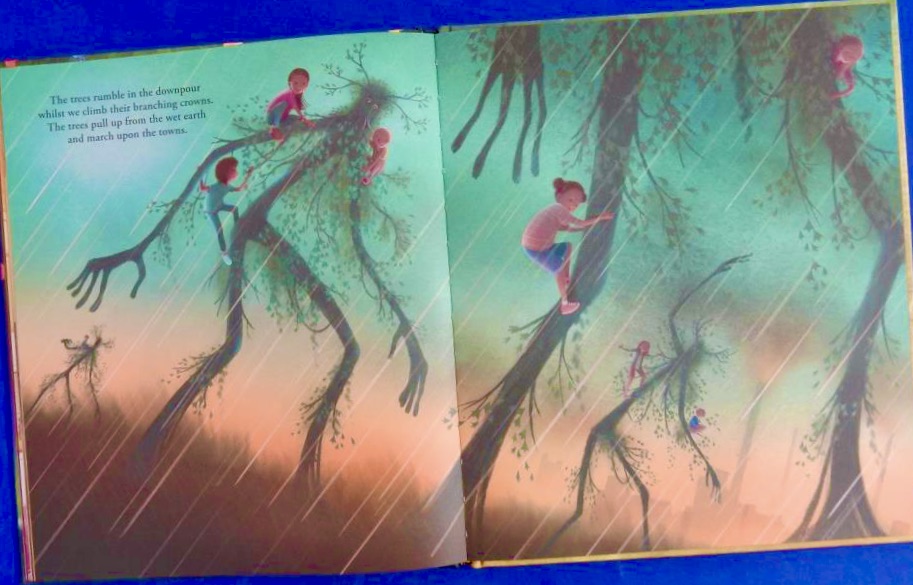
Three children are called from their tower block home to a hidden world beneath. They listen to a story of a tree-grown man explaining how things have changed, greatly endangering the world. It’s the hottest day of the year and already golden brown leaves are drifting down from the trees, the birds cannot find the food to fly and the worms can’t penetrate the surface of the baked-hard ground.

As they listen, they hear that the trees have been duped by the unseasonal heat and think it’s autumn. Meanwhile the grown-ups, delighted by the hot summer, are unconcerned and continue their polluting actions.

The wise tree-grown man puts a crown on each young narrator’s head, telling them “You have the magic now … to make this madness end.” Still though the adults ignore what they hear. Frustrated, using their magic and playing a ‘tune of change’, the three call forth the other children and they all work together,

watched by the amazed adults. Impressed by what they see, they wake up and start to play their part by replacing the burning fossil fuels with other means of generating power as well as trying to eliminate waste-producing systems. In this way, they hope the children’s future will be protected.

Jospeh’s powerfully moving and ultimately hopeful poetic narrative is complemented by Richard Johnson’s stunning luminescent scenes. Let’s hope that young readers/listeners will be inspired by the message that big changes start with small individual actions which can grow into community efforts.

The Other Side of the Rainbow

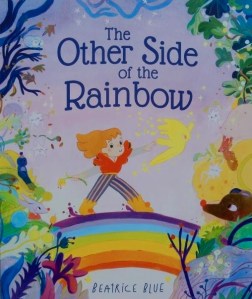
Like many young children, Lucien is very cautious about change. He worries about such things as trying new foods, the first day of school and making new friends.

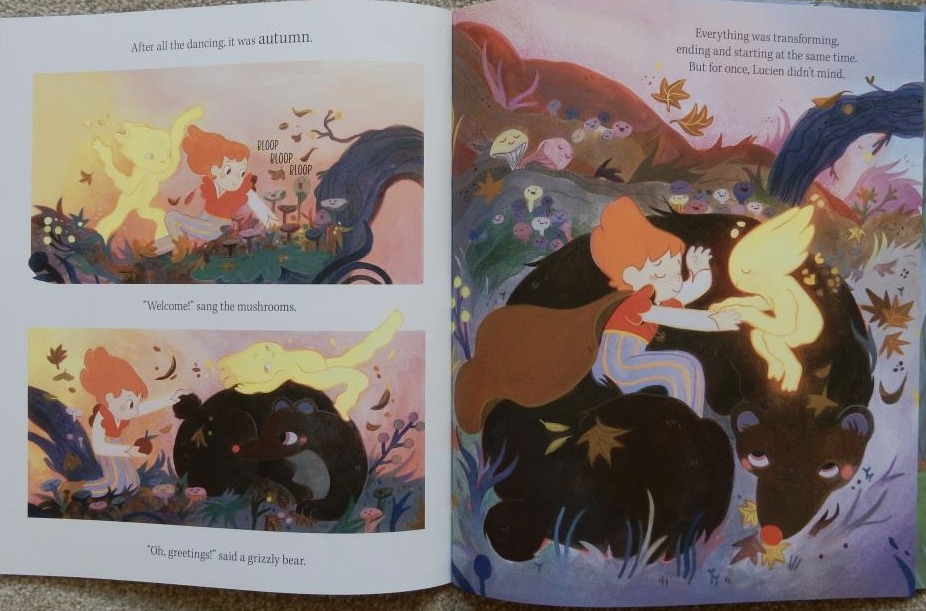
One night a very strong wind blows open a window in his room extinguishing the flames in the fireplace. Having closed the window, he notices a glowing ember, a tiny spark that suddenly starts to move and change into something new. The flame introduces itself as Seraphin and asks Lucien if he’d like to accompany him to see the spring flowers. Somehow Lucien finds himself following him outside into the sparkling rain where there are small, friendly playful creatures. Seraphin draws the boy onwards showing him all the colours of a rainbow that they move across towards the summer. In fact during his day with Seraphin, Lucien journeys through all four seasons. He sings and dances in summer, on into autumn, the time of transformation – ‘ending and starting at the same time’.

Eventually as they sit together, the flame says, “It’s time for me to go now, Lucien.” Having explained that everything must change to make way for new adventures, Seraphin leaps into the sky for now his work is done – Lucien understands the vital need for change. Back home he goes with his memories, excited about new possibilities and new adventures.

Joyful and reassuring, this is a story to share with all young children, not just those scared of change. Beatrice Blue’s illustrations bubble over with magic and movement, almost overwhelming the senses.

Fox and the Mystery Letter

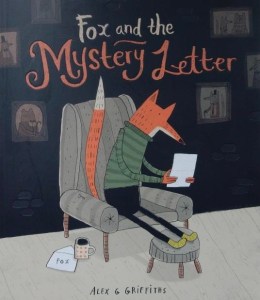
There’s a clue on the cover as to the sender of the mystery letter Fox receives as he sits alone in his cottage in the middle of a forest. He’s just sat down to breakfast when there’s a knock at the door; it’s a mail bird with a letter for him sent special delivery. It’s ages since Fox has received any post, his last being from … he pushes the thought away and opens the letter. It’s something of a puzzle and instructs him to head to the forest path to begin his journey and is signed ‘from an Old Friend’. After musing on the message he decides to take a quick look at the first clue, so he packs a few things in a bag and sets out, telling himself he’ll come straight back.

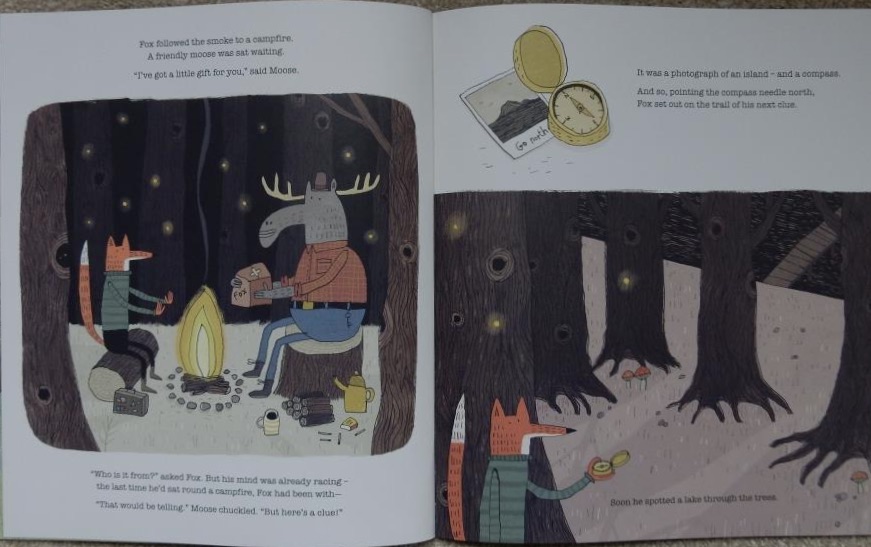
Soon he comes upon a fragment of a map and an arrow marked on the ground. He follows the direction of the arrow and the next one, eventually seeing a moose sitting by a campfire waiting. The Moose says, “I have a little gift for you,” handing him a box but refusing to say who it’s from.

Instead he gives Fox a clue – a photograph – and off goes Fox again in a northerly direction as indicated by the compass also in the box.

Come nightfall, after journeying, over land and water and another encounter –

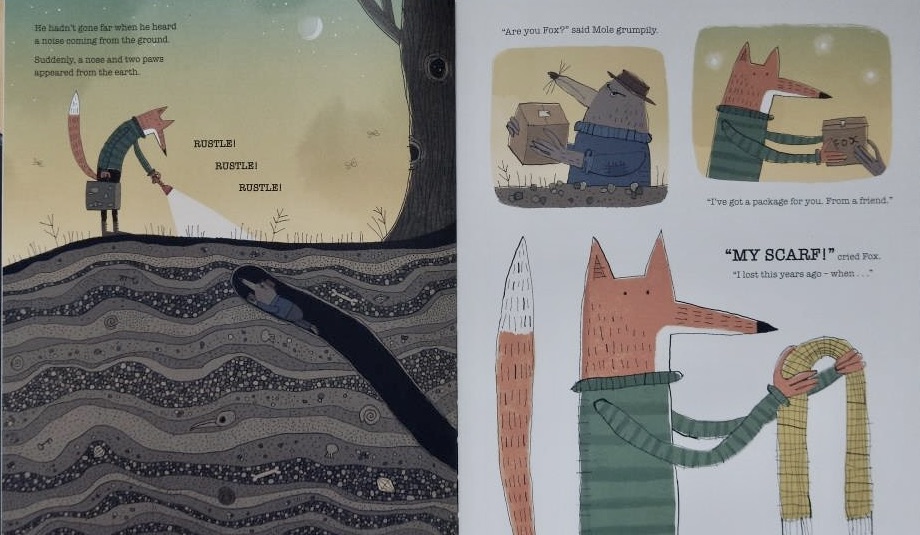
with a Mole this time – Fox is sure he knows the sender of the letter and despite memories he’d been continually pushing to the back of his mind, he finally hears the gentle voice of his dear friend with whom he’d quarrelled so long ago. It had taken a treasure trail to bring him to face his ursine pal and resolve whatever they’d fought about.

Illustrated in Alex Griffiths’ characteristic detailed pen and ink drawing style, coloured in predominantly earthy hues, this is a story of friendship, forgiveness and revealing your true feelings. Sharing this with a KS1 class could lead to some interesting discussion.

The Lost Book of Undersea Adventure

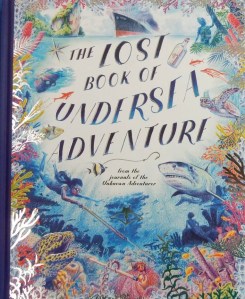
This begins with the author inspired by his grandmother’s stories, embarking on a quest to find the legendary sea nomads of the Coral Triangle. Five days later something terrifying happens. Having stumbled upon their dangerous cargo it’s the intention of three smugglers to silence him by killing him. He’s tossed from the ferry and struggles to stay afloat until eventually he reaches land – a deserted island. Utterly alone and initially exceedingly frightened, but having found his journal and pencils, he decides to start the journal he’d promised his siblings he’d write. He also puts his survival skills to the test and after a couple of days, he’s made a camp, a hammock, fishing spear and found a way to make fire.
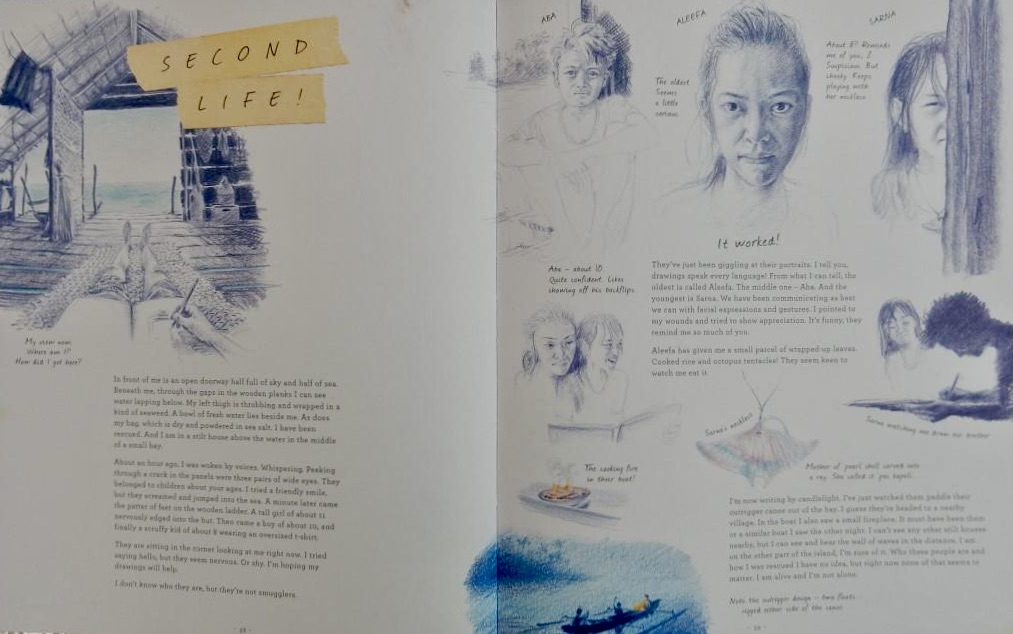
A couple of weeks later he sees that the island is split into two and that something leaps from the water in the middle of the lagoon – a ray perhaps. Not long after he notices a moving light reflected on the water: it’s time to investigate. The following day having finished building a raft it’s time to go. But the waters are extremely dangerous and the next thing he knows is that he’s in a stilt house. Woken by voices and three pairs of staring eyes, they’re not smugglers but children, the adventurer realises.

Prepare to be transported to distant seas and a coral reef with incredible marine life,

discover ancient legends of sea spirits, face unimaginable perils and meet with some amazing people in this exhilarating story of survival and friendship.

Utterly engrossing, the book is presented in the form of an artist’s journal/log with diagrams, close-ups of marine creatures and more.

Nelly the Very Different Bird

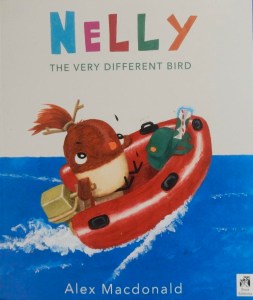
Nelly can’t fly so when the other birds migrate for the winter, she is left behind. However, she’s eager to join them and so being a determined, resourceful little creature, she learns ‘to do things differently.’ She orders an inflatable boat, an outboard motor, a map, climbing gear and other items and then begins her steepest learning journey yet but the great thing is she can travel far from the woods, scaling heights, sailing the seas,

traversing the desert, without the need to fly.

Eventually, thousands of miles away Nelly finds her flock. Unfortunately though, the next morning, they take off from whence they’d come, leaving her all alone. But not quite, for one bird remains; he like Nelly has discovered he can’t fly and appears far from happy about it.

He hasn’t however, expected to encounter Nelly who proceeds to teach him ‘how to do things differently.’

Before long they’re ready to embark on adventures together and in so doing they discover that ‘life’s a lot more interesting when you do things together … and a lot more enjoyable too.

An empowering, absolutely charming tale of doing things differently. It celebrates independence, perseverance, individuality, co-operation, creativity and friendship and is a great book to share with young learners. They’ll delight in the acrylic and gouache illustrations of the endearing Nelly and her lateral thinking achievements.

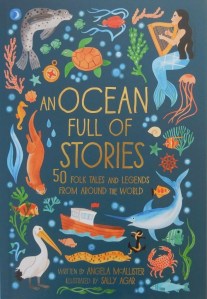
An Ocean Full of Stories

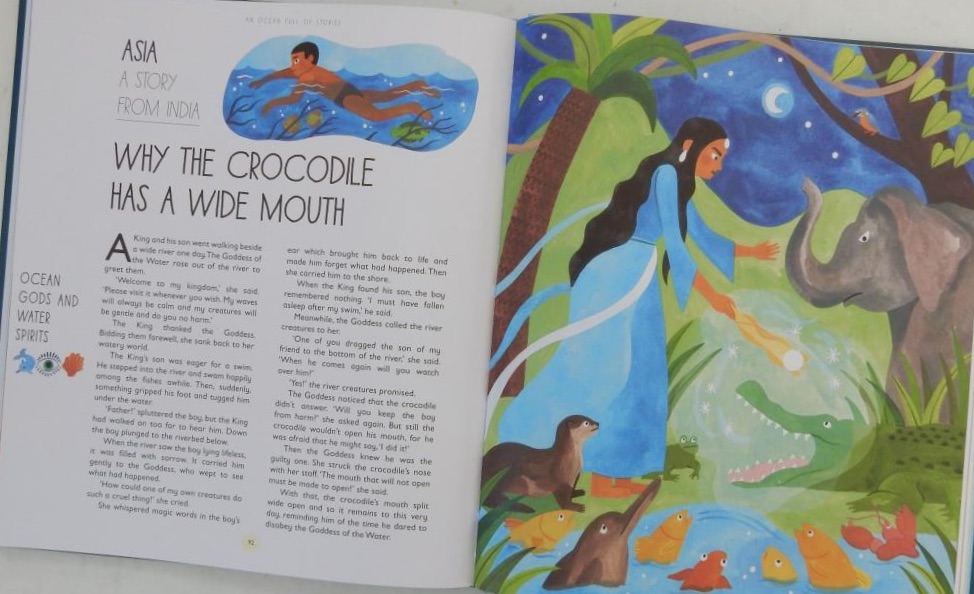
This is a fascinating collection of fifty folk stories, legends and traditional tales from all over the world retold by Angela McAllister. All are centred on different aspects of ocean life and the book is divided into six sections: Fishy Tales, Crossing the Water, Pools, Lakes and Rivers, Tricks and Trials, Ocean Gods and Water Spirits and finally, Beside the Sea, Beneath the Waves.
Some, including the North American Why River Waters are Never Still, Why the Sea is Salty (from Japan) and Why the Crocodile has a Wide Mouth (also from North American) are pourquoi tales that seek to explain why things are as they are.

You’ll discover several stories about greed and its consequences such as The Fisherman and his Wife and The Sea King’s Gift.

Not all the stories have human characters, indeed many are all about animals: a story from England that’s new to me The Magic Mackerel has anthropomorphised fish and we discover what happens when Lord Shark decides to hold a grand ball although he doesn’t have a ballroom.

As with many traditional collections, Anansi the trickster manages to find his way into this one. He’s taught a lesson by Anene the crow that he endeavours to get to do all his work for him in Anansi’s Fishing Trip.

That Ghanian tale was also new to me: indeed one of the joys of collections such as this is discovering new stories. If you read them aloud to a class or group, make time to let your listeners enjoy Sally Agar’s bold, lively illustrations.

So Devin Wore a Skirt

Devin’s family are getting ready for Nanabapa’s Big Birthday party. Everybody in the household has already found their perfect outfit for the celebration: Jay’s new tie makes him look super stylish, Amaia’s wings give her a magical look, Mummy looks like ‘a soft, pink cloud’ as she wafts around in her lengha but Devin still can’t make up his mind what to wear. He tries all kinds of things such as his red trousers, his favourite jumper and several hats. He keeps the blue beret on and eventually decides to put on his sister’s blue and purple sparkly skirt. He likes what he sees in the mirror but then in bursts Amaia protesting “You can’t wear my SKIRT! What will Nanabapa say?”

Rather than taking off the skirt, Devin decides a disguise is needed so he selects a ninja suit and a wizard cape. Then with a feather in his hat as a finishing touch, he’s good to go. By this time the party is under way and he joins his mum in the dancing.

Having bopped and boogied for some time Devin is very hot and decides it’s time to shed a layer or two but he gets even hotter as he continues dancing. Eventually he removes the ninja suit revealing the sparkly skirt. As Devin stands nervously in front of his Nanabapa he’s worried about what his family will say especially Nanabapa. Not for long though as the response is unexpectedly positive. Soon everyone is dancing joyfully including Devin who feels as magical as the others but most importantly, he feels like himself.

Lucy Fleming’s textured illustrations capture so well Devin’s changing feelings as layer by layer he takes off his disguise and finally reveals his skirt to everyone in Shireen Lalji’s warm-hearted family story about being true to yourself.

The Bear-Shaped Hole

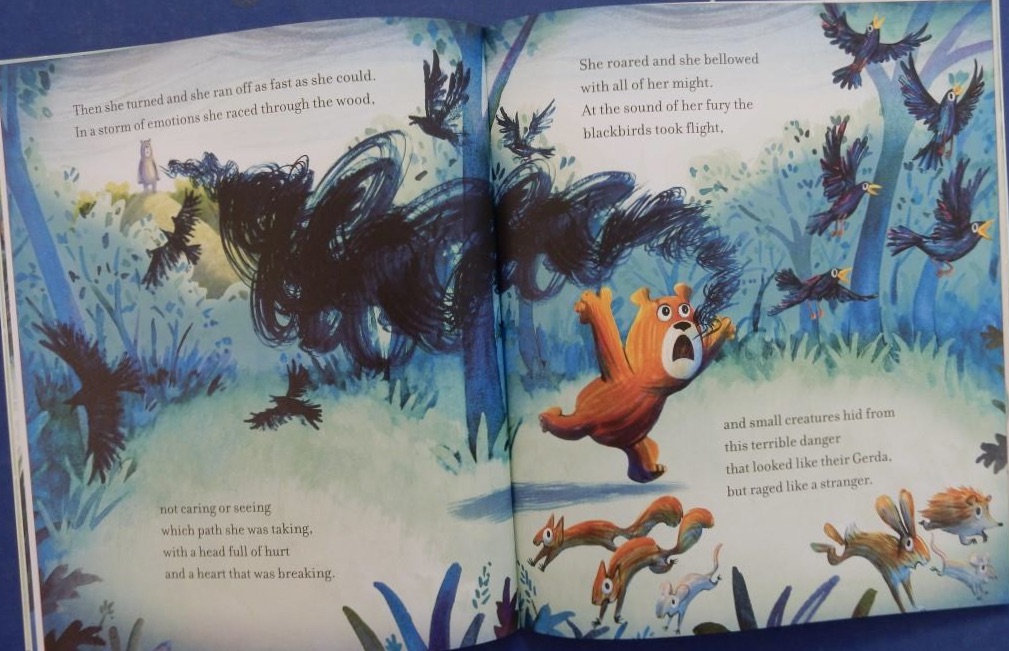
Loss , especially death is always difficult to deal with even when you know it’s coming. So it is with this companion book to the creators’ The Hare-Shaped Hole. Skilfully written in rhyme, poet John Dougherty tells the story of Gerda and Orlo. Orlo bear is gentle, caring, kind and fair – the most respected creature in the woods. Orlo is much loved by young Gerda and the two spend a great deal of time together walking, talking, playing and telling stories but one day Gerda notices a change in Orlo. He’s much slower and seems to have lost that zest for life. Orlo explains that he’s ill and will soon die. Gerda’s initial response is one of anger and she runs away roaring uncontrollably in her misery.

However as we read, ‘ … you can’t outrun sorrow. You can’t outrun pain’: Gerda returns tearfully to Orlo who welcomes her with a big bear hug and then goes on to validate her feelings, assuring his young friend that despite her hurt – that hole in her heart – she will feel happiness again and Orlo will live on in her heart and her head as she remembers the wonderful times they shared. Eventually, come the autumn after making more memories together through the summer,

Orlo dies. Eventually Gerda does find she’s ready to make new friends and have happy times with them.

A reassuring message and it’s stunningly illustrated by Thomas Docherty whose scenes are bright and over-flowing with love. A must have to share with children at home and in the classroom.

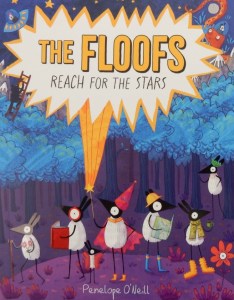
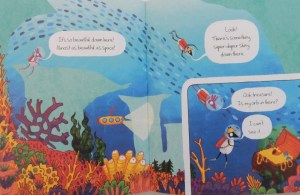
The Floofs Reach For The Stars

Meet the Floofs: there’s Wizard, who has magical powers) Bean (an avid reader), treasure hunter Dill, Anise – the wise one that loves baking, Leaf, mushroom enthusiast, fashionista Clementine and laid back Teasel; each introduces him or herself on the second spread, as does not-Floof, Mica, There’s a map of their homeland on the first.
Having set the scene, there follow three short tales: in the first the friends endeavour to find out why the stars are missing from the sky when Wizard endeavours to cast a midnight spell.

The second story sees Leaf arriving at Dill’s door accompanied by a creature that introduces itself as Comet. Comet tells them that its spaceship crashed near a lake and the glowing orb vital to get back home is missing. The friends decide this is an adventure and off they set to the Great Lake in search of the orb.

An adventure it surely is but will they succeed in their mission?

Bean has just settled down to enjoy a quiet read when in burst the other Floofs disturbing her peace and prompting her to stomp off to be alone. However the park is anything but peaceful; but what about Dill’s suggestion, the forest? There follows another amazing adventure of the Floof kind but peace? Hmm – eventually though of the kind that pleases both Bean and adventurous Dill.

With bright, quirky illustrations, unique characters, a surreal backdrop, wisdom, working together and adventures of the magical sort, this is an absolute. delight from cover to cover.

These Are My Rocks

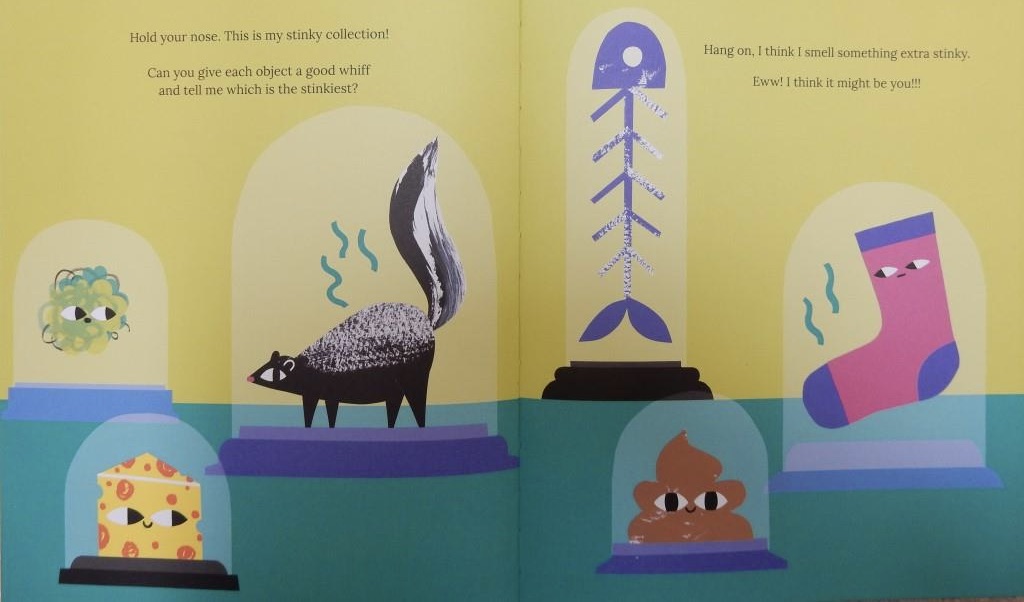
An inveterate collector of things offers would-be collectors ie readers, a tour of collections. First comes the instruction to turn on the light which serves to illuminate the narrator’s cleverly curated collection of ‘small things’. These include an ant, a paperclip, a button and an acorn. To most of these items, Bethan Woollvin has given eyes. The same is true of those in the other collections be they big (you’ll need to pause and assist in a spot of reorganisation to prevent them spilling right off the page), pointy, or prickly (the difference is known only by expert collectors), the most exciting (rocks). After which there come stinky items,

fan mail, bananas (have a joke at the ready to amuse them), and then it’s time to stop for some lunch. Each spread offers readers an opportunity to participate: you can blow away cobwebs from the prickly assemblage, find the stinkiest item in the relevant collection, sort particularly delicate objects – ‘Gently does it!’ Whoops! the teapot’s become a potential addition to the broken things collection, then grab a straying spider. Our narrator places this in the collection of things having ‘far too many legs’.

Eventually as the objects start nodding off, it’s time to turn out the light and bid everything goodnight. The last page suggests that young readers could themselves become collectors though having enjoyed Bethan Woollvin’s chatty conversational text and offbeat illustrations, one suspects little persuasion will be needed.

Early Years Bookshelf: Little Dino Boo-Boos! / Bear

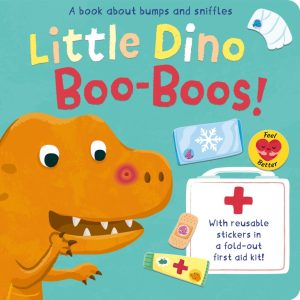
The little dinosaurs are a very lively lot and inevitably accidents happen: Triceratops gets a graze, Spinosaurus gets a soaking, followed by a cold, Velociraptor take tumble and bumps his paw and so on, so it’s important to know what to do when one gets hurt or doesn’t feel too good.

Through this delightful interactive board book, with its first aid kit containing a set of reusable stickers in the form of a fold-out inside the back cover, very young children can begin to learn about first aid and care in a playful way. On a first reading you may just want to point out each item and name it, but this is a book you can share over and over so your little one can learn more about each item as appropriate in addition to enjoying Jannie Ho’s humorous scenes.

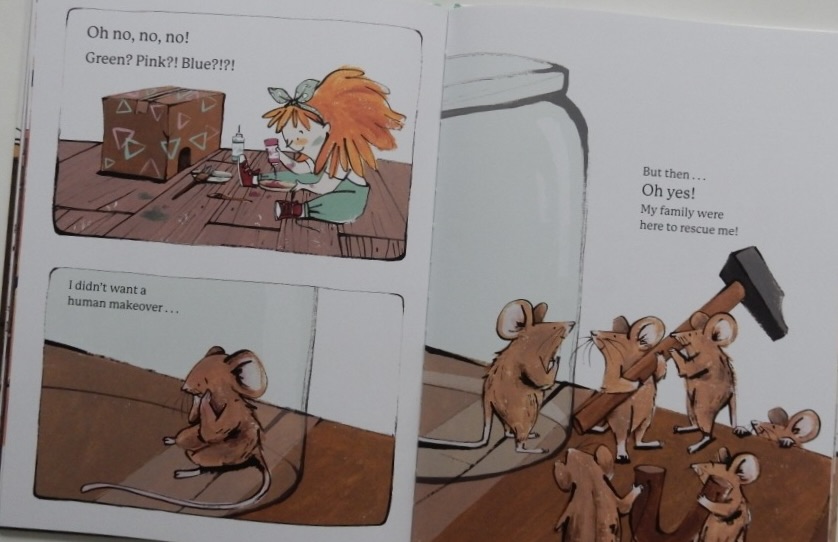
A story about learning to share – maybe.
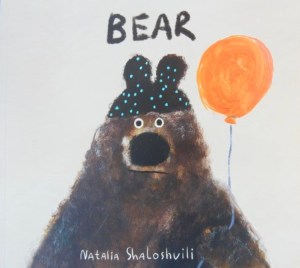
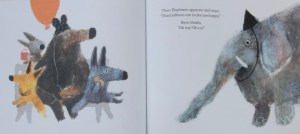
Bear is very happy with his ursine life: he loves his cookie, his book and his balloon; and he loves to sit by himself on his bench. As he sits comfortably contemplating, up comes Fox wanting to sit beside him on the bench. Wolf too wants something belonging to Bear – a delicious cookie; Rabbit wants a look at his book and Elephant asks for the balloon. Bear’s problem is that he doesn’t know how to say no to their requests

and consequently ends up with nothing. Now our ursine friend isn’t happy, he’s very, very unhappy as he sits thinking. Some while later along comes Duck with a cookie. Now we know Bear loves cookies so he requests a bite of Duck’s. I wonder how Duck will respond.

It’s important to know when to say no to others and this seemingly simple story with its wonderfully expressive, smudgy illustrations created with watercolour crayons and acrylic paints offers a good starting point for discussion with little humans.

The Only Monster

This is a story with a message about being an only child in a family and not comparing one’s family with other families.

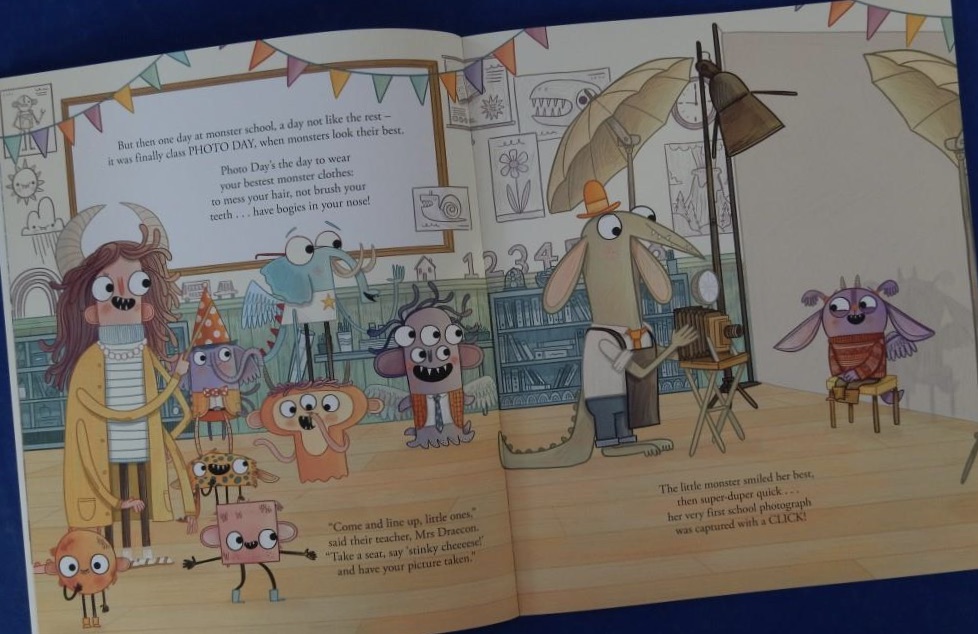
Residing happily with her parents on Grönklebad Street, in the monster town of Bonglibod is a little monster. Then at monster school it’s the day class photos are taken. Little monsters wear their ‘bestest monster clothes’, mess their hair, leave teeth unbrushed and have bogies in their noses. The teacher calls her students in turn, instructing them to say ‘stinky cheeeese’ as they sit in front of the camera for their photo. This little monster does with a big smile.

However when the teacher announces brother and sister photos, little monster begins to feel sad

and this feeling of sadness continues right through until she’s walking home with her dad. He notices her demeanour and asks what’s wrong. She explains that everyone else – the Jooberwibblies, the Bogeynoodles, the Humplebutts, the WindyFlips and the Parps, the Dombledoofs,.the Humplejoys, the Marmaflippydoofs and all the rest have siblings, lots often. Dad acknowledges that this is so but goes on to reassures her that families should be measured by love, not numbers. Moreover, the little monster has all of those friends plus their brothers and sisters, and that is marvellous.

By the time the two reach home little monster is feeling cheerful enough to sing with her dad. However, she still has one more thing to say …

Little humans will love the final twist and all the fun vocabulary, especially the crazy monster names. They’ll love too Brendan Kearney’s superbly imagined, highly detailed illustrations.

The Not-So-Wicked Witch

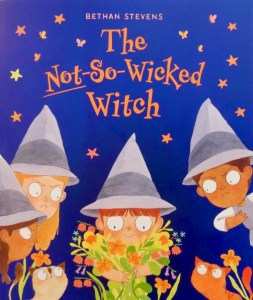
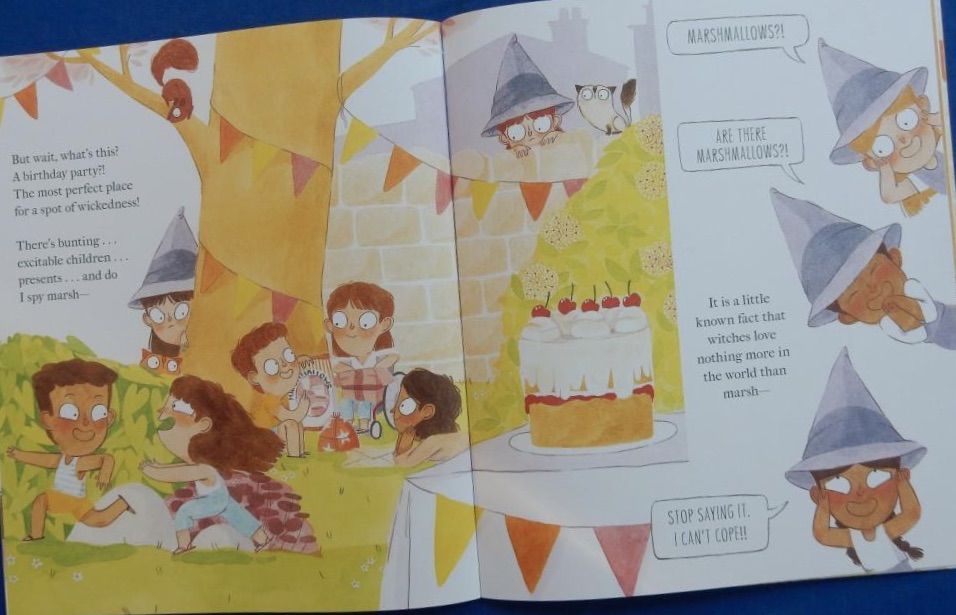
This is a delightful play on the wicked witch trope with a young protagonist who puzzles the other little witches by not joining in with their trouble-making deeds that include such things as eating the very last biscuit in the tin and pinching one of your favourite socks.. Because of this, the baddy brigade decides that the littlest witch needs to be rescued from ‘all this icky, gooey goodness’.

The lessons in wickedness commence with upsetting children at meal times, which fails dismally. Next location is a birthday party – what better place for a spot of wickedness?

Our littlest witch is instructed to acquire various items for a potion that will enable them to steal all the marshmallows (their favourite ever food) from the party.

What happens however is rather different: the littlest witch concocts her own sweet recipe and sabotages the plans of the would-be marshmallow stealers.

The result is that the wicked little witches finally learn that ‘kindness beats wickedness’ …

With detailed illustrations of the enchanting kind, a thoroughly endearing little witch who doesn’t fit the mischief-making mould, a wealth of speech bubbles for the adult reader aloud to dramatise, young human listeners will delight in watching as the littlest witch teaches everyone that goodness is the way to go.

Barnaby Unboxed!

The Fan Brothers (with Devin joining his older brothers for this story) take readers back to the recently reopened Perfect Pets store selling boxed creatures that have interactive personalities that have been genetically created. One such is Barnaby, ‘half mouse, half elephant’ and a tiny bit of flamingo to add the pink colour: he’s been on the shelf far too long and is eager for somebody to come in and choose him to be part of their family. Then one day, somebody does: a little girl who immediately falls for him.

Before long the two are inseparable: the girl reads him bedtime stories,

they watch the Saturday tv programme ‘Barnaby and Friends’ and go on walks together. Life is as near to perfect as possible until one Saturday morning everything changes: when they turn on the tv to watch their favourite programme Barnaby has been replaced by the new Rainbow Barnaby.. The following day the little girl asks her father to buy her a Rainbow Barnaby pet which he refuses to do. Barnaby is relieved but then notices a change in the girl’s attitude towards him as little by little she loses all interest in her playmate.

Now it’s the girl’s father who takes Barnaby on his Saturday walks and on one such, the little creature slips free of his lead intending to run away ‘just long enough for people to miss him.’ However as days turn to weeks and then months Barnaby is unable to find his way home; instead having had a narrow escape from a feline, he bonds with other lost pets, makes new friends including some squirrels that help him survive the winter. Come the spring the little girl, searching for her lost pet, comes upon a very bedraggled little creature: could it possibly be Barnaby?

She does various things to try and trigger his memories of their life together and now all she needs to do is to take him home and regain his trust: will she succeed?

Poignantly told and with its detail and varied viewpoints, an absolute delight visually, the story – longer than average for a picture book – has messages about accepting imperfection, responsibility, pets and long term commitment.

A Mystery At The Incredible Hotel

We’re back at the Incredible Hotel for a second story which begins one autumn afternoon when manager Mr Starch announces that the World Baking Contest is to be held in the hotel and the head judge will be Chef Tartine, owner of the Stupendous Restaurant. Moreover Chef Stefan has been chosen to represent the city of Delaunay in the event. Stefan works and works until he’s invented a new secret recipe but come the morning of the contest, shock horror! His recipe has disappeared.

Fortunately ace detective, aka Matilda, the hotel’s bellhop, Stephan’s best friend is at the ready to solve the case. But who can the thief possibly be? It turns out that a chef’s hat has also gone missing as well as a cushion.

As Matilda continues trying to find a thief, the police are busy interrogating various suspects. She follows footprints but suddenly is apprehended and accused by Mr Starch of being the thief herself. Just in time however, the determined Matilda discovers the whereabouts of the recipe and the other missing articles. All is forgiven by a very shame-faced manager

and she’s given a new role; but by now there are only ten minutes of the competition left. Surely Stefan can’t bake his cake in time for the judging – or can he …

Another truly tasty treat from team Davis and Follath. Children will delight in joining Matilda as she follows clues to the surprise revelation of the culprit, as well as savouring the delicious details in Isabelle Follath’s mixed media scenes of the unfolding events. Watch out for the antics of the cat and mouse as you peruse the pages.

Moon Bear

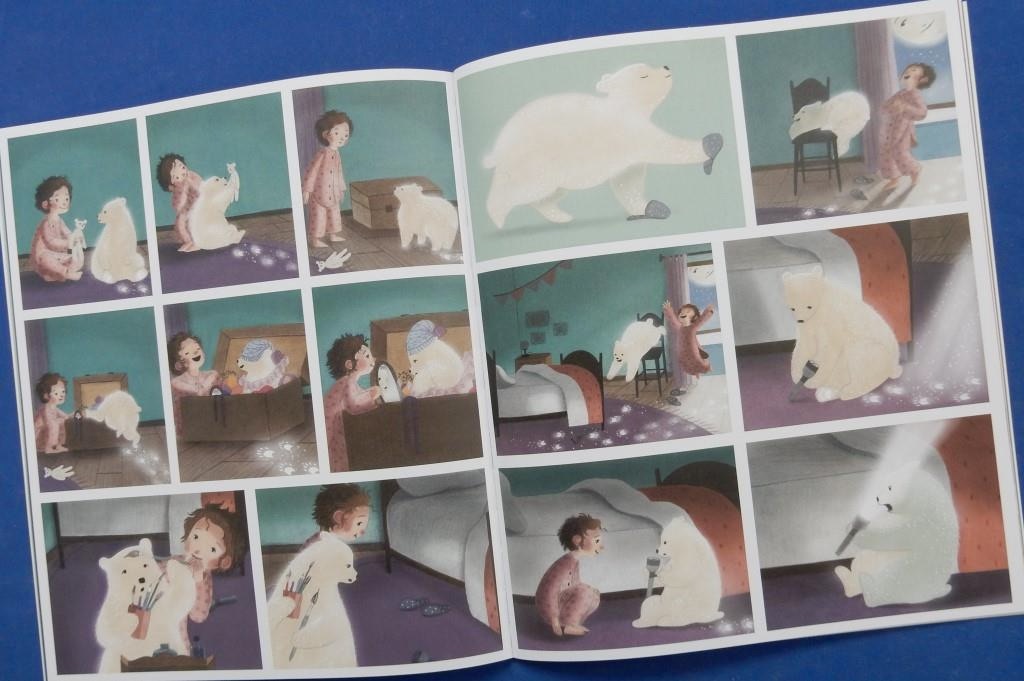
Ettie is afraid of the dark, even keeping a torch under the bedclothes at bedtime. One night though, there’s no need for her torch; instead a surprise cascade of shimmering light enters her room through the gap between the curtains.

Rising from her bed, Ettie starts to interact with the lights, using them to paint patterns on the walls and dancing with them. She does so until the bedroom is a wondrous sight to behold. She then draws the curtains right back, smiles at the moon and begins to connect up the dots made by the glowing stars until she has created a bear. A bear that comes into her room in a burst of brightness. Together the pair spend the night playing

and having a wonderful time. Come the morning the bear has disappeared and so too have Ettie’s fears about the dark. Throughout the day the girl eagerly anticipates the return of her ursine friend and can hardly wait for her bedtime routine to be over . Will she have another visit?

Told almost without words, the delightful fantasy unfolds in different sized panels containing gouache and coloured pencil scenes, comic book style. Sparkling with gentle magic, this tale of a girl who doesn’t like the dark and a bear that doesn’t like bright light, leaves young children free to let their imaginations take flight in similar manner to the girl protagonist.

Little People, Big Dreams: Rafa Nadal / Little People, Big Dreams: Usain Bolt

These sporting heroes are great additions to the series of mini biographies. Both are legends who have gone beyond their sporting successes and helped other people,.providing great role models for younger readers.

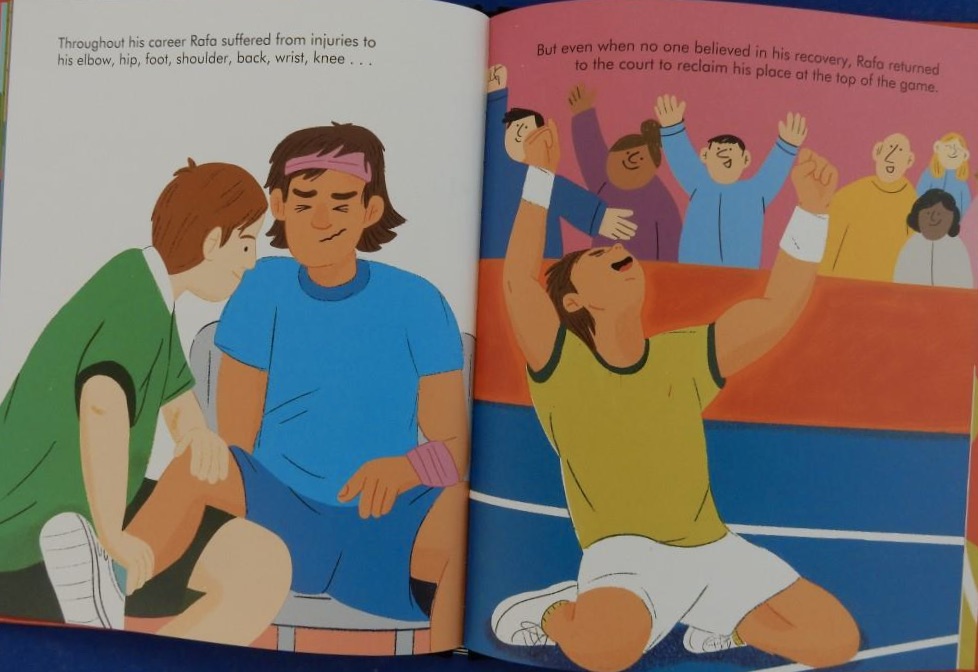
Rafa Nadal was born into a sporting family: one of his uncles passed on to the boy his love of football; another uncle gave him his first tennis lesson when the lad was just four years old. When he started winning tennis tournaments it wan’t only his innate ability but also his humility and determination to do well that made him such an outstanding player. How many others I wonder would turn up early to train and stay after everyone else to sweep the court and collect all the tennis balls. And how many others could continue playing with a very painful broken finger and win a tournament? That was just one of the many injuries Rafa sustained during his career and he never let them hold him back,

rather he increased his efforts determinedly wherever, whenever he played. His resolve also came to the fore again when Mallorca, his home, suffered devastating floods; Rafa was among the first people to help with the clean-up. Moreover through his charitable work he used sport and education to help future generations.
The book’s final timeline focuses on key highlights of his life and has further details of his story.

Usain Bolt’s first sporting interest was cricket; indeed it was his cricket coach who convinced the boy to join the track team and before long, having won a silver medal was offered the opportunity to move to Kingston and practice alongside other promising young athletes. At only fifteen, despite suffering pre-race nerves, he become the youngest ever World Junior champion. He learned an important lesson about dedication and discipline a few years later though: preferring to hang out with his friends rather than focus on running technique, he suffered an injury during the Athens Olympics and was eliminated. However a new coach made all the difference to what happened thereafter. Despite his scoliosis, his height and determination, Usain won two gold medals at the 2008 Beijing Olympics (one with a shoelace undone)

and earned the name ‘Lightning Bolt’. He went on to be the only sprinter to win Olympic 100 m and 200 m titles at three consecutive Olympics (2008, 2012, and 2016). In so doing he found himself a place in the heart of every Jamaican. Even more so by starting a foundation to help other children follow their dreams.
Both books deserve a place in primary school collections.

Here Be Giants

This sequel to Here Be Dragons is every bit as comically entertaining as its predecessor.

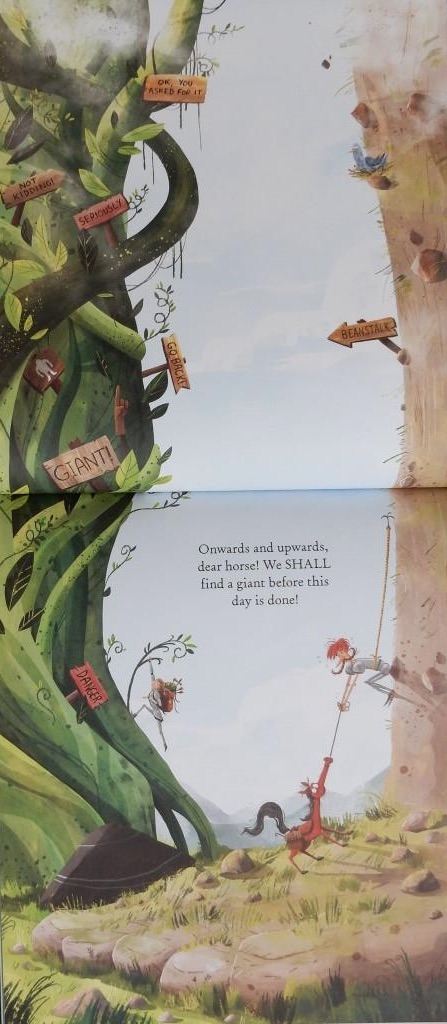
We join the same hapless knight as he sallies forth with his trusty steed, on a new and perilous quest, determined to prove to the other knights that he’s no fool. Having paused to consult his Giant Spotting Book, he starts looking out for LARGE things as per its instructions, measuring various normal sized objects, significantly an armour clad damsel. However, he fails to notice something that alert readers will have spotted.

Despite various clues fairly liberally scattered over the ground, our knight manages to miss every one and instead decides to find a spot higher up that offers a better view.

Having secured himself further from the ground it’s time to follow step two: beware of the ‘cursed sound of giant tummy rumbling’. That thunder the knight hears signifies a storm on its way, he thinks; but what is that ‘damsel’ on about; it certainly can’t be heard above the thundering sound. Better take shelter till the storm has passed and while so doing check out step three in the manual.
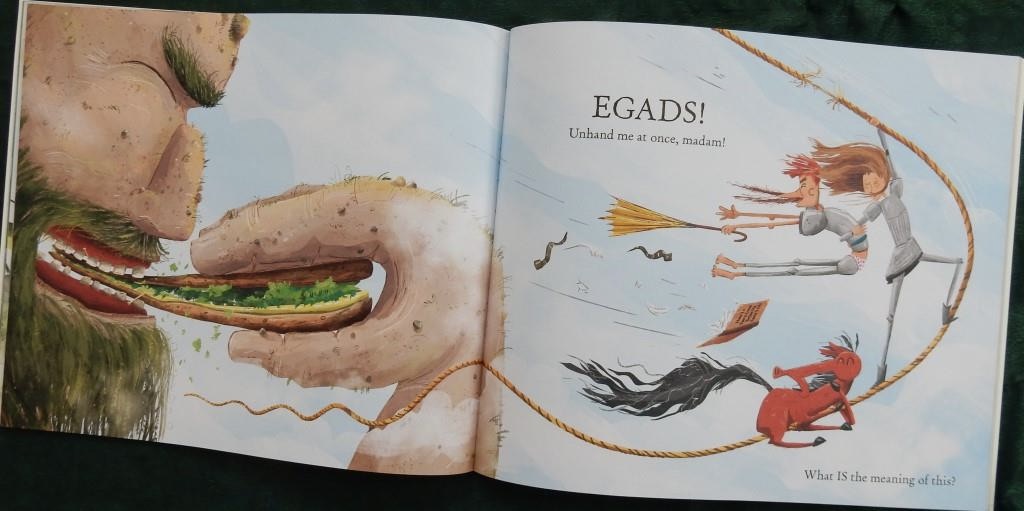
Even with the dastardly giant’s drool dripping on him from above, our hapless knight fails to recognise the clue and starts faffing about with his brolly.

Turns out, it’s just as well he’s brought that along on his quest: verily a poke from its tip provides a timely twist and demonstrates several things, not least of which is that females are frequently more savvy than males.

Paddy Donnelly provides one hilarious scene after another as the saga unfolds. That they are completely at odds with the knight’s (ie Susannah Lloyd’s) verbal narrative makes this book, with its knightly language, a story adventure-loving listeners will want read aloud multiple times as they relish being in on the joke from the outset.

I Love Books

On the last day of term, the girl narrator along with her classmates receives this parting comment from her teacher, “Enjoy your holidays, and don’t forget to read a book!” This girl, we then learn is a total bibliophobe. Nonetheless she’s duly taken to the library but nothing there appeals in the slightest

so it’s left to mum to make the choice for her.

Back home, the girl makes herself comfortable and reluctantly, opens the book. To her surprise, she’s almost immediately drawn into the story, a wonderful adventure story wherein she meets a furry guide

who leads her on a search for special ingredients. And what are these ingredients for? The most powerful of all spells …

If ever a child needs convincing of the magical power of books and stories – give them this, Mariajo’s new picture book that has everything you could want – adventure, magic, a demonstration of the power of the imagination and terrific illustrations with clever colour changes. I love the sneaky insertion of the author’s previous two picture books on the class bookshelf on the first spread, as well as a certain polar bear who, along with several other book characters, appears on the final page. Don’t miss out on the endpapers either. As a life-long bibliophile, I love everything about this story.

The Cat who Couldn’t Be Bothered

Greg, at least that’s what his feline friends call him, has no wish to do anything at all. He seems totally disengaged and turns down each offer made to join in with what could be a fun or exciting activity. So, it’s no to chasing a string ball, no thanks to a party,

joining an exploration doesn’t appeal and as for going to Mars, it’s a case of ‘I can’t be bothered.’

Then one of his moggy pals asks the all important, ‘What’s up, Greg?’ and eventually our Greg calls for all their suggestions to cease. He goes on to explain the reason behind his naysaying of all their offers. His empathetic friends then proceed to demonstrate just how much they understand.

The author’s narrative, both written and visual conveys simply and beautifully Greg’s friends’ learning journey. It’s an important life lesson: rather than making assumptions or imposing an idea on a friend, be there, listen and only then respond to their needs.

We all feel sad from time to time and this book shows the importance of understanding and doing nothing together. Definitely a book to share with a group or class and an excellent way in to a circle time discussion on responding to emotions. I wonder what they will make of the story’s final twist.

A World Full of Winter Stories

This is a veritable cornucopia of folk tales, myths and legends – fifty in all – gathered from around the world and retold by Angela McAllister. There are six sections: Birds and Beasts, Tricks and Troubles, Ice and Snow, Quests and Journeys, Spirits and Magic and the shortest, Christmas. Each contains stories I was familiar with, but also several new to me. One such was the very first, a tale from Japan telling how snowballs made by the children of the Sky Goddess become the ‘The First Rabbits’. Also new to me, from the same section is an amusing Ukrainian story about a dropped mitten that, unbeknown to its boy owner, becomes a temporary shelter for seven animals.

From the Tricks and Troubles section, a story from Kazakhstan that made me smile was The Marvellous Coat wherein a crafty man tricks another into exchanging coats, ending up with a thick warm coat plus a fine horse, instead of his original holey coat and worn out steed.

Bears feature quite often in wintry tales and this book is no exception. The Long Winter. a Dene story from Canada, in the Ice and Snow section tells how a group of animals struggling from the constant winter climb up into the sky to search for the world’s warmth. There they discover some bear cubs from whom they learn of the whereabouts of that which they seek, although reclaiming it from the mother Bear and restoring sunshine is anything but an easy task.

If you’ve ever wondered why some trees and bushes never lose their leaves, The First Evergreens, a Mongolian tale in section four, offers an explanation that involves a good-hearted swallow.
There’s an Inuit story in Spirits and Magic that took my fancy. It tells how a stolen wife was reunited with her husband, a village chief thanks to an old woman, a special charm and some magic words remembered just in the nick of time.

You might be surprised to learn that a scarecrow features in the final section, in a story from North America, a scarecrow that ends up helping Santa.

This book is a joy to share with children at home or in the classroom during the winter months. The tales are just the right length for a story time session and Olga Baumert’s illustrations, be they large or small, bring an extra touch of magic to each one.

Once Upon A Witch’s Broom

From Beatrice Blue’s Once Upon A series comes this story of two future witches, best friends Lilly and Moira. Lilly is able to do everything, new learning comes easily to her but not Moira. Moira is shy, things don’t always seem to work for her, she struggles with what she considers her inadequacy and consequently feels very lonely at times. However she is hoping that her once in a witch’s life opportunity, when she receives a magical Relic, will fix her and make her able to do everything well.

On her big day though, Moira’s Relic is a big disappointment. All the other witches receive something that matches their personality but why has she been given a broom? Moira shares her disappointment with Lilly who encourages her friend by saying that their Relics will help them become better witches, no matter what powers they carry. Could Lilly perhaps be right, wonders Moira. She decides to give her broom another chance but nothing works and she ends up breaking the Relic.

She’s just on the point of hiding the useless object away forever when she sees Lilly watching her and asks her a question. The wise answer she receives makes Moira resolve to have one more try.

Could her friend’s kind words and advice make a difference? Can Moira finally learn to believe in herself and let her powers shine?

A heart-warming story, powerfully illustrated, with an important message for all young children that shows them, and reminds us all, that believing in ourselves can reveal the magic we hold within. Young listeners will love following all the froggy details as the tale unfolds.

One Little Word

This image has an empty alt attribute; its file name is dscn9676-3.jpg


Two friends are playing in the park when suddenly an unspecified incident happens between them. There’s face pulling, shouting and a monster appears – The Argument – that keeps on growing as the quarrel escalates and the two children separate. Still the beast grows involving all the other children and making the most of the situation to keep on getting bigger and bigger

This image has an empty alt attribute; its file name is dscn9677-3.jpg

until the two that triggered things stand face to face and the girl who is narrating gives the other one a nasty push, immediately resulting in her feeling ‘sad and angry, mixed-up and confused’. He retaliates with a push too and both children end up in floods of tears. Those tears prove cathartic and the two are able to exchange just one tiny but crucial word. The effect on The Argument is dramatic: it gradually shrinks

This image has an empty alt attribute; its file name is dscn9678-3.jpg

until it disappears completely and very soon the park is full of happy, laughing children once more.


This is absolutely brilliant, both verbally and visually. Allison Colpoy’s attention to detail is superb, capturing the changing expressions of the two protagonists and their concerned, supportive pals. Her colour palette is hugely effective in highlighting the emotional journey and accompanying physical changes of the engaging adversaries especially : what a superb complement for Joseph’s lyrical telling.

This terrific book needs to be in every primary classroom to be shared over and over, carefully considered and discussed. The potential of its impact is tremendous – like that of The Argument at its most monstrous.

The Story of Conservation

The Story of Conservation
Catherine Barr and Steve Williams, illustrated by Amy Husband
Frances Lincoln Children’s Books

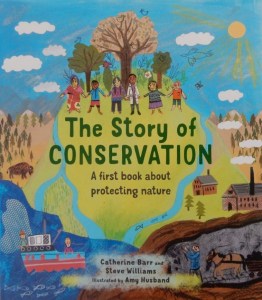
Catherine Barr and Steve Williams present an overview of the interaction of humans with planet earth. They take readers on a journey from prehistoric times to the present, highlighting the changes in people’s habits, the ways nature has been harmed, the natural resources used, and the ways people have worked to counter those changes to protect nature, citing Rachel Carson’s work as key when it came to the use of chemicals on crops in North America.

As well as highlighting the importance of changing global habits, the book also gives examples
of problems that different countries are facing – the consuming of ‘wild-caught’ meat in some parts of Africa being one, and the displacement of indigenous people.

Along with scientists’ attempts to stall the onslaught of global warming and pollution, the book discusses protests and attempts at conservation solutions.

Amy Husband’s gently humorous illustrations and the integral timeline show how human life has changed, and the way we use natural resources has evolved over time as practices like hunting and farming have altered the way we live. All of this should help children to develop their understanding of climate change globally and hopefully accept the authors’ final challenge to join in and make a difference.

A terrific introduction to the most pressing issue currently facing us all; this is a book to share and discuss in primary classrooms, and this, one hopes, will galvanise children into taking action.

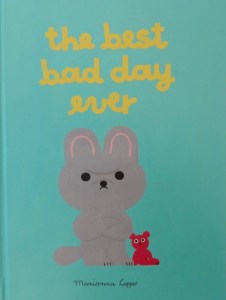
The Best Bad Day Ever

The Best Bad Day Ever
Marianna Coppo
Frances Lincoln Children’s Books

The feeling when we wake up and straightway know that it’s going to be a bad day, will be familiar to adults and perhaps to some children too. It’s certainly the case for little Wolfie, even his cuddly companion, Pepito, is in a bad mood.

Off Wolfie goes to school, through a street of happy-looking people and arrives late.

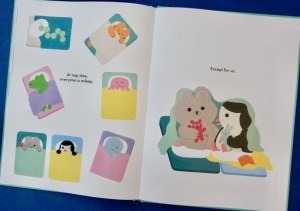
Nothing he tries turns out right and our small narrator feels nobody understands how he feels.

Then snack time comes and despite getting a fruit he dislikes, things start to look up. After a rest – not a sleep though for another little one stays awake too – the afternoon passes all too fast

and at home time, two little ones report to their respective parents, “It was the BEST BAD DAY EVER!”
Bring on tomorrow!

In just a brief text and scenes with an abundance of deadpan, gentle humour, Marianna Coppo captures that bad day feeling, going to on show how a kind action by another can change everything, making that great big frown into a beaming smile. All that’s needed is somebody who empathises and interacts, and … gone are those grumps.

Add to any preschool book collection, share it and invite the little ones to talk – to one another – in the first instance.

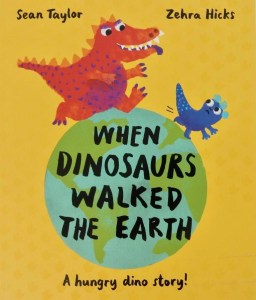
When Dinosaurs Walked The Earth

When Dinosaurs Walked The Earth
Sean Taylor and Zehra Hicks
Frances Lincoln Children’s Books

It seems young children can’t have too many dinosaur stories; this is a splendidly silly one about three dinosaurs. There’s Smallosaurus, she’s a herbivore; there’s great big Badasaurus who enjoys consuming small dinosaurs that eat a plant-based diet and finally there’s the monstrous meat-eating Worseasaurus.

The action begins with Smallosaurus wandering along with a smile on her face on account of the juicy ferns that she’s spied ahead – just the thing for a delicious breakfast. Hold it there! This is exactly what Smallosaurus does on realising that rather than the peaceful rock she first thought, she’s actually confronting great big Badasaurus whose idea of a good breakfast – ‘a small dinosaur, with a plant-based diet’ – is standing in front of him. Time to activate those little grey cells Smallosaurus; however only possessing a walnut-sized brain, she dashes away – in the wrong direction …

However, it transpires that Badasaurus has a brain even smaller than Smallosaurus and so he too makes an error …

Back to Smallosaurus who now strolls along again, this time between peaceful rocks and large trees, her mind once more of those juicy ferns. Little does she realise that Badasaurus is back, albeit looking slightly frazzled but still eager to sate his appetite with one small dinosaur, with a plant-based diet.

Oh my goodness, this situation requires another round of thinking by Smallasaurus. She decides to take cover behind a large tree but it turns out she’s over-estimated its size. Uh oh! Here comes her’ sad and terrible ending’. Or is it another error – a chomping one – by Badasaurus?

Step forward Worseasaurus, you now have a choice between two meaty dinosaurs for your breakfast. I wonder what SHE goes for …

With a cleverly constructed narrative containing surprises aplenty, Sean Taylor’s prehistoric romp will delight young audiences, as will Zehra Hicks’ bright splodgy scenes of those days When Dinosaurs Walked the Earth.

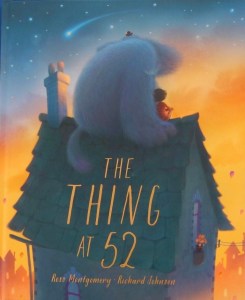
The Thing at 52

The Thing at 52
Ross Montgomery and Richard Johnson
Frances Lincoln Children’s Books

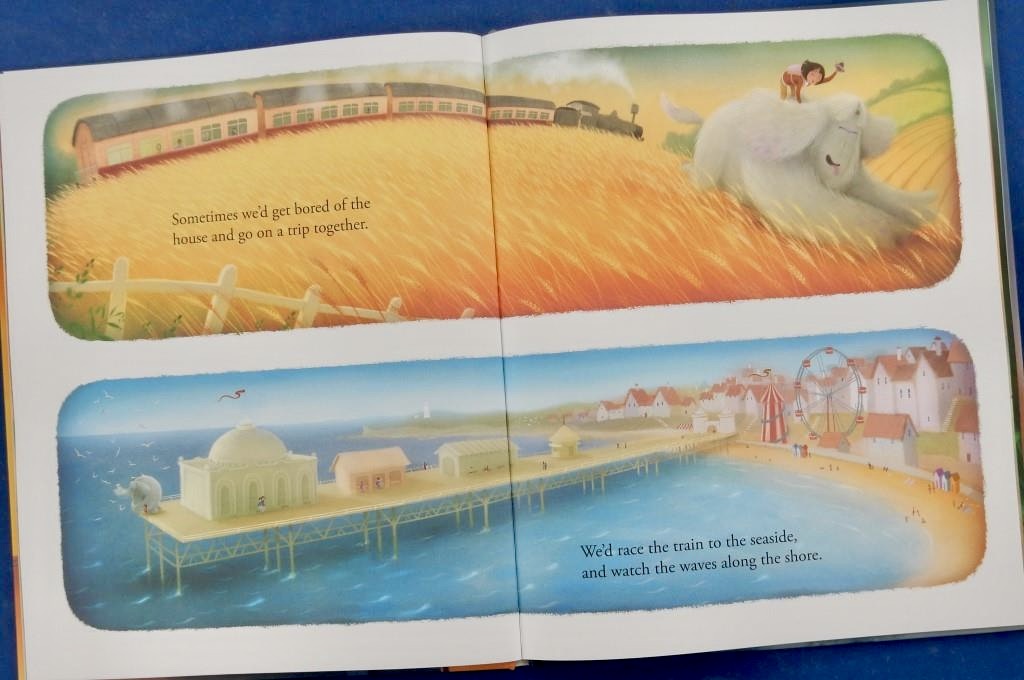
This tale is narrated by a little girl who makes friends with the large fluffy Thing that lives close to her home.

Deciding to take him a flower, she and her mother call on the creature and are invited in to what the girl thinks is a strange house with just a single chair, newspaper rugs and a fridge containing only jars of mustard – fifty of them. His response to her question about feeling lonely is answered thus, “All things are lonely sometimes.”

As their friendship blossoms, the two spend more and more time together, sometimes going on adventures,

and the child learns that there are hundreds more Things just like her friend.

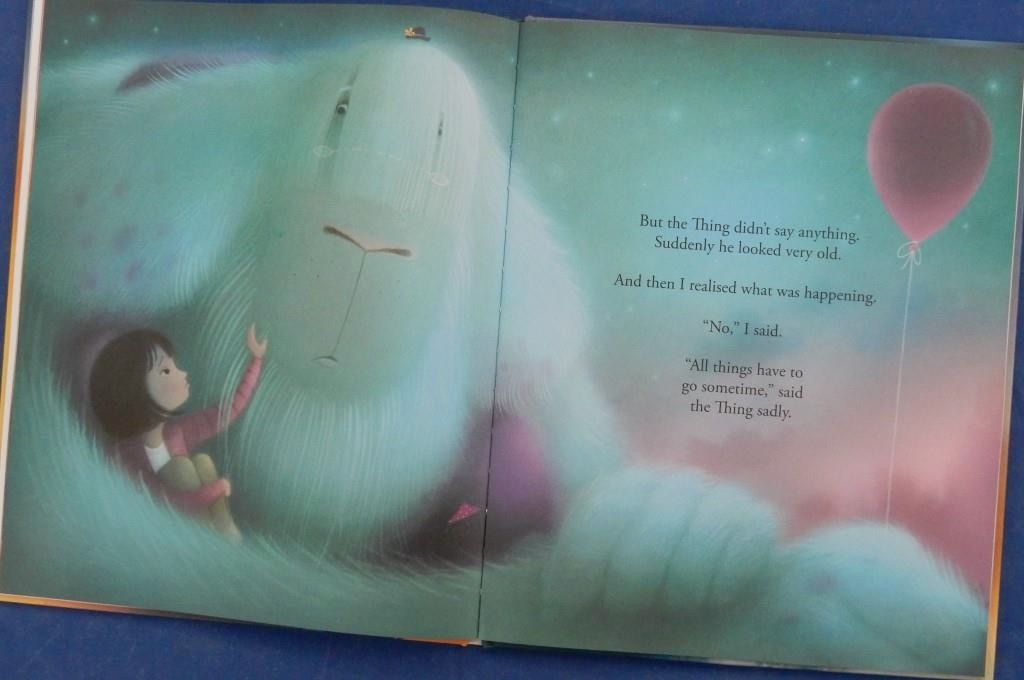
The narrator organises a wonderful party for all the Things, but then suddenly the special Thing looks very old

and the worst happens: with a hug as they watch the sunrise, the Thing disappears. All that remains are his old photos and memories of the wonderful times the two had spent together.

This tale of friendship and loss is all the more powerful on account of its gentleness. Death is never mentioned though it can be inferred from the somewhat dreamlike story. Dreamlike too are Richard Johnson’s soft-focus illustrations that have a potency of their own and are a superb complement to Ross’s words.

A Hero Like Me

A Hero Like Me
Angela Joy, Jen Reid and Leire Salaberria
Frances Lincoln Children’s Books

‘They call him ‘HERO’, but he’s no HERO – not to me.’
So it says on the first spread of this picture book – a fictional account – inspired by the events of 7 June 2020, when, during an anti-racism protest, prompted by the killing of George Floyd by police in the USA, a statue of seventeenth-century slave trader Edward Colston was pulled down and thrown into Bristol Harbour.

Co-author Jen Reid was among the protesters that day, and despite being afraid of heights, she felt compelled to climb onto the empty plinth and raise her fist above her head in a black power salute  – a moment that was captured on camera and shared all round the world.

Written together with Angela Joy, this wonderfully inspiring story relating the events of that memorable day are retold through the eyes of a girl who every day on her way to school sees the huge statue of the so-called hero, in reality a man who sold freedom for cotton and tea. She knows this man is not a hero.
However, it’s not easy to find real heroes: people who stand up for Justice, Peace and Kindness so our young narrator takes things into her own hands. She, her family and friends create placards and march, shouting out for what they believe in.

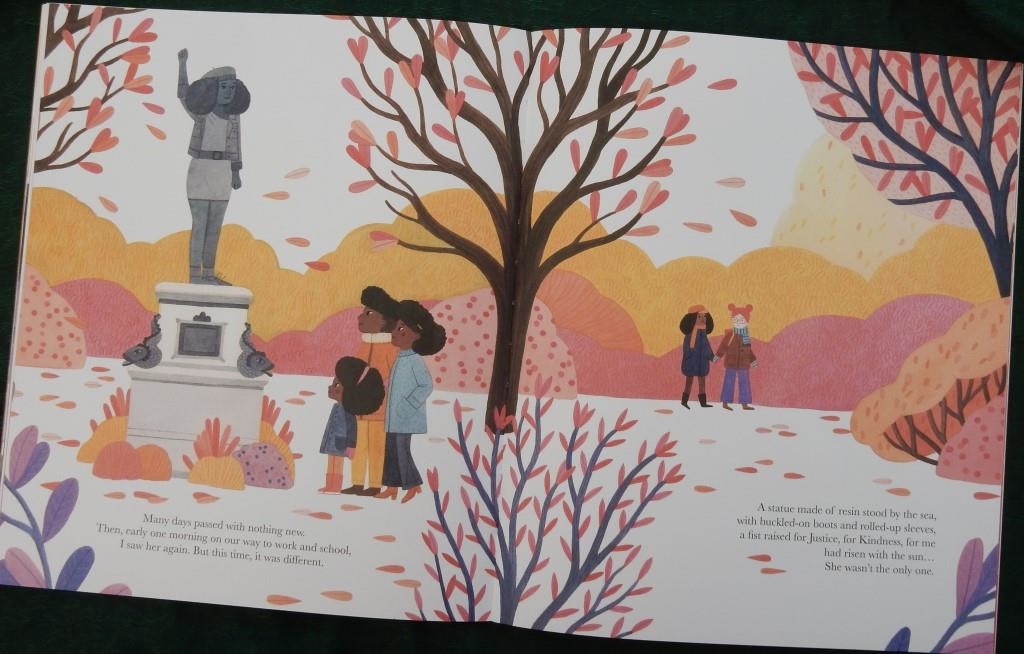
They march towards that bronze statue of Colston and eventually that towering statue becomes a toppling one that is dragged by many pairs of hands to the harbour’s edge and thrown into the water. Then in it’s place stands a real hero, a young woman with fist held up for Black Peace and Black Power

A few weeks later, (15th July) on her walk to school, the narrator sees a statue of Jen Reid by artist Marc Quinn had been added to the empty plinth. Called A Surge of Power, it was only in place for 24 hours.

Adding even more impact to Angela Joy and Jen Reid’s empowering words are Leire Salaberria’s distinctive, bold, stylish illustrations. Together they have created an important book for young readers; one that shows them a hero can be just like themselves, as well as offering them hope in humanity, in particular in those who stand up for what is right: activism can lead to change. It’s a must for primary classrooms and family bookshelves.

Little People, Big Dreams: Vanessa Nakate / The Flying Man

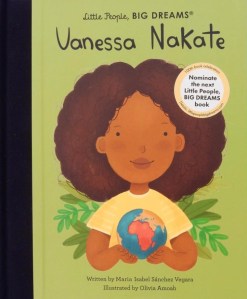
Little People, Big Dreams: Vanessa Nakate
Maria Isabel Sánchez Vegara, illustrated by Olivia Amos
Frances Lincoln Children’s Books

In this addition to the excellent series we meet a young and outstanding activist. As a child growing up, Vanessa lived with her parents in Uganda’s capital city, Kampala. Her parents always encouraged her to speak out for what she thought was right, but in the countryside where she attended school, climate change seemed a world away.

At university however she began noticing how, despite being the least responsible, Africans were suffering most by climate change. Thus she became an activist and persuaded her friends and relations to do likewise. She spoke out against the destruction of the Congolian rainforests and its consequences and one day she, one of few from the African continent, was invited to join other young climate activists in New York where they hoped to make world leaders take action against global warming.

When she returned home Vanessa continued her fight and after a setback at a protest in Switzerland, her work has been recognised
and now she is an inspiration to fellow young Africans and indeed the entire world. A vital topic and with its focus on Africa, this is an excellent book to inspire KS1 readers to use their own voices and indeed actions, to support the on-going fight to save the planet.

The Flying Man
Mike Downs and David Hohn
Astra Young Readers

In this picture book biography Mike Downs pays tribute to a relatively unknown German aviator, Otto Lilienthal, whose pioneering spirit led him to create the first flying machine.

Perseverance was key as despite considerable skepticism from others around, he and his younger brother, Gustav worked away observing, experimenting, testing and improving their designs until in 1891 Otto was successful in making a hang glider that travelled through the air . Eventually in 1896 in a more sophisticated (albeit still flimsy) glider he soared above admiring crowds with, so the illustrator shows, a euphoric expression on his face.

Following this a photograph dubbed him ‘The Flying Man’ but sadly a week later, Otto died from injuries that were the result of a crash. (This information the author places in an afterword) Nonetheless his work inspired many other fliers, including the Wright brothers who cited Otto as their greatest inspiration.

It’s evident from his writing that author of this book Mike Downs, found Otto Lithenthal inspirational too.

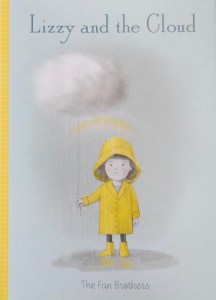
Lizzy and the Cloud

Lizzy and the Cloud
The Fan Brothers
Frances Lincoln Children’s Books

The Fan Brothers set their story in a bygone era when zeppelins hovered above the row of shops and people rode penny farthing cycles.

Every Saturday Lizzy and her parents go walking in the park. Most of the children visiting make straight for the roundabout or the puppet show but not Lizzy: despite clouds being ‘a bit out of fashion’ in those days, she makes for the Cloud Seller. From him she buys not one of the fancy animal clouds on a string, but an ordinary cloud. This she names Milo. (Naming your cloud was the first instruction in the accompanying manual.).

Lizzy takes great care of her cloud, following the instructions, watering it daily, taking it for walks and allowing it to go soaring out of her window while she held the string firmly in her hand.

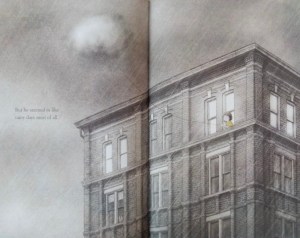
Over the months, Milo grows … and grows until one day it covers the whole ceiling.

There’s no instruction in the book to help fix the growing problem, then one night there’s a thunderstorm. It’s this that steers her towards a vital realisation: Milo has outgrown her room; she can’t contain him any longer: her cloud needs a bigger sky. Lizzy must do what is best for Milo and so she sets it free.

This beautiful meditation on letting go is brilliantly imagined and by blending the ordinary everyday with the extraordinary, the Fan Brothers deliver a truly original fable. It gently shows children that sometimes one needs to allow somebody (or something) you love to move on and that in time, those raw memories will become something sweet to be cherished always.

The delicate, dreamy illustrations in soft greys and browns with muted colours, are perfect for showing the alternative reality in which the tale unfolds. Whimsical and wonderful.

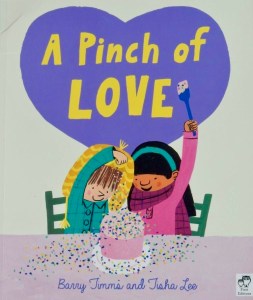
A Pinch of Love

A Pinch of Love
Barry Timms and Tisha Lee
Frances Lincoln Children’s Books

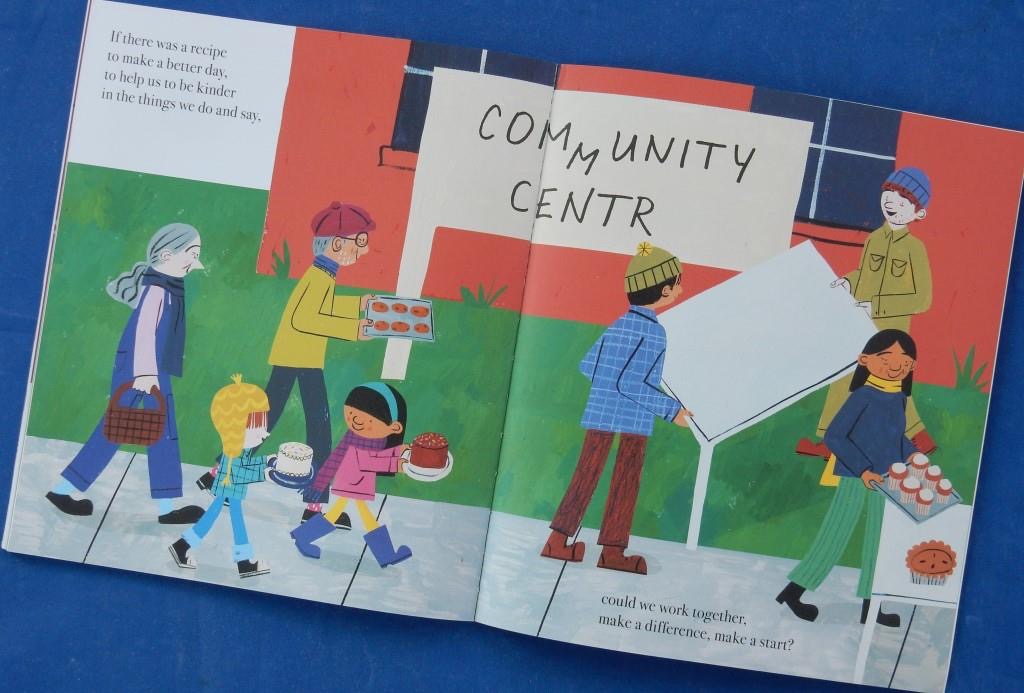
A little boy and his grandmother love to cook together and they especially like to make the titular pinch of love one of the ingredients no matter what they bake. Through Barry Timms’ rhyming text and Tisha Lee’s vibrant acrylic illustrations, that heartfelt love is shared throughout the local community. We see the empathetic little lad out offering fresh cookies to those in the neighbourhood; he seems to know just when there’s a need for a tasty treat that contains that vital ingredient.

Readers will enjoy the ‘sticky moments’ grandmother and grandson share in the kitchen as they too sometimes need a touch of tenderness especially as they prepare for that big neighbourhood fund raising bake sale at the community centre.

Choosing to be kind and loving isn’t always easy, but Tisha’s scenes of the wonderfully diverse community show just what a big difference it can make to be on the receiving end, as well as for the giver.

Love can be a power like no other: that message comes across in both the skilfully mixed text and the illustrations that add further heartwarming details to the words.

A lovely book to share with children and a smashing starting point for a class or local group event along the lines of the one shown in this story: baking/food is both a means and a metaphor for ‘paying it forward’.

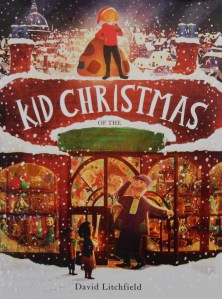
Kid Christmas of the Claus Brothers Toy Shop

Kid Christmas of the Claus Brothers Toy Shop
David Litchfield
Frances Lincoln Children’s Books

Everything David Litchfield does is a winner as far as I’m concerned and this one is no exception. It features young Nicky and his three uncles: Louis, Hans and Levi, aka the Claus Brothers, the finest toy makers in all the land.

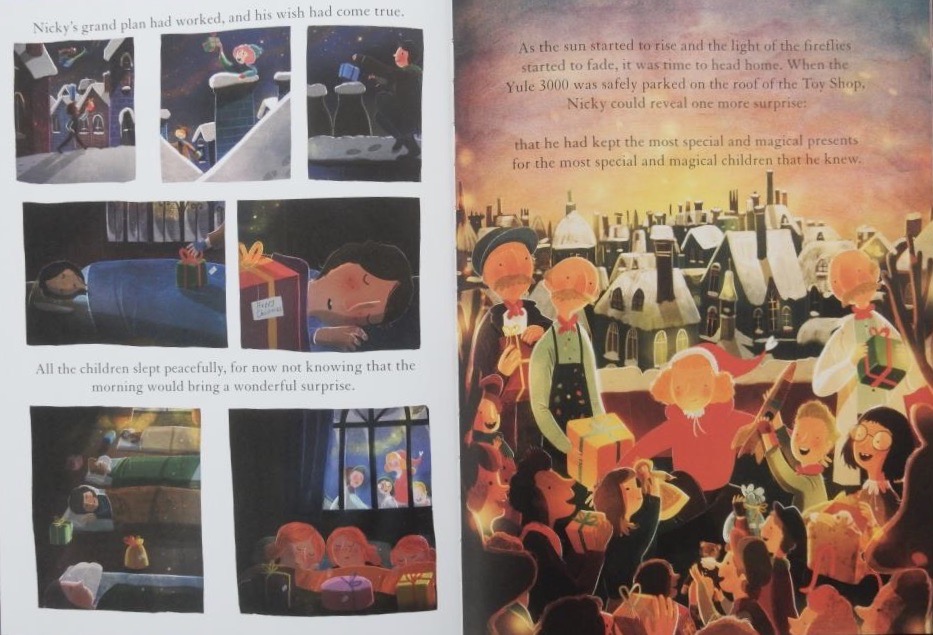
Nicky is now old enough to work for his uncles in their emporium behind which is their workshop. There, Uncle Hanz was to be found making the toys, Uncle Louis would check them and Uncle Levi had a special role: he added the magic sparkle to every single toy making it perfect for the recipient. From time to time Nicky would notice less fortunate children outside the shop peering in and on Christmas Eve, with the shop closed early, Nicky decides to follow the children. What he discovers saddens the boy greatly and he vows to give every child in the city a present to make them happy, even if only for one day.

Back in the Toy Shop, his uncles are agreeable to the plan and with huge sacks full of gifts, Nicky suddenly realises that delivering them is going to be beyond his capabilities. Or maybe not, thanks to another of his uncles’ creations.

Off he sets but then faces other difficulties on his journey pulled by reindeer that require frequent supplies of carrots. Will Nicky ever bring his plan to fruition? Happily yes: how else would the story of Father Christmas have come to be?

David’s illustrations are out of this world brilliant. Full of Victorian details to pore over, and combined with a story brimming over with kindness that will fill anybody lucky enough to read the book, with a wonderful seasonal glow.

Board Books for Christmas

Cat Family Christmas
Lucy Brownridge and Eunyoung Seo
Frances Lincoln Children’s Books

There’s an olde world feel to this Christmas count down. We follow the Cat Family through the busy days in the run-up to the festival, right through to Christmas Eve in this lift-the-flap book.

With twelve days to go to the big day, after many hours working in town, Mummy Cat joins her kittens just back from school and Daddy Cat already there to welcome them, and then it’s all systems go. There’s so much to do: the first being putting up the decorations – a task for the kittens; then comes the baking of Christmas cake and mince pies – hmmm you can almost smell that lovely spicy aroma. While their parents write cards, the kittens write to Santa and the following day, the family go to meet Granny and Grandpa at the station. Next the Cat Family go out into the village to do some cat-a-carolling, “We fish you a meow Christmas and a tabby new year”. 

With six days to go, there’s a bit of garden harvesting needed of veggies for the Christmas feast and finally with all the last minute jobs done, it’s time for a snuggly Christmas Eve with the family and a regaling of Grandpa’s special story.

There’s seasonal cheer aplenty here with not a hint of a cross word or a tear and the family seemingly cruise through all the preparations. Eunyoung Seo’s scenes are bursting with detail and each spread has a plethora of small flaps to peep behind (careful handling required), where further details are revealed. This large format board book will last more than one season in contrast to the traditional advent calendar; moreover it’s something to share with your little ones.

Santa’s Christmas Countdown
Kath Jewitt and Sebastien Braun
Townhouse Publishing

Poor Santa! Having lost his list of jobs to do, he’s worked himself into such a state, till, lightbulb moment: he’s been doing them for so many years that surely he can now recall every single task. It’s surely worth a try so off he goes. First he checks the sleigh is clean and shiny; then there are all the presents to wrap and his own snacks to put in his food box. Singing jolly songs helps him get into the spirit of the season and of course, the reindeer must be well fed and their coats brushed. Good old elves, they’re at the ready for this job and more.

Then Santa works on himself: that entails donning his lucky socks and pants, some tonsorial treatment and then it’s time to get into his red outfit (heated of course). That done, he feeds his moggy, makes a hot chocolate, hitches the reindeer, loads the sleigh and Ho! Ho! Ho! off he jolly well goes on his round.

A touchy-feely, fun book for tinies with a rhyming text and Sebastien Braun’s bright, busy illustrations. It’s great to see a black, bespectacled Santa and a diverse team of elves too.

A World Full of Spooky Stories

A World Full of Spooky Stories
Angela McAllister, illustrated by Madalina Andronic
Frances Lincoln Children’s Books

This collection of fifty traditional tales from all over the world is organised thematically into eleven parts – by geographical feature or location – and celebrates things spooky (but not terribly so). Some are very familiar: Hansel and Gretel and Little Red Riding Hood being two from the ‘Into the Woods’ section, which comes first.

One witch I wasn’t familiar with is the Water Witch. In this tale originally from France, William the hero goes to the bottom of an enchanted lake to find riches so he can afford to marry his beloved, a dairymaid, but is tricked by the witch, transformed into a frog and thrown into a fish tank. All ends happily I hasten to add, though maybe not for the witch.

Readers are more likely to know Baba Yaga who resides in the house that stands on a pair of chicken legs: she’s the one Vasilissa the Beautiful gets the better of when she goes into the forest, in a Russian tale of the same name.

If you follow a mountain path it might lead to a man-eating ogre. This fearsome being is found in the mountains of Tibet and he tricks a girl into believing he is her mother and thus is able to carry her off to his cave. Do you think he eats the girl? Possibly, but it’s also possible that a fox helps the girl’s mother and in so doing causes the demise of the old ogre. Also feared for consuming humans is the Chenoo that features in a North American Passamaquoddy story. This giant creature had once been a man but on account of his wickedness, his heart had turned to ice. Can that ice perhaps be melted again and with it the wickedness? …

Certainly there are spooky elements in all the stories, but very few are really spooky and one or two are even humorous. Helping to bring the tales to life are boldly coloured folk art style illustrations by Madalina Andronic. Yes, this could be a book for reading while snuggled up on chilly autumn and winter evenings, but equally, folk tales are entertaining whenever you encounter them.

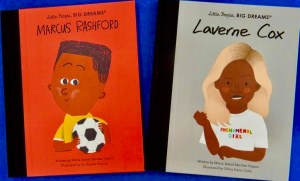
Little People, Big Dreams: Marcus Rashford / Little People, Big Dreams: Laverne Cox

Little People, Big Dreams: Marcus Rashford
illustrated by Guilherme Karsten
Little People, Big Dreams: Laverne Cox
illustrated by Olivia Daisy Coles
both written by Maria Isabel Sánchez Vegara
Frances Lincoln Children’s Books

World famous soccer player and campaigner against child poverty, Marcus Rashford is a truly inspiring person. Coming from a loving family in Manchester he spent much of his childhood practising with his football. His mother did everything within her power to ensure her children had enough to eat, though the family still had to rely on free school meals supplemented by food charities. Supported by his mother he followed his soccer dreams, was scouted and joined the academy at Manchester United where he worked hard to become a great forward, eventually becoming at just eighteen years old, the youngest player to score for his country in his debut match.

However, every single time he played he believed he was doing it not just for himself but for everyone who had shared his dream; and he never forgot where he came from. During the 2020 school closures on account of the Coronavirus pandemic children no longer had free school meals and Marcus’s social conscience led him to start a nationwide campaign so that no child would go hungry.

With powerful illustrations a timeline and additional information, this is an inspiring addition to the series.

One of twins, Laverne Cox experienced considerable bullying as she came to terms with her gender identity. She received no support from her mother, turning to dance to find some joy in her life.
Eventually she gained a scholarship to Alabama Academy of Fine Arts where youngsters were encouraged to be true to themselves. At last Laverne was able to express herself as she was and to make real friends. While studying ballet in New York she was offered a role in a play, discovered a love for acting, went into film and supported by friends who had already made the journey, developed sufficient confidence to start her gender transition.

A very useful book for younger primary age children to learn about the importance of acceptance and respect for others as well as being true to oneself.

An Unexpected Thing / Hello Autumn

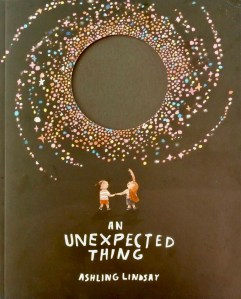
An Unexpected Thing
Ashling Lindsay
Frances Lincoln Children’s Books

Little Fred is a fearful child. Unlike most of us who feel frightened from time to time, Fred is fearful almost always, so he spends his days and nights in fear of such things as unexpected loud noises and shadowy shapes
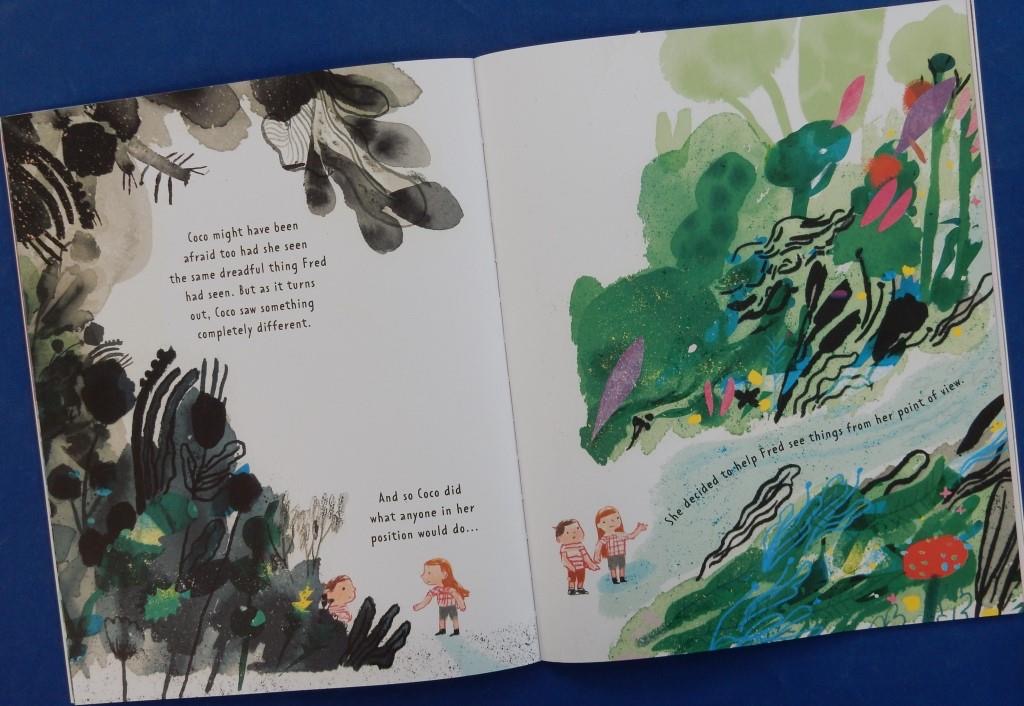
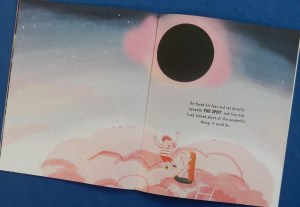
Surprisingly one day a spot appears and unsurprisingly Fred hides himself away, too afraid to look directly at it. Coco also sees the same spot when standing close by in the garden, but her reaction is quite different for what she sees is totally different.

She decides that she can help Fred by trying to get him to see things from her viewpoint. For instance if Fred sees a moon blasted from its orbit whereas Coco sees it as a wind born bubble bobbing along: Fred sees a catastrophic comet, Coco a balloon bearing a birthday wish. Eventually after some discussion, fearful Fred and fearless Coco agree that the spherical object could have been anything.

As a result Fred now feels ready to face his fear.
When something else unknown comes along Fred is able to do something he’d never have done without Coco’s support: he joins her in a voyage of discovery. A friend can make all the difference when it comes to facing things that make us feel unsure or frightened.

This smashing story about finding the courage to go out and explore the world is touching and empowering. Ashling’s use of different perspectives for her beautiful scenes underscores the different viewpoints of the two characters.

On a similar theme is

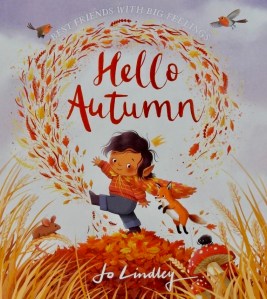
Hello Autumn
Jo Lindley
Farshore

This story (the second in a sequence) features four friends – the Little Seasons – Spring, Summer, Autumn and Winter in human form. As the book opens they realise that Summer must hand the weather crown to Autumn so the new season can begin. Doing so triggers changes such as the appearance of a chill mist and the heavens turning from green to golden yellow; the friends feel the call of adventure.
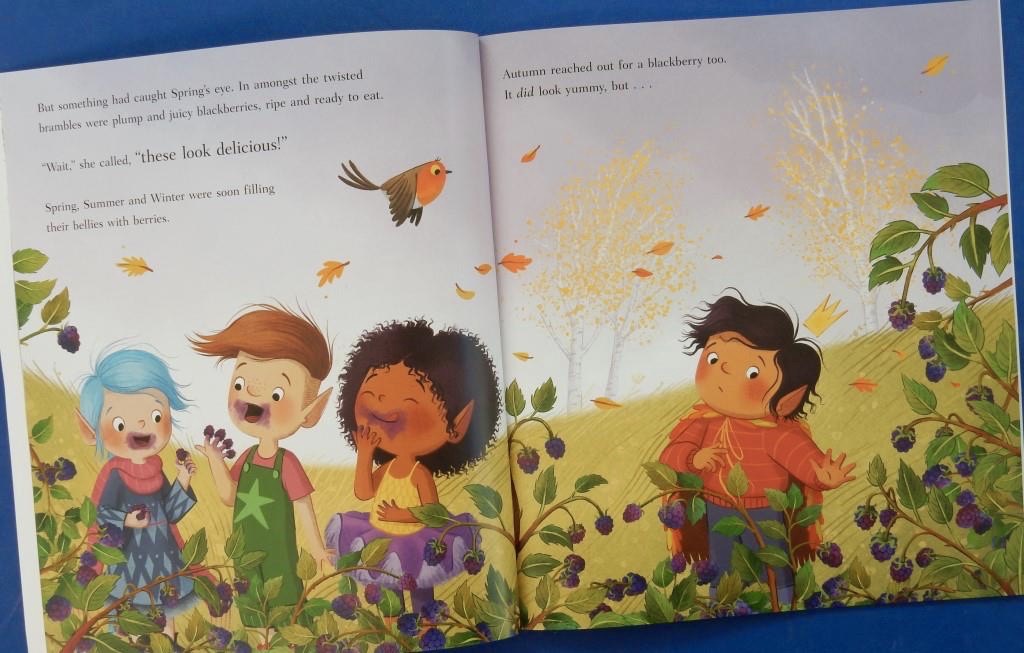
Some fun games ensue on the way to the Tick Tock Tree for a leaf romp but the sighting of ripe juicy blackberries causes them to pause and three friends start feasting. Not so Autumn: he worries about such possibilities as pricking a finger, or becoming entangled in the brambles.

A similar thing happens each time one of the others suggests trying something new: what his friends see as fun games, Autumn sees as worrying situations. His weather crown weighs heavy.
When the four reach the Tick Tock Tree with its abundance of fallen leaves, Autumn’s fear mounts even higher as a cascade of terrifying ‘what-ifs’ invade his thoughts. Suddenly there’s a cry for help. Summer is stuck on a branch. What happens after that involves teamwork, resulting in a jumbled tumble and a fear-releasing realisation for Autumn. What a relief; now he’s ready to face the world.

Vibrantly coloured scenes accompany an important message about facing your fears with the support of friends. A cute story and also some gentle learning about seasonal change that’s just right for sharing with foundation stage children.

Our Tower

Our Tower
Joesph Coelho and Richard Johnson
Frances Lincoln Children’s Books

This is Joseph Coelho’s first book as Children’s Laureate and what a truly magical one it is. Inspired by Joseph’s childhood growing up with his sister in a tower block on an estate in Roehampton, close to Richmond Park it is deeply personal and exquisitely told. The story – a modern fable – follows three children who live in a high-rise block, ‘Boring, hard and grey.’ but with a view to greenness beyond the drab grey, as they venture away from the suburban streets in search of a special tree with big leafy brows.

Having found what they were seeking,

the children tumble through a gap in its trunk into a magical world deep down where all kinds of creatures lurk.

There too on a throne sits an old tree-grown green man with bushy brows and he holds out something to the three. It’s a circular stone with a hole in the middle; this he gives the children and it’s as though he’s given them a new lens through which to view the world. For when they peer through the hole ‘the world goes upside-a-diddle’ and they suddenly see their own tower in a completely new light. It’s full of the love and laughter that they’d really been seeking all along: a place where everyday magic can happen once you know how to look.

Looking is assuredly what the artist Richard Johnson has done for his powerfully atmospheric, evocative illustrations. It’s so brilliant how his colour palette changes as the children move between their mundane urban home environment, the fantasy world and the natural one; this adds to the feeling of poetry in motion in Jospeh’s lyrical words. Richard includes details of architecture and sculpture (a version of Lynn Chadwick’s The Watchers) that make several links for this reviewer as well as the author.

Full of hope and enchantment, this timely story is a glorious fusion of words and pictures that blends the mundane and the dark with the magical and the triumphant, the urban and the countryside: nature and magic are everywhere if you know how to look. Unmissable this.

This Book Will Save the Planet

This Book Will Save the Planet
Dany Sigwalt, illustrated by Aurélia Durand
Frances Lincoln Children’s Books

As I sit reading my copy of this book, (it’s part of the Empower the Future series), much of the UK swelters in temperatures of 40 degrees C, wild fires are raging in various parts of the world and people are dying as a result of the heat: it’s clear our planet is in crisis. So Dany Sigwalt’s thought-provoking look at climate change couldn’t be more timely.

Herein she shows how it’s the marginalised communities across the world over that are most affected, stating that it’s those of us among the more privileged who need to use whatever privileges we have to help less fortunate and hence, less powerful people.

All is not quite lost. There is still just enough time for every single one of us to make a difference; by pulling together – mutual support and aid is paramount – and by using Dany’s framework we can all further the cause of climate justice. In order for this to succeed, people must come before profit.
Our precious planet will be protected if all its inhabitants are protected; the people will be protected if the planet is protected.

The vibrant illustrations by Aurélia Durand add to the impact of this hugely pertinent, powerfully presented book. Read it, make sure you do the activities at the end of each chapter and act – NOW! Make that crucial difference.

A New Friend

A New Friend
Lucy Menzies and Maddy Vian
Frances Lincoln Children’s Books

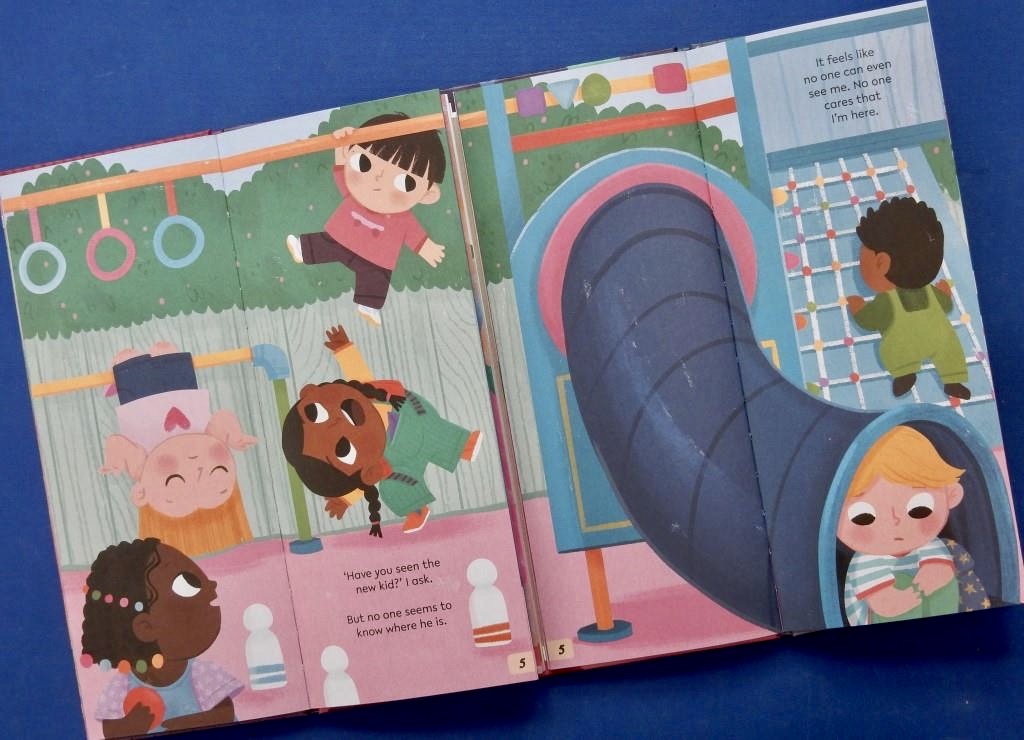
This truly heartwarming story is told from the perspectives of two children, Mae and Joe and it’s a terrific demonstration of there being two sides to every story. On the left side Mae introduces herself telling readers of her excitement about there being a new arrival in town for whom she has written a special letter to give him at school. At playtime though, she’s unable to find him anywhere.

Joe, the new boy tells his story on the right side explaining that he and his dad have just moved to a new home and now everything feels strangely different. He’s eager to make new friends like his dad says but Joe feels invisible in the playground, wishing he could be back playing space adventures with his old friends. Then suddenly …

Could this be the start of an exciting friendship, and further space adventures perhaps …

A smashing, cleverly conceived book that will help young children understand the importance of empathy and how sometimes being in an unsettling, worrying situation might lead to misunderstandings or misconstrual on a newcomer’s part. Both children however show courage: Mae for her persistence and determination to show kindness, Joe for facing up to his fears. Close perusal of Maddy Vian’s bright, inclusive illustrations will reveal lots of galactic theme details such as the sticker on Mae’s letter, toy rockets and Joe’s backpack.

Flooded

Flooded
Mariajo Ilustrajo
Frances Lincoln Children’s Books (First Editions)

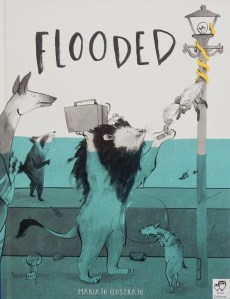
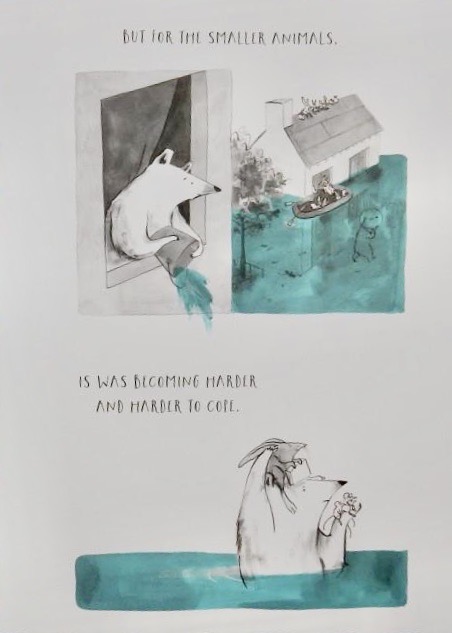
Full of water, wit and a little one’s bit of wisdom is this debut picture book from Mariajo Ilustrajo, about a city inhabited solely by animals. It happens one summer beginning on a day just like all the others except that the entire place is rather wet. Initially all the residents except one are happy to use the excess of water as a chance to splash about in wellies and carry on with life as normal, merely making it a topic of conversation and a source of fun.

As the water level keeps on rising there remains a lone voice that shows increasing concern as most others become further involved in their own issues, until that is, some of the smaller animals start having problems.

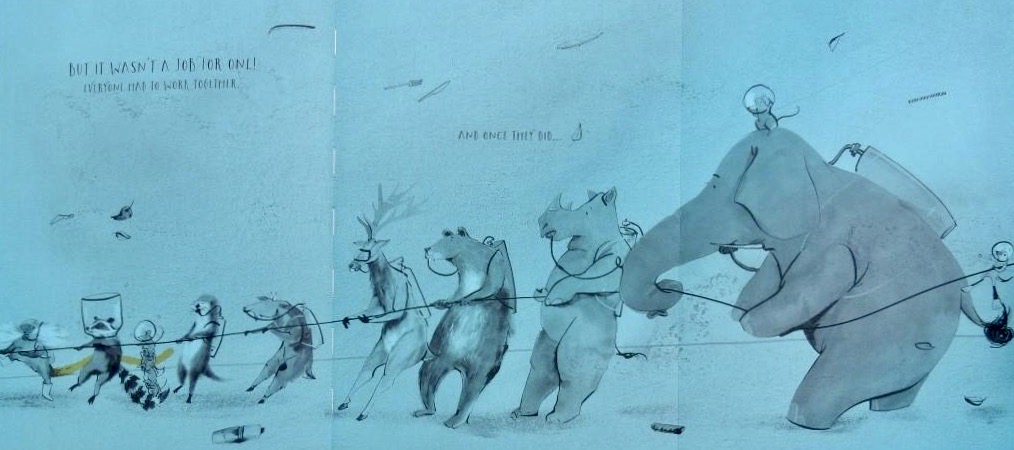
Eventually a small volume of water has become an enormous problem, impossible for anyone to ignore; but is there anybody that knows what should be done? Happily yes and at last that little creature is able to voice a simple (and we readers would think, obvious), solution. With the entire population working as a team …

the plug is extracted and the drowning of the city is finally halted. Yes, new problems arise and have to be dealt with, but happily now community collaboration rules and solves …

This tale of pulling together in times of need is wonderfully illustrated by an exciting newcomer using ink and graphite and digitally coloured. The text is kept to a minimum allowing the wealth of funny details in each scene to do much of the storytelling.

An Artist’s Eyes

An Artist’s Eyes
Frances Tosdevin and Clémence Monnet
Frances Lincoln Children’s Books

As the story opens adult Mo and young Jo are out walking together. Readers are invited to notice their eyes – they have the same friendliness, shape and smallness but Mo’s eyes are different: she has artist’s eyes. As they walk through various different natural places Mo comments imaginatively on their surroundings: she sees the seascape as ‘a dazzling duck-egg blue, a swirl of peacocks and the inky, indigo of evening, whereas Jo says it’s “so blue!” As they continue Jo describes the forest literally as “green” whereas Mo sees “a shiny apple-green, the lime of gooseberries, and the spring zinginess of moss.”

The field of yellow flowers are “bright yellow” to Jo and Mo notices variations in shades. “Notice how light changes the colour. See the mellow yellow of melons and the pale pastel of primroses.” Jo’s response is despondent: he becomes angry and frustrated at not seeing like an artist.

Patiently, Mo encourages him to trust his own eyes and little by little Jo begins to see what they show him; and what they show him as he deploys his imaginative powers to the full are patterns, textures, shapes and more.

No, he doesn’t see as Mo sees but he does now see with artist’s eyes.

Assuredly, with Clémence Monnet’s gorgeous mixed media illustrations, and Frances Tosdevin’s empowering story, this is a book that, shared with the right adult, will encourage youngsters to accept, employ and make the most of the unique skills they have, as well as conveying the idea that everyone can see like an artist and describe imaginatively what they see.

This is the Way in Dog Town / Cheesed Off! / Blue Badger

This is the Way in Dog Town
Ya-Ling Huang
Frances Lincoln Children’s Books

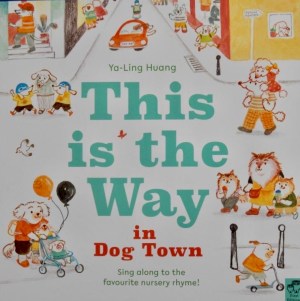
Spend a day in Dog Town with little ones and you’ll soon be singing along to the tune of Here we go round the Mulberry Bush. Just like humans, the residents of this canines only town start by brushing their teeth, after which they get dressed (with a bit of adult assistance) as they ‘Pull, pull, pull!’ Then it’s off to school, hurrying of course as there’s so much there to enjoy be it drawing, playing outdoors and having lunch at midday. Duly sated, ‘Yum, yum, yum!’the afternoon is spent painting and swimming. Early in the evening, the young dogs, walk home and once indoors the way they eat their dinner is let’s say rather messy as they ‘Slurp, slurp, slurp! their way through plates full of spaghetti. So, it’s as well they have a jolly good scrub in the bath later in the evening before retiring to bed.

As they share this book with an adult, little humans will enjoy joining in with action words, as well as emulating the puppies’ actions and exploring the various busy scenes created by Ya-Ling Huang.

Cheesed Off!
Jake Hope and Genevieve Aspinall
uclan publishing

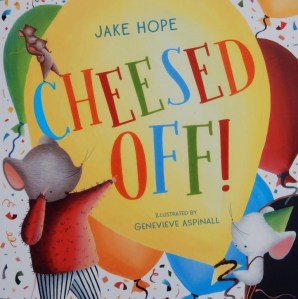
The humans are having a party and it’s time for the photos: on the count of three everyone say “Cheese!” but what about that warning sign at the start of this book – the one about a certain word bringing mice from their house. Too late! The partiers have uttered the word and it’s been heard behind the skirting board. Out come the mice but not a whiff of cheese can they detect. Not a single sighting of a sliver can they spy no matter how hard they try.
Then suddenly an announcement is made and something with candles atop is carried in. Now what might that be …

Huge fun for those in the early stages of becoming readers especially, is Jake Hope’s extended joke illustrated with lots of amusing details from the viewpoint of the mowses’ – oops, make that mice. Therein Genevieve Aspinall shows how humans don’t always realise what’s actually going on right under their noses – or, to be more accurate, beneath their feet.

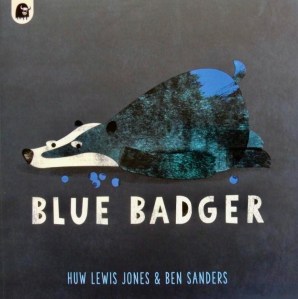
Blue Badger
Huw Lewis Jones and Ben Sanders
Happy Yak

Badger is having an identity crisis: is he black or is he white – albeit with a blue bottom having sat down beneath a bush to eat berries. Off he goes to ask the opinion of other creatures. Bird is unsure, Dog doesn’t know either although he admires Badger’s blue rear and invites him to play. Both Cow and Skunk are dismissive whereas Zebra is equally nonplussed about his own colour markings and Panda merely takes the opportunity for some self-flattery.
Whale sends Badger off to meet Penguin whose considered response is both helpful and constructive, making Badger feel much more positive about himself as well as perhaps, a tad hungry … Happiness at last.

Author Huw Lewis Jones adopts an almost detached tone to his gently humorous text that includes a repeat refrain, while Ben Sanders places his black and white characters on stark, coloured backgrounds in this story with its ‘You can be whatever you want to be’ message.

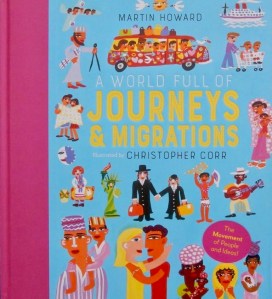
A World Full of Journeys & Migrations

A World Full of Journeys & Migrations
Martin Howard and Christopher Corr
Frances Lincoln Children’s Books

Migration has been very much in the news for the past several years with stories of people fleeing wars in Syria and Afghanistan, overcrowded and flimsy craft undertaking hazardous crossings of the Mediterranean and the English Channel and refugees attempting to cross land borders of eastern European countries to reach the European Union. This book chronicles that migration is not a recent phenomenon but something that began 70,000 years ago when the first people started to spread out from Africa to inhabit the whole globe.

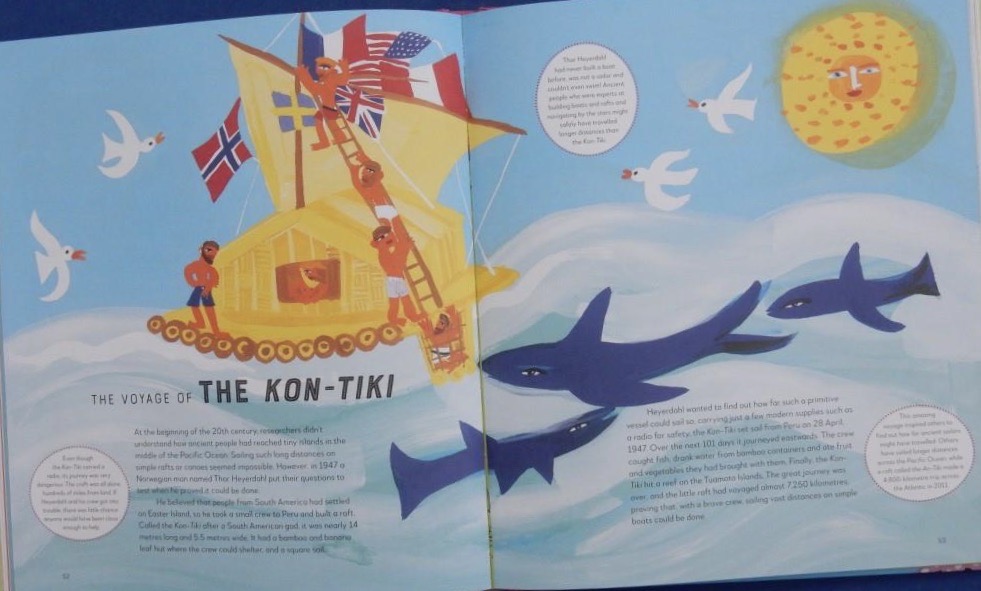
Author Martin Howard and illustrator Christopher Corr explore some fifty instances through history, continent by continent covering a large variety of relevant topics. These include navigational journeys of discovery by Marco Polo and Christopher Columbus, as well as Thor Heyerdahl’s Kon-Tiki,

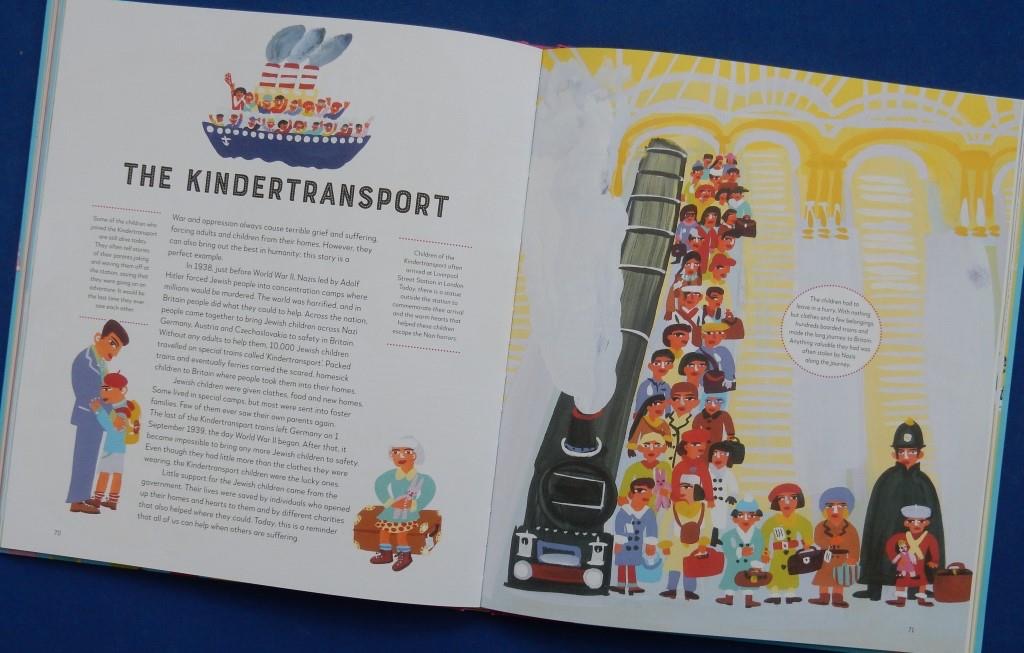
which emulated primitive vessels of ancient peoples; forced migration of slaves such as those of African peoples from their homelands to American colonies; colonial journeys for power and profit including those of the British to India and many European countries to Africa and various other parts of the world. Also included is an excellent example of what humans can do for those on whom great suffering is inflicted, the Kindertransport British people set up to bring Jewish children to Britain to prevent them being sent to concentration camps by the Nazi regime.

What is key no matter the reason, is that with the movement of people comes a wealth of new, potentially enriching ideas. The author acknowledges that in a book such as this it’s impossible to cover everything and it’s an amazing thought that as he says, inside everyone of us is a ‘kaleidoscope of human history and thousands of stories of travel and adventure.

Christopher Corr’s distinctive illustrative style is ideal for the book making what would otherwise be quite a demanding subject much more accessible.

Nen and the Lonely Fisherman / Love Grows Everywhere

Nen and the Lonely Fisherman
Ian Eagleton and James Mayhew
Owlet Press

Far out to sea lives Nen; he’s a merman who loves exploring but nonetheless has an empty feeling in his heart. Every night he sits beneath a starry sky singing to the sea whose waves carry his words of hope but Nen remains alone when he returns to the seabed.

Despite his father Pelagios’s warnings, Nen’s explorations of the world beyond his own lead him to discover fishing boats beyond which lives Ernest, a lonely fisherman who also feels something is lacking in his life.

One night Ernest hears Nen’s song and feeling something in his heart, he sets off in his boat to find the owner of this magical voice. So it is that a bond develops between Nen and Ernest. However Pelagios urges his son to stay away from the humans who are harming the oceans. Nen pays no heed however for he feels that the gentle, kind Ernest is special and their nightly meetings continue.

As Pelagios’ anger and sadness increase they unleash a terrible storm that puts Ernest’s life in danger as he’s thrown from his rickety boat into the foaming deep. Can Nen possibly come to his rescue

and if so, might it just change the mind of his father?

Washed through with an important conservation message, Ian Eagleton’s soft-spoken, lyrical tale of acceptance and love is compelling and perfectly paced, helped in no small part by James Mayhew’s powerfully atmospheric illustrations that include a wonderful full-length vertical scene of Nen searching the depths for Ernest, as well as small vignettes and double page spreads.

There’s love too in:

Love Grows Everywhere
Barry Timms and Tisha Lee
Frances Lincoln Children’s Books

‘Love grows everywhere…
From country farm to city square
From desert village, hot and dry,
to mountain home where eagles fly
.’
Through Barry Timms’ gentle rhyming text and Tisha Lee’s vibrant illustrations we share a family’s love, not only for one another but also for the plants they grow, nurture, sell, and give to members of their local community, newcomers especially. When reading this It’s impossible not to feel the various ways love is shown and shared

be it within the family, the richly diverse community or anywhere else: for love is a gift that helps to make the world a brighter, happier place; it keeps on growing and there’s sufficient for everyone, everywhere. It might just take some time for its magic to happen.

How wonderful it would be if this heartfelt book could show the way to everyone, in every place where such love is yet to manifest itself.

Rita Wants a Robot / The Toys’ Christmas

Rita Wants a Robot
Màire Zeph and Mr Ando
Graffeg

Rita is a small girl with a big imagination and a head full of ideas. Her latest is a ‘super-sorting’ robot: something that would tidy up the ginormous messes she creates in her bedroom thus putting paid to mum’s repeated chastisements. There is a stipulation however; said robot mustn’t spoil Rita’s fun by creating hyper tidiness, so he’d need to know when enough was enough or risk her wrath. Of course, said robot would need to be an appreciator of wildlife, as well as never overstepping the mark, for doing so would land Rita in big trouble.

Then there are special considerations at the approach of the festive season: who would want a Christmas saboteur robot, albeit a well-intentioned one? Definitely not Rita: maybe time to have another think about the whole robot-sorting idea …

This is another fun episode in the imagined life of Rita conjured by author Màire Zeph and illustrator Andrew Whitson (Mr Ando) that will be enjoyed by youngsters around the age of the protagonist. This adult reviewer wouldn’t mind a brief visit from Rita’s super-sorting robot to work on my partner’s super messes, although it would need to be kept a close eye on, I suspect.

The Toys’ Christmas
Claire Clément and Geneviève Godbout
Frances Lincoln Children’s Books

It’s Christmas Eve but rather than feeling excited, little Noah is very worried and upset: his favourite cuddlesome toy elephant Fanfan is nowhere to be found. Despite his mum’s reassurances that his absence is only temporary, Noah isn’t convinced.

Meanwhile, outside in the snow Fanfan is on his way to an important meeting when he hears a voice asking for help. It’s toy rabbit Mr Long Ears with a bad foot, upset at the possibility of not getting to the meeting on time and of course the kindly elephant offers him a lift and they reach the clearing where the other toys have gathered just in time for the long journey.

Why are they, along with toys from all over the world, out on this chilly night when they could be snuggled up with their children? 

They’re on a special mission to see Santa to tell him what their owners want for Christmas, but they also need to make sure they get back home in time for the big day.. What will Noah discover when he wakes on Christmas morning?

An unusual story illustrated in soft focus pastel by Geneviève Godbout whose art here has an olde-worlde charm.

A Natural History of Magick

A Natural History of Magick
Poppy David and Jessica Roux
Frances Lincoln Children’s Books

To provide an element of authenticity, a letter at the beginning of this book introduces it as a ‘precious scrapbook’ from 1925 by one Conrad Gessner, grandfather of Alfie to whom his opening letter is addressed.

There follows a first person narrative from the professor, purporting to be his research into magick practices starting with that in Ancient Egypt and going right through to modern magic in the 19th and 20th centuries. There’s a look at magick from the African continent, used still to this day for such purposes as healing the sick and helping crops to grow. However, magick knows no boundaries and respects no borders, so we’re told on the ley lines pages whereon there’s a world map showing how they all connect. Also referred to briefly on the same spread is Machu Picchu.

After the brief history come spreads devoted to overviews of single magickal forms including divination, cartomancy, numerology, alchemy and the making of potions. (Should you wish to try it, there’s even a recipe for a potion from one Guilla Tofanus who fled to France, said to conjure up fairies and sprites.)

Then you might need a wand, in which case the kind of wood from which it’s fashioned makes all the difference: for example if you happen to be a healing wizard, then a wand from a restorative tree is what’s required but so I read, it’s not entirely up to you for ‘in wand lore, it is magic that pulls a wand and its bearer together.’

It’s useful to have an amulet or talisman, an object containing magical power, to keep close at hand all the time, they’re popular even today; some examples are shown here …

Beautifully illustrated by Jessica Roux in pencil and watercolour, with a muted colour palette, this book is assuredly a fascinating read but I’m not sure who the target audience is. I suspect you might find it in the Hogwart’s lending library so fans of the Harry Potter stories may well go for it.

Journey to the Last River

Journey to the Last River
Frances Lincoln Children’s Books

Teddy Keen edits a spin-off from The Lost Book of Adventures, an Amazon adventure presented in the form of a scrap book journal belonging to ‘The Unknown Adventurer.’ Smudgy, apparently finger-marked pages and ‘handwritten’ text add authenticity.

Again the written account grips the reader from the start as you learn that the adventurers (the writer, and Bibi who grew up somewhere in the region) are staying in a wooden outhouse belonging to a local villager, preparing for their six week canoe trip into the rainforests. They’ve got the original map ‘borrowed’ from The Geographical Society to help them search for that Last River and discover its secret. The writer hasn’t mentioned this to his companion; instead he’s led her to believe that he’s an artist adventurer.

There’s certainly drama aplenty including an unexpected encounter with a man who draws the supposedly non-existent river in the sand with a stick and Bibi recognises a few of his words including ‘wait’, ’rains’ and ‘guide’ before disappearing again. The two travellers are heartened and eager to continue however.

Continue they do and just over two weeks into their journey they acquire a new crew member, a squirrel monkey that they name Nutkin.

The days pass and the two begin to despair of ever finding what they’re searching for; but then comes the lightning followed by torrential rain.

Suddenly a realisation dawns: perhaps their journey isn’t in vain after all …

Brilliantly illustrated with powerfully atmospheric scenes of the Amazon flora and fauna,

as well as the elemental spreads, there’s a lot to learn from this book with its important final conservation message. Readers will be enthralled by the detail included in both the words and visuals, as well as by seeing the transformative effect the trip has on the ‘writer’.

A superb book that offers huge potential to upper KS2 classes in particular.

My Beautiful Voice

My Beautiful Voice
Joseph Coelho and Allison Colpoys
Frances Lincoln Children’s Books

From the duo who created the hugely moving If All the World Were… comes an inspirational story about finding your voice, literally as well as metaphorically.

Joseph Coelho’s narrator is a shy child who doesn’t talk at school, that is until a flamboyant, understanding new teacher, poetry lover Miss Flotsam, wields her transformative magic in the classroom.

She starts by sharing stories of her adventures, then moves on to sharing stories from books

and then the very personal form of her own poetry; and little by little one shy child begins to unleash that inner creativity we all have if only there’s somebody to nurture it.

A poem begins to form on the page, line by line and eventually, judging when the time is right, Miss Flotsam proffers its author an invitation to share that poem with the class …

With poet and playwright Joseph’s heartwarming, highly empathetic text and Allison’s superb, powerful illustrations of creativity at work,

with their splashes of neon-bright colour that capture so well the feelings of the two main characters, this is a perfect book to foster empathy in children. They’ll surely respond to the inherent themes of courage, resilience and determination in this heartfelt story of unlocking a child’s potential.

Every youngster deserves to have at least one teacher like the one portrayed here, during their early years of education.

I Love my Bike

I Love my Bike
Simon Mole and Sam Usher
Frances Lincoln Children’s Books

The little girl narrator of this story is the proud owner of a new red bike and with the help of her dad, she’s learning to ride it.

His encouragement enables her to get going and with confidence growing, ‘a tingle in her tummy’ and a ‘flame on the frame’ she soon loves the experience, even starting to take some risks as she rides.

Hills are a struggle (my bike gets lazy) but the walk up is well worth it as the view from the top is incredible.

Now for the downhill run, that’s sure to be fun, or is it?

Before long, exhilaration gives way to exasperation, the tingle in her tum turns to a tangle and …

Her response reminds me a a young relation who having taken her first tumble said, “Nincompoop bike”, threw hers down and walked away. Inevitably such falls hurt, probably both pride and limbs, but thanks to an understanding Dad and some beautiful natural surroundings to rest in, it isn’t too long before our novice cyclist is back on the saddle and feeling positive once more, off she goes again …

Both poet Simon Mole’s words and Sam Usher’s illustrations capture so well the lows and highs of learning to ride a bike as well as celebrating both a warm father/child relationship, and the sheer joy of being outdoors, especially in a green place.

Race Cars

Race Cars
Jenny Devenny ed. Charnaie Gordan
Frances Lincoln Children’s Books

This book, is the result of a collaboration between author/illustrator Jenny Devenny who uses the metaphor of a car race to introduce institutional and systemic racism to children, and diversity and inclusion expert, Charnaie Gordon who edited the story. (Both have written an introductory note).

Meet best friends Chase and Ace. Chase is a black race car; Ace a white race car and they both love racing. Chase is super speedy and in his first year of entering, becomes the very first black car ever to win the ‘world-famous, annual race-car race.’ To his Ace friend who finishes fourth , it matters not: place is unimportant. However the race committee (all except the youngest, pink-tyred Grace, being white male autos) are anything but happy and resolve to alter some of the rules in favour of the white cars, thus disadvantaging the other cars in future races.

The route change they introduce for non-white cars

enables Ace to win the next race the following year and in the subsequent one, an official stops Chase before he enters the magic forest, demanding to be shown his ID. These two demonstrations of blatant discrimination result in Chase failing to qualify for the next year’s race. Now Ace starts to think perhaps something isn’t right: but even worse, Chase now feels inferior.

At a further committee meeting, Grace quietly talks of making the race ‘fair and equal for all’, but only one or two others agree, while the rest, fearing change, keep quiet.

The following year Chase is there spectating and supporting his friend who starts off at super speed. But as Ace approaches the magic forest, he notices something he’d not previously been aware of

and decides to take the route intended for non-white cars. Consequently he gets lost.

Back at the track the committee are worried about their star race car Ace not having crossed the line. Now, Grace knows she must speak out and so she does, with the result that Chase agrees to search for his friend … and finally they finish the race together.

Designed to be accessible to a young audience, and intended as a starting point for opening up discussion, this book has been engineered to tackle a difficult and sensitive topic. To this end there are discussion notes after the story. Almost every time I turn on the news I hear something alarming and upsetting concerning the ill-treatment of a person or persons of colour, so it’s clear that opportunities such as this book offer to get children talking are much needed.