The Floofs Brave the Wild / The Terrible Trio: The (Not-So) Superheroes

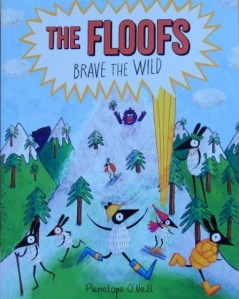
The Floofs return in three new stories wherein they venture into the wild. Challenges await.

In the first, Floof and the Avalanche, Dill persuades Teazle to step out of his comfort zone by leaving his volcano abode for a skiing holiday in the mountains. En route they meet Bean and Wizard who join them. and then on arrival at the cabin where they’ll be staying, they see a light on. Inside is Clementine sitting on a sofa drinking hot chocolate. (There’s a lot of hot chocolate in this story.) Some of the friends do go skiing, even having a race, when they encounter a monster and an avalanche starts. All ends happily though.

It’s ice-skates rather than skis that the Floofs try out in A Different Kind of Floof. Almost inevitably though, one of their number, Leaf, bumps down hard on the ice, falling through
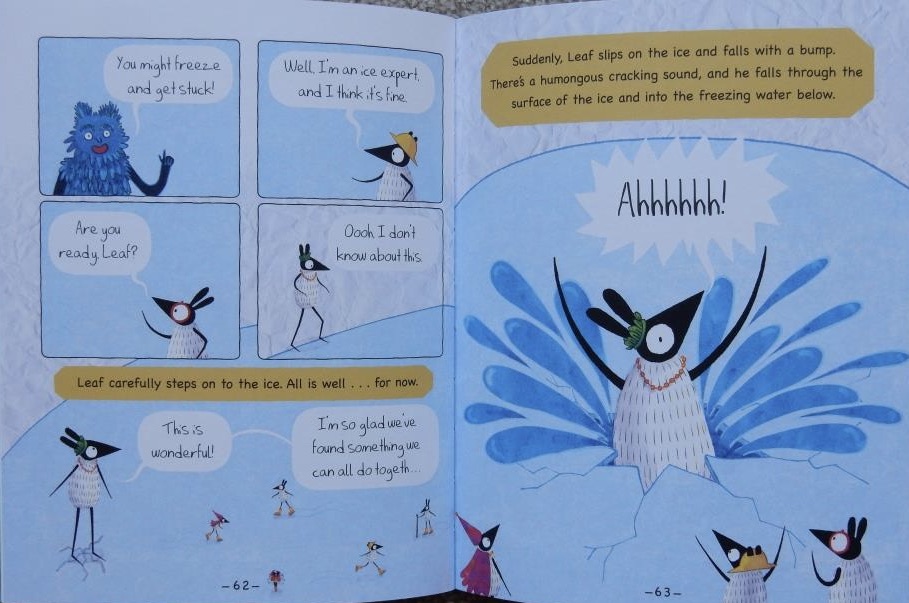
and becoming frozen solid. Fortunately, Dill has something useful with her that she uses to melt the ice and release her friend. Leaf then spends some of the day in the Giant Forest comparing himself with the other Floofs and again all ends happily.

Floof and the Giant begins with Dill longing for a new adventure somewhere she’s never been before. Maybe a wave of Wizard’s wand will help them find a secret location. Secret it might be, but then a duck warns them of a giant … a hungry giant it turns out …

Just right for readers gaining confidence, especially those who like their stories presented comic style and sprinkled with humour and magic.
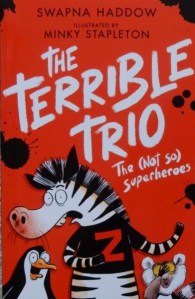
The terrible trio comprises Margarine the Penguin, Zeb the Zebra and Barry the Lemur. We meet them as they stand in line eagerly waiting to reach the front as it’s the day when a superpower will be bestowed on each and every animal. The line is a very, very long one and is moving very slowly so there’s plenty of time for them to ponder upon the power they’ll be given. Zeb wonders about speed, strength or the ability to see the future. When the buffalo bum in front of them eventually moves off, he’s let’s say, disappointed to hear from the Ministry Superpower Manager that he’s “all out of powers”. However they manage to persuade the power giver-outer squirrel that they must take priority over his favourite tv show and finally Penguin receives ‘the power to make mac, n’cheese’, Barry receives the power of nice handwriting, but what about Zeb. To him, his superpower feels pointless.

Barry and Marge soon come up with a plan – gain employment at the new cafe in town with the former writing menus and the latter making the mac’n’cheese meals.
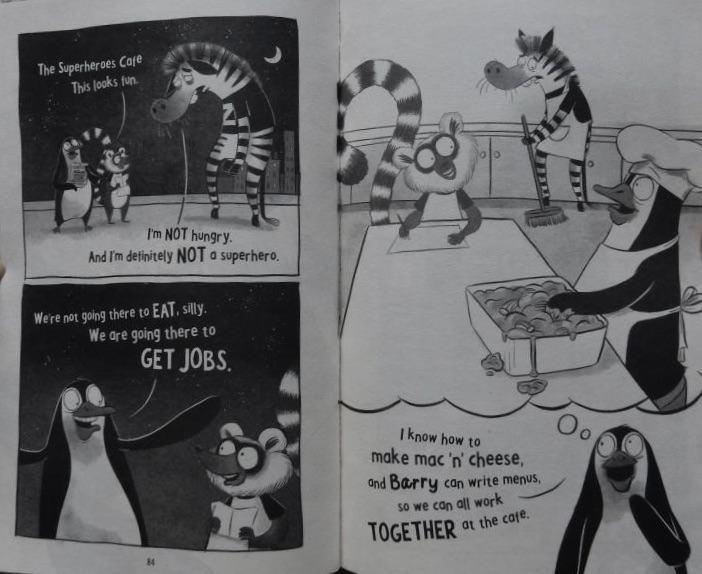
Having thrown a tantrum, Zeb goes along too and all three start that very day; Zeb though is still determined to prove he’s a superhero. Will he have to go it alone or will his best mates help?

The laugh-out-loud silliness from Swapna Haddow combined with Minky Stapleton’s wacky portrayal of the cast of characters is great fun and has at its heart a vital message about being there for friends when things go wrong.
The Angel and the Mermaid

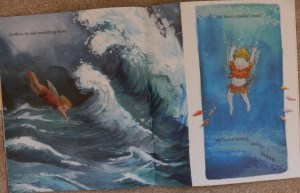
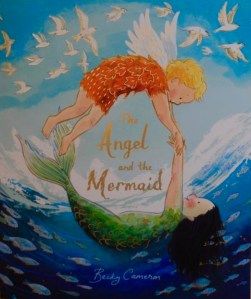
Meet siblings Avery and Mira born one midsummer’s night. Baby Avery was ‘gentle and quiet as the whispering breeze.’ In contrast, baby Mira was ‘as wild and loud as a crashing wave.’ As they grew, despite their differences they spent their days playing together close to their home. However as the days turned to years the siblings become curious about the world and one day Mira suggests they play a game: whoever went the furthest and found the best treasure would be the winner.

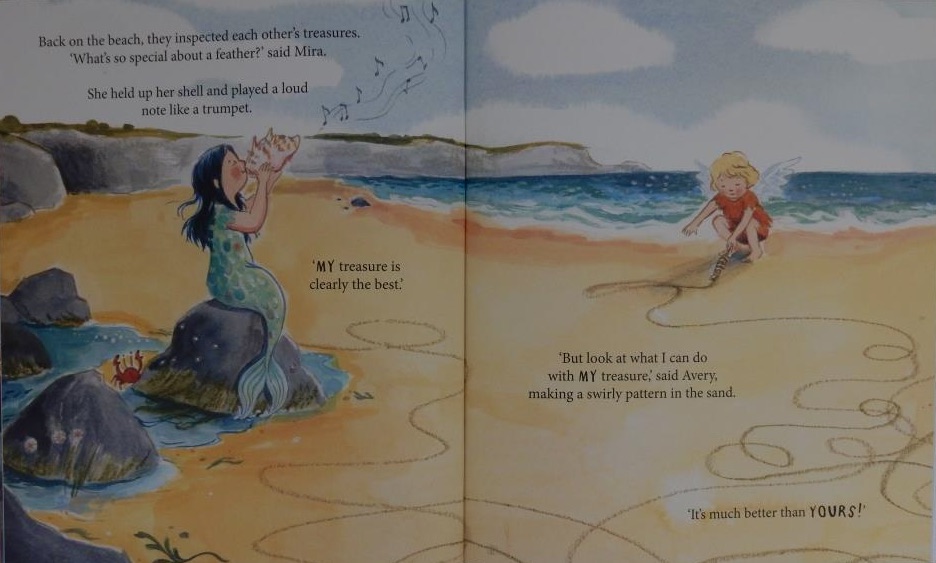
Excitedly they begin their quest, Mira diving deep down in the ocean and Avery taking flight to the highest mountain. On their return the two compare treasures and Mira considers her shell the best whereas Avery declares his feather much better.

They squabble and part company but soon begin to miss one another. Suddenly a storm blows in and Mira, concerned for her brother’s safety, determines to find him. Meanwhile Avery is missing his sister too and the thought comes to him that she probably feels the same. Unable to swim, he dives courageously into the waves but starts sinking.

Fortunately a hand stretches out and takes hold of him: it’s Mira, and they give each other sorry, forever friends hugs.

Henceforward no matter where their lives led them, they’d always return home to their special place where sky and sea meet.

An unusual magical tale of two siblings and their unbreakable bond. Becky Cameron’s illustrations are a delight, detailed and capturing the feelings of the siblings beautifully.

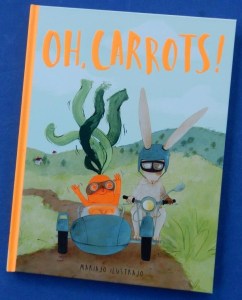
Oh, Carrots!

Mr Rabbit lives all alone and has grown used to so doing, occupying himself caring for his plants, keeping his place clean and reading, though at times it’s so quiet he does feel a tad lonely.

Now with the coming of spring Mr Rabbit can plant his favourite thing, carrots. It certainly keeps him busy and after 240 seeds are safely in the soil he’s more than ready for a hot drink and some relaxation. But suddenly he spots another seed in the packet. “Where were you hiding?” he asks seed 241, carefully planting it and resolving to give it a little bit of extra TLC so it doesn’t feel overlooked again. With daily watering, singing to the seeds, sunshine and loving kindness the carrots start to grow, one especially well.

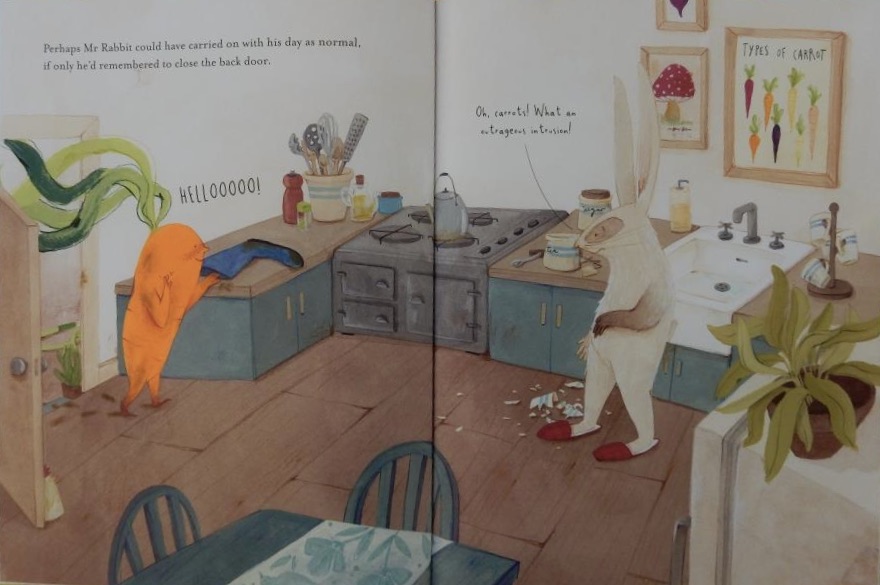
One day he notices a carrot top give a wriggle. He pulls, pulls and pulls and out pops a walking, talking carrot. “Hello Mr Rabbit” it says. ”Oh, Carrots!” comes the reply and Mr Rabbit dashes off home, forgetting to close the back door.

It soon becomes evident that Carrot just wants to be Mr Rabbit’s friend but Mr Rabbit wants his visitor to leave him alone not jump on the sofa, interfere with his record collection or rummage through his books. Carrot’s lively antics irritate Mr Rabbit who is not at all used to mischief. However during the course of the day our lupine friend gradually finds that he’s enjoying himself.

So used to being a loner, he’s never considered having somebody else around. Could it he that needs a friend after all?

Mariajo’s combination of words and pictures is a winner with its striking illustrations and text both imbued with gentle humour and wisdom. A book that celebrates the joys of making new friends and a demonstration of how a close friend can help a person learn more about themselves.

The Princess and the Pee

This is a modern fairy tale wherein young Princess Amma struggles with a problem that will resonate with lots of families: she wets the bed and is constantly fretting about so doing. The Queen, the King, and the palace staff all have ridiculous suggestions: eating dry toast just before bedtime to soak up all the pee, sleeping with lemons beneath her pillow, and putting feather dusters by the loo so that the princess can “giggle all her pee out before she goes to bed.” Needless to say none of these work: the princess’s worries remain and she wakes to a wet bed every morning.

Fortunately wise Grandma Grace is much more supportive in her approach; “Let’s take our time. Let’s be steady. / She’ll stop when she is good and ready.” is what she urges.

One morning having shooed the other adults out of Princess Amma’s bedroom, Grandma gives her a bubble bath, then sits beside the child and with an encouraging smile tells her, ““My darling Amma, a little bit of pee will NEVER come between you and me.” That evening Grandma Grace snuggles beside her granddaughter and together they let their imaginations grow into magical stories

after which Amma is lulled into slumberland by her Grandma’s calming singing. Come the morning Amma’s bed is to her delight, dry. The palace residents are surprised. other than Grandma Grace, of course; she knows that Amma’s journey to dry nights has just begun and that eventually it will become the norm.

This is a delightfully whimsical, lighthearted way to approach a tricky, often embarrassing issue for younger children, the humour and fantasy nature of which should help make it easier to cope with. Juanita Londoño Gaviria’s textured illustrations are splendidly expressive and convey the changing mood of the story well throughout. I love the portrayal of the supportive relationship of Grandma Grace towards Amma: just what any child in a similar situation needs.

A Damsel Not in Distress

A Damsel Not in Distress
Bethan Stevens
Frances Lincoln Children’s Books First Editions

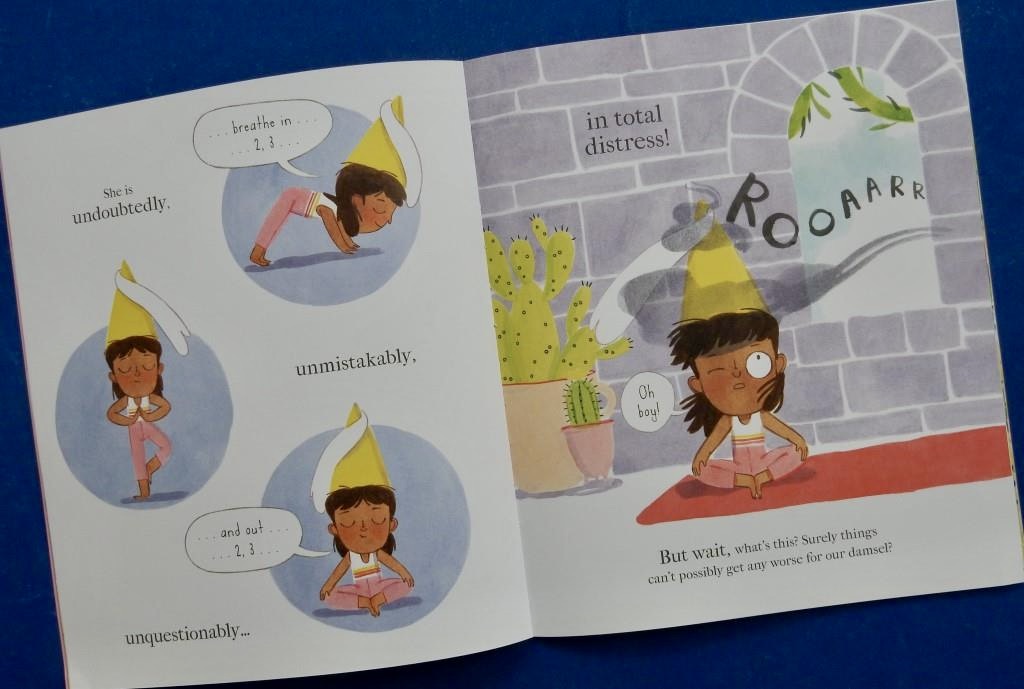
Regular readers of this blog may already know that I’m a fractured fairytales enthusiast and Bethan Stevens has chosen to turn the traditional Rapunzel story inside out, throwing the stereotypical helpless princess trope right out of the window. Our damsel states from the outset – or tries to – that she certainly is not distressed, nor is she trapped in her tower by a curse. Indeed she lives with her grandma and the castle moat is full not of horrific monsters, but ducks and frogs. In fact she seems pretty satisfied with her lot, except for the fact that her story is being spoiled at every turn of the page.

When her peaceful yoga session is interrupted, 

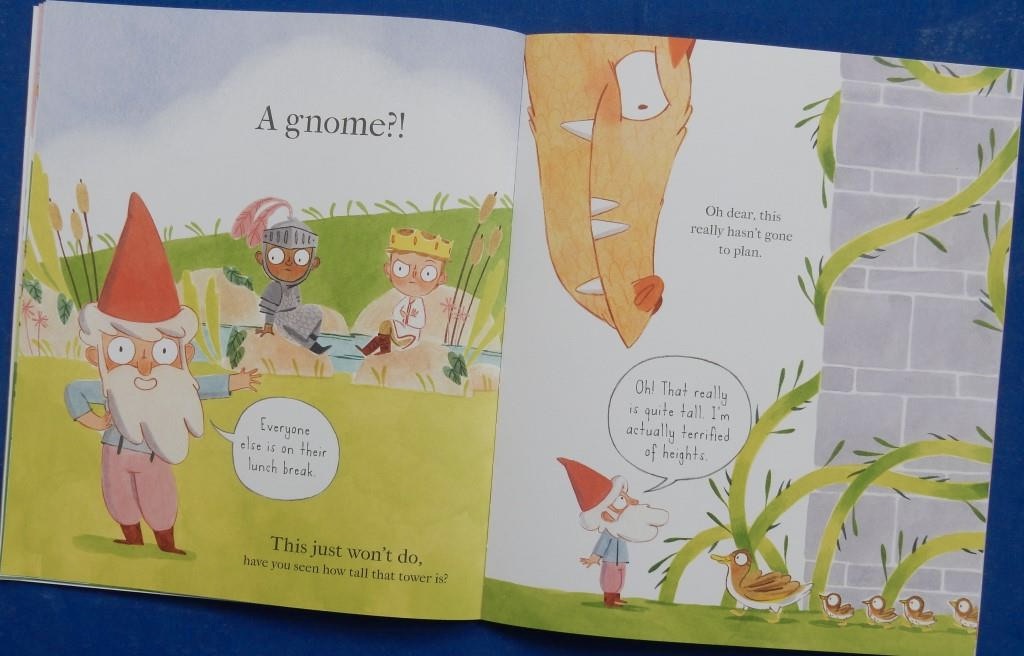
she cleverly predicts the fate of the first gallant knight that comes to rescue her from the massive dragon that has appeared. The brave Prince Charming is equally unhelpful but who’s this? A gnome with acrophobia supposed to scramble up the brambles to the top of a tall tower – really?

Our protagonist has had enough and is determined to turn the story around so its finale is to her liking? Can she do so and how? Hot chocolate anyone?

This is huge fun with Bethan’s text and illustrations working really well together, and the expressions on the faces of the characters are hilarious be they human or animal.

The Hare-Shaped Hole

The Hare-Shaped Hole
John Dougherty and Thomas Docherty
Frances Lincoln Children’s Books

Despite their differences Bertle (a turtle) and Hertle (a hare) are almost inseparable. Hertle, the speedy one felt ill at ease in the water but with Bertle’s advice and patient support she was never left behind even though she never learned to swim. “We’re friends to the end!” they would both say but then suddenly and without warning, ‘the end came.’ Hertle was there no more; poor Bertle, all he can see is a hare-shaped hole in the air, nothing more of her at all.

Bertle finds it hard to believe so he sets out in search of his friend; he looks high, low and everywhere in between but all that remains is that empty Hertle-shaped hole. Bertle’s disbelief turns to anger and he gives vent to his feelings by shouting out until his throat hurts. No matter what Bertle tries to do, nothing brings back his friend, though the hole still accompanies him everywhere.

In utter despair Bertle sits and sobs at the side of the river, feeling himself surrounded by his sorrow.
As he sits immobilised by sorrow, a kind bear, Gerda comes along. She waits a while and then gives Bertle a bear-cuddle, allowing him to feel as deeply as he needed. 

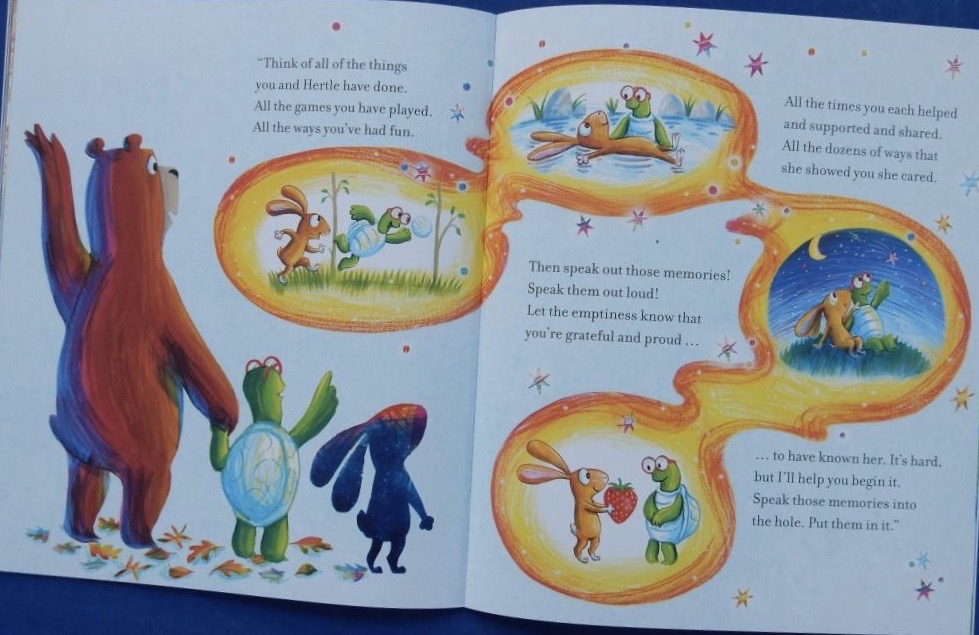
After a while Gerda speaks some very wise words to the young turtle, telling him that the only thing to do is to fill that hare-shaped hollow with happy memories of the time the two friends spent together.

So begins the healing process for Bertle; certainly his emptiness won’t go away quickly but, now he has a new friend, the very wise Gerda to offer her helping paws.

The rawness readers will feel on first reading or hearing this heartfelt rhyming story of Bertle’s loss, grief and gradual embracing of life without Hertle, soon gives way to one of tenderness and appreciation of both the way John Dougherty’s tale is written and the manner in which Thomas Docherty captures the emotions in every one of his lovingly created illustrations. You might want a packet of tissues handy when you read this.

Ultimately uplifting, this poignant book is one to add to all primary school collections.