When We Go Camping/ Skyfishing


Who is the narrator of this lively celebration of family camping? Could it be one of the children? A parent? Or perhaps, the eponymous dog that gets into each and every scene? I doubt it’s one of the grandparents; all they seem to do is sit around or participate in some form of spectator sport, with the odd pause for a spot of insect swatting on occasion.
Meanwhile, other family members make friends, play, cook, fish, swim, shiver thereafter: beg your pardon Gramps: there you are boiling up the billy can for a warm-up drink for the chilly swimmers.

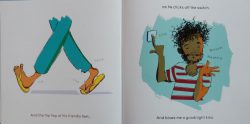
Naturally taking a pee involves a bit of inconvenience and perhaps it might be advisable to take a clothes peg along.

Perhaps the highlight of the day is a spot of ‘Hummetty strummetty squeak-io’ singing around the fire before finally repairing to the tent for some dream-filled slumbers.
Sally Sutton’s rhythmic, rhyming narrative is irresistible, especially so those playful refrains that accompany every scenario so beautifully portrayed in Cat Chapman’s watercolours: there’s a ‘Smacketty tappetty bopp-io‘; a ‘Zippetty zappetty flopp-io’ and a ‘Snuffletty wuffletty roar-io’ to name a few: I’ll leave readers to guess what actions they orchestrate.
My memories of camping are of endeavouring to bash pegs into sloping, rock-hard ground, lumpy porridge and noisy sleep-intruding voices in the night. This book in contrast makes the whole experience – well maybe not the loo visits or the odd trip-up – a pleasure, full of simple, fun-filled delight.

Skyfishing
Gideon Sterer and Poly Bernatene
Abrams Books for Young Readers
The young girl narrator’s grandfather loves to fish; so when he moves from his rural idyll to live in the big city with his family, he greatly misses his passion. The child is determined to find a way to engage him, but through autumn and winter, nothing catches his interest.
Come spring, the girl has an inspiration: she initiates a game of ‘let’s pretend’ fishing over the balcony edge and …

The possibilities escalate until they cast their lines deep into the rumbling tumbling ‘ocean’ below: an ocean full of wonderful adventures to last for months and months …

As the narrative unfolds, Bernatene’s vibrant, whimsical paintings show the chaotic city transformed into an ocean teeming with amazing sea creatures.
A warm-hearted story of the special relationship between the young and old, and the power of the imagination.

I’ve signed the charter  

Quiet! / The Unexpected Visitor

%0a

Quiet!
Kate Alizadeh
Child’s Play
We join a small girl on an exciting auditory exploration of her (seemingly single-parent) family home. ‘Ssssh! Listen, what’s that noise?’ is her invitation as we follow her from room to room. Staring in the kitchen there’s the bubble bubble of the pan rattling on the cooker, the hummmmmmmm of the fridge, the click of the toaster, the whizz whoosh of the mixer, the kettle rumbles and burbles, the microwave beeps and pings, the pedal bin clanks and Dad at the sink washing up, sloshes and clatters.
Mealtimes are equally noisy with four residents creating all manner of eating-related sounds …

%0a

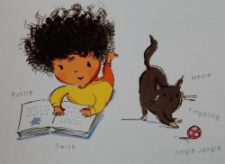
But there’s more to hear, so our guide repeats her invitation and leads us into the next room where I counted at least thirteen sounds in Kate Laizadeh’s living- room illustration, and that’s without baby brother’s giggles and rattles; even turning the pages of a book causes a swish and rustle

%0a

There’s plenty to listen out for at bath-time and as bedtime preparations are under way, with hair drying and teeth brushing and finally comes one more ‘Ssssh! …’ as it’s time to get into bed ready for Dad’s bedtime story told in suitably hushed tones, and a goodnight lullaby. Those however, are not the last sounds we hear …

dscn9982

One of the learning experiences most early years teachers do is to take their class or nursery group on a listening walk either indoors or out. (I’ve done it on many occasions). This onomatopoeic celebration of a book is a wonderful introduction or follow-up to such an activity.

dscn9937

The Unexpected Visitor
J. Courtney-Tickle
Egmont Publishing
A little fisherman lives alone on a rocky island. Each day he takes his boat out, casts his fishing net and waits. His haul is usually plentiful and at night he has plenty to cook for supper. Far too much in fact, but the fisherman always hopes that others will visit, although they never do.
Then one morning he does receive a visitor, a big friendly whale. Although the visitor is far too huge to get inside the fisherman’s home, the two become friends …

dscn9938

and even go on a fishing expedition together. That’s when the whale needs to teach his new friend a lesson, for the sea is decidedly empty of fish: not a single one is to be found. ”You took far more fish than you needed. That was greedy,” the whale tells him and the fisherman knows it’s so.
A promise is made and in return, the whale takes the fisherman and his boat to another island whereon he can start afresh, with a new home …

%0a

a new fair fishing regime and a whole host of new friends, both human and marine-dwelling.

dscn9940

With its important themes of sustainability, friendship and sharing, this thoughtful and thought-provoking picture book puts its message across in a manner that, like the whale, packs a powerful punch.
Jessica Courtney-Tickle’s stippled spray effect and the swirls add a touch of maritime depth and magic to the otherwise flat style of her illustrations.

Charter logo FINAL.indd

Line, Colour, Shape and Contrasts: Some Explorations

dscn9121

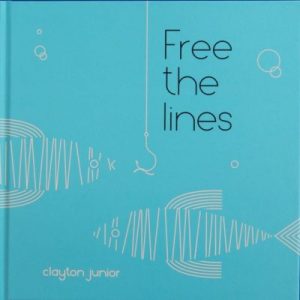
Free the Lines
Clayton Junior
Words & Pictures
It’s amazing how much you can say in a picture book without a single word of text. Clayton Junior does it all with lines – straight lines, curvy lines, thick lines and thin lines, lines close together and lines far apart; white lines and black lines. Using all these and the occasional bit of blocking, he tells a story of a small cat in a small boat sailing out into a large ocean to catch fish.

%0a

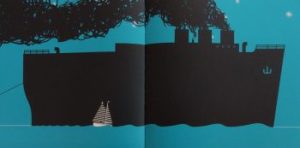
Into that same water comes a huge, smoke-belching trawler,

%0a

a trawler that casts an enormous net, an enormous net that scoops up everything in its path.

%0a

Fortunately- for the trapped, though not the trawler’s crew – an outstretched paw with a large pair of scissors puts paid to the marine life devastation and cat sails serenely into port over an ocean once more teeming with life.
This thought-provoking tale poses questions about the ethics of fishing and the fishing industry, as well as offering lessons in visual literacy and opportunities to explore and experiment Clayton Junior’s minimalist techniques of creating shape and form. It has something to offer all ages from around four to adult.
From the same artist is

%0a

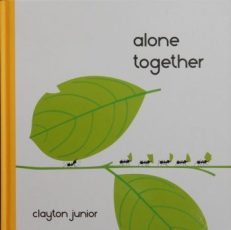
Alone Together
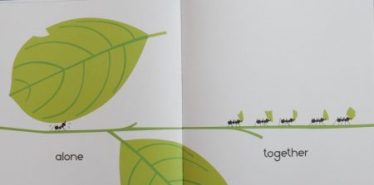
Herein all manner of animals are shown as a means of exploring a wide range of opposites and contrasts. Each one of the stylish spreads could well be a storying starting point in addition to demonstrating the concepts chosen. This one really made me smile:

%0a

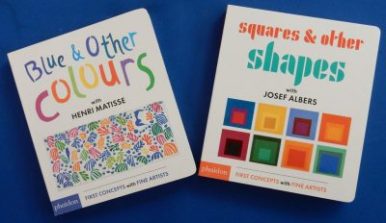
Also worth adding to your early years collection are:

dscn9118

Blue and Other Colours with Henri Matisse
Squares and Other Shapes with Josef Albers

Phaidon
These are two of the ‘First Concepts with Fine Artists’ series, beautifully produced board books that use the work of famous artists to introduce very young children to everyday concepts.
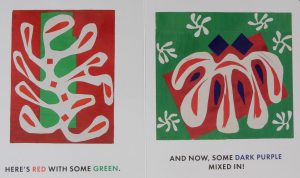
In the first, coloured cutouts from Matisse’s collages are the basis for teaching not only about colour, but also about shape and form, and how various colours can work when juxtaposed. Although blue crops up on most spreads, here’s one where it doesn’t …

%0a

Both inside covers are used to provide information: at the back is a brief introduction to the artist and some of his works, in particular the cutouts; and at the front, in tiny print, is a key to the works featured with their dates.
An unusual way to introduce colours and the notion of ‘painting with scissors’ and more important, especially if like me, you believe most children do not actually learn colours from books but from life experience, a springboard to creativity.
Equally fascinating and also essentially about colour juxtaposition and perception too, but this time introducing basic 2D shapes is an introduction to the 20th century artist Josef Albers’ work, in particular, Homage to the Square.