The Secret of the Tattered Shoes

The Secret of the Tattered Shoes
Jackie Morris and Ehsan Abdollahi
Tiny Owl

The latest addition to Tiny Owl’s ‘One Story, Many Voices’ is a rather different interpretation of the Brothers Grimm tale The Twelve Dancing Princesses.
Here the princesses are still locked up each night, and their dancing shoes are still worn down each morning.

However, having met a beautiful woman in the forest

and learned of the princesses, the strong handsome soldier who takes it upon himself to accept the king’s challenge to discover their secret, is weary of life.

Unlike those who have gone before he has a different ending in mind from that offered by the princesses’ father.

Jackie Morris’s text is poetic: ‘The soldier followed, out from the twisting tunnel of steps to an avenue of trees lit by curious starlight. The leaves shone with silver as if painted by moonlight’.
It’s also rather dark: it’s certainly not marriage to one of the king’s daughters – the happily ever after ending of the Grimm version that this soldier seeks. Nevertheless although readers are left to decide for themselves what happens to him, we’re left with a hope that the soldier finds that which he goes in search of after leaving the royal gathering.

Ehsan Abdollahi’s collage illustrations are absolutely right for Jackie Morris’s rendition: from endpaper to endpaper, with puppet-like figures, they’re exquisitely detailed, infused with melancholy and mystery, and reminded me rather of medieval tapestries.
The Golden Cage

The Golden Cage
Anna Castagnoli and Carll Cneut
Book Island

Dark, disturbing and enigmatic are the words that immediately sprang to mind after I read this fairy tale from Europe, which is a collaboration between French-Italian author, Anna Castagnolii and the Belgian illustrator of Witchfairy, Carll Cneut.

It tells of the Emperor’s daughter, an incredibly indulged girl who, despite having everything she desires, is not happy.

Her particular penchant is for birds of which she has a vast number but her greed drives her to want still more. Her demands become increasingly hard to meet: ‘a bird with glass wings!’ … ‘a bird that spurts water like a fountain’ …

Many, many servants lose their heads as they try in vain to fulfil her outrageous requests

till finally with her newest cage, a golden one, yet to be filled, Valentina has a dream.

In this dream she meets a talking bird

and knows that this is what she must have to complete her collection.

Off go the servants to search but again their offerings do not fit the bill and CHOP! off come their heads. It’s conversation, not mimicry she desires in her parrot.

Time passes, the palace gradually becomes a ruin and the cage remains empty.

Then one day a young servant boy, new to Valentina with ‘eyes as cunning as arrows’ approaches her eliciting a promise from her in exchange for the bird she yearns for.

Rather than a bird, the boy returns months later with an egg, telling her that from it will hatch a talking bird.

Happy, at last, the princess waits and waits and …

But this isn’t a happily ever after ending and readers must decide for themselves the finale to this multi-layered story, as indeed they must put their own interpretation on the whole.

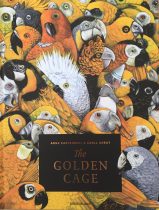
Caril Cneut’s illustrations – sumptuous paintings and drawings that sometimes cover an entire spread, and the child-like drawing epitomising all that Valentina yearns for, are totally arresting. The former are rich in detail, truly snaring the attention but so does the latter, which in its own way also says so much.

Not a book for young children but it’s brimming over with potential if offered to older audiences including students of literature and art.

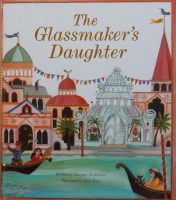
The Glassmaker’s Daughter

The Glassmaker’s Daughter
Dianne Hofmeyr and Jane Ray
Frances Lincoln Children’s Books

Daniela is the daughter of a glassmaker living in Venice in the 16th century. So full of melancholy is she that her despairing father offers a glass palace as reward to the first person who can make his daughter smile. The palace is duly fashioned and people come from near and far to try and bring on that smile.
A flame swallower, a mask maker, a lion-tamer followed by ‘Glove makers, tart bakers, trumpet players, dragon slayers, monkey trickers, pocket pickers, bell ringers, opera singers, even sausage stringers‘ all fail miserably.

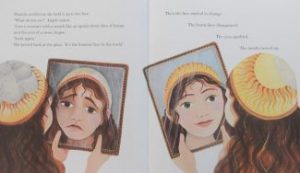
Then along comes young glassmaker, Angelo with the looking glass he’s carefully fashioned as a gift for Daniela. Now the girl has never seen such a thing before, nor has she seen the sight that meets her eyes when she looks into it as Angelo instructs. At first it’s her cross face that stares back, then as she begins to smile, so too does the mirror;

and when her smile gives way to laughter, the effect is truly dramatic in more ways than one …

And before long, the entire city of Venice is one laughing, dancing, ringing celebration of joyfulness.
Diane Hofmeyer takes a familiar fairytale theme and like Angelo in her story, fashions it into something new and special. We all know that true happiness lies within but it’s good to be reminded sometimes, especially in such a captivating way as this. (An introductory note gives some information about historic Venetian glassmaking.)
Jane Ray’s intricate images and vibrant scenes conjure up the fairy story-like Venice of the setting making every turn of the page both magical and memorable.

Rapunzel

Rapunzel
Bethan Woollvin
Two Hoots
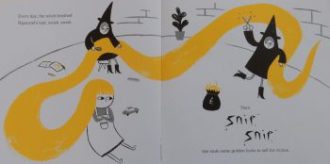
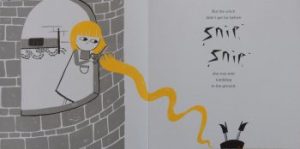
The witch in Bethan Woollvin’s alternative version of Rapunzel has a good little business going: she snips off lengths of the girl’s golden tresses and sells them.

Keeping Rapunzel locked up in the high tower she threatens her with a curse should she dare to attempt an escape.
With Rapunzel however, the evil woman has more than met her match. Far from being fazed by such threats she’s positively emboldened.
If the witch can ascend using her captive’s hair, then the girl can descend by the same means; and so she does.
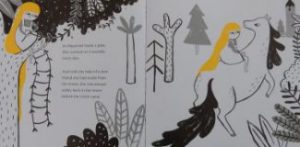
Once free Rapunzel explores the forest, forms a friendship and hatches a plan.

No it isn’t with a handsome prince: this wily young miss is more than capable of managing her own fate. She’s determined to get the better of the old hag. Thus it’s Rapunzel, not the witch who wields the tonsorial scissors and sacrifices her flowing locks ridding herself of her jailor once and for all.

Then with the aid of her forest friend, she embarks upon her very own witch hunt.
Again Bethan Woollvin uses a limited colour palette – black, grey and yellow on an expansive white background to dramatic effect for her fairy tale rendition. Her assured lines and minimalist shapes are rendered in gouache and she injects subtle humour into every scene: the flies bothering the frog, the abandoned sock on the floor, and more darkly, her subversive heroine continuing to show no fear in the face of her captor’s threats, standing meekly before her with her intended weapon of witch destruction hidden behind her back.
Make sure you check out the endpapers too: the hunted of the front ones becomes the hunter at the back.

I’ve signed the charter