Lionel is just like Dad / Look / Friend

These are recent Gecko Press publications – thanks to the publisher for sending them for review.

This celebrates the relationship between a father and small child, lion style.

Little Lionel closely watches his father’s every move, copying his actions carefully.
When Dad combs his hair. so too does Lionel, Dad taps his teeth, Lionel does the same, Dad scratches an itch, ditto Lionel, Dad sings a song very loud, Lionel reciprocates. Then after a brief break, Dad throws things into the air, Lionel does likewise; 
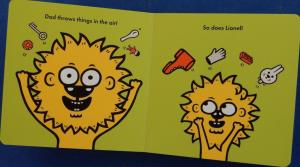
however something that Lionel throws falls on Dad’s head. with a THUNK! causing the parent to cry out in alarm, as does Lionel. Now Dad is not so impressed with his little one’s copying behaviour and they turn away from one another. After a think on Dad’s part and on Lionel’s the two go and hide themselves. Not for long though for all ends happily with forgiveness from Dad and hugs all round.

Charming, reassuring and a fun portrayal of a parent’s unconditional love. Ville’s seemingly simple illustrations show so clearly the emotional changes of both characters.
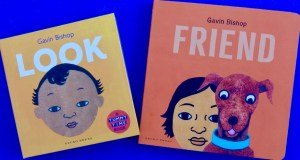
Essentially Look , a wordless concertina fold out, opens one way to reveal a sequence of ten faces, nine human and one a dog. Opened the other way, you find a series of seemingly random objects likely to be familiar to an infant – a bird, a bunch of keys, a doll, a ball, a pair of spectacles, a toy bear, a snail, a ship, a dog, a rabbit and a truck – each one simply depicted centre stage in bold bright colours.
Unfolding to almost 2 metres this simple ‘tummy time’ book is sturdily built to withstand the frequent use it might well get.

Friend features a child narrator – the owner of a dog – who clearly loves the animal , calling her ‘My best friend’ on the final spread. Words are kept to a minimum with four being the most on a spread, and several have just a single descriptive word: happy, angry, rowdy, sad, shy, each of which is mirrored in an expressive picture of the pooch.
Little ones will enjoy the sequence relating what unfolds when the dog discovers an unwanted visitor in her food bowl, 
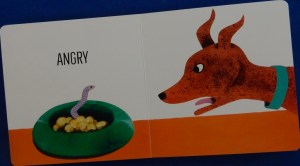
expresses how she feels about it by howling at an adult, receives a ticking off from the girl causing the creature to tuck herself under the table for a while.

An opportunity for small humans to learn new vocabulary as they follow the action and interactions. showing that real friends don’t always need to say much; their expressions speak volumes.

More Board Book Fun

These are recent board books from Gecko Press and Nosy Crow – thanks to the publishers for sending them for review

Lionel Eats All By Himself
Lionel Poops
Éric Veillé

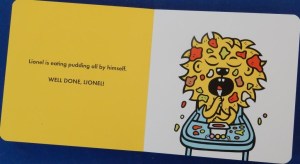
Lionel is a lively little lion and in the first story he’s endeavouring to become an independent eater cheered on by a paternal voice as he consumes his peas, his pumpkin, a slice of cake, a banana and some kind of pudding, using either his paws or a spoon. After each food, although most of it has gone into Lionel’s mouth some has splattered onto his mane making it increasingly blobby 

until it’s almost entirely covered. Then after a hearty roaring burp that sends the blobs on his mane flying every which way, the little creature makes it known he wants to get down and as he walks away from his high chair we see a trail of food.
Doubtless little humans will enjoy seeing Lionel’s increasingly messy mane as he receives repeated praise for his eating.

In the second book Lionel is trying to get to grips with pooping in the appropriate place but as he bounces on his trampoline the urge comes upon him and he contemplates dumping elsewhere: on some passing cows, a pair of wild cats, tennis balls, a couple of polar bears, a bus, even the Eiffel Tower and the sun. However with each passing possibility he receives a loud ‘NO, LIONEL, NO!’ aside and it’s that which causes him to seek another possible place on which to poop. Eventually our infant lion bounces right onto his potty and there, not only does he drop his pile of poo but he also has a wee – hurrah! A rousing cheer comes from all the animals and landmarks Lionel very nearly pooped upon. 

Veilllé’s vibrant scenes of the mischievous Lionel in combination with the simple texts with their repeat refrains will delight young humans and will surely make adults laugh too.

Who’s Hiding?
Satoru Onishi

Those who play the Who’s Hiding? game with this book will meet eighteen different animals. For each of the double spreads Onishi uses alternately white or a brightly coloured background. On each of the coloured spreads readers are asked to work out the answer to the titular question with the missing animal(s) merging with the background, although the black and white facial features – eyes, nose and mouth – are still visible.
After the first, which introduces the named characters, on all the spreads with white backgrounds, a creature (or more than one) is in turn, crying, 

angry, with horns, facing backwards, sleeping, facing backwards (the answer is different this time). Finally out go the lights: this spread is black save for eighteen pairs of eyes and the question is “Who’s who?’
An engaging and entertaining alternative to the usual seek-and-find books through which little ones can sharpen their observation skills, for attention to detail is vital and memory is also important. Why does zebra appear to be suffering from the grumps on every spread, one wonders. Is that its normal nature or has something upset this particular animal?

National Trust: Big Outdoors for Little Explorers: Woods
Anne-Kathrin Behl
Nosy Crow

Young children will meet a multitude of creatures in the woodland habitat visited in this book. There’s a woodpecker that creates a loud tap, tap sound as it pecks at the tree trunk with its sharp beak (the slider really demonstrates this well), while among the trees lurks a fallow deer and a hedgehog scuttles by. Minibeasts aplenty are there too – munching caterpillars, ladybirds and a beautiful blue butterfly. Turn the page and a couple of moles have popped up from their tunnels and rabbits hop hither and thither.

Night has come on the final spread bringing out some foxes from their dens and owls are a hunting.

A lovely introduction to some of the fauna, and indeed flora, of a wood.

Nits! / Encyclopedia of Grannies

Here are two picture books from New Zealand publisher Gecko Press

Nits!
Stephanie Blake
Gecko Press

In the latest Simon story, Sephanie Blake brings her own brand of humour to nits, the dreaded little creatures that make your scalp itch.

Simon decides he loves his classmate Lou, but she loves another named Mamadou.

Then Lou gets nits.  Where might they have come from?

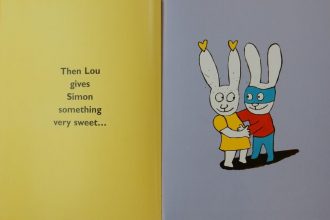
Now Simon is in with a chance … The outpouring of affection he receives from Lou isn’t the only thing she bestows upon her new love however.

Nits are part and parcel of foundation stage classrooms nowadays, so much so that the mere mention of them from a parent or carer gives we teachers itchy heads too; (even reading this book made me start scratching).

This simple, funny story provides a good opportunity to reassure everyone how it’s not shameful to have those ‘little visitors’ and to talk about how they can be treated.

Share at home or at nursery or playgroup.

Encyclopedia of Grannies
Eric Veillé (translated by Daniel Hahn)
Gecko Press

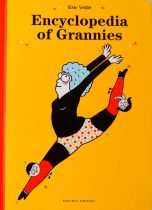
Here’s a modern and amusing take on grannies that starts with a focus on the different kinds of grannies you might come across, followed by a look at age: ‘Some grannies are 58 … some are 69 … and some are even 87!’ (Perhaps it should span an even wider age range. I once taught a five year old whose granny was 35 although she called her ‘mummy’; her actual birth mother was then 18 but the child had been told she was her big sister.)

Veillé employs questions to explore inside a granny;

and out: ‘Why do grannies have creases?’; the mystery of why grannies travel on buses –we don’t learn the answers to the last two however; and ‘Do grannies only knit cardigans? – definitely not.

Other scenarios look at flexibility; time – grannies appear to have more of it at their disposal than others;

what a good rummage in a granny’s bed might yield, hairstyles, travels and more.

In reference book style, the book includes a contents page (of sorts), a glossary and a list of suggested further reading (all tongue in cheek of course) and the illustrations are a quirky delight. There’s one snag though, apart from the “Green Gran’ included in the reading list, every single one is white.

Sturdily built to withstand the frequent reads this book might have; but don’t be deceived into thinking it’s for the very young; the droll humour requires a degree of sophistication.