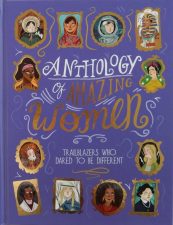
Anthology of Amazing Women
Sandra Lawrence, illustrated by Nathan Collins
20 Watt
The author has selected fifty amazing women from various walks of life and from all over the world, who have made significant contributions to society through their ground breaking achievements in art and design, history, politics, science, sport, entertainment, literature and business.
The choice must have been an incredibly difficult task, so as well as the fifty who are each allocated a full double spread, Lawrence manages to squeeze in almost another fifty by including thumbnail sketches of an additional half dozen woman at the start of each section. I’m somewhat ashamed to say that a few of the names are new to me so I am particularly indebted to Sandra Lawrence for drawing my attention to these wonderful women.
One such is the sculptor Edmonia Lewis who created a series of sculptures based on Longfellow’s The Song of Hiawatha, but of whose work very little has survived, although her The Marriage of Hiawatha and Minnehaha sculpture was discovered in 1991 and is now on display at the Kalmazoo Institute of Arts in Michigan.
Equally inspiring and previously unknown to me is Elena Cornaro Piscopia, who studied at the University of Padua in the seventeenth century and became the first ever woman to receive a Ph.D. So too is Stephanie Kwolek, the chemical researcher who invented Kevlar, the super-strong plastic material.
No book about the achievements of women would be complete without Emmeline Pankhurst, political activist and leader of the British suffragette movement whose 40 year campaign for women to have equal voting rights with men, finally achieved complete success shortly after her death in 1928.

Other women who have made their mark in politics featured herein include Eleanor of Aquitaine, the Rani of Jhansi, Lakshmi Bai, who dressed as a man, led her army in an attack against General Hugh Rose but was sadly killed in battle and even Rose himself was mightily impressed by her bravery and cleverness.
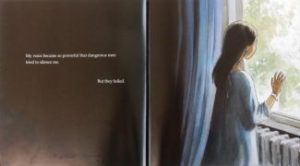
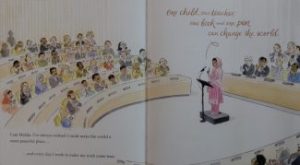
The politics section concludes with Malala Yousafzai, winner of the 2014 Nobel Peace Prize and now a UN Messenger of Peace, who in her struggle for the rights of girls to have an education was seriously wounded by the Taliban in 2012.
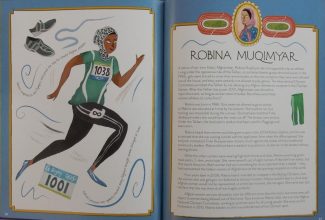
Another young woman who stood up against the oppressive rule of the Taliban, this time from Kabul, is the athlete Robina Muqimyar who twice represented Afghanistan in the Olympics.
Several of my favourite authors are featured in the Literature section including Chimamanda Ngozi Adichie who wrote Purple Hibiscus and Half a Yellow Sun; and the Finnish writer and illustrator Tove Jansson, creator of the wonderful Moomins books.

I could go on at length but must quickly mention Anita Roddick creator of the The Body Shop chain, champion of ‘natural ethically sourced products in reusable bottles’ and much more.
Striking illustrations by Nathan Collins of each of the featured women accompany the pen portraits and every spread has a coloured frame giving the whole book an inviting, stylish appearance. All schools, both primary and secondary should buy this.
Also celebrating great women is
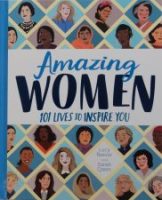
Amazing Women: 101 lives to inspire you
Lucy Beevor and Sarah Green
Stripes Publishing
Of the one hundred and one women featured herein, the majority are British and the earliest such as political activist Constance Markievicz, author and illustrator Beatrix Potter, scientist Marie Curie, nurse Edith Cavell and women’s right activist Emmeline Pankhurst were born in the 1850 and 60s.
The youngest woman included is Kiara Nirghin, born in 2000, who as a 16 year old schoolgirl in South Africa, invented a polymer, SAP which is made from cheap recycled and biodegradable materials that is able to store water and, it is hoped, can be used to feed crops particularly in times of drought – truly amazing, and what an inspiration for the cause of girls in science.

Sarah Green’s portrait of Kiara Nirghin
Interestingly in their press release, the publisher says this, ‘… following recent political developments and resulting conversation, Stripes has taken the decision to replace Aung San Suu Kyi with Mithali Raj, captain of the Indian Women’s cricket team in the Leaders section in future reprints’.
Published in the year of the centenary of the Representation of the People Act, this beautifully illustrated collection of women’s achievements is another worthwhile addition to both primary and secondary school libraries and one I suspect will be much borrowed and discussed.



 Red Reading Hub - Jillrbennett's Reviews of Children's Books