Bee: Nature’s Tiny Miracle

%0A

Bee: Nature’s Tiny Miracle
Britta Teckentrup and Patricia Hegarty
Little Tiger Kids
Buzzing with bee-u-ty, this sent shivers all through me; right from that arresting die-cut front cover with its centrally placed sunflower, through spread after spread of exquisite collage-style scenes linked by strategically-placed, die-cut hexagons, to the glowing endpapers: it’s just SOO breath-takingly gorgeous.

%0A

Stunningly beautiful endpapers

With each new book from the inimitable Britta Teckentrup, I think, she won’t better this; but, she’s done it again here in this glorious collaboration with Patricia Hegarty whose rhythmic rhyming text transports readers and listeners, accompanying a single bee as she travels here and there, flitting from flower to flower on a vital, life-giving journey –

%0A
    Gathering nectar as she goes,
From every foxglove, every rose.
Dusty with pollen, the little bee
Buzzes, buzzes, busily.

It’s almost as though you can smell the sweet-scented flowers …
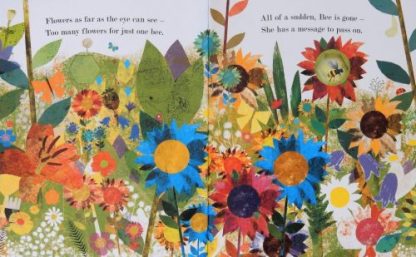
%0A

and hear the sounds of that bee and of those back at the hive. For they in turn hear bee’s crucial message – with the vast numbers of flowers, it’s too huge a job for a solo bee- and join her in that all-important role of pollination …

%0A

until:
‘ … A tiny miracle occurs.
For every plant and flower you see
Was given life by one small bee.

What a testament to one crucially important little insect and its symbiotic relationship with plants. The author gently imparts nuggets of scientific information into her poetic text as she tells of pollen harvesting and transporting; that bees use the sun to navigate by; that bees communicate one to another and crucially, that the life of most flowering plants is dependent upon them.
Bees have become almost an endangered species, yet not everyone is aware of either the contribution they make to our precious planet, or the magnitude of the crisis of their dwindling numbers. I’m currently living in Stroud, which claims to be ‘Britain’s First Bee Friendly Town‘. May there soon be many others that follow suit. There is a snag though, this ‘bee friendliness’ seems to give my partner tacit license to allow bees to build a nest right above my front door; and to let a large area of our front garden become a wild ie ‘bee welcoming’ space!
This book may well start a small revolution. It’s certainly a MUST have for every family bookshelf, early years establishment and primary school.
Now try this: Sit comfortably, close your eyes, and imagine yourself into one of those stunning scenes from the book; place your lips close together, inhale through your nostrils, place your finger tips gently just inside your ears, then slowly exhale, also through the nostrils, making a deep buzzing sound in your throat like a bee: you will hear a ‘swarm’ of bees in your throat. That’s brahmari or bee breath and it has a wonderfully calming effect. Just like this book, although that’s exciting too.


WNDB_Button localbookshops_NameImage-2

Environmental Concerns

DSCN7214 (800x600)

The Tree
Neal Layton
Walker Books
There stands a tree – tall and proud – a conifer that’s home to fledglings in a nest, a squirrel family, an owl one and amidst its roots, a family of rabbits. Beside the tree stands a FOR SALE board.
Then come a man and woman, also intent on making a home. The work begins …

DSCN7216 (800x600)

and halts suddenly –

DSCN7217 (800x600)

Tears are shed. Then, it’s back to the drawing board …

DSCN7218 (800x600)

and after a whole lot of measuring, hefting, hammering and painting, the result is …

DSCN7219 (800x600)

Like the humans in this seemingly simple book, Neal Layton’s fable wields a lot of power. In just fifty words and a sequence of gently humorous illustrations, he delivers a vital message about the importance of humans and animals living together and sharing.
This one delivers on so many levels: In addition to sharing it with young (and not so young listeners), I suggest giving a copy to those developers who pay scant regard to the destruction of natural habitats when drawing up and executing their plans.
In addition, it’s a perfect learning to read book that blows mindlessly boring reading schemes right out of the water.

DSCN7220 (800x600)

Where’s the Starfish?
Barroux
Egmont
See the whale – an enormous one and the brightly coloured fish – a whole multitude of them; then there’s the Starfish, the Jellyfish and the Clownfish.

DSCN7221 (800x600)

Can you spot them? Keep turning the pages and you’ll notice something else starting to appear, something undesirable and alien to the ocean. The fish appear somewhat puzzled but turn over again; the rubbish pile has grown and Starfish, Jellyfish and Clownfish are slightly easier to spy.
On the next few spreads larger rubbish items appear – car parts, washing machines, a fridge, TVs, microwaves– all evidence of our thoughtless, throwaway society; but the fish numbers have declined significantly and it’s easier still to spot our three friends.

DSCN7222 (800x600)

Finally whale cannot take it any longer and taking matters into his own hands – or rather – snout – he takes revenge in an altogether satisfying manner.

DSCN7223 (800x600)

Work out for your self – or better, get the book and see for yourself – what happens hereafter …
This, like Where’s the Elephant? is a an enormously effective and affecting lesson on how we harm our precious natural environment: the conservation message is the same though the setting of the story is entirely different.

Use your local bookshop     localbookshops_NameImage-2

WNDB_Button

Animal Alert!

A new Burningham book always calls for shouting and waving from the rooftops; this one, for me, especially so:

DSCN2080

The Way to the Zoo
John Burningham
Walker Books
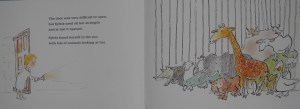
When Sylvie discovers a door in her bedroom wall leading to steps and a passageway, of course she decides to investigate. Torch in hand, she moves along only to discover another door.
Hard work and determination make it yield and Sylvie comes face to face with a zoo full of animals.

DSCN2091

Back to bed she goes, taking with her as sleeping companion a small bear, with the proviso that it is returned to the zoo before school-time next morning.
This, naturally leads to other nocturnal visitors – the small ones only – to Sylvie’s bed but then she brings back penguins; these of course splash water all over the bathroom. Next night comes a tiger and cub, the next a whole collection of birds.

DSCN2092

Not all animals however, are suitable guests,
some steal, DSCN2093

others smell and size is an issue in a couple of instances …

DSCN2095

Then one morning, in a rush Sylvie forgets to close the bedroom wall door and on her return discovers that there’s been an animal invasion of the sitting room. Sylvie vents her wrath,

DSCN2097

the animals depart and it’s time for a hasty clean up before her mother returns – O OH!
Now, there’s a lesson to be learned there, Miss Sylvie.
As the inimitable John Burningham himself says, children do believe that their bears are real. Indeed, in my experience, at a young age, the line between fantasy and reality is often blurred and as teachers we frequently encourage their imaginative play and flights of fancy.
This wonderfully understated story works on several levels and the interplay of the verbal and visual is, as ever, truly brilliant Burningham.
Buy from Amazon

DSCN2098

Barbapapa’s Ark
Annette Tison and Talus Taylor
Orchard Books
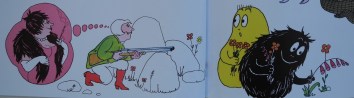
The shape-shifting Barpapapas don their ‘green’ hats and come to the aid of all manner of threatened animals in this story, be they suffering from pollution sickness, chased by hunters or hounded out of their ocean home by zealous fishermen.

DSCN2099

The hunters are particularly persistent with the result that even Barbabeau with his desirable fur pelt, finds himself in danger.

DSCN2100

Time for the Barba flea sprinklers to set to work …

DSCN2101

Eventually the Barbapapa Refuge is not only over flowing but in serious danger of the encroaching city’s pollution. A rocket-style ark is designed and the Barba family, Francois and Cindy plus all the animals blast off in search of a peaceful, green planet.
Only then do the earth’s inhabitants see the error of their ways: a clean up operation ensues, air and water are purified, promises made, trees planted. Finally Barbabright spies the newly greened planet Earth and the Barba family and animals return home.
The environmental message comes across loud and clear in this delightful re-issue and it is equally pertinent today as it was when the story was first published in 1970. (Interestingly, Talus Taylor, co-creator of the series was himself a biology teacher.) Let’s hope that the people of our earth pay more heed to the Barbapapas’ message this time.
Buy from Amazon

DSCN2102

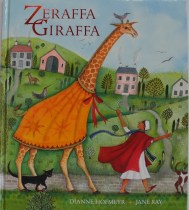
Zeraffa Giraffa
Dianne Hofmeyr and Jane Ray
Frances Lincoln
What is a giraffe doing in Paris of all places?
Crazy as it may sound, this gorgeous book relates how in 1824, Zeraffa is caught on the plains as a baby giraffe and sent by the Great Pasha of Egypt to the King of France as a gift.

DSCN2103

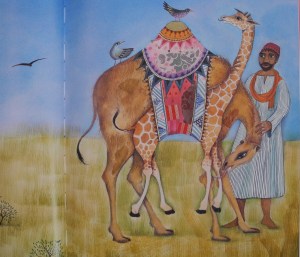
First though, she is slung on the side of a camel, fed on camel’s milk, then put on board a felucca sailing craft and travels from Africa all the way down the Nile to the coast

DSCN2104

and thence to France. From where, accompanied all the while by the devoted Atir who protects her and cares for her, their journey continues on foot to the palace of Saint-Cloud and where she becomes beloved by the King’s granddaughter too.


DSCN2106

Jane Ray’s glorious illustrations illuminate every facet of the journey from the start to Zeraffa’s triumphant welcome into Paris. There seemingly, the entire city is struck by an attack of ‘giraffism’, which embraces everything from baking to hairstyles, musical notation even.

DSCN2105

Ray’s patchwork of giraffe pieces is particularly fine and suitably tinged with humour.
Assuredly this beautifully told and illustrated story is an example of the oft said ‘Truth is stranger than fiction.’
Buy from Amazon

newly out in paperback and previously reviewed are:

DSCN2162

Monkey Found a Baby
Jeanne Willis and Jane Chapman
Walker Books pbk
A charming rhythmic story about a baby monkey found by a larger one ‘beneath the banyan tree‘.
Buy from Amazon 

and:

DSCN2163

The Ice Bear
Jackie Morris
Frances Lincoln pbk
This lyrical story from the beginning of time when people and animals shared the earth, tells of a polar bear cub, stolen from his mother by Raven, raised as their own child by hunters and much later, having wandered far away from home, forced to make a choice between two families.
Both words and pictures are of equal beauty. Morris’s paintings are both magical and awe-inspiring and as she says at the beginning of the story, ‘Words held a magic‘; assuredly hers do herein.
Buy from Amazon

Find and buy from your local bookshop: http://www.booksellers.org.uk/bookshopsearch