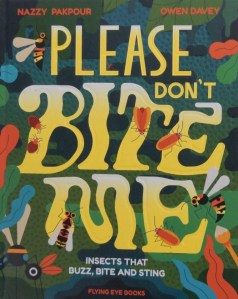
Please Don’t Bite Me!

Please Don’t Bite Me!
Nazzy Pakpour and Owen Davey
Flying Eye Books

With a partner who can’t walk more than twenty metres without stopping to examine the vegetation for insects in various stages of metamorphosis – complete or incomplete – Nazzy Parker explains the difference – I was I suppose, predisposed to be interested in the contents of this book. It introduces readers to six varieties of insect pests, mosquitoes, lice, wasps, cockroaches, fleas and bedbugs; the very names, excluding wasps, make me want to squirm.

Pakpour starts by defining insects and the scientists who study them after which three or more spreads are devoted to each of the aforementioned pests. She describes their appearance including the difference between males and females, their impact on humans and how they find us, their habitat – I was intrigued to discover that mosquitoes are found everywhere except Antarctica and Iceland where it’s too cold for them to survive, and that it’s only the females that bite.
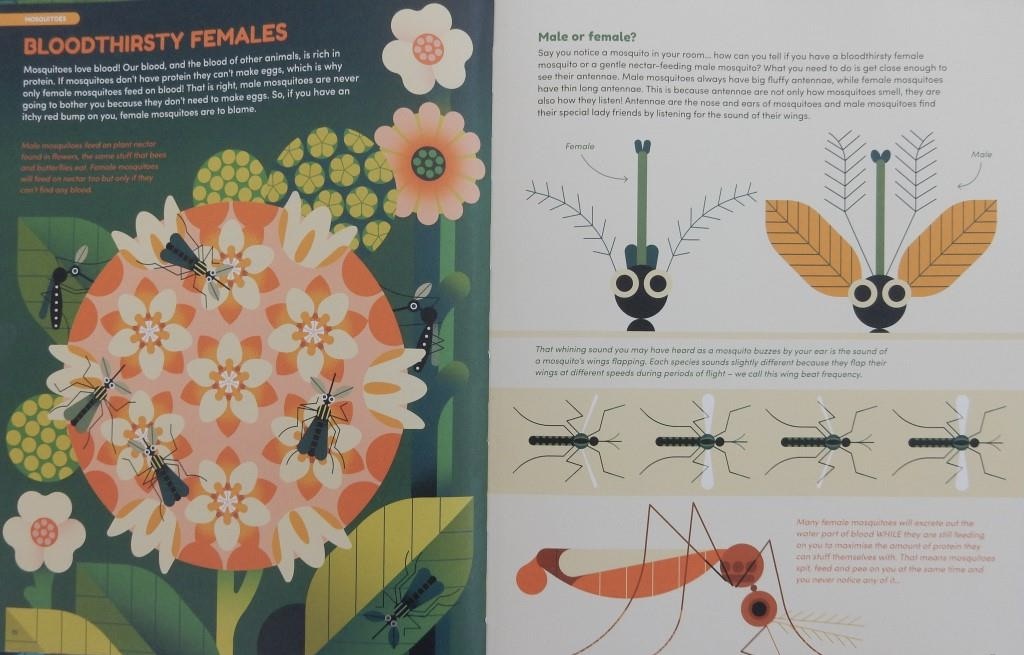
We also read about their habits and their development from egg to adult. Mosquitoes, wasps, and fleas undergo ‘complete’ ie four stage metamorphosis, whereas lice, cockroaches and bedbugs have a three stage, or incomplete metamorphosis.

Can you believe that there are more than 5,000 different kinds of lice, each kind being specific to the kind of animal it feeds on. Those that feed on humans spit saliva that can take as much as thirty days for us to develop an allergic response to. Weirdly though the very mention of a child in one of my classes having headlice has always made me start itching round my hairline straight away.

As for cockroaches, I will never forget the sight of an enormous one crawling across the pillow of our room in one of Jaipur’s five-star luxury palace hotels; it certainly didn’t get a five star review from me despite the fact that so we are reminded herein, the creatures don’t actually feed on human blood.

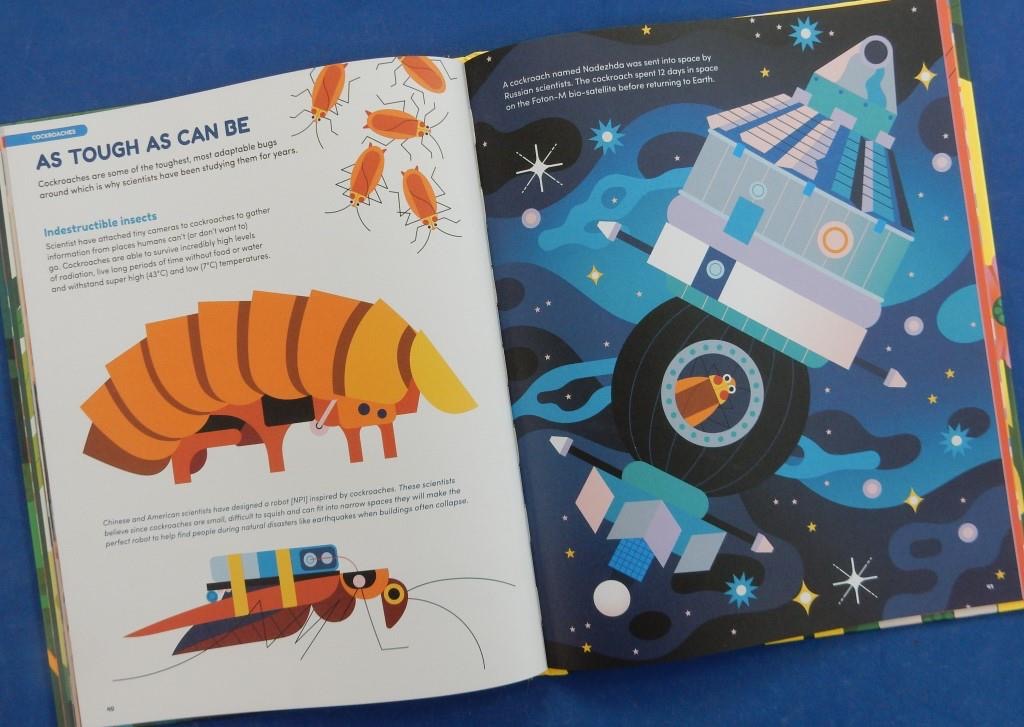
The author provides lots of fascinating snippets of information including that Chinese and American scientists have designed a robot inspired by cockroaches and that Russian scientists sent a cockroach into space for twelve days on a bio-satellite.
Probably though what is most important is the role of various insects in the world’s ecosystem; this is assigned the book’s final paragraph.

Owen Davey’s stylised, stylish illustrations work really well with biologist, Nazzy Pakpour’s text. Not the first book one would go to for general information about insects but a thoroughly engrossing one nonetheless.

Amazing Information Books

Bees
Toni Yuly
Walker Books
For the very youngest is this beautifully simple book of gratitude that demonstrates our connectedness to the natural world: it’s narrated by a small boy, who we see interacting with the things he mentions.
‘Sun gives us light. // Thank you, sun. // Bees give us honey. // Thank you, bees.’ Thus begins the concatenation of connections: from sheep we have wool. From clouds comes the rain, trees provide wood

and thanks to dirt, there are plants.
Appropriately, bold, bright collage illustrations combine fabric, paper, wood, ink and tissue, re-enforcing the biological bounties of the natural world.
Perfect for an end of the day sharing, be it with a single child, or nursery group; and equally with its minimal patterned text, it’s ideal for those just starting to read.

The Story of Snow
Mark Cassino and Jon Nelson
Chronicle Books
In this narrative non-fiction book we begin high up in the clouds with an explanation of how a tiny speck of earthly matter becomes a snow crystal (each crystal requires a single particle to start growing); and then we zoom right into a crystal.

Did you know that its shape depends on the wetness of the cloud and how cold it is? Or, that a single crystal is rarely perfect.
We learn that there are in fact, three main types of snow crystal – star-shaped, plate and column-shaped; and are told something about each kind including the different conditions under which the three kinds form.

With its succinct text, diagrams and amazing photographs of each kind of crystal, this is an excellent starting point for those who want to discover more about snow and can be used across a wide age range. There’s even an instruction spread on how to catch and observe snow crystals; and I love the final quote from Japanese scientist, Ukichiro Nakaya, ‘A snow crystal is a letter from the sky.’ – a perfect ending to a fascinating book.

Bugs
Simon Tyler
Pavilion Books
This large format book is packed with bright, bold illustrations and is designed to draw readers into the fascinating world of insects, the title word being used as an alternative generic term for this entire class of animal.
The first third is devoted to their general characteristics including anatomy, life cycle, eyes …

and other senses, and how and what they eat. Also included is an explanation of taxonomy.
The remaining 60 or so pages cover the nine main insect orders including beetles,

true bugs,

dragonflies, flies, cockroaches and termites. There’s also a double spread each, covering the most dangerous bugs, and some beneficial ones at the end.
The larger than life illustrations of representatives of each order are drawn from all parts of the world and each is captioned with its own common and scientific names, its size, its geographic range and a short factoid of additional information. The detailed scientific information together with the superb illustrations make it appropriate for a wide readership.

13 ½ Incredible Things You Need to Know about Everything
DK
Dorling Kindersley do non-fiction books really well and this one is amazing.
The title of this large volume makes you stop in your tracks and wonder what on earth could be inside.
Prepare to be impressed at the superb exploded illustrations you’ll encounter at every turn of the page, be they of Fantastic Fungi, Super Seeds or any other of the biological topics explored.

Biology isn’t the only subject herein though. The book also covers medicine, space, geology, history, technology, music and more, such is its diversity.
With over a thousand facts (not to mention those myth-busting halves, one per topic) you’re guaranteed a fascinating read. And if you don’t come away from the book knowing a whole lot more than before you started reading it, then your knowledge must have been truly encyclopaedic.