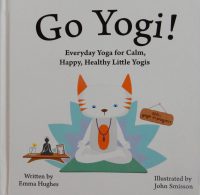
Go Yogi! / Animal Asanas

Go Yogi!
Emma Hughes and John Smisson
Singing Dragon
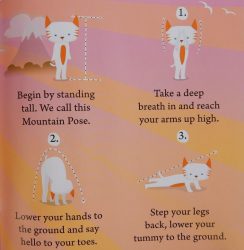
Namaste: Meet Monkey, Mac and cat, Flo: they are enthusiastic about yoga and its benefits and want young children to join them and learn a special yogic way of breathing and some of their favourite yoga poses. First though, a space away from distractions is needed and then, mat down it’s time to start. The first focus is on the breath, and this is followed by a round of sun salutation. Here are the opening moves:
The two animals then move on to some standing poses, the first being the triangle – here called ‘Tea Pot’.
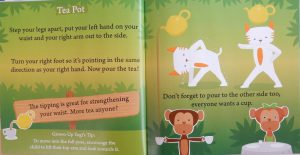
Clearly this book is for very young children who will most likely be familiar with the favourite nursery action song.
After this come four further standing poses; ‘balancing barn door introduces the slightly tricky (for 3 and 4 year  olds) standing on one leg. They’ll love to try though and increase the time before wobbles set in. Equally great fun, is the ‘warrior’.
All good yoga sessions need a variety of standing and sitting poses, so Flo demonstrates the ‘balancing boat’ next.
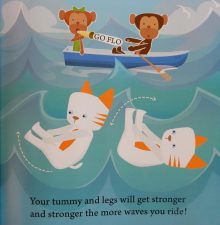
Following it with what they call here ‘pebble on the shore’ and many yogis will know as the pose of the child or balasana. Three additional poses are shown by Flo and then it’s time to relax. Mack gives her instructions and Flo begins to let go completely, making a ‘Ha’ sound to help her.
The entire yoga lesson is nicely illustrated by John Smisson who also teamed up with the author in Striker, Slow Down!
The final spread is aimed at adults and offers words of wisdom from a very experienced teacher of yoga, the author, Emma.
For me, as an early years teacher and yoga teacher, this is perfectly pitched for the very youngest beginning yogis. I’d strongly recommend it for all early years settings and families with young children. It could, one hopes, be the start of a life-long practice that offers many benefits, physical and emotional.
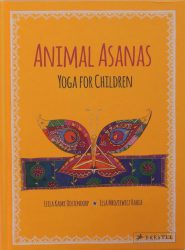
Animal Asanas: Yoga for Children
Leila Kadri Oostendorp and Elsa Mroziewicz Bahia
Prestel
A gloriously ornate menagerie of creatures great and small demonstrate over a dozen yoga asanas, and relaxation exercises.
‘Namaste, Children’ the author says on the introductory page and then goes on to give some wise words about yoga and taking it up. Anyone coming to yoga for the first time should read and inwardly digest what’s said before going near a yoga mat
The first asana shown is Vrikshasana – the tree pose and before embarking on the pose itself, there’s a ‘tree meditation’ that begins ‘Imagine you are a tree … You stand firmly on the ground and nobody can move you.’ A great introduction and believe me, as a yoga teacher and one who specialises in teaching children, this really works. Benefits of the pose (and indeed, all the others), is given as is a helpful tip. Here it’s the crucial anti-wobble: ‘Focus your eye on to a single point straight ahead of you. This will help keep your balance.
After this, all the asanas are animal-based: there’s the Frog, Cat and Cow, The Dog ,
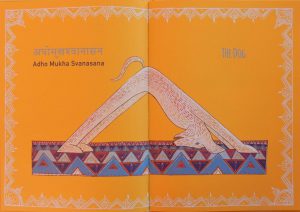
the Cobra, the Dove (I know it as the Pigeon), the Butterfly, the Camel, the Tortoise, the Roaring Lion – a great one for letting off steam and relieving tension/stress – children love this …
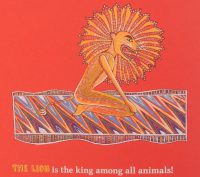
the Rabbit, the Locust the Fish and finally, the Crocodile.
Relaxation is extremely important after a yoga session and there is a lovely Rainbow journey to undertake while lying in sarvasana.
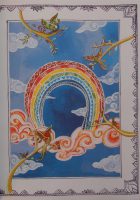
The final spread gives some words of yoga wisdom – and wise they are ‘time spent … is for children’s enjoyment and exploration; it is not a time to be achievement-oriented or critical.’ and some practical tips for parents on a child’s yoga practice.
The whole book is beautifully presented both verbally and visually. Ornate Indian style borders enhance each spread and really help to underline the notion that the yoga mat or demarcated space is ‘a place from which to become aware’ and that time spent on yoga is a very special time when nothing else matters; and nothing should be impinging on that time.

Under the Love Umbrella

Under the Love Umbrella
Davina Bell and Allison Colpoys
Scribble
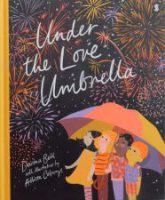
One of my closest friends lives in India and when his two daughters were much younger, we took some holidays in Goa together. The elder girl, Triambika had recently started at boarding school and was not at all happy during her first term. One evening after dinner near the beach we stood together in the dark, looking up at the sky, where the moon had formed a smile shape. I recall saying to her, “Whenever you are feeling sad or alone, look up at that smile in the sky and know I’m there for you, thinking of you and sending my love.” This beautiful picture book brought this right back to me, using as it does an umbrella as the symbol of love and protection. ‘Over your head and just above / There’s an umbrella of my love. / To show it’s you I’m thinking of / Wherever you might be.
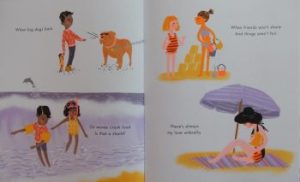
It then goes on to explore various situations when a child might feel frightened, upset, shy or sad

reminding him/her that a loving parent with the love umbrella is always there to comfort, reassure and embrace.
Moving home is particularly challenging for many children; another situation that calls for the umbrella and its loving care …

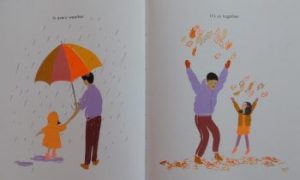
As do wet pants accidents, breakfast disasters, camping trips in maybe scary woods and more; whatever the weather, out comes that umbrella.

Indeed there isn’t a single instance when that all embracing cover cannot offer succour.
Delivered through Davina Bell’s gentle soothing rhyming words and Allison Colpoys’ striking, stand-out scenes rendered in neon shades: this creative partnership goes from strength to strength. A MUST buy book for families especially.
I’ve signed the charter … 

Feelings

Red Reading Hub is Happy that Caterpillar Books invited me to be part of the FEELINGS blog tour and thanks too, to the book’s creators, Richard and Libby for …

%0A

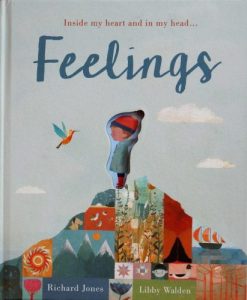
Feelings
Richard Jones and Libby Walden
Caterpillar Books
Emotional literacy and well-being are at the heart of the Early Years Foundation Stage and Every Child Matters, and yet still, as we’re told in the PR for this book, ‘One in ten children aged between 5 and 16 (have) a mental health problem.’
So what happens once children move into primary school at age five? Here is not the place to discuss this issue although I have strong views on what I see to be some of the contributory factors: rather, I welcome anything that can help children to explore their own feelings and emotions openly and within a safe context. Many picture book stories offer this possibility; now here we have a lovely, specially written and illustrated book to this end.
Richard Jones, the illustrator, places the child right where he or she should be: at the heart of this book …

DSCN8777

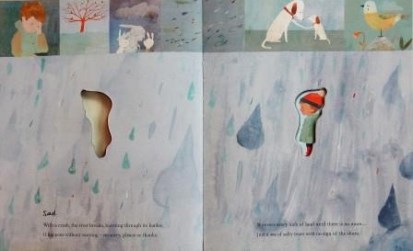
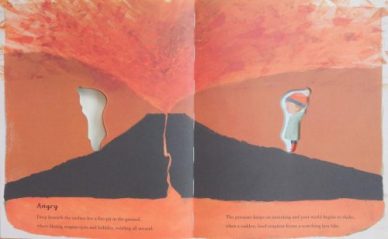
and then, after the introduction, assigns a double spread to the exploration of ten different feelings/emotions: Brave, Sad, Angry, Happy, Jealous, Alone, Embarrassed, Excited, Afraid and Calm. Each one is beautifully atmospheric.
Vitally important as personal feelings are, it is also essential, in order to function well in society, to be able to see things from other people’s viewpoints. So after acknowledging that we’re all different and that this is mirrored in our own personal feelings, Libby Walden (or rather her child narrator) makes this final suggestion: ‘Try to walk in someone’s shoes to see how they might feel, /For though you cannot see them, their feelings are still strong and real.’ How many times a day or week do those of us who teach in the foundation stage or spend time in Early Years settings say to individuals after an incident, something like “Now how do you think so and so feels about that?”
The rhyming text makes use of metaphor to look at what happens when one is overwhelmed by a particular emotion: Sad is a ‘river … bursting through its banks’ covering the land and creating a ‘sea of salty tears with no sign of the shore.”

%0A

Angry is ‘a fire-pit in the ground ‘blazing, spitting, bubbling and swirling and finally, erupting …

%0A

Jealousy, in contrast, is a rolling ‘emerald mist’, churning, seething and eating away at you from inside, blurring your vision and fixing your mind on something you don’t have.
For many children, particularly younger ones, pictorial representation is the easiest (and for them, safest) way to explore their feelings. With this in mind, I shared the book and asked some children to talk, reflect and respond in their own way: here are a few of their pictures.
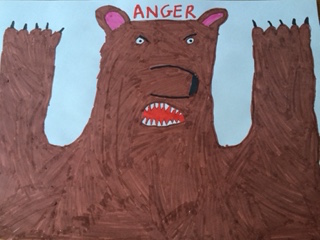
Angry seemed to be the one feeling that was all-engulfing: Gracie has become an enormous bear with jagged teeth and claws …

IMG_2261

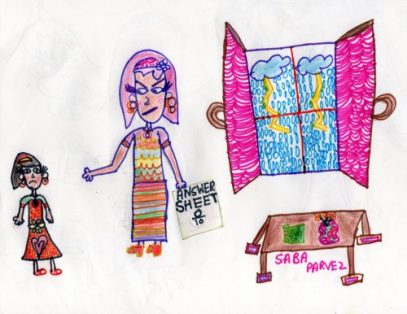
Interestingly Richard himself mentions jagged shapes and fiery colours in his discussion of illustrating Angry for the book. Saba too has jagged lightning in her Angry scene …

saba- angry

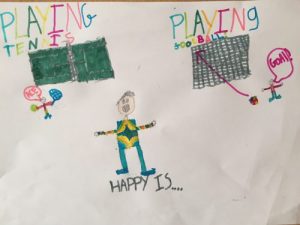
Happy for Daniel is doing sport …

image1

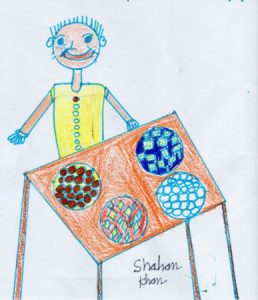
for Shahan lots of sweets to eat, especially his favourite gulab jamun …

shahan-Happy

For Lexi, it’s celebrating a birthday …

DSCN8775

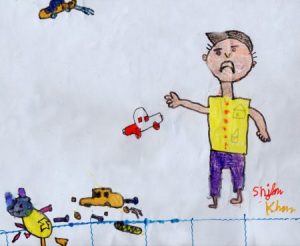
Sad, for Shifan is broken toys …

shifan - sad

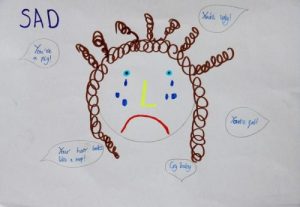
for Frankie it’s bullying …

DSCN8774

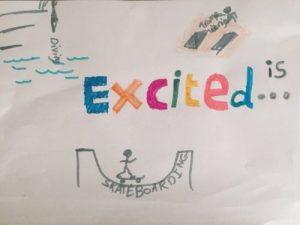
Excited for James is activities that allow him to release his boundless energy …

2016-08-29-PHOTO-00000030

If these responses are anything to go by, Feelings should certainly prove to be a very valuable resource for teachers and other working with children.