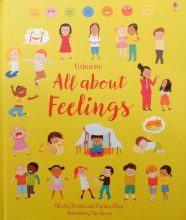
All About Feelings

All About Feelings
Felicity Brooks, Frankie Allen and Mar Ferrero
Usborne

Emotional literacy is now part and parcel of the school curriculum right from the early years, yet seldom does a week go by when we don’t read or hear of the increased concern about children’s mental health and well-being, something we in education have been highlighting for many years. So, it’s good to see a book aimed at young children to help them become aware of, and thus better able to cope with their feelings and emotions.

It’s very visual and full of bright illustrations by Mar Ferrero that make it immediately alluring to its audience be that an individual, a nursery group or early years class.

Each colourful spread is given over to a different aspect and the language used is spot on for young children.

Sections include identifying how you feel (with reference to colours of the rainbow);
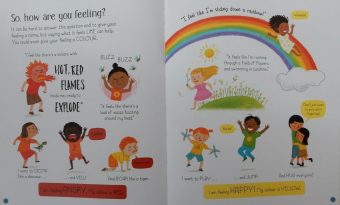
why do you feel a particular way; how would you feel if? (with helpful word clouds)…
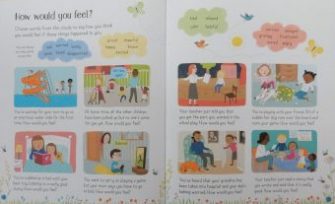
how feelings can change during a day; ‘jumbled up feelings’ and discussing your feelings.

There are suggestions for things to do that help you remain in control;
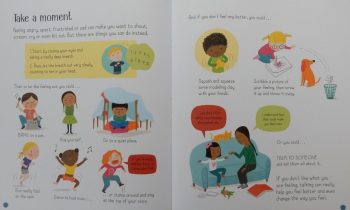
ideas to alleviate worries; ways to express feelings and emotions; ‘being kind to yourself’ and ways in which an individual can help others of all ages feel good.

The final page is for adults – notes on how best to help youngsters; things to try at home (could equally apply at school or nursery) and some on-line resources.

Young children most definitely can learn to become more mindful of how they feel and thus be better in control of their feelings. The authors of this book have done an excellent job of facilitating this and I’d strongly recommend a copy for family bookshelves and all settings where young children are learning.

One thing that struck me about both it and The Unworry Book was that little is said about the benefits of being outdoors. I highlight this after returning from a walk around Ruskin Mill in Nailsworth, near to where I live. This is in part, an establishment for neurodiverse young adults that does amazing work educating its students, with a focus on the outdoors. And, I know from experience that being outside is of enormous benefit to people of all ages from the very youngest children.
Feelings

Red Reading Hub is Happy that Caterpillar Books invited me to be part of the FEELINGS blog tour and thanks too, to the book’s creators, Richard and Libby for …

%0A

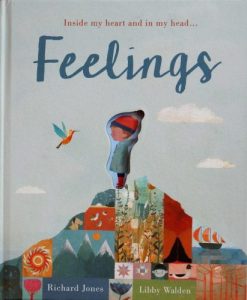
Feelings
Richard Jones and Libby Walden
Caterpillar Books
Emotional literacy and well-being are at the heart of the Early Years Foundation Stage and Every Child Matters, and yet still, as we’re told in the PR for this book, ‘One in ten children aged between 5 and 16 (have) a mental health problem.’
So what happens once children move into primary school at age five? Here is not the place to discuss this issue although I have strong views on what I see to be some of the contributory factors: rather, I welcome anything that can help children to explore their own feelings and emotions openly and within a safe context. Many picture book stories offer this possibility; now here we have a lovely, specially written and illustrated book to this end.
Richard Jones, the illustrator, places the child right where he or she should be: at the heart of this book …

DSCN8777

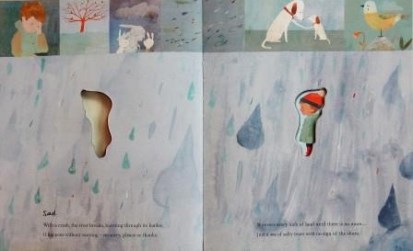
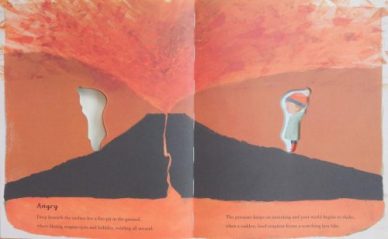
and then, after the introduction, assigns a double spread to the exploration of ten different feelings/emotions: Brave, Sad, Angry, Happy, Jealous, Alone, Embarrassed, Excited, Afraid and Calm. Each one is beautifully atmospheric.
Vitally important as personal feelings are, it is also essential, in order to function well in society, to be able to see things from other people’s viewpoints. So after acknowledging that we’re all different and that this is mirrored in our own personal feelings, Libby Walden (or rather her child narrator) makes this final suggestion: ‘Try to walk in someone’s shoes to see how they might feel, /For though you cannot see them, their feelings are still strong and real.’ How many times a day or week do those of us who teach in the foundation stage or spend time in Early Years settings say to individuals after an incident, something like “Now how do you think so and so feels about that?”
The rhyming text makes use of metaphor to look at what happens when one is overwhelmed by a particular emotion: Sad is a ‘river … bursting through its banks’ covering the land and creating a ‘sea of salty tears with no sign of the shore.”

%0A

Angry is ‘a fire-pit in the ground ‘blazing, spitting, bubbling and swirling and finally, erupting …

%0A

Jealousy, in contrast, is a rolling ‘emerald mist’, churning, seething and eating away at you from inside, blurring your vision and fixing your mind on something you don’t have.
For many children, particularly younger ones, pictorial representation is the easiest (and for them, safest) way to explore their feelings. With this in mind, I shared the book and asked some children to talk, reflect and respond in their own way: here are a few of their pictures.
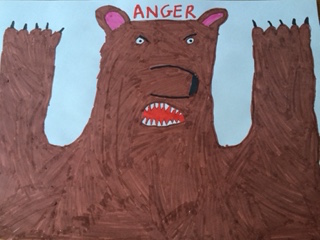
Angry seemed to be the one feeling that was all-engulfing: Gracie has become an enormous bear with jagged teeth and claws …

IMG_2261

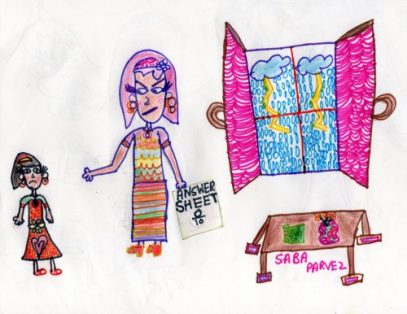
Interestingly Richard himself mentions jagged shapes and fiery colours in his discussion of illustrating Angry for the book. Saba too has jagged lightning in her Angry scene …

saba- angry

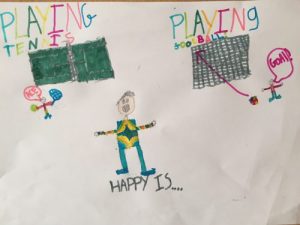
Happy for Daniel is doing sport …

image1

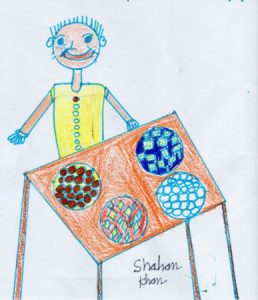
for Shahan lots of sweets to eat, especially his favourite gulab jamun …

shahan-Happy

For Lexi, it’s celebrating a birthday …

DSCN8775

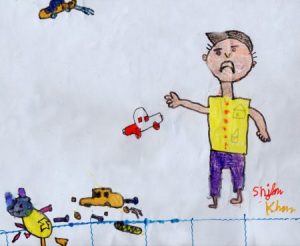
Sad, for Shifan is broken toys …

shifan - sad

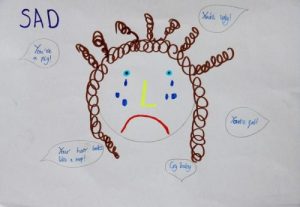
for Frankie it’s bullying …

DSCN8774

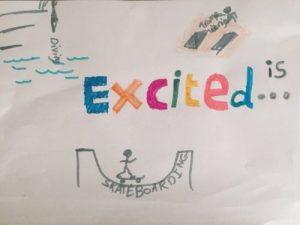
Excited for James is activities that allow him to release his boundless energy …

2016-08-29-PHOTO-00000030

If these responses are anything to go by, Feelings should certainly prove to be a very valuable resource for teachers and other working with children.