Green: The Story of Plant Life on Our Planet

Starting with a single tree, team Nicola and Emily take readers on a journey through the natural world focusing on the vital importance of plant life. In so doing such topics as the process of photosyntheses
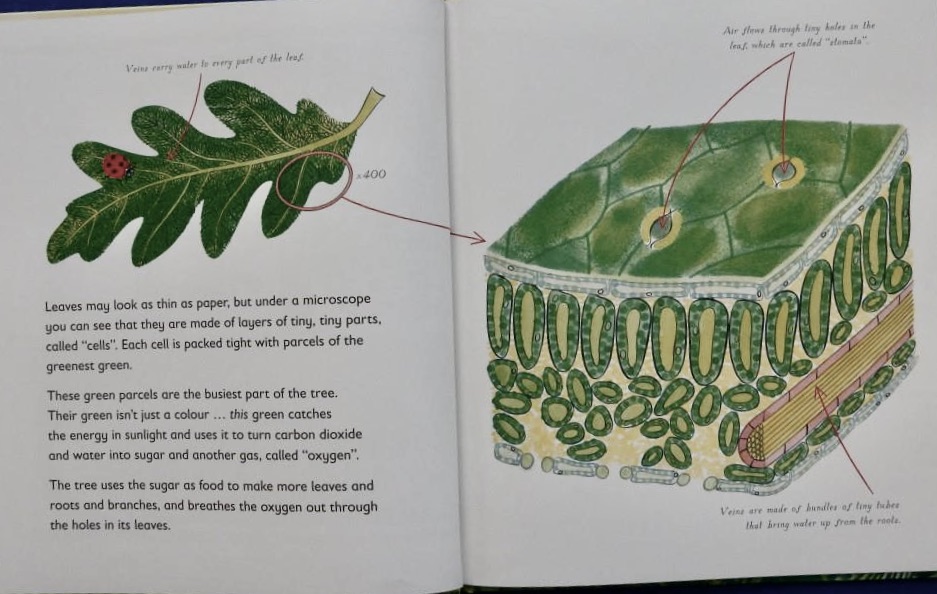
and the opposite process, respiration, are elucidated in the author’s carefully considered prose, She takes us right back to 4.5 billion years ago when earth’s air was toxic, moving forward a billion years when the very first plant microbes began to release oxygen into the air and more diverse life forms became possible. We learn how over millions of years the remains of forests were turned into the fossil fuels coal, gas and oil within which were enormous stores of carbon dioxide and energy from sunlight, this energy being used by humans for their various needs It’s terrible to realise that in so doing we have caused the formation of a thick blanket of CO₂ around the Earth thus stopping heat from escaping, the consequence being global warming.

All is not lost though for plants continue to do their work, giving shade, releasing water to create rain as well as using their ‘greenness to trap energy from sunlight and locking CO₂ in their leaves, branches and roots. Plants however need to work with other living things such as animals and fungi to do this, as well as working with each other in communities that Nicola calls ‘great green nations’
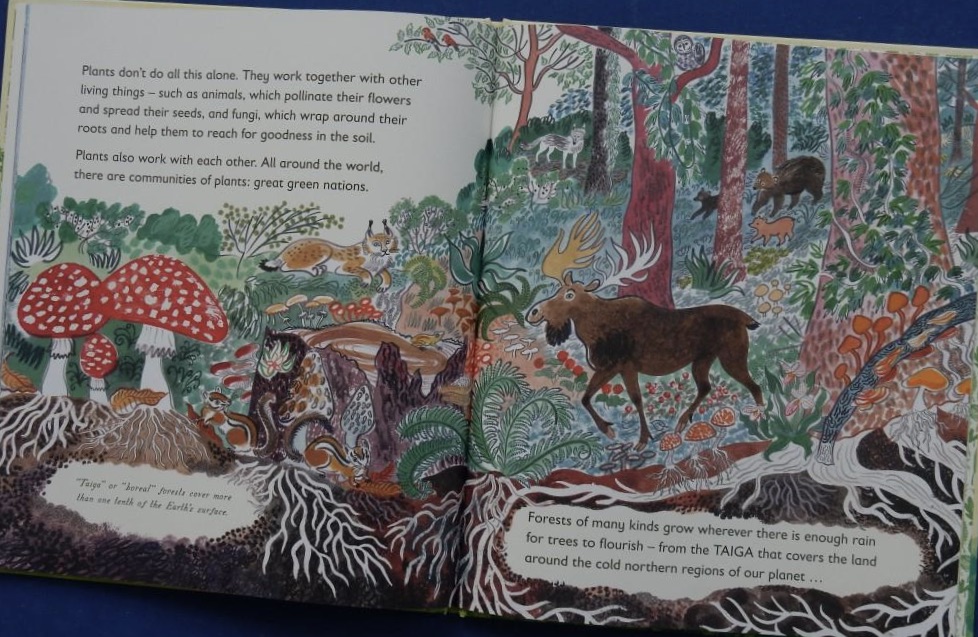
This is why it is vital everybody, the world over, stops destroying forests and polluting the oceans and focuses on protecting all things green.

Once again Nicola’s passion, knowledge and understanding shine through her carefully chosen words: the text in combination with Emily’s captivating, detailed scenes have created a book which gives us all hope that it’s not too late for our precious planet.

Betty and the Mysterious Visitor

Every summer Betty visits her grandma in the village of Wobbly Bottom. She loves spending time in the Acorn Hollows, the garden shared by all the residents of Grandma’s terrace. There she delights in the abundance of flora and fauna; there too her gran cultivates various fruits and Betty helps her pick them, make jam and sell it in the local market.

Full of eager anticipation Betty wakes on market day only to discover that overnight the garden has become a muddy mess. However there’s no time to investigate properly before they leave for the market. 

There it’s full of people buying and selling and come teatime all grandma’s jam has been sold so they head home with Betty determined to find out how the Hollows was spoiled.

She watches through the window that night and in the moonlight she spots a large creature thrusting its nose under the fence but in a trice it’s gone.

The following morning Betty’s Grandma says it was probably a badger and that it’s likely to return. Sure enough, over the next few nights the badger comes back, wreaking havoc in the garden. Supposing it gets into Gran’s fruit cage? Time to get working on a creative solution, thinks Betty and she puts together a frightening monster, then lays a trail towards it. 

Wide awake that night, Betty watches and in comes the badger. However, such is the effect of a sudden wind on the monster, that the intruder hastily departs but not before, so Betty thinks, looking directly at her, as if saying farewell.

Grandma is pleased to hear her granddaughter’s account next morning and together the two sit beneath the trees and celebrate with hot chocolate.

Author, Anne Twist’s inspiration for this, her debut picture book, was her own country garden and what a lovely celebration of the natural world it is. It’s also a beautiful celebration of intergenerational love. How brilliantly Emily Sutton’s jewel-like illustrations bring the world of Wobbly Bottom to life; each re-reading will likely reveal fresh details to savour.

The Season of the Giraffes / Wild Animals of the World

The Season of Giraffes
Nicola Davies and Emily Sutton
Walker Books

This the first of the publishers new Protecting the Planet series looks at the effects of climate change on the much loved giraffes of Niger; its inspiration was the work of climate activist and film maker, Kisilu Musya.

Once some time back giraffes were very much a part of everyday life in Niger: and considered a blessing in the same way as the birds, the trees and the rain. The children saw them browsing the trees on their morning walk to school or when they brought home the cattle at night; the giraffes had a strange fighting regime and communicated in a language of grunts and snorts.

However the number of these graceful animals sadly started to decline as more and more buildings, roads and farms filled the land and then on account of climate change the rains began to fail too. The result was terrible droughts that parched the land causing much suffering to both animals and humans.

Soon very few giraffes were left in Africa but in the country of Niger, there was still time to save the few that remained. The humans stopped hunting, protected the trees giraffes fed on as well as the creatures’ favoured places and gradually, then more rapidly, the giraffe population increased. So much so that some have been transported by truck to other parts where they live under the watchful eye and care of wildlife rangers and scientists. The hope is that one day these beautiful animals might be able to return to the places they once roamed.

Nicola’s story of optimism shows how with resolve, we humans can change things for the better; it’s gorgeously illustrated by Emily Sutton who captures both the grace of the animals and their homeland, and the lifestyle of some of the people of Niger.
(There’s additional information about giraffes, climate change and what we can all do to help both causes.)

Wild Animals of the World
Dieter Braun
Flying Eye Books

This sumptuous volume brings together Braun’s Wild Animals of the North and Wild Animals of the South taking us on a world tour that begins in North America, moving in turn to South America, Europe, Africa, Asia, Australia and finally, Antarctica.

Magnificent art takes the forefront in an awe-inspiring introduction to an array of creatures great

and small of the land, sea and air. Sadly some – the Asian elephant, the Emperor penguin for instance – are on the endangered list, others are threatened, though this isn’t stated in the book.

Dieter Braun manages to encapsulate the very essence and spirit of every one of the hundred and thirty plus animals portrayed. Some have an accompanying factual paragraph, others leave the labelled illustration to speak for itself. (Both scientific and common names are given.) A great gift for young wildlife lovers.

Grow

Grow
Nicola Davies and Emily Sutton
Walker Books

Nicola Davies has a rare skill when it comes to explaining sometimes quite tricky concepts to young readers and Emily Sutton’s illustrations are always superb.

With the opening statement ‘All living things grow’, award-winning team Emily and Emma then explore for young readers, the mysteries of DNA, the genetic code that determines the characteristics of every plant and every animal including we humans.

First are examples of different speeds of growth ranging from the desert four o’clock plants that grow from seed to flower in ten days

to the guahog clams found in the chilly depths of the Arctic Ocean that take 500 years to grow to the size of the palm of a child’s hand. WOW!

The importance of how much things grow is considered next followed by another aspect of growth, that of change,

and that leads neatly into DNA.

We find out about its four bases and how they can be combined in different ways creating a genetic code pattern, comprising for we humans, 20,000 genes.

Everyone has a unique genetic code half of which comes from their biological father and half from the biological mother (identical twins however share a genetic code).

There’s follows a spread showing the relative closeness of the human genetic code to various plants and animals; another points out that thanks to DNA all living things are connected. DNA also provides a connection that can be traced right back to the beginning of life on Earth – awesome – and all on account of the fact that as Nicola concludes ‘all life has always been written in one language’.

This is just the kind of book I would have relished as a child; it will surely inspire as well as educate youngsters.

Buy for home and for KS2 primary classrooms.

A First Book of the Sea

A First Book of the Sea
Nicola Davies and Emily Sutton
Walker Books

Award winning team Davies and Sutton present a fine, diverse collection of sea related poems that subtly blend information within.
Starting down by the shore readers can experience a paddle, sandcastle building, watch a flock of seagulls, have a spending spree on the pier, ride a wave, become creative with shells and pebbles, or stop still and watch a Shore Crab:

‘Delicate! / As a dancer, / The crab sidesteps / To a dead-fish dinner. / Wary! / Periscope eyes up, watching. / Its big claws pinch tiny scraps / And pass them to its busy mouth. / Dainty! / Like a giant eating fairy cakes.’

I love that observation.

Equally beautiful, from the Journeys section, is Star School wherein, ‘The old man draws the night sky out in pebbles / to teach his grandson the pattern of stars. / They will steer his path across the ocean / like stepping stones laid out in the sky, / They’ll steer him safe to tiny islands, / green stars lost in seas of blue.’

I’ve never been a particular lover of beaches and the sea other than in tropical climes, but Nicola Davies’ superb word pictures in tandem with Emily Sutton’s remarkable watercolours have made me want to head to the nearest coast and look anew at those seagulls, limpets, shells and ‘bits of beauty that are pebbles.’
I know I’ll have to travel a bit further in search of puffins though, and I can wait a few more months to watch fishermen on palm-clad shores, perhaps in Kerala or Goa, tossing their nets ‘spider web’ like, endeavouring to ‘catch just enough fish for dinner’.
This is an outstanding and wondrous evocation of the sea – beside, upon, above and beneath –

‘A festival of flashlight fish! Off-on, off-on. It’s a morse code fiesta of living lanterns.

for every book collection, be that at home or in school. A ‘First Book of the Sea‘ it might be, but this is one that will go on being appreciated over and over and …

Lots: the Diversity of Life on Earth

Lots
Nicola Davies and Emily Sutton
Walker Books
Subtitled ‘The Diversity of Life on Earth’ the enchanting large-sized book looks at biodiversity and interdependence on our planet.
The ‘LOTS’ herein encompasses over a hundred different animals as well as numerous plants and one enthusiastic little girl narrator.

By giving voice to the child, Nicola Davies cleverly explains what would otherwise be an abstruse topic in words that pre-school and KS1 age children can engage with and enjoy.
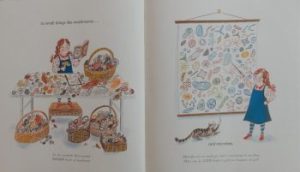
We visit a variety of locations from deserts to tropical islands; and zoom right in to such microbial habitats as beneath the feathers of birds, on the backs of lichen beetles

and even boiling volcanic pools. Counting all the different kinds of flora and fauna is far from easy on account of sheer numbers; but sometimes it’s a very difficult task due in part to the comparative inaccessibility of particular habitats – the tops of tall jungle trees or the bottom of the coldest seas for instance. But also there’s the fact that some young creatures – the Queen Angelfish – for one, look quite different from the adult; or alternatively things that look virtually identical are entirely different species such as here:

The Viceroy Butterfly and the Monarch look almost identical

All this is explained in a straightforward narrative that as well as providing youngsters with a wealth of information, is likely to engender awe and wonder in the ‘almost two million different kinds of living things’ already identified; and the millions that probably are yet to be found.
In the three final spreads, crucial ideas about extinction and the importance of preservation of living things are introduced, leaving readers much food for thought about the vital stewardship role humans have in the whole scheme of things.
This follow up to Tiny also has wonderful detailed, painterly illustrations by Emily Sutton. A must for primary school classroom collections and family bookshelves.

I’ve signed the charter 

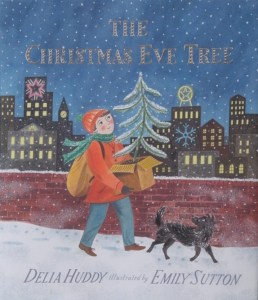
The Christmas Eve Tree

DSCN6019 (800x600)

The Christmas Eve Tree
Delia Huddy and Emily Sutton
Walker Books
The author, of this book, Delia Huddy, who I knew as an editor at Julia McRae Books, was working on the story at the end of her life and it’s wonderful to see it in print as a beautiful, moving picture book illustrated by Emily Sutton.
The story begins with a ‘carelessly planted’ little fir tree growing yes, but crookedly, so that when finally the trees are cut years later, it is stunted and tangled with its neighbour. Nonetheless it’s taken along with all the others to be sold, this ‘bottom of the pile’ tree. As the rest are sold one by one, the little tree fears for its fate until on Christmas Eve, a boy comes into the shop and the shopkeeper gives him the sad-looking object. A better fate than the black rubbish sack assuredly.
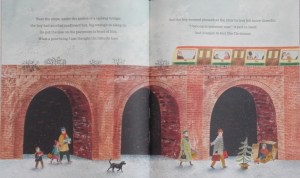
Indeed once outside the shop, the boy heads for the river,

DSCN6020 (800x600)

plants the tree in a box he discovers at the waterside and heads off back to his own, larger box shelter.
The Christmas spirit begins to descend upon both boy and the tree, that now feels a sense of belonging.

DSCN6021 (800x600)

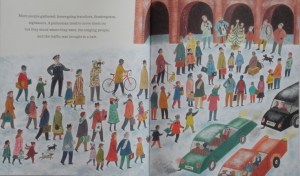
Soon others join them and before long the traffic’s at a standstill as everyone gathers to listen to the Christmas song. And suddenly …

DSCN6022 (800x600)

Eventually, as rough sleepers do, the boy moves on. And the tree? It’s put into a road sweeper’s barrow and taken off to the park, planted in a corner and now against all the odds there it still stands ‘cheerfully stout’

DSCN6023 (800x600)

and giving pleasure to so many all year round.
Giving pleasure to many is assuredly what this wonderful story will do to what I hope will be its many readers and listeners, all year round too.

DSCN5998 (800x600)

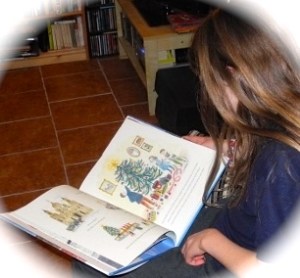
Nina engrossed in the wonderful story

Emily Sutton’s retro-modern scenes portray an almost fairytale atmosphere of a wintry London.

Previously reviewed in hardback, but now out in paperback is a totally contrasting presentation of Christmas:

DSCN5970 (800x600)

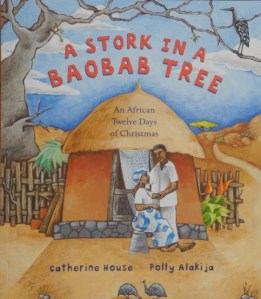
A Stork in a Baobab Tree
Catherine House and Polly Alakija
Frances Lincoln Children’s Books
Subtitled ‘An African Twelve Days of Christmas’, this book is far more than just a reworking of the traditional English version of the song. Readers are treated to a superb experience of African village traditions and customs, animals, food and clothing, and much else. Christmas in southern Africa, we are told, comes during the rainy season. …

DSCN6042 (800x600)

when the grey branches of the Baobab are covered in leaves and white flowers.
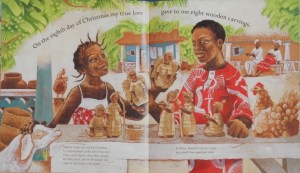
Each of the twelve days, portrays a different African country and is given a double page spread where,

DSCN5971 (800x600)

in addition to the main text, there is a paragraph in smaller print explaining the particular scene. There are many allusions to the biblical story of the nativity woven into Polly Alakija’s fine illustrations;

DSCN5972 (800x600)

in fact the more you look the more you see. Indeed the whole book is one to be revisited over and over allowing considerable time to be spent exploring each setting.

Use your local bookshop        localbookshops_NameImage-2