The Biggest Mistake

“It’s time for you to catch a gazelle on your own.” So says Papa Lion to his cub one morning. Having located his prey, the little lion convinced that his task will be easy, hides behind a bush, waits and leaps. However, the gazelle escapes. Little lion tries again … and again

but none of his strategies are successful. His prey escapes every time and to make matters worse the other gazelles gather to laugh at his attempts.

Ashamed, with his ego dented, the little lion hides away leaving gazelle basking in her triumph. A triumph that is short lived however as it soon gives way to boredom.

The gazelle hunts for a long while for the little lion but her search is unsuccessful until at sunset, she spies him.. She creeps closer and closer but now it’s her turn to make a mistake , a very big one and she’s captured. Is this the end for the nimble creature?

A tongue-in-cheek tale with a fun final twist, deftly translated from the original Italian by Debbie Bibo. With a focus on the animals’ movements, Camilla Pintonato’s bold. dramatic illustrations use the creatures’ eyes to great effect, ensuring that young humans stay engaged and amused throughout.

How To Spacewalk / Wind: Discovering Air In Motion

How To Spacewalk
Kathryn D. Sullivan and Michael J. Rosen
Walker Books (in collaboration with MIT Kids Press)

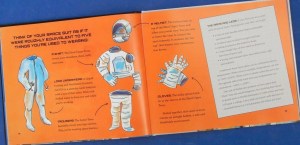
In 1984, Kathryn Sullivan became the first woman to walk in space: in this book, illustrated with photographs and Rosen’s ink and pastel images, she shares her story.
As a child in the 1950s, Kathryn developed an interest in science early on but like other girls, she wasn’t encouraged to follow her interest. However, with determination and perseverance she studied geology and became an oceanographer, eventually applying to join NASA’s astronaut programme for which she was accepted, as well as receiving an offer to explore the ocean depths in a submarine. She chose the first option.

From then on the author addresses readers as though they are participants in her training as an astronaut. What is it like to do a spacewalk? How do you use cutting-edge equipment? What does it feel like to wear and carry out experiments in a hugely heavy space suit? – space armour as it’s called here.

What about experiencing weightlessness?. Will I suddenly feel scared?

A large amount of fascinating factual information is presented, but alongside this we share an empowering account of a woman fulfilling her dreams; it’s one that will surely encourage child readers to live the ‘life you invent’ – to reach for the stars, whatever that means for them.

Wind: Discovering Air In Motion
Olga Fadeeva
Eerdmans Books for Young Readers

Translated from the original Russian by Lena Traer, this book poses and explores eighteen wind- related questions, devoting a double page spread to each question, with illustrations by the author.
The responses to the first – Where does wind come from? are somewhat playful; for instance ‘Maybe there are giants… / who blow air with all their might?’ and ‘Or maybe the wind comes from the wings of a large bird?’.

However from there on the tone changes and What is wind? is answered with a scientific explanation ‘Wind is the horizontal movement of air over the surface of the Earth’ … The author then interweaves information on meteorology, biology, ecology, history, even venturing into outer space, so there’s plenty to keep readers interested.

Each double spread is distinctively designed and the richly textured illustrations are strikingly executed using acrylics, collage and digital media.

Included in several scenes are a little girl, sometimes accompanied by her grandfather and one assumes the questions are coming from the child.

Created with the help of a meteorologist, this exploration of my least favourite element is engaging and absorbing: I would recommend adding the book to primary school collections.

Bear Is Never Alone

Bear Is Never Alone
Marc Veerkamp and Jeska Verstegen
Eerdmans Books for Young Readers

An ursine piano player entrances the forest community with his beautiful music making, but non-stop playing is very tiring and the other animals demand more than the exhausted creature can give, so he stops for a break. However, the listeners just won’t hear of it and yell, “More, more, more!’ repeatedly

until pushed to his limits, Piano Bear gives forth an almighty ROOOOAAAAR’ that scares even himself.

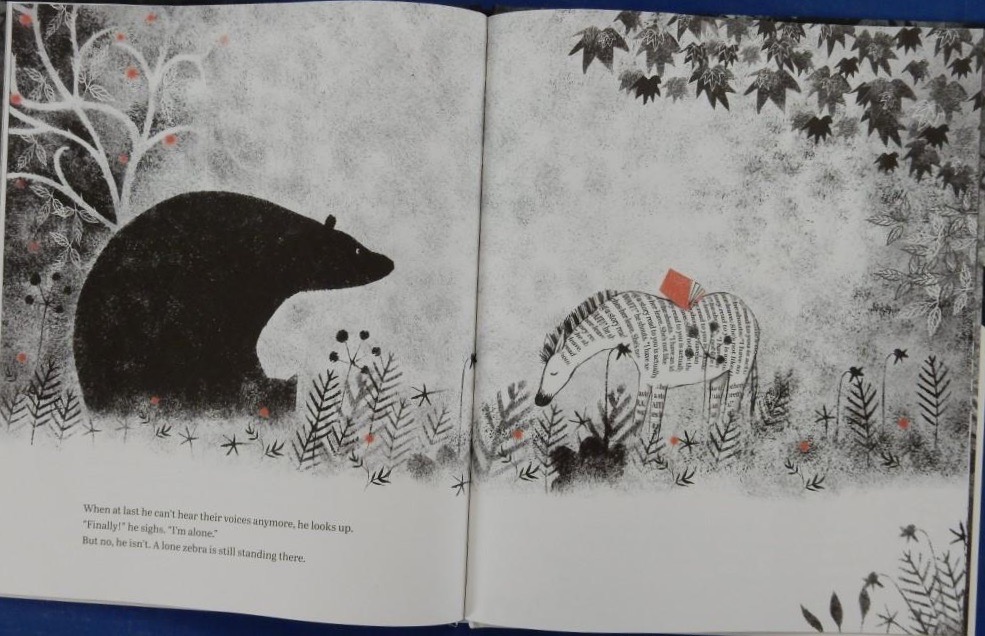
Then comes a tirade from the other animals, which Bear ignores completely. When the last of their voices has disappeared Bear looks up: “I’m alone,” he sighs. However, this isn’t so, for there in front of him stands a zebra.

A thoughtful zebra that offers to read Bear a story in return for all his beautiful music making. Initially Bear refuses but straightaway changes his mind and calls her back with “Zebra, wait! I have an idea! Let’s be alone together.” After all, having a story read to you by a friend is a fun experience he doesn’t want to miss.

Yes, the ending feels a trifle abrupt but the author’s message about Bear’s need for some solitude after giving of himself for so long, definitely comes through in Laura Watkinson’s translation of Dutch author Marc Veerkamp’s telling. Stars of the show, along with Bear, are Jeska Verstegen’s mixed media black and white illustrations with occasion splashes of red for this story that provides just sufficient space for readers and listeners to form an understanding of how we should treat one another. I love the way she builds that dramatic crescendo of the listening animals’ demands across several double spreads culminating in Bear’s almighty roar.

How the Sea Came to Be

How the Sea Came to Be
Jennifer Berne and Amanda Hall
Eerdmans Books for Young Readers

Jennifer Berne divides her rich poetic account into three parts: The Birth of the Sea, The Birth of Life and All That the Sea Came To Be, covering geology, oceanography, biology and evolution over 4.5 billion years – an enthralling journey indeed, especially when set alongside Amanda Hall’s show-stopping mixed media illustrations. The layout of every spread is a joy to explore.

The verbal imagery grips from the outset: ‘Volcanoes exploded from inside the Earth. / They blazed and they blasted and boomed. / And comets and asteroids crashed out of the sky, icy and rocky they zoomed.’

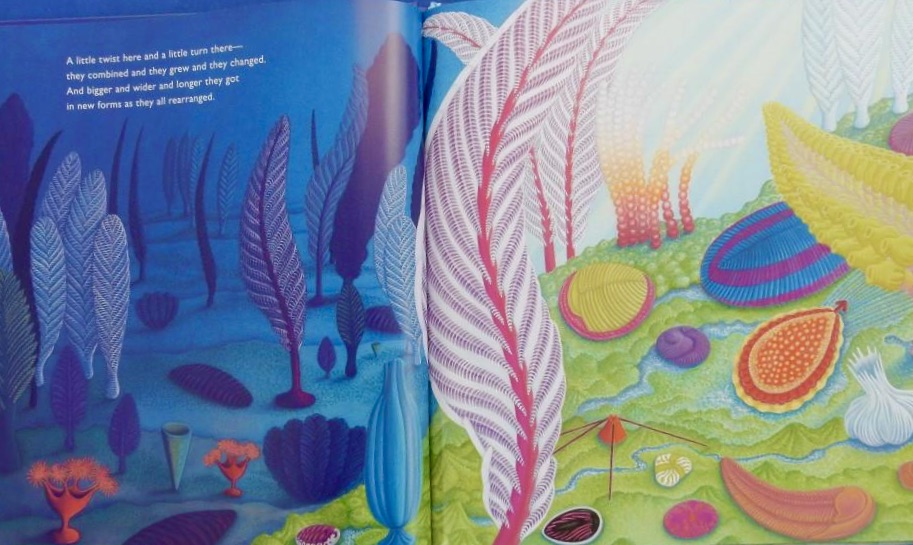
Having presented nature’s violence in storms and volcanic eruptions, the author and artist present the emergence of microscopic life forms – ‘smaller than small, and adrift in the seas,’ that gradually combined and changed into new 

and larger forms: ‘frilled creatures that wiggled and crawled’ as well as drifting, squishing jellyfish with their thread-like tentacles and then came the worm – a creature that ‘points as it squirms’.

Eventually we reach the multi-layered aquatic zones of the present time 

and then slowly return to the surface encountering a wealth of amazing marine flora and fauna to land at last on the shores of now, where people are exploring the rock pools.

Scientifically accurate throughout and written in almost faultless rhyme, there are no labels but it’s not difficult to locate the creatures named if you look carefully. Moreover, those who want to dive deeper can use the additional resources at the end of the book.

Totally immersive and with a wide appeal, this is a book for any collection.

The Dog That Nino Didn’t Have

The Dog That Nino Didn’t Have
Edward van de Vendel and Anton Van Hertbruggen
Eerdmans Books for Young Readers

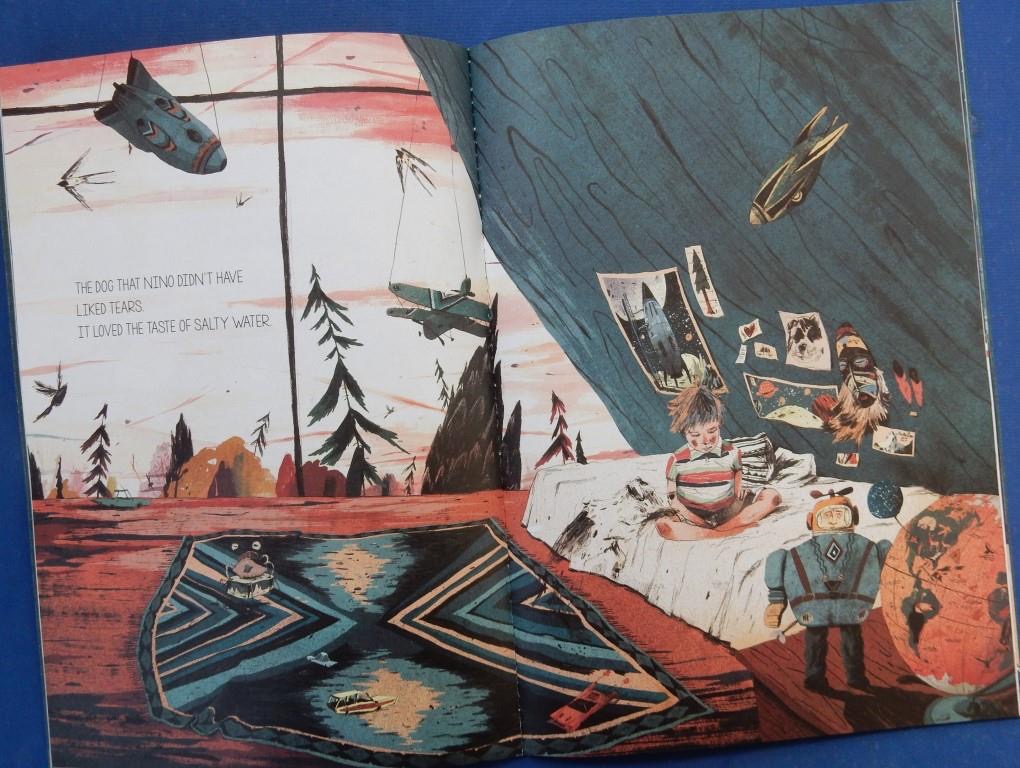
In a woodland landscape, lives a boy named Nino. Nino has a dog – but he doesn’t – or only in his imagination. His mum can’t see the creature, nonetheless the boy, whose dad, – a pilot – is away much of the time – knows said dog listens to his dad’s long distance calls. When Nino goes into the woods, the dog copies the actions of the squirrels, it jumps on to great-gran’s lap when they go to visit her, likes the taste of salty tears

and dives into the lake when the boy goes boating.

Then one day that dog disappears and a different one with other interests takes its place; a soft, sweet pooch everybody can see.

Things feel rather different for Nino now, but nonetheless the presence of a real dog doesn’t stop him imagining a whole host of other animals and even several additional dogs.

Nino is highly imaginative – using his imagination to fill the void his father leaves during his absences and to navigate change; he’s also resilient and loves the outdoors.

This unusual, contemplative story is strange and gently powerful; the detailed illustrations predominantly in green and brown hues, brilliantly evoke a time in the recent past when children were able to play safely in the countryside without adult supervision.

A thought-provoking demonstration of the power of the imagination to help and perhaps heal in difficult times.

I Hate Borsch!

I Hate Borsch!
Yevgenia Nayberg
Eerdmans Books for Young Readers

The young narrator of this picture book loathes her family’s and fellow Ukranians’ favourite food, borsch; despite it being considered a national delicacy . In a cleverly bringing together of the ingredients 

and the process of making this supposed culinary treat, the girl puts her case for being anti-borsch. The stuff even invades her imaginings giving her daydreams of being marooned on a deserted island of sour cream in a red sea of borsch whereon dill floats wherever she looks. Sunflowers too grow profusely in Ukraine, so why not instead have sunflower borsch she pleads, only to receive a resounding NO! 

Every single grandma in Kiev, we read, has the one ‘true’ borsch recipe so inevitably when the girl narrator and her family move to America, you can imagine what she receives as a farewell present from each grandmother. Once in the new country however she finds this dreaded foodstuff has gone there before her – although both its name spelling and taste are different – further reasons to detest this red sludgy stuff. Or maybe not entirely. 

For after a surfeit of American cuisine and the passing of time our narrator – having rediscovered the old family recipes – finds an old friend: borsch. Anybody fancy a bowl of the Ukrainian staple?

Yes this tale, based on the author’s own experiences might at first appear to be about hating a specific food as a child; however beneath the surface are themes of how food is embedded in cultural expression, holding on to one’s cultural identity as an immigrant, and better appreciating the past as you grow up. The bold, mixed media illustrations are both arresting and imbued with a sense of nostalgia and there’s even a borsch recipe at the end of the story.

With the on-going Russian invasion of Ukraine forcing so many Ukrainians from their homeland to safety in other countries including the UK, this book will be especially welcome in schools, both to celebrate the Ukranian culture and the enduring strength of Ukranian people.

Pick A Story / The Book that Kibo Wrote

Pick A Story
Sarah Coyle and Adam Walker-Parker
Farshore

Involving younger readers in the decision making in stories is a great way to get them interested in reading and to keep that interest, but whereas there are plenty of interactive choose your own adventure stories for the over eights, there are relatively few pick a path picture books. The creators of this Pirate + Alien + Jungle adventure put the reader firmly in the navigator’s seat in their picture book starring Vincent and his dog, appropriately named Trouble.

It all begins in the park where the two are enjoying a stroll when all of a sudden Trouble disappears; where has she gone? Now Vincent needs the help of the reader to help him find his pooch: there are three possibilities in the first instance. The first will lead Tom to a stinky pirate galleon; the second will send him to the depths of the jungle and if he chooses the third option, he’ll find himself on board an alien spaceship. The problem is none of these actually help in the search for the missing Trouble.
With judging a talent show,

exploding asteroids, sea monsters and whirlpools to contend with, not to mention a dozen pirates brandishing swords and the possibility of a pursuing zombie, 

Vincent has a tough time of it, but will he find the trophy and more importantly will he and the elusive Trouble ever be reunited?

Sarah Coyle plunges her protagonist and the reader headlong into an adventure with an abundance of possibilities shown in Adam Walker-Parker’s energetic, comic illustrations with their plethora of funny characters and decisions to be made on every spread.

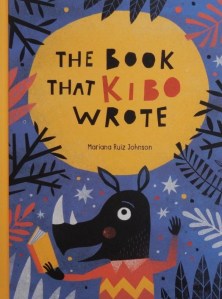
The Book that Kibo Wrote
Mariana Ruiz Johnson
Eerdmans Books for Young Readers

This book contains the story of a story that begins one evening under the setting sun of a warm savannah with Kibo a rhino who wants to capture the beauty of his surroundings. Before he knows it, Rhino has written a whole book under the watchful eye of Naki the crane who has read every word. She uses her beak to sew the written pages between two strong covers making a sturdy book.

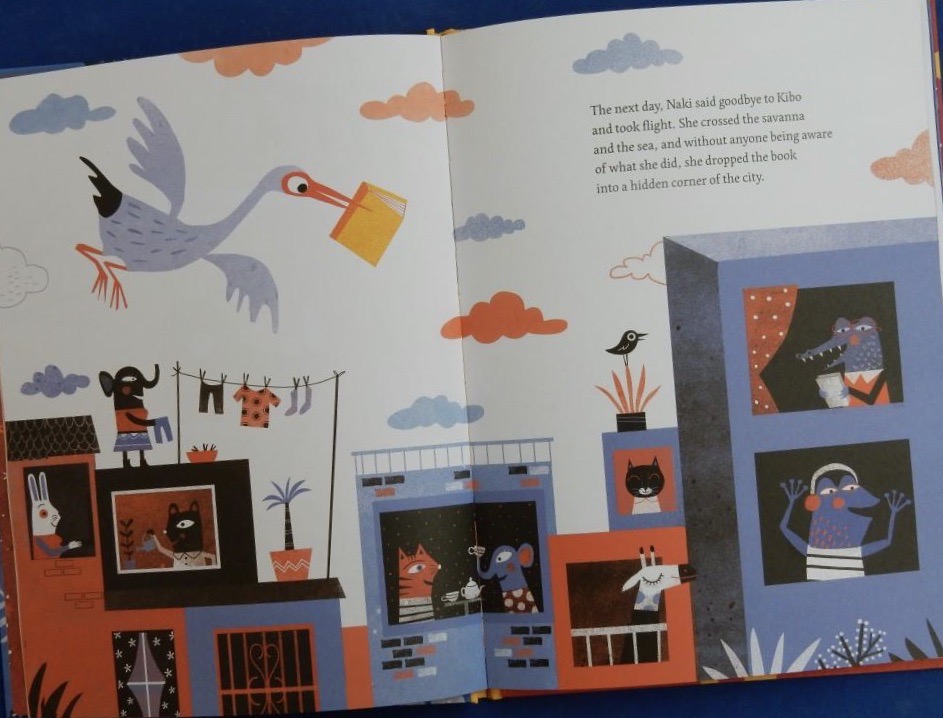
Next morning, bidding farewell to Kibo, off she flies over land and sea, eventually dropping the book in a city. 

There it’s discovered by Camilo the lion and reading the book gives him a strong nostalgic longing for his savannah birthplace. Camilo passes the yellow book on to a friend and it passes from friend to friend until Kibo’s story of the African savanna has travelled all the way to the Arctic and into the paws of a resident polar bear. 

As night descends on the North Pole, polar bear Nanuk feels warmed by the savannah heat as he completes his reading of the book from a distant land.

The open-ended nature of the narrative encourages readers to become participants in the story and I love the use of patterning in the vivid illustrations, which creates a folklorish feeling about the tale. (translated by Lawrence Schimel).