Ranger Hamza’s Eco Quest / Brown Bears

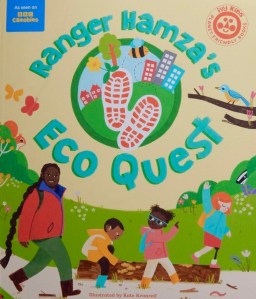
It’s great to be back in the company of Ranger Hamza and here he takes three children and readers on an important learning journey to discover how nature’s everyday heroes from the smallest seed to the tallest tree play a crucial role in our ecosystem, and how we also have a vital role to play. It’s not difficult and Ranger Hamza explains in straightforward steps some ways to help the planet, starting with the making of a mini water butt.
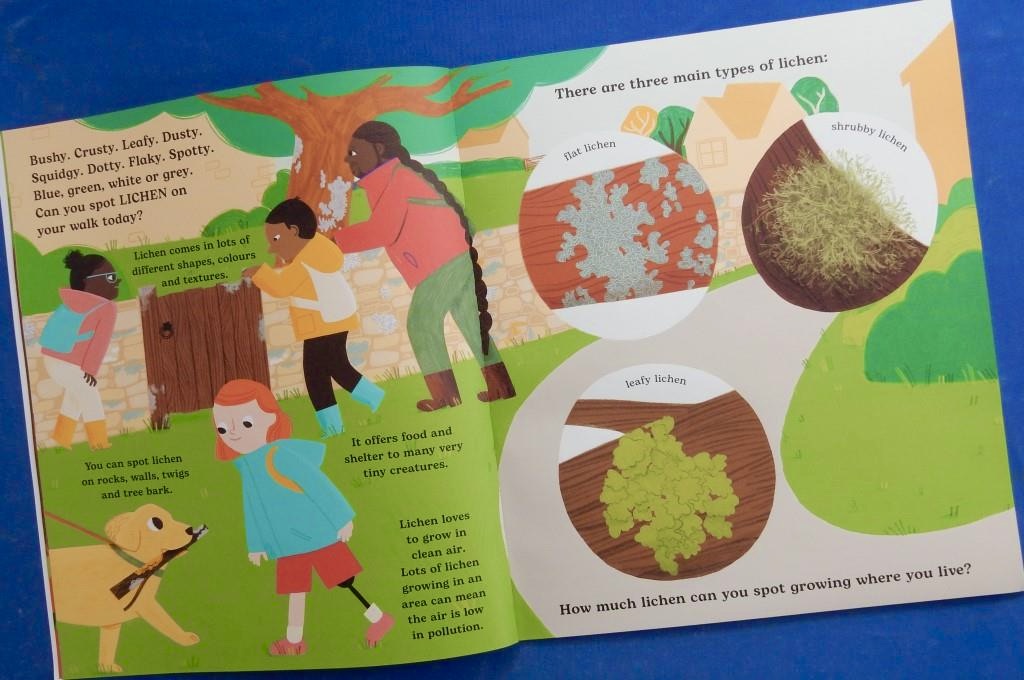
I loved the adjectives used to describe lichen, of which there are three types. In addition to providing food and shelter to tiny creatures, lichen acts as an indicator of the air quality in an area: lots of lichen indicates the likelihood of low pollution, so next time you walk with children keep a watch too see how much is growing.
One thing virtually everybody will notice is dandelions; rather that pulling them up (even from your garden), leave a place where some can grow. In so doing you will be helping several kinds of insects. I know from experience that children love to plant sunflower seeds and watch them grow: this is a great way to provide food for birds, so long as you keep the heads, let them dry out and then put them somewhere birds can access.
These are just some of the suggestions in this thoroughly engaging, inclusive book. It’s never too soon to start teaching children about ways they can help nature thrive so I suggest adding a copy to your family bookshelves, and foundation stage/ KS1 teachers, you need one in your classroom: it offers an abundance of forest school activities.
Another highly effective narrative non-fiction book is
Set in Alaska, USA, this tells the story of a mother brown bear and her two cubs, one male, one female that we follow through a year in the forest. Therein lie dangers aplenty so, almost as soon as they are born, the mother bear starts teaching her offspring survival skills in order that they will be able to live and thrive alone in the wilderness.
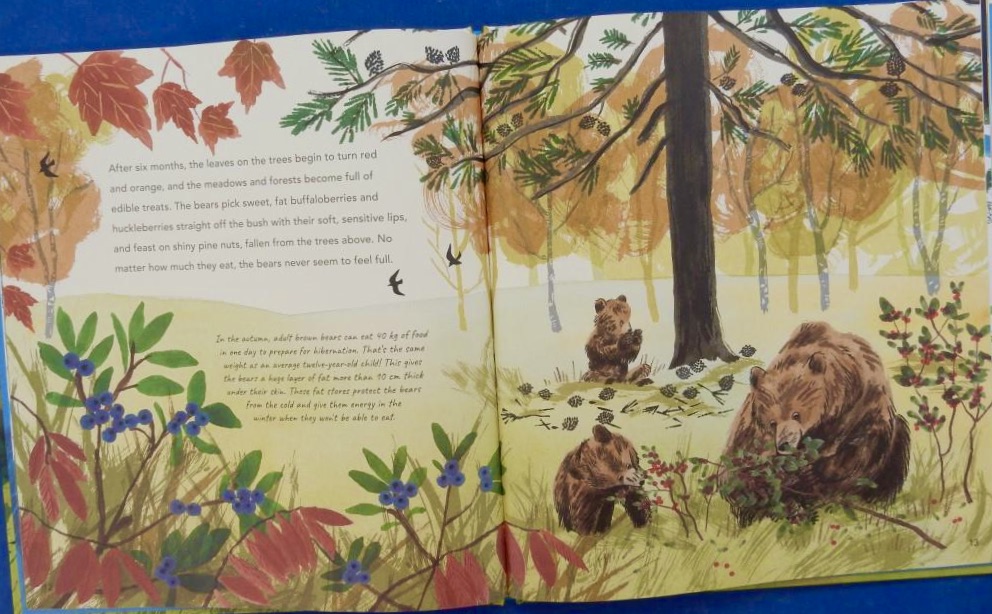
The cubs learn to climb, to leave scents to inform other bears where they’ve been and to remove bugs from their skin. It’s dangerous for bears to stay too long in locations where people have left discarded food, as this can endanger both humans and the bears that have followed their noses. Much better is picking berries and foraging for nuts in the meadows and forest areas, which is what the cubs do come the autumn to build up a layer of fat to help protect them through the winter when hibernation prevents them from eating.
Come the snowfall, mother bear builds a new den wherein they will all spend the winter, in the warmth trapped by the tree branches covering the tunnel’s entrance.
After a whole seven months the mother wakens as do the cubs, the light hurting their eyes after so long. Then it’s out into the melting snow to start feeding again and come the summer part of their food will be salmon that have come to lay eggs in the gravelly rivers. Danger isn’t over however; indeed it comes in the form of a massive, very hungry male brown bear; but thanks to the cubs’ climbing skills and their mother’s warning sounds, the three remain safe and as autumn approaches again, the male cub will leave his family and go in search of a new home
Beautifully illustrated and captivatingly written, (with paragraphs of additional information to enjoy either during or after reading the main narrative), this is perfectly pitched for KS1 children.

How to Chat Chicken

Zoologist Nick Crumpton clearly enjoyed writing this splendidly quirky book on creature communication, for which he uses a chatty, matter-of-fact style.

Beginning with primates – chimpanzees, gorillas, orangutans, night monkeys and common marmosets – he focuses on the wonderful sounds these animals make to let others of their kind know they need food, investigate something new, want others to stay clear of them,

want to make friends, want a mate or are defending their territory. If your garden is frequented by a fox at night you could listen very carefully through an open window and you might just catch the ACK-ACK-A-ACK-ACK-A (This is my garden) of a fox indicating to another fox to vamoosh.

Not all animal sounds are vocal however. Some animals including grasshoppers and leaf cutter ants use a process called stridulation. Grasshoppers stridulate to advertise their whereabouts in order to attract a mate; leaf cutter ants stridulate when they want help from their nest-mates.

Then there is echolocation; dolphins use CLICKCLICKCLICKCLICK when they want to find their prey or to indicate they want to play.

Some creatures, dogs for instance, use pheromones (special chemicals) to communicate. I had to smile at the description of lampposts being used as ‘doggy chat rooms’.
And can you believe, there is even a form of animal dialect: the squeaks and clicks made by naked mole rats sound slightly different depending on which colony they are from.

There’s a concluding explanation of the science behind the sounds, a meet the author and the illustrator spread, a glossary and an index.

The book is very visual: Adrienne Barman’s playful cartoon style illustrations work really well with the written text. Add to primary school collections and home bookshelves.

Everything You Know About Sharks Is Wrong

Everything You Know About Sharks Is Wrong
Dr Nick Crumpton, illustrated by Gavin Scott
Nosy Crow

Having set the record straight about dinosaurs and minibeasts, Dr Nick Crumpton has (along with illustrator Gavin Scott) turned his attention to the oceans and in particular, sharks. Writing in an entertaining style he discredits many of the shark-related myths that have grown up over time and it’s likely they have the worst reputation of all living creatures. Remember those dogfish you studied in zoology at school back in the day? They are related to sharks, both being elasmobranchs.(cartilaginous fish).

Assuredly sharks are predatory creatures but do they kill lots of people? Worldwide sharks killed 11 people in 2021 but cows killed 22 people and that was just in the USA and snakes were responsible for the deaths of 50,000 people worldwide: the numbers speak for themselves. On the other hand, we read, humans kill 100 million sharks and rays each year and sharks are unable to replace those lost quickly enough, so actually a number of species are at risk.

What about those fearsome-looking sharp pointy teeth all sharks have. No they don’t, at least not all of them: different sharks have different sorts of teeth, which help them eat a wide range of food by piercing, slicing or crushing their prey. Did you know that all sharks’ skin is made from millions of tiny teeth and whale sharks even have teeth on their eyes. Moreover, these ‘dermal denticles’ each have elements – dentine, a pulp cavity containing blood and nerves and an enamel covering – similar to our own teeth. Knowledge about how these v-shaped denticles work has led scientists and technologists to develop swimsuits that enable swimmers who wear them to move faster through the water.

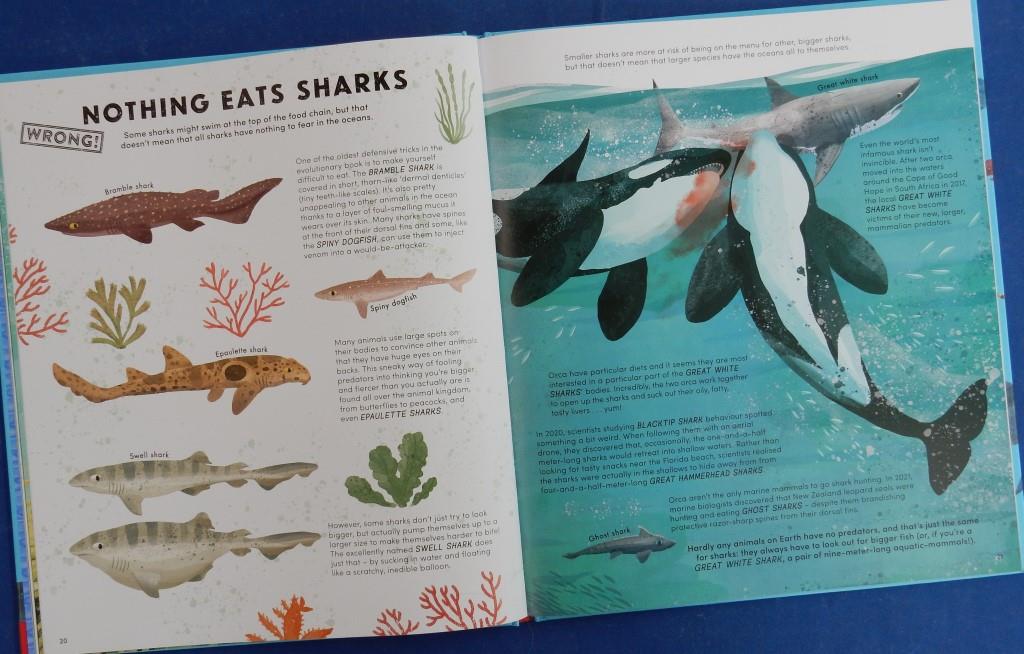
Amazingly the prey of Cookie Cutter Sharks are much larger than their predators; these sharks don’t hunt, rather they lure their fleshy prey to them. There’s a whole spread on how various sharks hunt: filter feeding whale sharks don’t bite, instead they open their mouths and swim straight into clouds of microscopic planktonic organisms. On the other hand, some of the smaller sharks might end up as food for other, much larger sharks, and recently there have been reports of orca whales eating sharks.

An absolute wealth of fascinating information is packed into the pages of this book and Gavin Scott has done a terrific job with the illustrations. The mystery, power and beauty of these amazing creatures and the underwater world they inhabit are spectacularly portrayed in his scientifically accurate paintings.

Primary readers (and beyond) with an interest in biology will find this absorbing.

Everything You Know About Minibeasts Is Wrong

Everything You Know About Minibeasts Is Wrong!
Dr. Nick Crumpton, illustrated by Gavin Scott
Nosy Crow

Adopting a gently humorous, entertaining style, the author explores common misconceptions about creepy crawlies in this highly informative, fascinating and entertaining book. Hands up all those who think that all bees die when they sting you: wrong! That’s just one of the almost thirty main myths cleared up in this book, but contained within each topic spread are several others, in the case of bees: not all bees live in hives, in fact over 90% are either solitary or live in small groups; nor is every bee black and yellow, indeed the orchid bee is actually green and some carpenter bees are blue.

Prepare yourself for another surprise (unless you are an entomologist): no centipede in the world has one hundred legs. It’s not possible because the number of pairs of legs a centipede has is always odd – try the maths.

Interestingly, minibeasts aren’t all small. Some – fairy flies for example – are microscopic, but there’s a species of stick insects that in adult form is, at around 64 centimetres, longer than an average cat. And the wingspan of a giant grasshopper is greater than that of a sparrow.

Another misapprehension is that all eight-legged minibeasts are spiders, but as the author tells readers, vast numbers of arachnids including scorpions definitely aren’t spiders; neither are tardigrades.

One particular erroneous piece of information that really annoys my partner who knows a considerable amount about butterflies, is that they all come out of cocoons. It’s a mistake fairly often found in books, especially those for young children. The spread entitled ‘Butterflies emerge from cocoons’ is particularly entertaining with its gentle dig at a very famous picture book creator.

No matter where you open this captivating book, you’ll find superb illustrations by Gavin Scott presented in a variety of ways to heighten visual interest. Including a wealth of statistics, it’s a terrific look at some creatures that are vital to human life. I’d strongly recommend it either for interested individuals to enjoy at home or as an addition to school STEM resources.