The Season of the Giraffes / Wild Animals of the World

The Season of Giraffes
Nicola Davies and Emily Sutton
Walker Books

This the first of the publishers new Protecting the Planet series looks at the effects of climate change on the much loved giraffes of Niger; its inspiration was the work of climate activist and film maker, Kisilu Musya.

Once some time back giraffes were very much a part of everyday life in Niger: and considered a blessing in the same way as the birds, the trees and the rain. The children saw them browsing the trees on their morning walk to school or when they brought home the cattle at night; the giraffes had a strange fighting regime and communicated in a language of grunts and snorts.

However the number of these graceful animals sadly started to decline as more and more buildings, roads and farms filled the land and then on account of climate change the rains began to fail too. The result was terrible droughts that parched the land causing much suffering to both animals and humans.

Soon very few giraffes were left in Africa but in the country of Niger, there was still time to save the few that remained. The humans stopped hunting, protected the trees giraffes fed on as well as the creatures’ favoured places and gradually, then more rapidly, the giraffe population increased. So much so that some have been transported by truck to other parts where they live under the watchful eye and care of wildlife rangers and scientists. The hope is that one day these beautiful animals might be able to return to the places they once roamed.

Nicola’s story of optimism shows how with resolve, we humans can change things for the better; it’s gorgeously illustrated by Emily Sutton who captures both the grace of the animals and their homeland, and the lifestyle of some of the people of Niger.
(There’s additional information about giraffes, climate change and what we can all do to help both causes.)

Wild Animals of the World
Dieter Braun
Flying Eye Books

This sumptuous volume brings together Braun’s Wild Animals of the North and Wild Animals of the South taking us on a world tour that begins in North America, moving in turn to South America, Europe, Africa, Asia, Australia and finally, Antarctica.

Magnificent art takes the forefront in an awe-inspiring introduction to an array of creatures great

and small of the land, sea and air. Sadly some – the Asian elephant, the Emperor penguin for instance – are on the endangered list, others are threatened, though this isn’t stated in the book.

Dieter Braun manages to encapsulate the very essence and spirit of every one of the hundred and thirty plus animals portrayed. Some have an accompanying factual paragraph, others leave the labelled illustration to speak for itself. (Both scientific and common names are given.) A great gift for young wildlife lovers.
Forgotten Beasts / Dictionary of Dinosaurs / Dinosaur Bingo

Forgotten Beasts
Matt Sewell
Pavilion Children’s Books

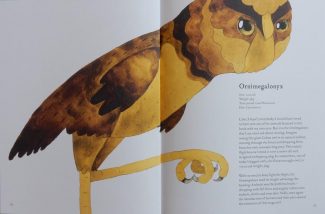
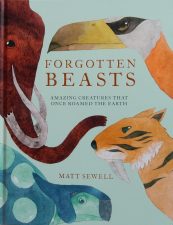
If you’ve ever wondered about the strange animals that were concurrent with, or followed in the footsteps of, the dinosaurs, then Matt Sewell’s sumptuous new book is the place to go. ‘Welcome to the amazing world of forgotten beasts!’ announces the introductory line of the book’s blurb. Of the over forty astonishing creatures large and small, most are completely new to this reviewer. Matt supplies readers with a note on his illustrations and there’s a double spread with a time line and other introductory matter before the animals are showcased.

First, we’re introduced to some of the very earliest ones that made their homes in the water: there’s the Ordovician marine dwelling Cameroceras with its 9-metre-long conical shell and the Dunkleosteus from the late Devonian period with its razor sharp teeth that it used to crack open shells of the creatures it fed on.

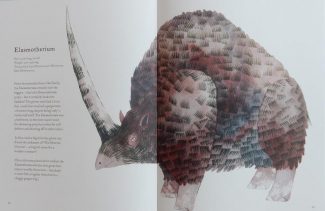
Two of my favourites though come much later, from the late Pliocene – late Pleistocene era.: meet the herbivorous rhino-like Elasmotherium that weighed between 3,500 and 4,500 kg.

Despite being only around a metre tall, the horn of the male sometimes grew to a length of 1.8 metres.
Another, the enormous owl Ornimegalonyx, is also from the late Pleistocene era. Over a metre tall, it weighed nine kilos.

Awesome!

Written in consultation with vertebrate palaeontologist, Dr Stephen Brusatte from Edinburgh University, this fascinating book will broaden he horizons of dinosaur enthusiasts. Every one of Matt’s magnificent paintings is a stunner.

Dictionary of Dinosaurs
illustrated by Dieter Braun, edited by Dr. Matthew G.Baron
Wide Eyed Editions

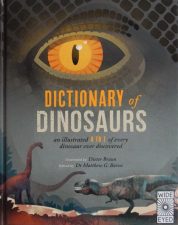
Wow! Every dinosaur that has ever been discovered is featured in this pictorial dictionary and who better to grace its pages with his awesome illustrations than Dieter Braun.

After a short introduction explaining the what, when, the demise and evidence of dinosaurs, comes a timeline and a page explaining how the book might be used.
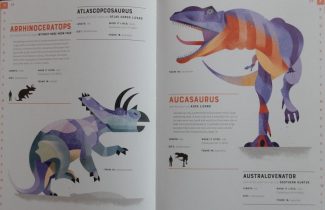
Then we meet each one from Aardonyx and Abelisaurus to Zhuchengtyrannus and Zuniceratops, none of which I’d previously heard of.
There’s a brief informative description that includes  how to pronounce the name, length, diet, when it lived and where found – just sufficient to whet the appetite and perhaps send eager readers off searching for additional information about some of particular interest.

For dinosaur addicts and school libraries or topic boxes I suggest.

For those who can’t get enough of things prehistoric, is a game for the dino-mad:

Dinosaur Bingo
illustrated by Caroline Selmes
Magma for Laurence King Publishing

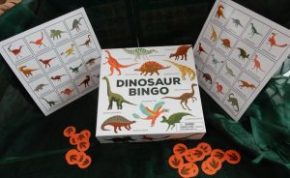
In the sturdy box are a folded caller’s game board, eight double-sided players’ game boards, 48 dinosaur tokens, 150 circular counters and a dinosaur head box to contain the tokens.
Between three and eight people can participate in what is likely to be a popular take on the classic game. Players might even learn some new dinosaur names such as Maiasaura or Therizinosaurus along the way. I certainly did.

Great for families or a group of friends, and it would make a good present for a dinosaur-loving child.

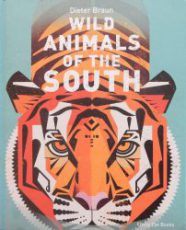
Wild Animals of the South

%0a

Wild Animals of the South
Dieter Braun
Flying Eye Books
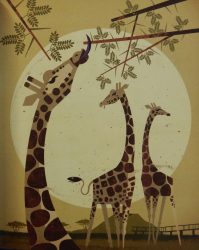
This companion volume to Braun’s Wild Animals of the North takes readers to Africa, South America, Asia, Australia and finally, Antarctica: it’s equally stunningly beautifully illustrated and almost every page would make a wonderful poster. How does a reviewer choose just a few pictures to show; a pretty impossible choice in this case as every one is magnificent in its own way. I’m starting in Africa with these beauties …

%0a

and I was surprised to discover that despite their necks being over two metres long, they have, like humans, only seven vertebrae. What a wonderful dusty, colour palette Braun has used here. Indeed each and every one of his poster-like images is strikingly composed of elegant, naturalistic detail and textural artistry.
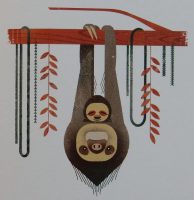
Moving on to South America, this little Two-toed sloth is perfectly constructed …

%0a

to allow rain water to run off it more easily.’ I was surprised once again here, to learn its fur hosts algal growth, which has a double use – as a food source and as camouflage.
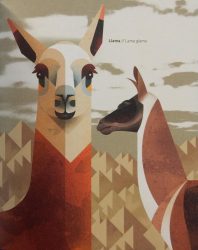
Cubism is, I think, the influence for this magnificent Llama portrait–

%0a

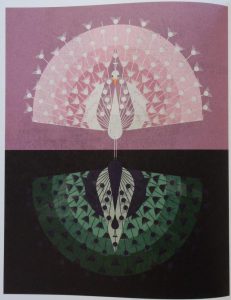
Indeed one can detect many artists styles herein. These incredible Indian peafowl (representing Asia)

%0a

have a definite Art Deco look about them
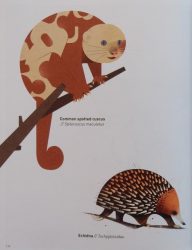
From Australia we have among others, the Common spotted cuscus and the Echidna: I love the way the curved shaped backs are juxtaposed on this page, as well as the use of geometric shapes. …

%0a

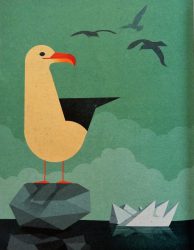
As with the ‘North’ volume, Braun allows his visuals of some of the animals to stand alone, such as this Kelp gull from Antarctica …

%0a

the region from which unsurprisingly, fewest animals are portrayed.
This is a book to keep, to give, to share and to inspire.

Charter logo FINAL.indd

Wild Animals of the North


DSCN7055 (800x600)

Wild Animals of the North
Dieter Braun
Flying Eye Books
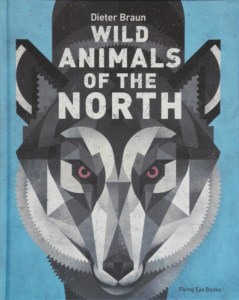
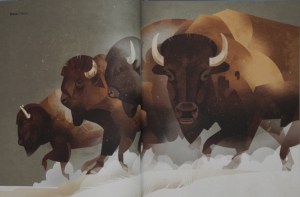
Magnificent art takes the forefront in an awe-inspiring introduction to an array of creatures great and small, all of which are native to the northern hemisphere. The book is divided into three regions: North America, Europe and Asia and, starting with North America, Dieter Braun takes readers on an exploration of animals of the land, sea and air: his stunning illustrations are a wonder to behold and seem to encapsulate the very essence, spirit and being of the animals portrayed. I was reminded of elements of primitive cave paintings in his rendering of the Bison

DSCN7057 (800x600)

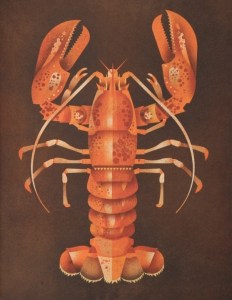
of Dürer in his American Lobster

DSCN7058 (800x600)

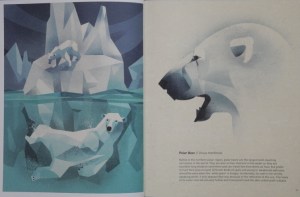
and Cubism in for instance, his Polar Bear

DSCN7056 (800x600)

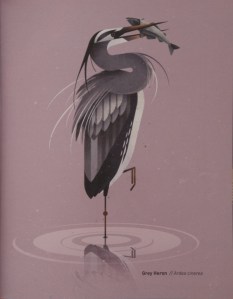
Moving on to Europe that glorious Grey Heron …

DSCN7059 (800x600)

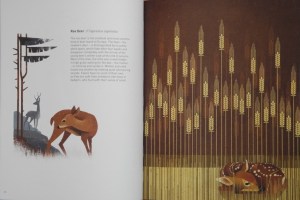
brought American ornithologist and painter Audubon’s work to mind and Braun’s beautiful Roe Deer illustration seems inspired by Art Deco.

DSCN7060 (800x600)

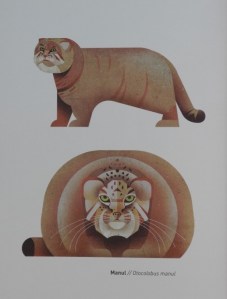
Some pictures are left to speak for themselves with just the animal’s common and scientific names given, others have a paragraph of factual information. I found myself ‘googling’ some of the less familiar creatures – the Asian, Manul for instance -where I found the photographs of the particular animal somehow less alive than Braun’s image on the page.

DSCN7065 (800x600)

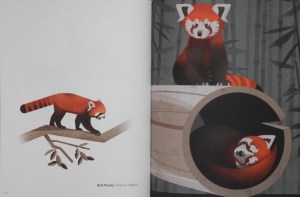
Several of my favourite portraits are among those from Asia. There’s the Red Panda …

DSCN7062 (800x600)

now an endangered species;
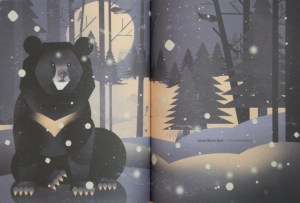
Black Bear, which in this gorgeous scene …

DSCN7063 (800x600)

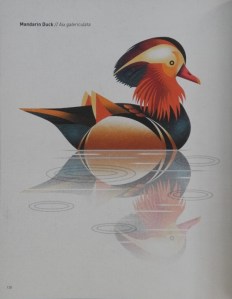
closely resembles the large soft toy replica I once bought from the Norbulingka Institute near Dharamsala in northern India and the beautiful crested Mandarin Duck …

DSCN7064 (800x600)

familiar to me from frequent visits to Bushy Park – a favourite haunt on mine.
Children and adults alike will get great pleasure turning the pages of this large, sumptuous volume and it will surely be the inspiration to find out more about some of the eighty odd animals presented herein. However, it is not a book for those interested in things zoological only; there is much to interest art lovers as well.
Top quality is something one now almost takes for granted from Flying Eye Books: here is yet another example of how attention to detail in design ensures that their high standard is once more maintained: I cannot wait to see the companion volume Wild Animals of the South soon to be published.

Those who have an interest in birds (no matter from where) and in creating art will likely enjoy:

DSCN7069 (800x600)

Kerry Lemon’s Birds of Paradise
Kerry Lemon
Pictura
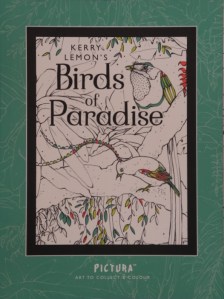
This concertina-style book takes us on a trip to the rainforests of New Guinea wherein live the stunningly coloured birds of the title. In addition to the colouring in possibilities, the author includes some basic information on the birds featured and lots of helpful tips on art in general, and how this particular book might be used.

Use your local bookshop        localbookshops_NameImage-2