I Remember

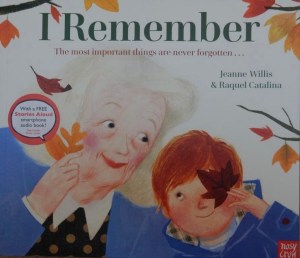
I Remember
Jeanne Willis and Raquel Catalina
Nosy Crow

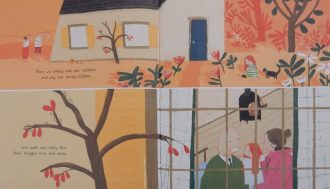
George’s grandma, Kathleen, is having trouble remembering things, even recognising her grandson. When he visits her one afternoon she’s forgotten that the last time he called was just the previous day. George however, is full of love and acceptance of his grandma’s forgetfulness and they share a wonderful time together as they eat a chocolate biscuit between them and go to play outside in the garden wearing their blue coats. Kathleen has a problem with her buttons
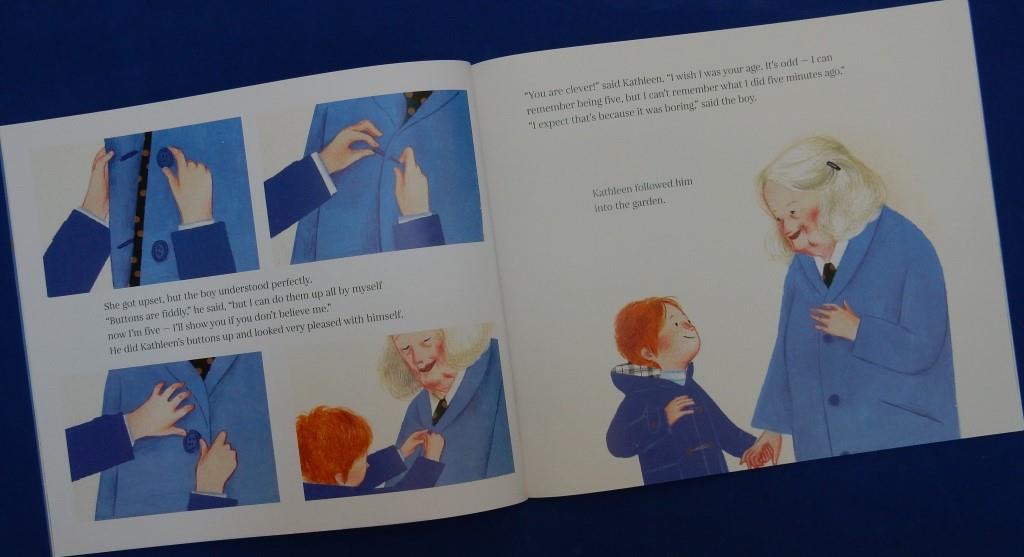
and then as they walk out together she explains how she is able to recall being five but is unable to remember what she did just five minutes earlier.

In the garden George involves his gran in some pretend play with her as an astronaut, himself as pilot of their spaceship (the garden bench) and the pigeons as aliens. When George climbs a tree, Kathleen suddenly becomes anxious but he quickly comes to her rescue and they go in together. There’s further confusion and George reminds her who he is as they look at a photo of when they were both younger.

After shedding a few tears, Kathleen joins her grandson in a song and dance until they’re both in need of a rest.

All ends happily with George knowing that even though her mind might forget, her heart never does: that shared love will always be there transcending all else

This is an important and beautifully told story of the effects of dementia, memory loss and confusion ,, the effects of which some children may well recognise in people they know and love. George’s way of dealing with how Kathleen is affected will reassure youngsters and Raquel Catalina’s brilliantly expressive illustrations portray the intergenerational love between the two characters perfectly. A real treasure for sharing at home or in school.

The Forgettery

The Forgettery
Rachel Ip and Laura Hughes
Egmont Books

Memory loss and dementia are ever increasing and although adults are well aware of this challenging topic, it’s not easy to open up a discussion with young children about why a much loved grandparent for instance, is unable to remember things. Sharing this beautiful book is a wonderful place to start: it never once mentions the word dementia during the story of Amelia and her Granny and their adventure together.

From the outset we’re told that Granny is forgetful, sometimes being unable to recall where she’s put the marmalade or where she keeps her socks but sometimes forgetting important things like special moments. Amelia is a daydreamer and explorer and this means that she too is apt to be a bit forgetful.
One day while exploring in the forest together they stumble upon a strange place called The Forgettery and decide to investigate.

They receive a warm welcome and Amelia explains that they’ve forgotten their way home. The kindly Memory Keeper invites them aboard a hot air balloon and off they go

eventually arriving at a door labelled with Granny’s name. Inside it’s enormous on account of all the memories it’s storing: ‘Moments of delight, lost and forgotten, fluttering in the room like butterflies.’ Sensory experiences including the smell of fresh bread, the crunch of autumn leaves underfoot and the giddy joy of cartwheeling. Granny chooses her very favourites from among them all

and then they move on to Amelia’s Forgettery. This is a small room and while Amelia is delighting in its contents, they receive a message reminding them it time to head home to dinner.

Back indoors Amelia decides to make an illustrated book of all the memories Granny had collected at her Forgettery and henceforward Amelia would take a photo of each fun thing they did together, to add to the book as a special reminder; a book they could always share.

Granny then adds a final item to their list of special things but it’s one neither of them will need to be reminded of …

Both new memories and all the lost, old ones are stored in The Forgettery so the book can equally be shared as an unusual fantasy adventure showing the special relationship between Granny and Amelia. This is highlighted both in Rachel Ip’s warm-hearted telling and Laura Hughes’ gently humorous, equally warm illustrations reflected in her choice of colour palette and the wonderful details in each of the scenes.

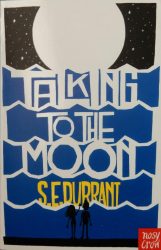
Talking to the Moon

Talking to the Moon
S.E.Durrant
Nosy Crow

What with Dad’s repairs to her bedroom and two year old twins to contend with, home life for Iris has become way too chaotic and stressful so she’s temporarily living with her highly unusual grandmother Mimi.

There though Iris soon discovers challenges and chaos of a different kind. Gran wants her to go swimming in the freezing cold sea and there’s no hot water to warm you up afterwards; and the place is full of bits and pieces Mimi has collected over the years, mostly boxes of old photos taken and developed by Mimi herself.

It’s not long before Iris begins to notice increasingly strange behaviour on Mimi’s part and it surely can’t all be down to her quirky nature. ‘It feels like Mimi’s getting holes in her memory. It’s scary,’ she tells readers.

Into the story steps the irritating, marble-obsessed boy Mason, who has observed some of Mimi’s behaviour from next door.

Despite all her intentions to wait until secondary school before forming a proper friendship, the two start spending time together. Mason’s granddad too has memory loss and the boy becomes increasingly involved in iris’s efforts to unravel the mystery of Coral, shown in one of Mimi’s photographs. Who is she and what happened to her?

Tenderly written, S.E. Durrant’s poignant story gently tackles the difficult subject of dementia and at the same time explores how the 11 year old narrator navigates her own tricky family circumstances.

We really feel we’re standing right beside Iris as she attempts to protect her beloved Mimi while dealing with the unsettling nature of her own life.

This utterly compelling book finishes with a beautiful and uplifting scene on Brighton’s seafront that brought a tear to the eye of this reviewer.

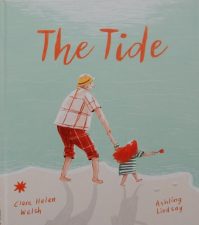
The Tide

The Tide
Clare Helen Welsh and Ashling Lindsay
Little Tiger

What a heart-wrenchingly beautiful story Clare Helen Welsh’s little girl narrator tells as she talks of her beloved Grandad. ‘Mummy says that Grandad loves me very much but that sometimes he gets confused.’

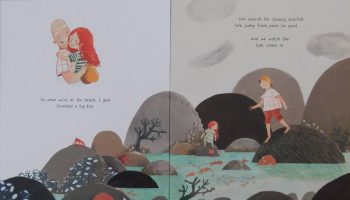
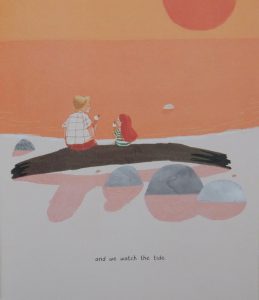
We then spend a day with the family at the beach – the child, her mum and Grandpa set up camp and as Mum watches, child and Grandad build sand castles and forts, crown themselves ‘king and queen of net and shells’. They all share a picnic (Grandad gets confused and buries the sandwiches) and then they go rock pooling (Grandad and granddaughter) and watch the movement of the tide as it comes in.

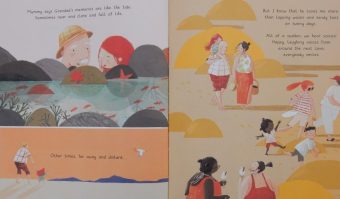
Mum likens Grandad’s memories to the tide – ‘sometimes near and close and full of life. Other times, far away and distant.’

Their musings are broken by voices and the family proceed together to buy ice-creams and again child and grandfather watch the tide

before becoming ankle deep in sea-water.

All too soon it’s time to go home but first they must shake away and wash off the sand and salty water.

Then it’s back home to talk lovingly together about their shared day.

The likening of Grandad’s memory to the ebb and flow of the tide is both moving and enormously powerful: Clare has chosen the perfect figurative language to help children to begin to understand dementia and be at ease with the subject. And, I can think of no better illustrator than Ashling Lindsay whose work I’ve loved since seeing her very first picture book. Her warm colour palette here is just gorgeous, radiating the unconditional love that so clearly exists between family members, especially child and Grandad.

A must have for family collections and for primary schools to share and talk about together.

Lovely Old Lion

DSCN4970 (800x600)

Lovely Old Lion
Julia Jarman and Susan Varley
Andersen Press
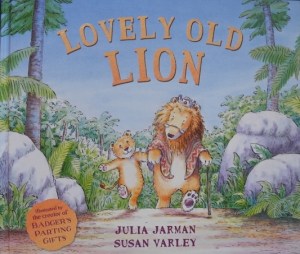
What a gorgeous book but one would expect no less: its illustrator, Susan Varley is the creator of the classic Badger’s Parting Gifts. Here, she’s worked in partnership with Julia Jarman and the result is an equally sensitive picture book, on the tricky topic of dementia.
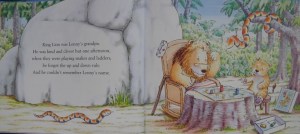
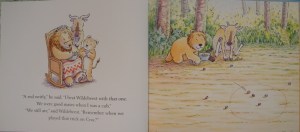
As with most grandchildren and their grandparents, there is a very special bond between young Lenny lion and his grandpa, King Lion. But lately Lenny has noticed changes coming upon his beloved Grandpa: he forgets the rules of games,

DSCN4971 (800x600)

what objects are used for and even, on occasion, Lenny’s name.
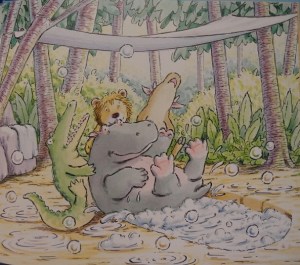
Gradually King Lion becomes more and more confused but young Lenny is determined to continue bringing light and life into his Grandpa’s days. First he chastises the other animals in no uncertain terms when they laugh at King Lion and then he enlists kindly Hippo’s help to ensure that for the remainder of his life, those neighbours and friends keep grandfather provided with objects that help trigger memories of his earlier years when for instance, he was able to outplay or trick his pals,

DSCN4972 (800x600)

or come to their rescue on occasion.

DSCN4973 (800x600)

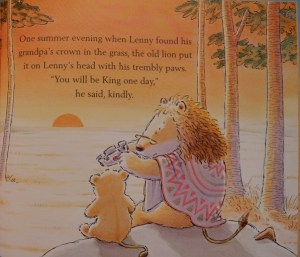
Every illustration is suffused with tenderness; the details are gently humorous and enormously appealing to the young (and not so young).
Compassionate as the telling surely is, the essentials of the condition such as bad temper are dealt with in an honest straightforward manner. And, the final part of the story in particular serves as a reminder that no matter what our age, the whole of life is an inevitable cycle of growth, change, ageing and eventual loss.

DSCN4974 (800x600)

Adults can choose to fill in specific family details if relevant or, as one would hope, share the story with all young children and let listeners ask their own questions.
This one deserves a place on every family bookshelf and should be in every primary school library and early years setting.

For much older readers is:

DSCN5015 (800x600)

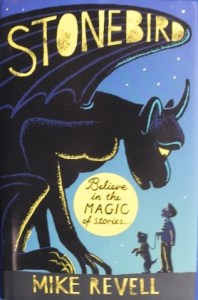
Stonebird
Mike Revell
Quercus
Moving home and starting at a new school, bullying, dementia and the power of stories and storytelling are some of the themes of this book. It centres on the eleven year old narrator Liam, who has moved with his sister Jess and mum, in order to be closer to his Gran who has dementia and now lives in a care home.
Exploring the locality of his new home one day, Liam comes across an ancient-looking stone gargoyle in the crypt of an old church. It’s this gargoyle, Stonebird, and a symbolic marble egg shaped stone his new teacher uses with his class during storytelling circle time sessions, that together play an ultimately transforming part in Liam’s life as he gradually comes to comes to terms with, and begins to cope with the changes he has to face in his new life.
Written by debut author Mike Revell, this powerfully affecting and convincing story is a haunting and ultimately, uplifting read.

Use your local bookshop    localbookshops_NameImage-2

Tricky Topics – Dementia and Death

Two unusual books dealing with difficult topics, dementia and death, that illustrate children’s creativity and impulse towards transcendence both self and situational and both presented through the eyes of children are:

DSCN2133

Really and Truly
Emilie Rivard and Anne-Claire Delise
Franklin Watts
Sensitive, gently humorous, tender, touching and warm are the words that immediately spring to mind, as well as tears to the eyes and a lump in the throat on reading this book.
The power of story and a message of hope come through strongly as Charlie, who is very close to his grandfather, tells how this fun-loving, wise, playful, story-telling person becomes changed through dementia. Lately, Charlie finds, Grandpa has no more jokes and no more stories; all he seems to do is gaze through the window at the cars driving past.

DSCN2134

An awful disease has eaten up his memory and his words. It has even swallowed up his smile.
So much does Charlie want to make Grandpa smile that he comes up with ‘storying’ to try and get something of his beloved grandfather back. Such is the boy’s determination, love and patience that he does indeed succeed in igniting sparks of the old Grandpa buried deep within as he responds to Charlie’s retelling of his stories when he doesn’t eat,

DSCN2135

smile or even recognize his grandson.
The richly detailed illustrations are cleverly conceived with the background colours reflecting the changing moods of Charlie and Grandpa, DSCN2136

while black ink is used to depict the fantastic pirate, witch, gnome, animals and Japanese ninja as they cavort across the pages and the imagination of the story participants.
Yes, this is an optimistic, spirited view but that’s the one children tend to adopt.
Buy from Amazon

DSCN2017

Scarlett and the Scratchy Moon
Chris McKimmie
Allen & Unwin
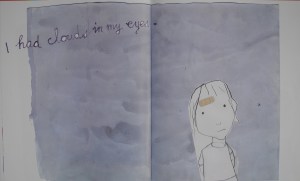
Told from the viewpoint of the girl narrator (who but a young child would utter such purely poetic words as “ I had clouds in my eyes” ?),

DSCN2019

this gently and simply tells the story of the sadness associated with losing beloved pets and the sheer excitement of welcoming new ones into your family.
Scarlett can’t sleep.

DSCN2018

The moon is scratching the sky, and she’s busy counting sheep “Daddy Neema, Mummy Neema” and “three, Baby Neema.
She is feeling sad because her beloved pet dogs, Holly and Sparky, have died. But then, during breakfast the following morning, a knock at the door brings a wonderful surprise and the world seems fresh and full of joy again.

DSCN2020

Eclectic, scrap-book style illustrations created seemingly, by the entire McKimmie family though largely the author, with a whole host of different media including watercolour and acrylic paints, pastels, gouache, charcoal, grid paper, manuscript paper and much more, perfectly complement the wandering, slightly distracted, style of the narration.
A quirkily beautiful, honest, evocative portrayal of loss and new life. I can envisage young children being inspired to create their own imaginative visual narratives in response to this one.
Buy from Amazon

Find and buy from your local bookshop: http://www.booksellers.org.uk/bookshopsearch