The Invisible Story

On a shelf, hidden away in a corner of a large library is a book that’s unlike all the rest. They would sometimes spend time arguing about which is most read, or best loved; but the ‘Invisible Story’ listening from the shadows has never been read. It longs to be colourful and popular like the others. “I’m just a ghost, nobody can see me.” it chants over and over.

Then, one day a young girl visits the library; she runs her fingertips over the spine of the ‘ghost’ book, discovers tiny raised dots. and announces … “I’m going to read.” The alarmed book begs her not to, saying that its pages are blank. However the girl’s gentle voice calms the book and it goes on to discover that it is in fact a very wonderful story indeed, a story written in braille, “the language you read with your fingertips’.

The invisible story now realises that no one story is better than any other, they are just different.
Translated from the original Spanish by Daniel Hahn, Jaime Gamboa’s inclusive tale is a reminder that not every book is intended to be read with the eyes. It also contains an important message about the power of a great story – the best books can be read over and over; they never really end.

Wen Hsu Chen’s watercolour and cut paper illustrations work in harmony with the text and are really effective, be they wholly white, predominately white with small splashes of colour or where the colour predominates.

For those readers who are blind, partially sighted (or dyslexic) the publishers have collaborated with the Royal National Institute for the Blind and accessible formats are available from RNIB Bookshare.

My Baby Sister is a Diplodocus

Adapting from being an only child to having a sibling is seldom easy as we see in this book.
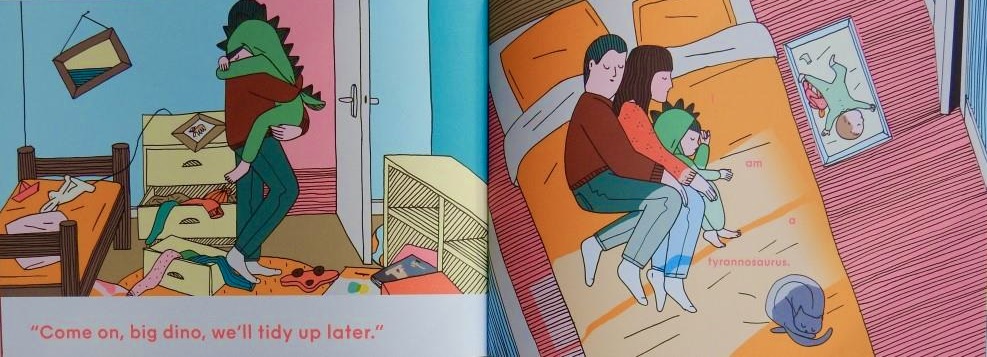
It begins with a visit to the hospital to collect Mum and the new arrival. Once home the small boy narrator eagerly dangles his soft toy elephant over his baby sister, he plays her guitar music and then shows her around the house. However, before long his initial enthusiasm starts to wane, partly on account of his being told “No!” frequently and when Mum asks, “So, do you like being a big brother?” he replies firmly, “No!” and storms off to his bedroom where he dons his T-Rex pyjamas and proceeds to turn the room upside down.

Warm-hearted Dad comes in, picks up ‘big dino’ and carries him to the parental bedroom (there’s a caption informing us that big brother is a tyrannosaurus) where, snuggled up with Mum and Dad he falls asleep.

‘My baby sister is a diplodocus’ we read on the next spread, presumably feeling somewhat empowered as a much bigger T-Rex. On waking. big brother sees his new sibling in a different, much more accepting light; the two have much in common after all, he now realises.

Concisely written and illustrated with simple images in bright hues that go well with the sympathetic, engaging telling, this is a book to share with a young child in a similar situation to the
child narrator.

Gotcha!: A Funny Fairy Tale Hide-and-Seek

Gotcha!: A Funny Fairy Tale Hide-and-Seek
Clotilde Perrin (translated by Daniel Hahn)
Gecko Press

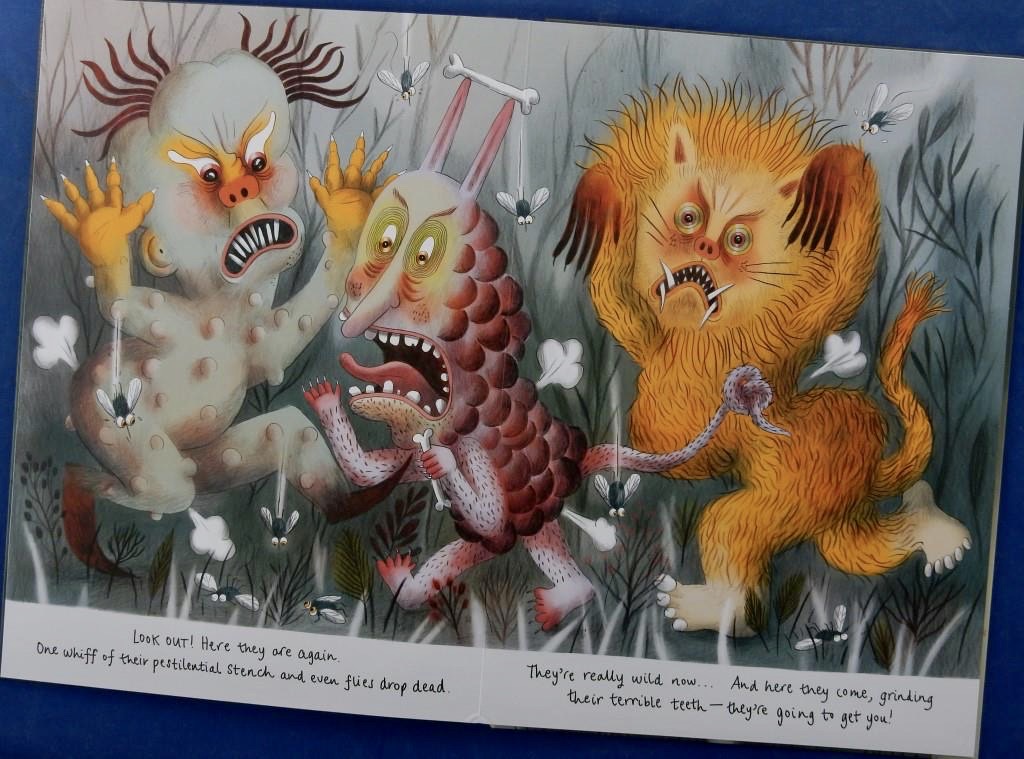
Between the covers of this large format book are three mock-scary monsters just waiting to give you the creeps and to catch the small character from the title page. First there’s a big yellow and decidedly nasty ‘hairball’. Fear not though, there is safety if you seek refuge within the brick house cleverly constructed by the third little pig and so our porcine pal says, this residence is built to withstand monsters.

He’s waiting within, cooking up something delicious and is willing to share it with little human visitors who want to hide from hairballs and the like.

Also on the prowl is the ‘fizzling stinkwort’; this monster uses its gaseous emanations to render you senseless and then consume you, unless you flee forthwith. Where better to hide than what looks like a deliciously welcoming abode with walls of gingerbread covered with confections of all kinds? Therein you will find the self-sufficient children, Hansel and Gretel – kind hosts who can help keep you safe once you’re within those walls.

Having recently consumed its breakfast, the tired-eyed creeper has its mind on the next meal and to ensure staying safe, it’s necessary to fight a way through the creepers covering the walls of Sleeping Beauty’s castle wherein lie sleeping fairytale characters.

However the three nasties don’t give up that easily so don’t think it’s safe just yet …

With the three residences full of amusing references to the stories they come from (and others), as well as flaps to explore and the satisfying disposal of the nasty monsters, this will keep youngsters entertained for ages, and returning for further forays into those favourite fairytale abodes.

Inside the Suitcase

Inside the Suitcase
Clotilde Perrin
Gecko Press

Right from the epigraph inside the front cover, we know we’re in for something special with this book: “A good traveller has no set plans and no destination.’ Lao-tzu and so it seems is the case with Clotilde Perrin’s young boy traveller.

We first encounter the boy inside a delightful little house tucked away behind the hills wherein he stands packing his red suitcase. We’re invited to open this case and view its contents – a seemingly random selection of items. But wait, read on and the importance of each one will be revealed as the journey progresses; a journey that takes the lad across the ocean in a small boat to land on an unknown beach whereon rests a large rock. Behind this stands a small house somewhat similar to the one the boy has left, but how will he gain entrance? How good is the reader’s memory, for this is now a game involving memory.

Once within, the boy makes a discovery; but what will he do with the tempting object? With a decision made and the item stowed safely in his case, the boy consumes one of the things he’d packed and continues his journey. Now he climbs tall, icy mountains – shiver shiver – is there anything in that suitcase to alleviate the cold he’s feeling? At the top of the mountain glowing in the ice is a hole wherein a host of luminous jellyfish swim. How lovely it would be to join them.

Time to check the contents of that suitcase again …

Strangely, having taken the plunge, there beneath the water stands something totally surprising; what could possibly be inside? … A rarity indeed! And definitely something to stow into that suitcase.

Jiggle, jiggle goes the object as the boy continues on his way until there before him is a dark forest wherein lurks – oh no!

Quick, the suitcase might just hold something useful …

Phew, a narrow escape for sure but so deep and black is the darkness that now the boy requires something to help him find his way: saved by a resource from the case again.

Once the night has gone the boy discovers yet another house but there’s nothing much within except a single seed; but a seed of what?

Best to pop it in the case and move on, and so he does, stopping briefly to remove the last item collected from his case before moving through a dense fog cloud behind which stands …

Yes, the boy’s journey has brought him full circle. Is there anything remaining in his suitcase.? I wonder … memories certainly.

Surprises aplenty await any reader in this cleverly designed book into which much has clearly been put, especially in the placing of images as well as the use of overlapping layers of large, shaped flaps and die-cuts. Features such as these make our discoveries as we follow the boy’s journey, all the more exciting. Then there are some touches of surrealism: that fish flying close to the boy’s home on the final spread for example; I’ll leave readers to discover others for themselves. The illustrations throughout are a delight, full of life and executed in a colour palette that enhances the mysterious fascination of the boy’s journey into the great unknown in this superb neo-fairytale.

Originally published in French, the story was translated by Daniel Hahn.

Nits! / Encyclopedia of Grannies

Here are two picture books from New Zealand publisher Gecko Press

Nits!
Stephanie Blake
Gecko Press

In the latest Simon story, Sephanie Blake brings her own brand of humour to nits, the dreaded little creatures that make your scalp itch.

Simon decides he loves his classmate Lou, but she loves another named Mamadou.

Then Lou gets nits.  Where might they have come from?

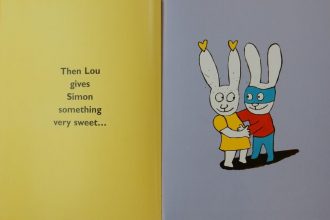
Now Simon is in with a chance … The outpouring of affection he receives from Lou isn’t the only thing she bestows upon her new love however.

Nits are part and parcel of foundation stage classrooms nowadays, so much so that the mere mention of them from a parent or carer gives we teachers itchy heads too; (even reading this book made me start scratching).

This simple, funny story provides a good opportunity to reassure everyone how it’s not shameful to have those ‘little visitors’ and to talk about how they can be treated.

Share at home or at nursery or playgroup.

Encyclopedia of Grannies
Eric Veillé (translated by Daniel Hahn)
Gecko Press

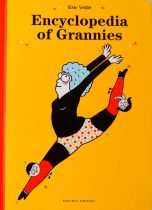
Here’s a modern and amusing take on grannies that starts with a focus on the different kinds of grannies you might come across, followed by a look at age: ‘Some grannies are 58 … some are 69 … and some are even 87!’ (Perhaps it should span an even wider age range. I once taught a five year old whose granny was 35 although she called her ‘mummy’; her actual birth mother was then 18 but the child had been told she was her big sister.)

Veillé employs questions to explore inside a granny;

and out: ‘Why do grannies have creases?’; the mystery of why grannies travel on buses –we don’t learn the answers to the last two however; and ‘Do grannies only knit cardigans? – definitely not.

Other scenarios look at flexibility; time – grannies appear to have more of it at their disposal than others;

what a good rummage in a granny’s bed might yield, hairstyles, travels and more.

In reference book style, the book includes a contents page (of sorts), a glossary and a list of suggested further reading (all tongue in cheek of course) and the illustrations are a quirky delight. There’s one snag though, apart from the “Green Gran’ included in the reading list, every single one is white.

Sturdily built to withstand the frequent reads this book might have; but don’t be deceived into thinking it’s for the very young; the droll humour requires a degree of sophistication.