Africa: Amazing Africa

Africa: Amazing Africa
Atinuke, illustrated by Mouni Feddag
Walker Books

Nigerian-born storyteller Atinuke takes us on an exciting journey through the countries of Africa in her celebration of this incredible continent – its history, culture, religions, traditions and languages.

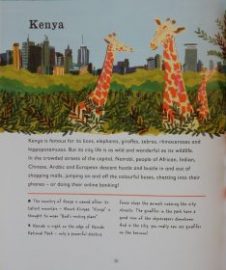
She divides the 55 or so countries into regions – Southern Africa, East Africa, West Africa, Central Africa and North Africa providing quintessential details of each country: the wild life for which Kenya is famous;

the irresistible drumming rhythms of Burundi – (who can fail to respond to the sound of those awesome Royal Drummers of Burundi, certainly not me),

the diamond industry and contrasting cattle-herding of Botswana for instance.

There are also maps, pages featuring hairstyles, football and religions.

Mounti Feddag’s vibrant illustrations are superb, exploding into colour and pattern on every page.

I’m fortunate in having many friends from different parts of this huge continent but have never visited it other than for a childhood holiday to the island of Mauritius, and occasionally in transit; brimming with gorgeousness, this book has made me want to change that.

Those with a thirst for finding out about life in different parts of the world will also enjoy this activity book:

This Is How I Do It
Matt Lamothe
Chronicle Books

The creator of This Is How We Do It, Matt Lamothe invites the reader to document his or her own daily life and compare and contrast it with children from over 50 other countries. Included in the book are punch-out postcards, sheets of stickers, a fold-out map and photos of members of four families.

Welcome to Our World

Welcome to Our World
Moira Butterfield and Harriet Lynas
Nosy Crow

To open this book is to get lost in a world of children, children from 97 different countries and when you finally emerge having spent a considerable time immersed in its riches, you’ll be a whole lot wiser and probably happier too. I certainly was!

Covering such topics – I love the choice of headings – as greetings, homes, food, drinks, transport, animals, family names, school uniforms & classrooms, clothes, play – games …

and toys, musical instruments, as well as specific words for ‘happy’, ‘hooray’ …

and sneezing, customs (relating on one page, to losing a tooth), this book truly celebrates children, human diversity, language and world cultures

I was amused to learn that both in Brazil and Hungary children celebrating birthdays get their earlobes pulled. Ow! In Brazil it’s one pull for every year of the person’s life. Ow, ow, ow! … and in Hungary it’s customary to say ‘May your earlobes grow to your ankles’, in other words, ‘May you have a long life.’

Equally I was fascinated to find out about the different sounds animals make according to where they’re found: apparently in Germany, rather than buzzing, bees go ‘sum sum’, whereas in South Korea, it’s ‘wing wing’, ‘bun bun’ in Japan and ‘zoum zoum’ in Greece.

You too might laugh out loud at some of the sayings from various parts of the world: ‘Stop ironing my head’ means ‘Stop annoying me’ in Armenian and ‘There is no cow on the ice’ said in Swedish means ‘There’s no need to worry.’

The absorbing text by Moira Butterfield, in combination with Harriet Lynas’s captivating illustrations, make for a read that is both joyous and informative.

Horses: Wild & Tame / Home Sweet Home

Horses: Wild & Tame
Iris Volant and Jarom Vogel
Flying Eye Books

My experience of and with horses is decidedly limited, or so I’ve always thought. Certainly my only riding experience was when  aged about twelve, I had gone to find my best friend who lived round the corner in a suburban road like mine. She wasn’t in but suddenly appeared round the corner on horseback. She dismounted and insisted I took her place. Now, never having ridden before I was reluctant but let her persuade me with ‘It’ll be fine, he only goes slowly.’ Next thing I knew the creature had taken off and was, so it felt, bolting up the road while I slid ungracefully down its back and off into the road, landing on my rear.
Having read the Horse Character page in this book however, I can look back and consider the character of that creature: was it a cold blood, a hot blood or a warmblood?

From Volant’s description it certainly wasn’t the first, and was most likely the last ‘strong and agile … perfect for riding’, despite thinking the best fit was ‘hotbloods … bold, spirited character’.
Flicking randomly through, I came across other spreads that particularly resonated. There’s one featuring Black Beauty, Anna Sewell’s classic novel; a book I loved as a voracious child reader. That story, as we’re reminded here, ‘encouraged people to be kinder towards horses, leading to many new laws in England and America’ concerned with the protection of horses.
However, it was the Royal Steed spread that came as an exciting surprise. It tells how in 1576 during the Battle of Haldighati, Rajput warriors made false trunks for their horses to wear, thus confusing the elephants ridden by their Mughal enemies so that they wouldn’t attack what looked to them like baby elephants. We also hear how Chetak, the badly injured horse belonging to the Rajput ruler carried his master to safety.
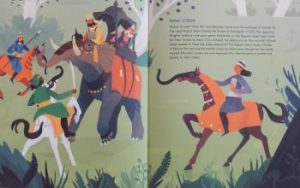
I’ve visited Haldighati on more than one occasion on trips to India and during my annual holidays in Udaipur am frequently reminded of the creature by an imposing statue of that particular horse in the centre of a roundabout in Udaipur city, aptly named Chetak Circle.
Author, Iris Volant, goes way back further than that though, right to horse evolution. Indeed there’s probably something for everyone in this fascinating book that has artistic references, literary ones, horses in legend, war horses, work horses, horses in sport and more. How fortunate that its illustrator, Jarom Vogel, decided to become an artist rather than pursuing his studies as a dentist; he’s certainly done these beasts proud.
Home Sweet Home
Mia Cassany and Paula Blumen
Frances Lincoln Children’s Books

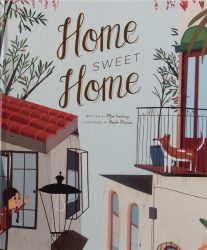
Both author and illustrator of this book come from one of my favourite cities, Barcelona. We’re given a look at different homes from around the world from the viewpoint of the pets, mostly dogs and cats, with the occasional bird and even a tortoise, that live in them.
Readers can discover what it’s like to live in say, a waterside house in a Netherlands village;

a tiny apartment in Hong Kong, China; a cabin with a roof of grass in Iceland or a townhouse by the Thames in London.

Cleverly conceived with the animal narrators, in addition to what we’re told in the text, there’s a great deal of visual information about each of the homes and lifestyles packed into every one of the locations we visit. Every one is made to look exciting:

where would you choose to live?
A stylish and fascinating addition to a primary classroom library or topic box.

Mabrook! A World of Muslim Weddings

DSCN6764 (800x600)

Mabrook! A World of Muslim Weddings
Na’ima B Robert and Shirin Adi
Frances Lincoln Children’s Books
Mahbrook, the title of this fascinating book means ‘congratulations’ (or I think, ‘you are blessed’) in Arabic, certainly a sentiment one would want to pass on to a couple who have just got married: ‘Muslims from around the world share the same religious rites, but they celebrate in different ways in the four corners of the world.’ We then visit various countries to get a glimpse of the particular celebration that might take place when Muslims living there get married.
First stop is Pakistan where there’s a pre wedding henna party in full swing:

DSCN6765 (800x600)

the bride’s hands and feet are being adorned with beautiful, intricate henna designs while family and friends enjoy some dancing. The following day, the groom rides in on a white horse, the bride, bedecked with gold, hides beneath her silks awaiting her husband to be. There’s a huge feast awaiting everyone once the baraat arrives and other formalities have taken place.
Morocco is the next wedding venue. There, weddings are community affairs when all the neighbours spend days cooking delicious food: couscous, roast lamb with olives and pickled lemons sufficient to feed the huge number of guests expected. The bride changes her dress seven times at the waleemah (feast for the community) into which she is carried by the crowds. There is much joy as the bride dances in a circle of song.

DSCN6766 (800x600)

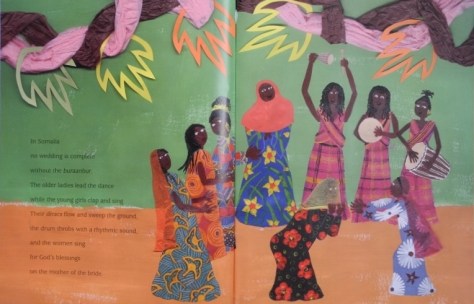
Traditional Somali dance to drums music and song is part and parcel of a wedding in Somalia …

DSCN6767 (800x600)

In Britain the bride might wear a white hijab and have guests from many different faiths and backgrounds. Here’s one happy celebration:

DSCN6769 (800x600)

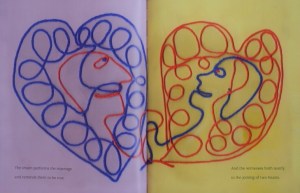
Those are just some of the ways Muslim weddings are celebrated but in addition to having the same rites there are formalities that will be common no matter where the celebration takes place: important family meetings and discussions, a marriage contract, conditions that must be respected, guidance is sought for a blessed union and the groom pledges the mahr be it gold, a home, a ring or whatever she wishes – a dowry for his bride to be, the ceremony, in front of witnesses, is performed by the imam.

DSCN6770 (800x600)

A new journey awaits the happy couple …
With its beautiful mendhi designs adorning the inside covers, glowing illustrations on every spread, and fascinating facts about aspects of wedding celebrations, this is a book to inform, to delight, to draw on for RE discussions and most of all, to further the celebration not only of the particular topic herein, but of the rich cultural diversity that is part of what makes our world such an exciting place.

Use your local bookshop    localbookshops_NameImage-2