Words, Words and More Words

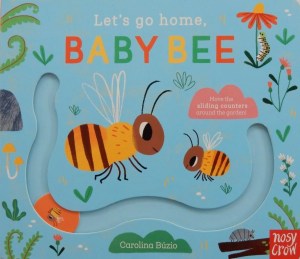
Baby Bee has to get safely to the hive and needs the help of little humans to do so. The same is true of some other baby minibeasts: baby ladybird wants help getting to a home log,; baby snail resides in a flower pot; and baby worm also needs guidance back home. There are plenty of things relating to the natural world to spot on each journey and each can only be completed with the help of a small human hand to guide the moving disc that depicts the named baby. Interactive fun that gives little children a sense of autonomy as well as delight at the brightly coloured spreads, each of which has the route on the recto and small, labelled images on the verso.
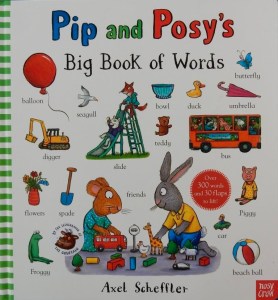
Little ones can learn and read more than three hundred words with friends Pip and Posy in this large format book. Its ten spreads have different themes each with flaps to lift and a multitude of labelled images both in and surrounding the scenes, the first being Garden Games. Here we see Pip busy planting seeds and Posy ready to entertain visitors by playing some musical instruments.
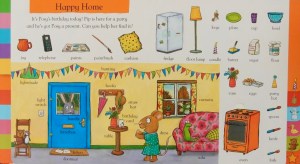
Next comes At the Shops where we find customer Posy, clutching a coin to buy a new toy. Sunny Seaside is the third destination and the two friends are enjoying a beach visit. Back at Posy’s Happy Home, Pip arrives bringing her a birthday present.
Christmas, Snow, Bubbles, Night Night follow and the final spread Learn with Pip and Posy presents colours, seasons, numbers (to 10)basic 2D shapes, and four examples of opposites.
Offering lots of potential for discussion, as well as vocabulary building and honing their visual skills, there’s a wealth of toddler learning possibilities between the sturdy covers of this book.

Also helping to enhance young children’s vocabulary are recent titles in a popular series:
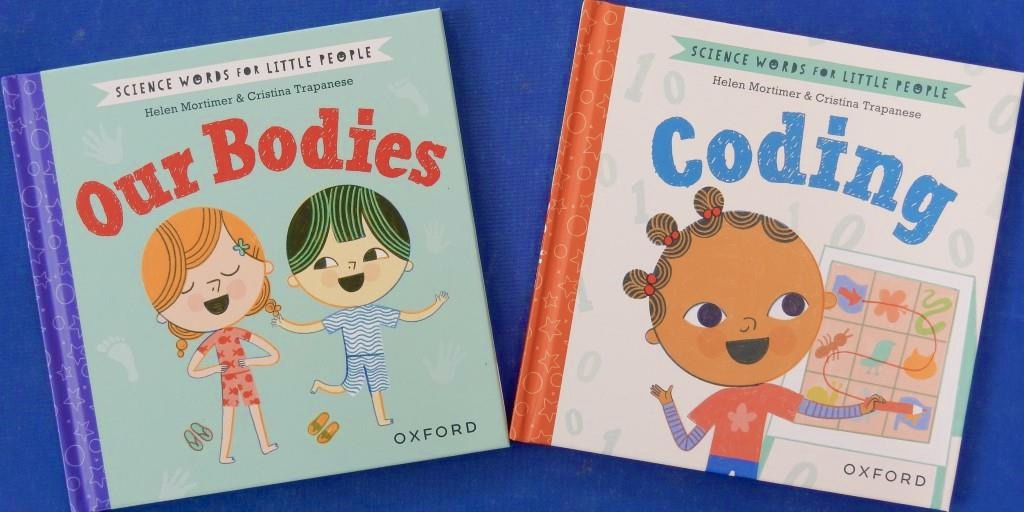
In Our Bodies children can take the plunge and have a day at the swimming pool where they can learn a wealth of body-related words from the brain to bones and senses to growing.
Coding presents basic language such as commands, sequencing, chain reaction and inputs and outputs. Both books feature a diverse cast of child characters, are engaging both visually and verbally and are worth adding to home shelves or collections in early years settings.
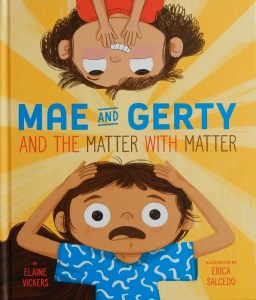
Mae and Gerty and the Matter With Matter / Let’s Build / Weather

This image has an empty alt attribute; its file name is dscn9939-1.jpg

Science and story come together in this picture book.


Mae and Gerty are sisters but they are very different. Mae, the elder of the two becomes increasingly annoyed when her parents constantly talk about their notions that Gerty is showing a scientific bent at so young an age; indeed the very first word she said was ‘madda’. Dad is forever drawing attention to her actions: “Look at all the ways she can manipulate matter: pushing, pulling and colliding!” he comments one bath time.

Gerty certainly does love mess making,

This image has an empty alt attribute; its file name is dscn9940-1.jpg

trying things out, constantly asks questions. These are exactly the things scientists do and during the story, both siblings discover that this is so, for Mae decides to show her mum and dad that she too can do all that Gerty does. They start exploring together and soon they become a true science team taking every opportunity to experiment, asking Why? Why? Why?

This image has an empty alt attribute; its file name is dscn9941-1.jpg

Some of their experiments in the kitchen produce matter of a very tasty kind but most important of all is that with their parents’ encouragement the siblings’ eyes and minds are always open to the scientific possibilities the world offers.


After the narrative, the author provides some questions adults might discuss with young listeners and there’s also a bubble recipe. Erica Salcedo’s wonderfully expressive scenes of the girls’ interactions with matter really brings out the importance of letting children explore the world with all their senses.

There’s more science in


This image has an empty alt attribute; its file name is dscn9898-1.jpg

These are both additions to the Science Words for Little People series.
In Let’s Build, the children are going to make a car wash and the book takes us through the stages involved in its construction from drawing up a plan to the finished building. The simple text is split between a straightforward narrative and speech bubbles containing the child constructors’ comments. Key words – materials, invent, tinker, forces, magnets, strong foundations, machines, movement solving problems, energy are used as headings for each of the twelve spreads, the twelfth being ‘all about building’ whereon readers are asked leading questions to get them thinking about their own projects.
The final spread gives ideas to adults to help them get the most from this book and Weather.
Similarly organised, the latter uses key terms including meteorology, atmosphere, various cloud names, cyclones, hurricanes, tornadoes and hurricanes in the brief narrative that has spreads on sun, clouds, rain, a rainbow, wind, storm, snow, seasons, weather watching and climate.


Visually and verbally engaging with a diverse group of child characters, both titles are worth adding to early years collections.


50 Words About Nature: Plants / Birds & Science Words for Little People: Nature / Space

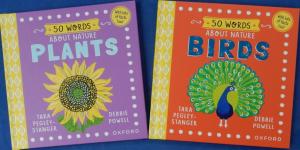
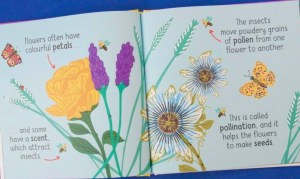
These are additions to the series wherein author, Tara Pegley-Stanger doesn’t believe in talking down to young children, instead she uses the correct scientific terms for processes such as photosynthesis, pollination and germinates as well as, in the first book, other plant-related words as she provides a look at the diversity of Earth’s plant life. I totally endorse this approach: children do assimilate ‘big’ words in context and love to impress grown-ups with their ever-growing vocabulary.

Young children sharing Plants with an adult will learn basic facts relating to flowers, seeds, fruits and growth as well as visiting various habitats including a tropical rainforest, a desert, an aquatic location, meeting a botanist at work and more.
Birds takes a similar approach introducing basic bird features, some specialisations such as those of waterfowl, the bee humming bird, the Asian peacock and raptors. There are examples of a migratory bird, flightless birds and there’s a spread about an ornithologist.
Both books are illustrated in a realistic style by Debbie Powell, whose images are carefully integrated with the text.

Engagingly written and visually attractive, both of these titles in a new series are worth adding to home bookshelves and early years collections.
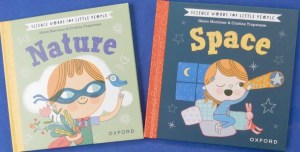
Nature presents life cycles of an apple tree and a frog, as well as spreads on growing, senses, habitats, behaviour, rocks and soil and care of the natural world.
Space is introduced by the child characters who have become astronomers having a sleepover in their observatory. Subsequent spreads see them using a telescope, pretending to be astronauts, using fruits to make a solar system, discussing Earth’s rotation, introducing the phases of the moon, a space mission, star gazing, space probes and imagine alien possibilities.
Aimed at adult sharers, the final spread of each provides ten ideas for getting the most from the book.

Maths Words for Little People: Shapes / Sums

Shapes
Sums

Helen Mortimer and Cristina Trapanese
Oxford Children’s Books

These are titles in the Maths Words For Little People series that aims to develop young children’s confidence in mathematical vocabulary and early maths concepts.

Set indoors, Shapes begins by affirming that our everyday lives are full of different shapes – both flat and solid. Some are made of straight sides and corners whereas others – curved shapes – have no corners. (Examples of each are given.)

Various kinds of pattern are depicted, as are shape sequences and tessellation.

A simple explanation of solid shape with several examples in varying sizes comes next, followed by a look at (bilateral) symmetry and finally there are a few questions for young children to answer. For adult users are ten suggestions for getting the most out of the book; and the final page has a brief glossary.

Using a similar structure, and a garden setting, Sums has spreads on more and less, add and take away, and part and whole.

A variety of arrangements of five objects (seeds) is presented and little ones are encouraged to count each set. Counting on and counting back are introduced along with a number line for some practice,

followed by a spread with ladybirds that focuses on the +, – and = signs. The notion that order matters in subtraction but not in addition is demonstrated and then we meet zero and how it has no bearing on the answer if zero is added or subtracted.
Daisy patterns are used to explain number bonds for five and the last spreads follow the same structure as Shapes.

Visually attractive, with fun characters and written in an engaging manner, these little books are ideal for one to one sharing at home and should help young children be more mathematically assured in a nursery or other early years setting.

My Mindful A to Zen / Being Healthy / Learning

My Mindful A to Zen
Krina Patel-Sage
Lantana Publishing
As the author/illustrator points out after presenting twenty six haiku ‘for happy little minds’, each of the entries in this book highlights one or more of the ‘five ways to wellbeing’, known to boost mental health and positivity: connecting,

being active, taking notice, keeping on learning and giving.

No matter whether youngsters prefer the great outdoors and all that has to offer,

or to stay indoors getting lost in a good book, or being creative with their favourite materials,

or perhaps spending time in the kitchen cooking a yummy cake (even if it doesn’t quite go to plan), done mindfully, it can be part and parcel of getting the very best out of life.

With its diverse cast of characters bringing to life this alphabet of contented being and doing, Krina Patel-Sage offers youngsters much to think about, talk about and act upon. This teacher/yoga teacher and reviewer heartily endorses this well-being picture book.

Also for fostering children’s wellbeing:

Being Healthy
Learning
Helen Mortimer and Cristina Trapanese
Oxford Children’s Book

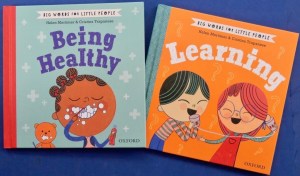
These are two new titles in the Big Words for Little People series that offers a very useful resource to early years teachers and other practitioners as well as parents of young children.

Using age-appropriate language, Helen Mortimer takes little ones through the day doing those activities that should foster their Being Healthy. There’s personal hygiene washing and tooth brushing, eating ‘wholesome’ food and drinking plenty, taking exercise that works their muscles, as well as engaging in mood boosting activities, getting out in the sun whenever possible. There are also spreads on allergies, doing things in your own way, being aware of and avoiding potential dangers, the helpers who might provide treatment when there’s an accident or illness, and finally, very important comes sleep.
Inclusive, engaging and interactive, as is Learning. This is a huge topic that begins at birth and continues throughout life but to get the most from it, that learning needs to excite the learners and that’s what this little book aims to do. It encourages questioning, problem solving, taking advantage of technology, developing good concentration, trying hard and taking risks with learning, as well as keeping the mind open to new ideas. Like previous titles, both books have Cristina Trapanese’s lively illustrations, a spread with helpful ideas for adult users and a glossary.

Everybody Has Feelings / Respect / I’m the Fire Engine Driver

These are recent titles from Oxford Children’s Books – thanks to the publishers for sending them for review

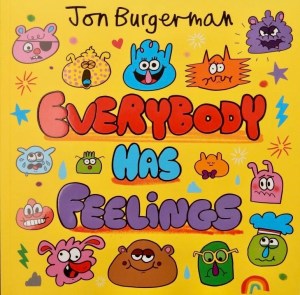
Everybody Has Feelings
Jon Burgerman

Through his exuberant style illustrations depicting colourful characters of all shapes and sizes in a play park setting, together with a narrative of rhyming couplets, Jon Burgerman presents over twenty feelings that youngsters (as well as zany blobby beings) are likely to experience.

In so doing he acknowledges that it’s perfectly normal to feel say anxious, disappointed,

embarrassed, frustrated, sad or scared as well as confident, calm, proud, and joyful and offers the vocabulary for young children to open up and discuss their emotions as well as listen to others talking about how they feel.

With lots of starting points for circle time sessions, this is just right to share in foundation stage settings especially.

Respect
Helen Mortimer and Cristina Trapanese

This new title in the Big Words for Little People series shows the importance of acknowledging and accepting individual differences and respecting them. It gives examples demonstrating that all lives matter no matter what people look like or believe: that means showing kindness, politeness and abiding by rules. Everybody should feel safe to speak out about their feelings and their lives in general.

Cristina Trapanese illustrates each of the key ideas enacted by a lively cast of characters and Helen Mortimer concludes by suggesting ten things adult sharers can do to get the most from this little book, be that at home or in an education setting.

Add to early years collections.

I’m the Fire Engine Driver
illustrated by David Semple

Here’s a book that allows little ones to switch to imagination mode and step into the shoes of a firefighter, donning the rest of the protective gear, meeting your crew and with siren sounding and flashing lights turned on, driving the fire engine to the scene of the fire in the bakery kitchen.

Part and parcel of the narrative are opportunities for number recognition and counting, joining in with sounds, vocabulary building, following instructions, describing a scene and more.

Through David Semple’s bright, stylistic illustrations and a narrative that makes youngsters feel as though they’re in control, this is a fun book to share either one to one or in a group.

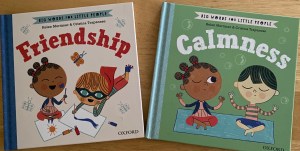
Friendship / Calmness

Friendship
Calmness

Helen Mortimer and Cristina Trapanese
Oxford University Press Children’s Books

These are two additions to the Big Words for Little People series: the first explores what being a good friend really means and the second presents various elements that are associated with feeling calm.
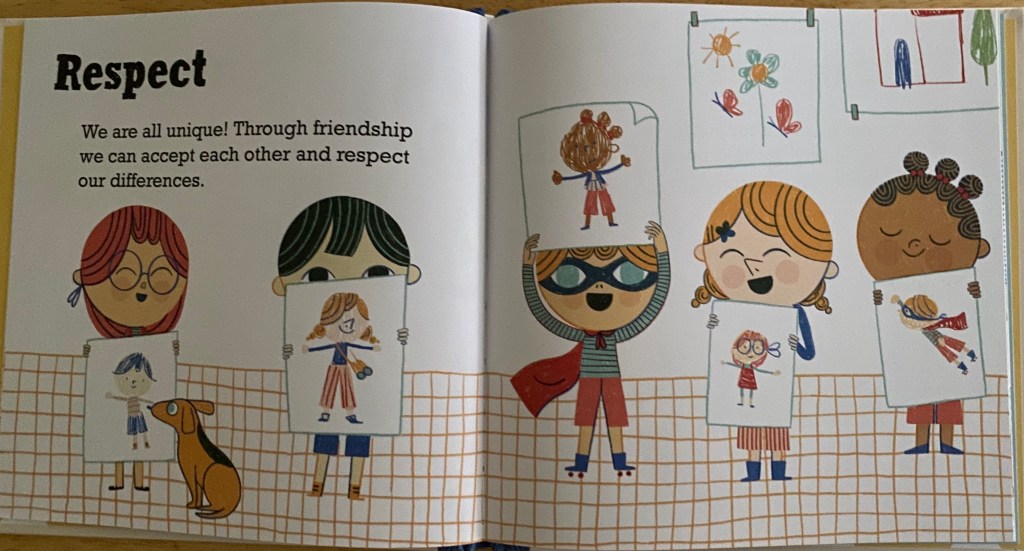
Each of the first eleven spreads takes a key word (or two) exploring it through an engaging scene and an explanatory sentence or two.

For instance part and parcel of Friendship is Respect and that entails accepting and showing respect towards differences.

Share offers examples of what you might share with friends – memories, ideas, treats and especially, time.
The penultimate spread is an affirmation of Friendship itself and then comes a spread aimed at adult sharers giving ten ideas of how to get the most from the book and a final glossary.

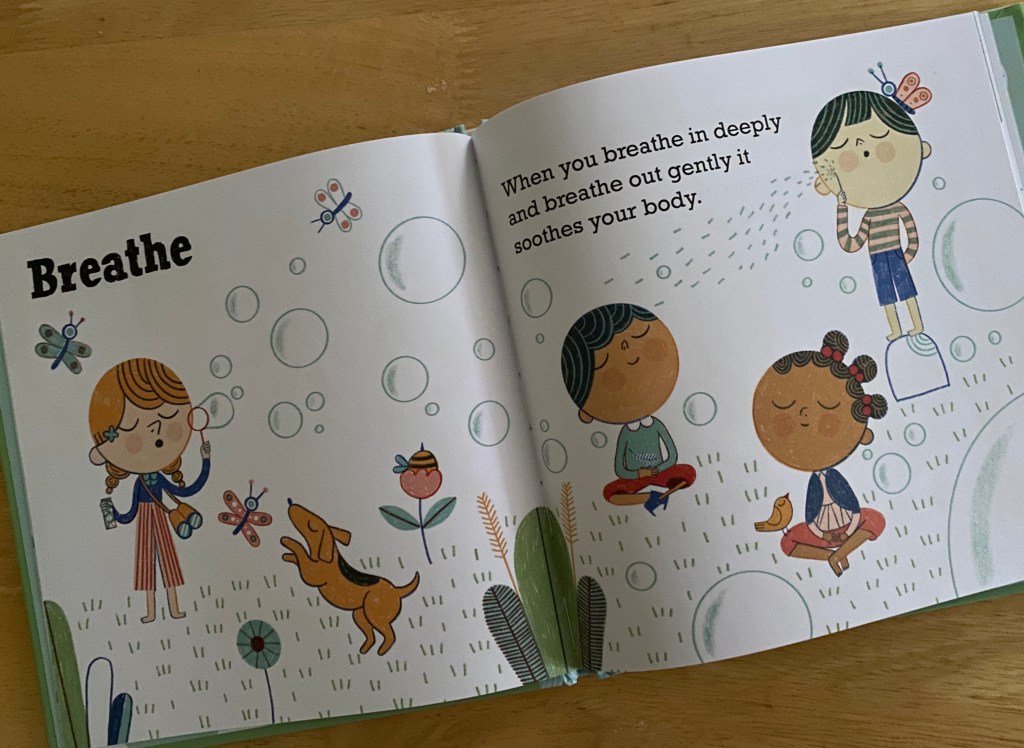
Calmness has spreads on quiet, feeling safe, breathing,

what to do about worries, focus, time – ‘Something as simple as walking gives you time to watch and listen while you move.’ I think that’s something we’ve all appreciated during the past year.

Other ideas suggested to induce that sometimes elusive sense of calm are to Pause, Imagine, ways to ‘get past your angry feelings’, Balance and to take a Softly, softly approach.
Calmness also ends within ideas and a glossary.

Both these engaging little books are well worth adding to an early years collection, as well as for sharing with little ones at home. Cristina Trapanese uses a different theme to illustrate each one. Friendship shows children engaged in a variety of art and craft activities while Calmness has an appropriate outdoor setting reflecting the important role the natural world plays in inducing calm. Both contain a wealth of language learning potential.

Kindness / Moo-Moo, I Love You

Kindness
Helen Mortimer and Cristina Trapanese
Oxford Children’s Books

This is one of the publisher’s new ‘Big Words for Little People’ series that aims with carefully selected ‘feature’ words embedded in a short narrative,, to help young children develop an understanding of how by means of words, they can best deal with their emotions and first experiences.
Kindness starts with a welcoming word – ‘hello’ perhaps and a welcome smile to help newcomers feel at ease.
Sharing,

Giving, Understanding (especially another person’s feelings), Listening, Helping, Caring (for the natural world as well as other people and ourselves), Being thankful, Loving (by reaching out with kind words and actions), Taking turns, being Thoughtful, showing Kindness are each given a double spread illustrating the action with stylised youngsters and a brief descriptive text.There’s also a final spread giving helpful guidance to adult users and a short glossary.

A useful addition to a preschool setting for both personal, social and emotional development, and language development, or for family use.

Moo-Moo, I Love You!
Tom Lichtenheld and Amy Krouse Rosenthal
Abrams Books for Young Readers

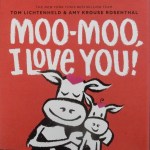
What a delectably adorably moo-vingly mood-uplifting way to tell your little one how mooch you loove them, is this moo-cow monologue (almost) directed at her little moo (who actually has the last word – or actually, four words).

Amy Krouse Rosenthal’s word play is crazily comical and exuberantly expressed, becoming even more comical when combined with Tom Lichtenheld’s thickly outlined cow characters clearly relishing being in each other’s company as they share their love of pizza, popcorn and farm hu-moo-r;

the adornment of their residence so it morphs into a moo-seum …

and a moo-se moo-ve-ment. Ma moo even states her readiness to launch herself loo-nar-wards to express her fondness for her little moo.

This crazily moo-ving manner in which a moo-ma shows her infant moo how much it’s loo-ved could also work as a valentine, especially if your partner’s into word play and you think they’d find it a-moo-sing.