The Little Worried Caterpillar / Dig Dig Dinosaur

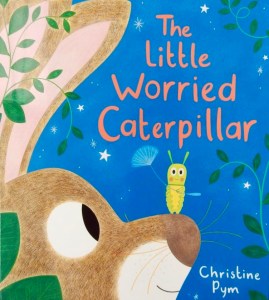
Little Green is on the brink of change. However she’s not aware of this when she wakes early one morning ready to play with her caterpillar pals, but she can’t find them anywhere on the ground. Then a call tells her that they have morphed into butterflies and are way up above her. “You’ll be next, there’s no doubt!” they tell her. However rather than sprouting wings, she sprouts fear, a fear of change that brings with it worries about the unknown. Her friends reassure Little Green that change is what they were born to do and it’s exciting but this makes her feel even worse.

Along comes bee with what is meant to be some helpful advice; she gets momentary relief but that’s all.
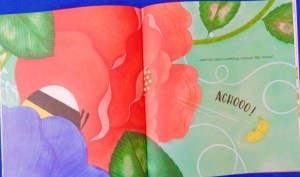
Other creatures also offer suggestions but nothing works until Rabbit appears on the scene. Rabbit listens and what her new friend tells Little Green enables her to feel ready to embrace and prepare for that transformational change
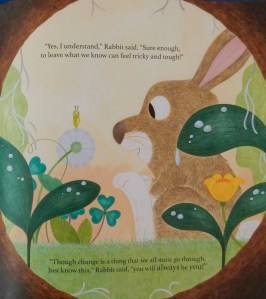
and become … Butterfly Green.

Some young children take change in their stride, others needs considerable support from empathetic friends and understanding adults. A book such as this one is particularly valuable for sharing with the second kind. Christine Pym’s illustrations capture so well Little Green’s fearfulness and eventual delight.
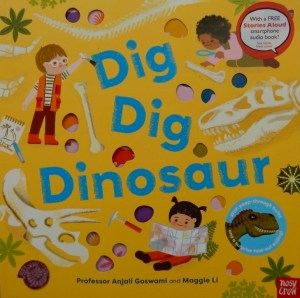
Three intrepid little explorers with their kit at the ready are on an expedition in the hope of finding something, something ‘REALLY big’. Dig! Dig! Dig! they go till one person discovers some remains of a sharp clawed dinosaur. These claws make the finder conclude that they belonged to a Velociraptor.

A second child’s Dig! Dig! Dig! digging unearths three large horns: young readers can perhaps guess from which dinosaur these came..
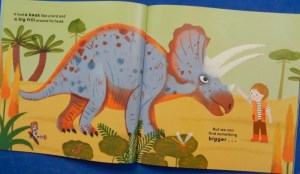
Still intent on finding something even bigger, they continue hunting till the third explorer tells of a dinosaur with a very long tail. and a tiny head supported by an extra long neck.

Little ones can have fun guessing what this might be before the big reveal fold out … They will also enjoy the peep hole pages showing the skeletal remains the young explorers find during the dig.
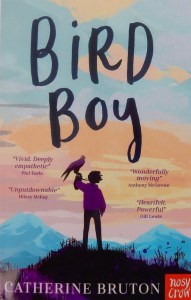
Bird Boy

Following the death of his mother, Will is sent to live with his Uncle Ian in a wild part of the Lake District. Will blames himself for the tragic accident that resulted in his mother’s death, but staying with her estranged brother is his only option while he waits for documents to be processed, after which he will move to Australia and live with his paternal grandparents. This new life couldn’t be more different from his enclosed, homeschooled life in a city tower-block where his mother had kept him cut off to ‘keep him safe’ so she said. Together they would spend time watching the birds and his mother had passed on her love of birds to her son, frequently telling him, “We will all come back as birds “.

Will feels overwhelmed as he battles with his grief and then two things happen: he meets Omar at a nature camp he attends during the day when his uncle is at work; and the boys discover an osprey nest with two tiny chicks in the mountains. It’s an amazing find as ospreys are one of the most endangered species in the country and haven’t been seen in this area.

The boys form a strong bond; Omar (a refugee from Afghanistan) shares Will’s passion for birds, while battling his own issues. Then Will rescues the chick that’s injured, unknowingly breaking the law and the friends devote themselves to caring for the little bird they name Whitecap, ‘the little one with the snow-tipped wings and forget-me-not blue eyes’, that reminds Will of his mum. However before long the boys realise that they have embarked upon way more than they can cope with; but dare they risk seeking help from someone else?

Little by little as the bird heals, so too does Will. Gradually he finds solace and even joy in his new life and his love for his well-meaning uncle grows. It’s hugely moving to see Will now able to support Omar in his grief, as Omar supported him, and with the help of the community both boys gradually face up to their loss.

This magnificent, profoundly moving story explores big themes including death, mental health, grief, depression and the lives of asylum seekers with huge sensitivity and optimism. showing how nature’s healing power, friendship, a sense of belonging and finding a family can provide the strength to rise above tragedy. Have a box of tissues to hand as you read.

Until You Find The Sun

Debut author Maryam Hassan was inspired by her own experience and children she has taught to write this poignant, affecting story.

Aminah’s life is a happy one, made especially so by the evenings she spends with her grandfather, Da, who while snuggled together on his charpai, tells her tales of adventurers who visited new lands and made exciting discoveries. Then one day her parents tell her that they too are going to set off on an adventure. At first Aminah is excited but then Da tells her that he isn’t going with them.
Saying goodbye to her beloved grandfather, brings Aminah to the brink of tears as she urges him again to join then. “I am always with you. You will find sunshine wherever you go,” he tells his granddaughter.

When their plane lands at their destination though, there’s no brightness, only grey skies and rain. The next few days continue to be sunless, bitterly cold and despite wrapping in several layers, Aminah still feels numb both inside and out. She feels out of place in her new school too

and despite her parents’ best efforts to cheer her up, the only warmth she feels is when talking to Da on the phone. How she longs to go back. Understanding Da reminds his granddaughter that her adventure is just beginning and promises to light her way until she finds some sun once more.

That seems more unlikely than ever as the days grow even colder, but then as she trudges along clutching her Mama’s hand, she suddenly spots something bright mango yellow that reminds her of home. Mama and Aminah go and make a special purchase, one that brightens up the day considerably.


The following morning Aminah opens her curtains onto a sight that seems to herald that adventure Da had promised her. Outside in the snow she meets a new friend and at last the cold doesn’t have that same dismalness. When next she talks with Da on the phone, he knows that Aminah has at last found her sunshine once more.

Having spend most of my teaching life in schools close to Heathrow Airport, this beautiful story resonates powerfully with me. The author captures perfectly those feelings of overwhelming grey so many children are beset by when they first arrive from parts of the world so different from the UK. Anna Wilson’s scenes in the early part of the book radiate warmth – interpersonal and climatic – as well as portraying the contrasting grey dreariness of Aminah’s new environment where she’s never experienced such cold. An important story to share with KS1 classes especially.

Coming to England

Coming to England
Floella Benjamin and Diane Ewen
Macmillan Children’s Books

In a colourful autobiographical picture book story of her own life and that of her family, Floella Benjamin celebrates the Windrush Generation, many of whom have been so badly treated as a consequence of our government’s ‘hostile environment’ policy.

It’s a beautifully written and illustrated account of the move from her childhood home in Trinidad

to England, undertaken first by her Dardie and then a year later by her Marmie and two siblings; then finally Floella and her remaining two brothers.

This new version will surely open the eyes of young children to long voyages undertaken during the middle of the twentieth century, by many, many families from Caribbean Islands who came to England. Certainly it was a shock in so many ways, not least being the cold and greyness in stark contrast to the vibrancy and warmth of Trinidad.

It still hurts to read of the treatment she and her brothers and sisters initially received from other children when they started at school in London;

but the book ends on a happy upbeat note with Floella receiving recognition for all the incredible work she has done for children.

Apart from one or two scenes of England, Diane Ewen’s mixed media illustrations are aglow with rich colours that really make the images come to life on the page.

The way to overcome adversity is through courage and determination: Baroness Floella’s life is an inspiring example of this, and it’s fantastic to see a version of her life story for a younger audience than her earlier 2016 memoir.

All KS1 classrooms need this special book.

Coping the Change: Charlie Star / How to Feed Your Parents

Charlie Star
Terry Milne
Old Barn Books

Charlie Star is a dachshund with a difference; he suffers from anxiety and it makes him exhibit repetitive behaviours. The creature is frightened that if he doesn’t do certain things such as checking under his bed and always walking the same side of a tree on the way to market, or lining up his toys neatly every night, something terrible will happen. He uses these routines to hold his anxiety at bay: it sounds to me as though he may have OCD.

One day however, an emergency occurs: his friend Hans is in trouble and is in urgent need of Charlie’s help.

Off dashes the dog not stopping to carry out all his usual routine actions to discover that Hans has his head stuck in a length of pipe as a result of a game of hide-and-seek.

Good old Charlie comes up with a clever way of extricating his friend and thus learns that a change in routine isn’t quite so scary after all.

That day his thought as he goes to bed is “Forgot everything today but things turned out okay.”

But what about the following day? Does he revert to his usual routine sequence? The answer is yes but also no for now Charlie knows that the occasional change isn’t a disaster and perhaps it might lead to something wonderful…

I love the focus on the importance of friendship at the end of the story.
The author/illustrator has a daughter who exhibits anxiety and repetitive behaviour and as a result she wrote this story to reassure other children who might have similar struggles. Assuredly, with its wonderfully expressive illustrations, it’s a good starting point for opening discussion on the topic, particularly in the way it demonstrates that change isn’t really so scary as we might suppose.

How to Feed Your Parents
Ryan Miller and Hatem Aly
Sterling

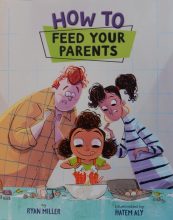
Matilda Macaroni is an adventurous eater, eager to try new foods, not so her mum and dad. They insist on sticking to half a dozen items – chicken, macaroni, burgers, grilled cheese, pizza and cereal.

In contrast Matilda’s foray into other fare starts when she tastes her grandma’s jambalaya and continues as she tries goulash (at Grandma’s), sushi – at a sleepover and pork paprika on a play date.
She comes to the conclusion that the only way to get her parents to sample different foods is to take over the kitchen and do the cooking herself. With the help of her gran, she soon learns the niceties of knife wielding, cookbooks become her bedtime reading and her babysitter shops at the local farmers’ market for the necessary ingredients.

It’s not long before the young miss has a repertoire of tasty dishes she wants to share with her mum and dad; the next task is to get them to sample some.

She decides on one of their favourites for supper – burgers – albeit with a few modifications.

“There are mushrooms on it. And green things,” protests her mum. But what will be the verdict when they sink their teeth into the only thing on offer that night?

A comic, wackily illustrated role-reversal tale that might even persuade young picky eaters to adopt Matilda’s parents revised attitude at the end of the tale and try anything.

A Home for Gully / Through the Gate

A Home for Gully
Jo Clegg and Lalalimola
Oxford University Press
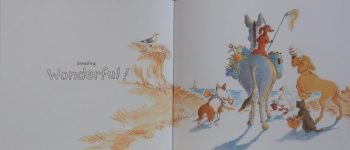
Gully is a long-suffering resident of the park; long-suffering because every morning his makeshift home is swept away by the keeper. This should no longer be tolerated, decides the scruffy dog that happens along one morning, introduces himself as Fetch and claims to be returning Gully’s stick. Fetch calls a meeting of his 412 resident fleas and thereupon they decide to assist the seagull in a search for a more satisfactory place of residence: one “that doesn’t get swept away, where my feet are warm and dry, and my tummy is full” is the bird’s desire.
They leave the relative peace and quiet of the park …

and head into the city where, after being shown the door of a smart hotel, they come upon the seemingly stuck-up Madison who offers her assistance as city guide. The three circumambulate the whole city before ending up at the library for some R and R. Make that R, R and R for therein they meet rat, Zachary.

On learning it’s a home rather than a book they’re seeking, Zachary leads them out and eventually, to a likely spot. Then with Gully safely installed, the other three head off into the darkness leaving their pal to his new warm, dry abode.
Next morning however, all is not quite hunky-dory with Gully. What good is a home if he doesn’t have others to share it with thinks our feathered friend …

There is a wonderful vintage look to Jo Clegg’s warm-hearted, funny story, thanks to Lalalimola’s delectably droll illustrations. These she packs with diverting visual (and verbal) asides that cause the reader to pause for a while and spend time exploring every spread. This is an artist I shall watch with interest, as I will the author.

Through the Gate
Sally Fawcett
EK
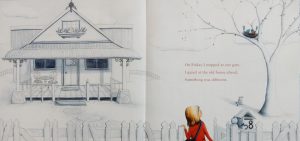
A little girl narrator, unhappy about a move to a new house, shares her step-by- step transformation from feelings of sadness and loss, to those of joy and satisfaction. The process is recounted as she travels with initially, downcast eyes, in a plodding manner to and from her new school; then after a week, the plod gives way to a mooch and the sighting of wild flowers growing through cracks in the pavement. Another week passes and she changes to an eyes-forward wander and hence, more awareness of the positives the environment offers …

The following week our narrator is ready to look all around her as she walks and thus, one becomes two walkers to school; and thereafter, things are altogether different.
Concurrent with the little girl’s changing feelings as new opportunities manifest, we see the new house gradually becoming a wonderful new home; but those aren’t the only changes: a lone bird on a bare tree builds a nest, finds a mate, eggs are laid, and life begins anew as three fledglings appear, just in time for blossom to burst forth on the tree.

Look closely at the spreads and you’ll notice a cat that plays a bit part in the whole transformation; delicate details of plants which, like the rest of the girl’s surroundings, change from shades of grey to full colour.
Sally Fawcett orchestrates this lovely story of change, hope and resilience superbly using a patterned text in tandem with subtly changing scenes of the girl’s actual and metaphorical journey.

I’ve signed the charter