Build a Skyscraper

Build a Skyscraper
Paul Farrell
Pavilion Books

Following on from his Build a Castle, graphic artist and illustrator Paul Farrell has, with a different colour scheme, created another terrific set of 64 slot-together building cards, this time with the intention that users build something very tall.

I put my set in front of Samuel (5) who delightedly seized it saying, “That’s a bit like the castle one”, clearly recognising the distinctive graphic style of Paul Farrell.

He then spent the next hour engrossed in building, wanting to know if he could build a skyscraper as tall as himself. “I bet it’s nearly up to my head” he commented. (estimating). He then proceeded to find out, carefully slotting the pieces together concentrating hard the entire time

and getting progressively more excited as it grew higher than his shoulder level.
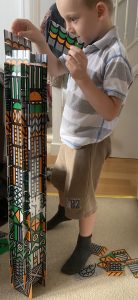
When he put the final piece in place he was thrilled to find his skyscraper was taller than he is.

During the building, Samuel’s big sister came in and she was told to see where it reached on her body which she duly did, with Samuel suggesting he’d need 4 more pieces to get to her height. (estimating again).

Samuel had been watched throughout the building process by his baby sister Faith (6 months) who was clearly fascinated by what was going on. Samuel then went outside for a little while for a kickabout with a ball and before so doing he built a barricade around his construction with cushions and other items.

As soon as he left, Faith started rolling towards his model with a mischievous look about her, seemingly intent on destruction. However, she couldn’t get close enough to do the deed. PHEW! The tower was saved.

There are SO many learning possibilities presented by this set. Samuel clearly was using his fine motor and manipulative skills, his imagination, and several maths skills. The potential for creative play by adding toy characters and working with one or more children is enormous. I suspect it could embrace all the areas of the early years curriculum if used in a foundation stage setting; and if put into a KS1 class, there are further possibilities.

An excellent resource for home or school use.

Caged

Caged
Duncan Annand
Tiny Owl

Wordless books say so much without uttering a single syllable. They challenge us, move us – sometimes to tears, make us laugh or make us feel joyful; they offer us a different way of looking at the world; sometimes they make us feel hurt or anger.

Duncan Annand’s picture book does all these, certainly for me.

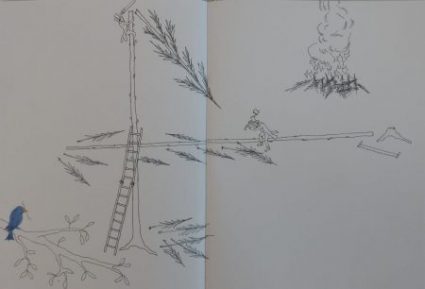
Herein we see, simultaneously two threads of interwoven visual narrative, one constructive, the other, in its way destructive, although a construction project is under way. The latter is the work of two eccentric-looking architects.

As the story opens we see the two men busy in the process of destroying what looks like virtually the last remaining tree; a bonfire is ablaze close by and on a branch, a bluebird perches with a twig.

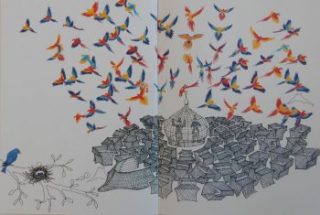
While the men work at bringing cages of brightly coloured parrots and using them to build a circular-based edifice, the bird flies hither and thither building a nest of twigs.

As the construction takes shape its architects perform some perilous climbing and precarious dangling feats to secure the cages in place.

All the while the bird keeps a watchful eye on the process.

By the time the dome is atop the enormous aviary – for that is what is being built – the bird has laid her eggs.
Job done all round. The men certainly appear to think so as they enter their edifice.

Not so the bird however; she has one final act to perform and it’s one of both liberation and entrapment …

Like the architects in his story, Duncan Annand has set the bar incredibly high for his debut picture book that tells a cleverly constructed, enormously satisfying story of environmental vandalism, just desserts and freedom.

This is most definitely a book for all ages and all people in all places. Like those parrots on the final spread, it’s one to make both hearts and imaginations take flight, particularly, the final denouement.

Priceless!

Ralfy Rabbit & Construction: Libraries for All

robber 1

WANTED! Ralfy Rabbit, Book Burglar
Emily MacKenzie
Bloomsbury Children’s Books pbk
Meet bibliophile Ralfy rabbit, maker of book lists– those he’s read (with carrot ratings ascribed), those he wants to read and those to recommend to friends and family. Ralfy would go to any lengths to get his paws on a good book. He’d even take them from people’s homes

robber 2

and large gaps began to appear on the shelves of one small boy Arthur. Arthur too was a book lover and when he discovers the absence of his favourite monster book he decides something has to be done to apprehend the thief. Time to put in a call to the local constabulary he decides, having been laughed at by his mum and chastised by his teacher. Even the police don’t take him seriously though, not until Ralfy tries stealing a book from PC Puddle that is.
Ralfy finds himself in a line-up but it’s pretty difficult to tell one bunny from another when they’re all wearing book lovers T-shirts; Arthur is certainly bemused. But then PC Puddle starts up a conveyor belt …

robber 4

That’s not quite the end of the tale though: Arthur knows just the place for someone with an insatiable appetite for books, a place where he must make sure to take the books back for others to enjoy.
This engaging book is an unashamed plug for libraries and an amusing read to boot. I love the alliterative list of Ralfy’s book-pilfering crimes and the book lists Ralfy himself makes (these will be appreciated by adults but most will go over the heads of young children; they will be amused by the carrot ratings).
The illustrations are great too – packed with humorous touches and of course, there are plenty of books in evidence. The conveyor belt scene is terrific, as is one of Arthur’s bookshelves complete with snails and slugs

robber 3

and I love the night spotlight of Ralfy returning home with his swag bag almost bursting at the seams with his latest haul.
If you share this with a class of KS1 children, make sure they see the poster on the book’s back cover. They could have fun making their own WANTED posters for Ralfy, or perhaps a poster promoting their local library (if they are lucky enough to have one still).

Building a new library, now that really is something to celebrate and it’s exactly what we see happening in

bathtime 15

Construction
Sally Sutton and Brian Lovelock
Walker Books
Big machines move onto the site digging, filling, concreting, hoisting wood – Thonk! CLONK CLAP! Then sawing, measuring, hammering as the stairs, floors and walls are erected. Next come the roof, doors and windows with a Heave-ho! followed by pipes and power wires and finally a couple of coats of paint. At last it’s time to bring in the furniture and most important of all come the books – lots and lots of lovely books all waiting to be borrowed. Ready … STEADY… READ! Hip! Hip! Hooray!
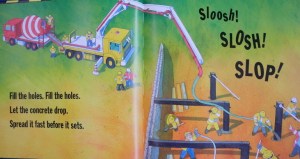
Sally Sutton’s energetically rhythmic text simply throbs along in patterned form – action and then onomatopoeic words: ‘Fill the holes. Fill the holes. … Spread it fast before it sets. Sloosh! SLOSH! SLOP!’

bathtime 16

and ‘Build the frame. Build the frame. … Bing! BANG! BONG!


bathtime 20

(Great for audience participation this.)
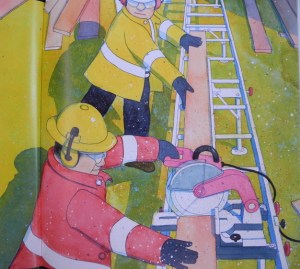
It’s good to see both male and female workers on Lovelock’s construction site with some of the latter clearly directing the operation in places.

bathtime 17

His changing perspectives allow the audience a variety of views from beneath the action to looking down upon it, at some distance or right in close.

bathtime 19

The final page provides brief explanations of the machines usage and shows the safety gear of a site worker. What more can little builders as well as readers ask?

Use your local bookshop localbookshops_NameImage-2

Don’t forget February 14th:ibgdposterlarge